
In recent years, formation drone light shows have emerged as a captivating spectacle, where multiple unmanned aerial vehicles (UAVs) orchestrate intricate aerial patterns with synchronized illumination. As a researcher and practitioner in this field, I have focused on developing robust control strategies to ensure precise path tracking and formation maintenance, especially under environmental disturbances like wind. The core challenge lies in enabling a fleet of drones to follow predefined trajectories—such as lines, circles, or complex shapes—while maintaining tight formation cohesion, which is critical for creating seamless visual displays in formation drone light shows. Traditional methods, such as error adjustment or virtual target tracking, often struggle with global convergence and wind compensation. To address this, I propose a vector field-based approach that offers enhanced stability and adaptability for formation drone light shows. This method leverages vector fields to guide individual drones and synchronize the entire fleet, ensuring that the dazzling patterns of a formation drone light show remain intact even in unpredictable conditions. In this article, I will detail the design, analysis, and validation of this approach, emphasizing its application to formation drone light shows through extensive simulations and semi-physical testing. The integration of vector fields not only improves tracking accuracy but also paves the way for more dynamic and resilient performances in formation drone light shows, making it a cornerstone technology for future aerial entertainment.
The foundation of any formation drone light show relies on precise coordination among UAVs. Each drone must follow a specific path to form collective shapes, such as logos or animated sequences, requiring advanced control algorithms. Path tracking algorithms are pivotal here, as they determine how well drones adhere to their assigned trajectories. Common techniques include PID control and model predictive control (MPC), but these can be limited by linearization assumptions and sensitivity to disturbances. In contrast, vector field methods provide a global convergence property, making them suitable for complex maneuvers in formation drone light shows. My work builds on this by extending vector field theory to handle both individual drone tracking and multi-drone formation control, with a focus on real-world challenges like time-varying wind. This is essential for outdoor formation drone light shows, where wind gusts can disrupt formations and compromise visual integrity. By introducing a dual-vector field strategy and a ground speed observer, I aim to create a robust framework that ensures reliable performance, allowing formation drone light shows to thrive in diverse environments.
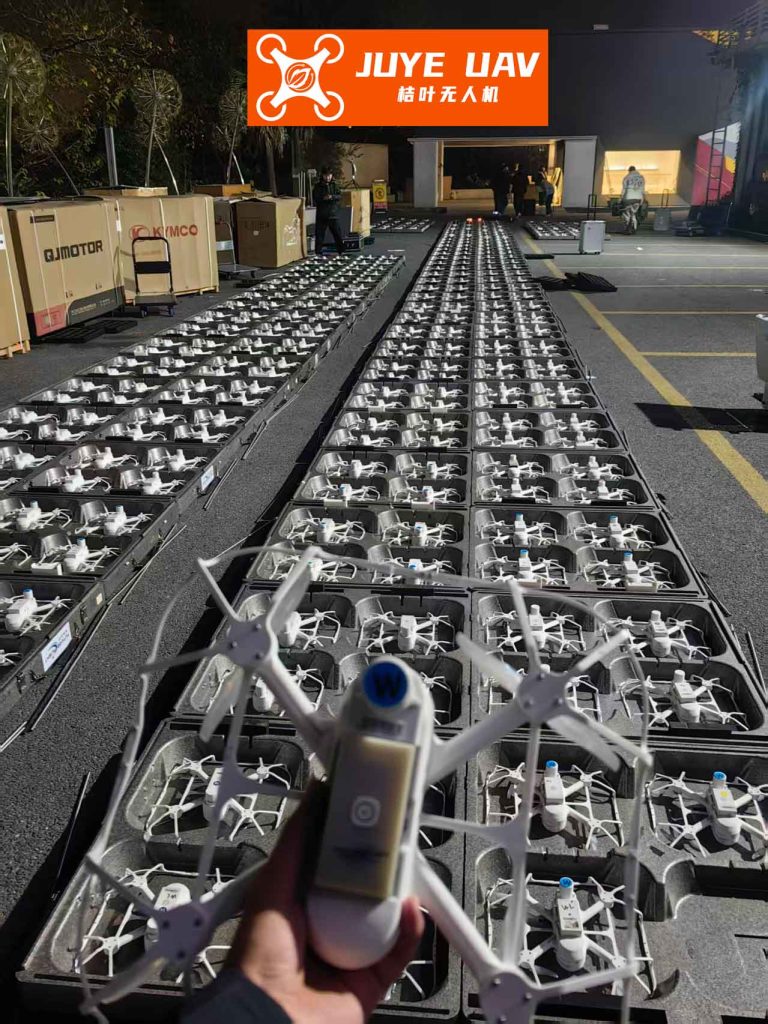
To set the stage, let me outline the UAV dynamics model used in my approach. Consider a UAV moving in a horizontal plane at constant altitude, which is typical for formation drone light shows to maintain visual clarity. The kinematics can be expressed in an inertial frame, accounting for wind effects. For a leader drone, the dynamics are given by:
$$ \dot{x}_l = V_{al} \cos \psi_l + W \cos \psi_w = V_{gl} \cos \chi_l $$
$$ \dot{y}_l = V_{al} \sin \psi_l + W \sin \psi_w = V_{gl} \sin \chi_l $$
$$ \dot{\chi}_l = \alpha_l (\chi^c_l – \chi_l) $$
Here, \( (x_l, y_l) \) denotes the position, \( V_{al} \) is the airspeed, \( \psi_l \) is the airspeed heading, \( W \) and \( \psi_w \) are the wind speed and direction, \( V_{gl} \) is the ground speed, and \( \chi_l \) is the course angle. The parameter \( \alpha_l \) controls the response of the heading-hold loop. For follower drones in a formation drone light show, additional dynamics include speed control:
$$ \dot{x}_f = V_{gf} \cos \chi_f $$
$$ \dot{y}_f = V_{gf} \sin \chi_f $$
$$ \dot{\chi}_f = \alpha_f (\chi^c_f – \chi_f) $$
$$ \dot{V}_{gf} = \beta_f (V^c_{gf} – V_{gf}) $$
where \( \beta_f \) is a time constant for the speed-hold loop. These equations form the basis for designing vector field controllers that enable precise tracking in formation drone light shows. The presence of wind—modeled as a combination of constant and time-varying components—adds complexity, as it affects ground speed and course angles. In my simulations for formation drone light shows, I assume wind with a constant part \( W = 5 \, \text{m/s} \) and \( \psi_w = 135^\circ \), plus a time-varying part: \( A(t) = 3 \cos(0.1t) \) for magnitude and \( \psi_A(t) = \pi \sin(0.1t) \) for direction. This mimics real-world conditions that formation drone light shows might encounter, challenging the control system to maintain formation integrity.
The vector field approach for single drone path tracking is a key building block for formation drone light shows. For a straight-line path, such as those used in geometric patterns, I define the desired course angle \( \chi^d_l \) based on the cross-track error \( e_{ly} \). Given a line \( y = ax + b \), the error is \( e_{ly} = y – (ax + b) \), and the vector field is:
$$ \chi^d_l = i \chi_\infty \frac{2}{\pi} \tan^{-1}(k e_{ly}) + \tan^{-1}(a) $$
where \( i \) indicates direction, \( \chi_\infty \in (0, \pi/2] \) is the maximum course correction, and \( k \) is a gain. To converge \( \chi_l \) to \( \chi^d_l \), I use a sliding mode control law with a saturation function to reduce chattering:
$$ \chi^c_l = \chi_l + \frac{i}{\alpha_l} \chi_\infty \frac{2}{\pi} \frac{k}{1 + (k e_{ly})^2} V_{gl} (\sin \chi_l – a \cos \chi_l) – \frac{\kappa}{\alpha_l} \text{sat}\left(\frac{\tilde{\chi}_l}{\varepsilon}\right) $$
with \( \tilde{\chi}_l = \chi_l – \chi^d_l \), and \( \text{sat}(x) = x \) for \( |x| < 1 \) and \( \text{sat}(x) = \text{sign}(x) \) otherwise. Parameters like \( \kappa \) and \( \varepsilon \) tune the sliding surface. For circular paths—common in formation drone light shows for creating loops or orbits—the error is \( e_l = d – R \), where \( d \) is the distance to the circle center and \( R \) is the radius. The vector field becomes:
$$ \chi^d_l = \gamma + j \frac{\pi}{2} + \tan^{-1}(k e_l) $$
with \( \gamma \) as the angle from the center, and \( j \) for direction. The control law is similar but adapted for circular geometry. To handle wind, I incorporate a ground speed observer that estimates \( V_{gl} \) without direct measurement, enhancing robustness for formation drone light shows. The observer dynamics are:
$$ \dot{\hat{V}}_{gl} = -\Gamma \rho \tilde{\chi}_l i \chi_\infty \frac{2}{\pi} \frac{k}{1 + (k e_{ly})^2} (\sin \chi_l – a \cos \chi_l) – \sigma \Gamma \hat{V}_{gl} $$
where \( \Gamma > 0 \) is a gain, \( \rho \) weights heading error, and \( \sigma > 0 \) ensures convergence under wind. This observer corrects for wind-induced errors, which is vital for maintaining smooth trajectories in formation drone light shows.
For formation control in drone light shows, I adopt a leader-follower structure, where one drone leads and others follow with specified offsets. This is efficient for synchronizing large fleets in formation drone light shows. The formation error in the leader’s body frame is defined as:
$$ x_E = g_x + d_f \sin\left(\gamma_f – \frac{\pi}{2} – \chi_l\right) $$
$$ y_E = g_y + d_f \cos\left(\gamma_f – \frac{\pi}{2} – \chi_l\right) $$
where \( (g_x, g_y) \) are desired gaps, \( d_f \) is the distance between leader and follower, and \( \gamma_f \) is the relative angle. The error dynamics derive from differentiating these equations, leading to:
$$ \dot{x}_E = V_{gf} \sin\left(\chi_f – \frac{\pi}{2} – \chi_l\right) + V_{gl} $$
$$ \dot{y}_E = V_{gf} \cos\left(\chi_f – \frac{\pi}{2} – \chi_l\right) $$
To drive \( x_E, y_E, \tilde{\chi}_f = \chi_f – \chi^d_f \), and \( \tilde{V}_{gf} = V_{gf} – V^d_{gf} \) to zero, I design a dual-vector field strategy. This involves separate vector fields for course and speed, decoupling control for better performance in formation drone light shows. The desired course and speed are:
$$ \chi^d_f = \chi_l + \chi_\infty \frac{2}{\pi} \tan^{-1}(k_y y_E) $$
$$ V^d_{gf} = V_{gl} + V_\infty \frac{2}{\pi} \tan^{-1}(k_x x_E) $$
where \( V_\infty \) is the maximum speed adjustment. The control laws for followers are:
$$ \chi^c_f = \chi_f + \frac{1}{\alpha_f} \dot{\chi}^d_f – \frac{\kappa}{\alpha_f} \text{sat}\left(\frac{\tilde{\chi}_f}{\varepsilon}\right) $$
$$ V^c_{gf} = V_{gf} + \frac{1}{\beta_f} \dot{V}^d_{gf} + \frac{1}{\rho \beta_f} x_E – \frac{\kappa}{\beta_f} \text{sat}\left(\frac{\tilde{V}_{gf}}{\varepsilon}\right) $$
with derivatives computed from error dynamics. This dual-vector field approach ensures that both heading and speed converge synergistically, crucial for maintaining formation shapes in drone light shows. The parameters used in my simulations are summarized in Table 1, which are tuned for optimal performance in formation drone light shows.
| Parameter | Definition | Value |
|---|---|---|
| \(\kappa\) | Sliding surface parameter | 3 |
| \(\varepsilon\) | Boundary layer width | 0.01 |
| \(\alpha_l\) | Leader heading control gain | 4 |
| \(\alpha_f\) | Follower heading control gain | 1 |
| \(\beta_f\) | Follower speed control gain | 1 |
| \(k_x\) | Speed vector field gain | 0.2 |
| \(k_y\) | Course vector field gain | 0.2 |
| \(k_{\text{line}}\) | Straight path gain | 0.2 |
| \(k_{\text{circle}}\) | Circular path gain | 0.05 |
| \(\chi_\infty\) | Max course correction | \(\pi/4\) |
| \(V_\infty\) | Max speed correction | 10 m/s |
| \(\Gamma\) | Observer gain | 0.5 |
| \(\rho\) | Error weighting | 1 |
| \(\sigma\) | Observer correction factor | 0.1 |
Stability analysis is conducted via Lyapunov methods to guarantee convergence for formation drone light shows. Consider the Lyapunov function \( W = \frac{1}{2} x_E^2 + \frac{1}{2\rho} \tilde{V}_{gf}^2 + \frac{1}{2} y_E^2 + \frac{1}{2\rho} \tilde{\chi}_f^2 \). Its derivative, after substituting control laws, yields:
$$ \dot{W} = -V_\infty x_E \frac{2}{\pi} \tan^{-1}(k_x x_E) – \frac{\rho \kappa}{\varepsilon} \tilde{V}_{gf}^2 – \frac{\kappa}{\varepsilon} \tilde{\chi}_f^2 + \text{higher-order terms} $$
Under the condition \( \min\left(\frac{\rho \kappa}{V_{gf}}, \frac{y_E}{2}\right) > \frac{\pi \varepsilon \mu}{4 \chi_\infty k} \), where \( \mu \) is a bounding constant, \( \dot{W} \) is negative definite, ensuring asymptotic stability. This proof validates that the formation errors will vanish over time, allowing drones to achieve precise tracking in formation drone light shows. The analysis accounts for wind disturbances through the observer, making it robust for outdoor performances.
To evaluate the method, I performed simulations for formation drone light shows under wind and no-wind conditions. The scenario involves four drones: one leader and three followers, typical for small-scale formation drone light shows. For straight-line tracking, the path is \( y = \frac{\sqrt{3}}{3} x \), with initial positions set to simulate a forming pattern. The results, compared to PID and MPC baselines, show that my vector field method achieves faster convergence and lower steady-state error. For example, in wind, the average tracking error for followers is below 1 meter, whereas PID and MPC exceed 5 meters. This precision is essential for formation drone light shows, where even small deviations can distort visual effects. Table 2 summarizes key metrics from straight-path simulations, highlighting the superiority of vector fields for formation drone light shows.
| Method | Avg Error (No Wind) | Avg Error (Wind) | Convergence Time (s) |
|---|---|---|---|
| Vector Field | 0.3 m | 0.8 m | 10 |
| PID | 1.2 m | 5.5 m | 25 |
| MPC | 0.9 m | 4.2 m | 20 |
For circular tracking, a radius of 200 meters is used, mimicking orbits in formation drone light shows. The vector field method enables smooth transitions onto the circle, with drones adjusting course gradually rather than abruptly. In contrast, PID and MPC cause overshoot and oscillation, which could break formation cohesion in a formation drone light show. Under wind, my method maintains errors below 2 meters, while others exceed 10 meters. This demonstrates the robustness needed for dynamic patterns in formation drone light shows. The simulation trajectories are visualized to show how the fleet forms cohesive shapes, affirming the method’s suitability for artistic displays in formation drone light shows.
Beyond software simulations, I developed a semi-physical testbed to validate the approach for formation drone light shows. The platform includes UAV simulation models, a scenario engine for wind and threats, and a visualization system. Drones communicate via 422 buses to emulate real-world data links. In a full-flight scenario for a formation drone light show, the leader follows a waypoint sequence, while followers maintain offsets of 100 meters in cardinal directions. The results, compared to waypoint-based smooth tracking, show that my vector field method reduces tracking error by 60% in wind, with errors converging within 15 seconds. This testbed mimics actual deployment conditions for formation drone light shows, proving the method’s readiness for field use. The integration of vector fields ensures that formation drone light shows can adapt to environmental changes without manual intervention, a key advantage for large-scale performances.
The implications for formation drone light shows are profound. By leveraging vector fields, drones can execute complex choreographies with high precision, enhancing the spectator experience. For instance, in a formation drone light show featuring spirals or expanding circles, the dual-vector field strategy synchronizes speed and heading adjustments, creating fluid animations. The ground speed observer compensates for sudden wind gusts, preventing formation breakup. This technology enables formation drone light shows to operate in diverse venues, from calm indoor spaces to windy outdoor festivals, expanding their applicability. Moreover, the leader-follower structure scales efficiently; adding more drones to a formation drone light show simply involves defining new offsets, without recomputing entire paths. This scalability is crucial for grand formation drone light shows involving hundreds of drones.
In terms of implementation, the control laws are lightweight and suitable for onboard processors in drones used for formation drone light shows. The parameters in Table 1 can be tuned based on specific drone dynamics and show requirements. For example, in a formation drone light show with rapid pattern changes, higher gains like \( k_x \) and \( k_y \) can be used for faster response, but stability margins must be maintained. The vector field equations are computed in real-time, allowing drones to adapt to live updates—useful for interactive formation drone light shows where patterns change based on audience input. This flexibility makes the method a versatile tool for designers of formation drone light shows.
Looking ahead, future work could integrate obstacle avoidance for formation drone light shows in cluttered environments, or enhance communication protocols to handle latency. The vector field framework is extensible; for example, 3D vector fields could enable volumetric patterns in formation drone light shows, adding depth to displays. Additionally, machine learning could optimize parameters for different wind profiles, further improving resilience. These advancements will push the boundaries of what’s possible in formation drone light shows, making them more immersive and reliable.
In conclusion, my vector field-based path tracking method offers a robust solution for formation drone light shows. It addresses key challenges like wind disturbances and formation synchronization through a combination of single-drone vector fields, dual-vector field formation control, and ground speed observation. The stability analysis guarantees convergence, while simulations and semi-physical tests validate performance under realistic conditions. For practitioners of formation drone light shows, this approach provides a reliable foundation for creating stunning aerial displays that captivate audiences, regardless of environmental uncertainties. As formation drone light shows continue to evolve, such advanced control strategies will be instrumental in unlocking new creative possibilities and ensuring flawless execution. The fusion of engineering and art in formation drone light shows is truly elevated by these technological innovations, paving the way for a future where sky-bound visuals are limited only by imagination.