
In my experience within the fire and rescue services, the evolving complexity of urban landscapes and industrial hazards has consistently demanded more advanced technological solutions. The integration of Unmanned Aerial Vehicles (UAVs), or drones, specifically configured for firefighting—hereafter referred to as fire UAVs—has marked a paradigm shift in our operational capabilities. These systems are no longer mere accessories but have become indispensable assets for enhancing situational awareness, ensuring personnel safety, and executing complex intervention strategies. This article explores, from a first-person operational perspective, the multifaceted applications, technical underpinnings, and future potential of fire UAV platforms in mitigating disaster impacts and saving lives.
1. The Fire UAV as a Multifunctional Platform
A fire UAV is fundamentally an aerial robot, but its value lies in the modular payload it can carry. Unlike consumer-grade drones, a professional fire UAV system is engineered for resilience, reliability, and data integration. Its core characteristics make it uniquely suited for the harsh fireground environment:
- Operational Resilience and Low Maintenance: Modern fire UAV platforms feature robust designs with redundant systems (e.g., dual GNSS, dual IMU). Their modular construction allows for rapid field repair and component replacement. The operational cost over time is significantly lower compared to manned aerial assets like helicopters, with minimal recurring expenses outside of battery cycles and scheduled maintenance.
- Superior Maneuverability and Access: The compact size and agility of a fire UAV enable it to navigate through dense smoke, enter confined spaces like building interiors or industrial structures, and hover steadily in turbulent thermal updrafts—missions often deemed too risky for human firefighters or larger aircraft.
- Integrated Data Hub: The true power of a fire UAV is realized through its seamless integration of sensors and communication systems. It acts as a flying data node, capturing, processing, and relaying critical information in real-time to the incident command post via secure data links, including 4G/5G, satellite, or dedicated mesh networks.
2. Sensor Suites: The Eyes and Nose of the Fire UAV
The payload defines the mission. A standard fire UAV is equipped with a synergistic array of sensors, each providing a unique layer of intelligence.
| Sensor Type | Function | Key Output & Metric | Operational Application |
|---|---|---|---|
| High-Definition (HD) & Zoom Camera | Visual situational awareness | Live video feed, high-res stills | Initial scene size-up, structural integrity assessment, search for visible victims, documentation. |
| Thermal Imaging Camera (TIC) | Heat signature detection | Temperature gradient map, hotspot identification. | Seeing through smoke, locating hidden fire pockets (compartment fires), finding victims via body heat, assessing thermal runaway in batteries. |
| Multispectral/Gas Detector | Chemical atmosphere analysis | Concentration levels of specific gases (e.g., CO, H₂S, VOCs). | Hazardous material (HazMat) incident assessment, monitoring for explosive or toxic gas clouds, ensuring air safety for ground teams. |
| LiDAR / Photogrammetry System | 3D mapping and modeling | Point cloud data, accurate 3D models, distance/volume measurements. | Creating pre- and post-incident 3D models, calculating burn area, planning tactical ventilation, assessing structural deformation. |
The thermal camera is arguably the most critical sensor. It converts infrared radiation into a visible image, allowing us to “see” heat. The relationship between radiated power and temperature is governed by the Stefan-Boltzmann law:
$$ P = \epsilon \sigma A T^4 $$
where \( P \) is the radiated power, \( \epsilon \) is the emissivity of the material, \( \sigma \) is the Stefan-Boltzmann constant, \( A \) is the area, and \( T \) is the absolute temperature. A fire UAV‘s TIC uses this principle to create a false-color map, visually distinguishing between a 40°C human form and a 600°C structural beam.
For 3D mapping, the fire UAV performs automated flight patterns, capturing hundreds of overlapping images. Using photogrammetric algorithms, it reconstructs the scene. The spatial accuracy of a point \( \mathbf{p} \) in the model is a function of the image resolution and overlap:
$$ \sigma_{\mathbf{p}} = f(GSD, \theta, S_{\text{overlap}}) $$
where \( GSD \) is Ground Sampling Distance, \( \theta \) is the camera angle, and \( S_{\text{overlap}} \) is the image overlap ratio. This model becomes the digital twin of the incident for command decisions.
3. Communications and Payload Delivery: Extending Our Reach
Beyond reconnaissance, the fire UAV serves as a versatile physical and communications platform.
3.1. Payload Delivery Systems
Equipped with precision release mechanisms, a fire UAV can deliver critical supplies or direct fire suppressants. The payload capacity is a key specification. For a multirotor fire UAV, the maximum take-off weight (MTOW) and flight time are in tension. The required thrust \( T \) to hover is:
$$ T = \frac{MTOW \cdot g}{n \cdot \eta} $$
where \( g \) is gravity, \( n \) is the number of motors, and \( \eta \) is the motor/propeller efficiency. Payloads include:
- Life-Saving Equipment: Automated External Defibrillators (AEDs), floatation devices, or survival kits to trapped individuals in floods or high-rises.
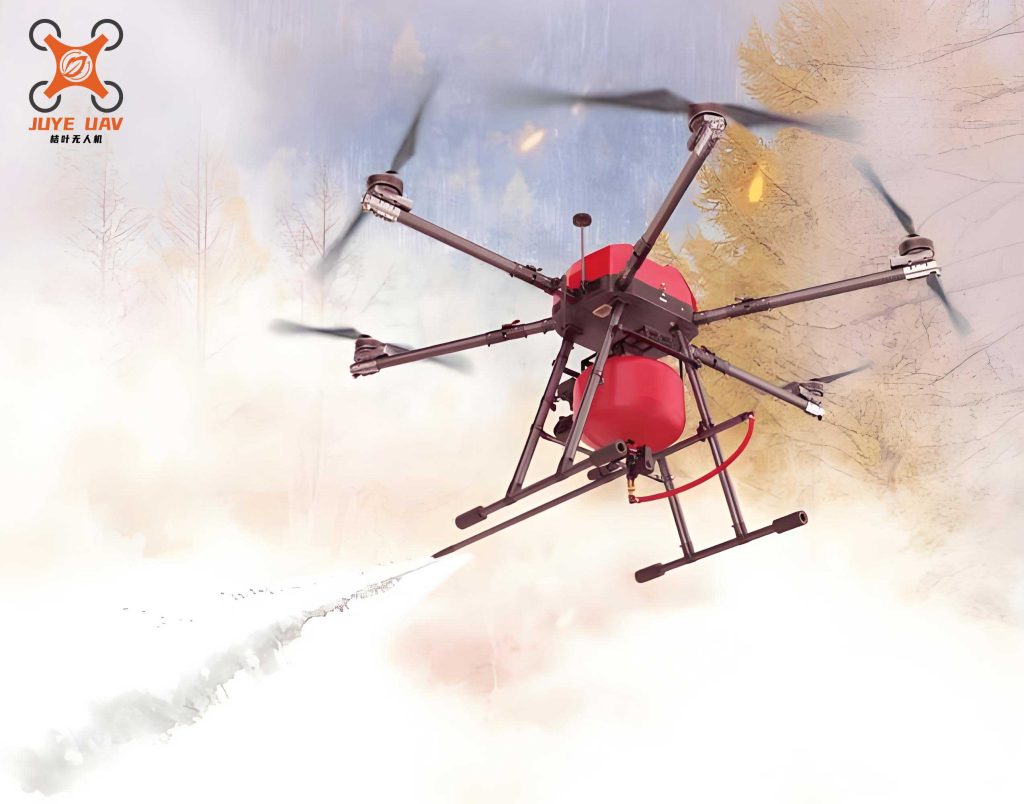
- Fire Suppressants: Specialized pods can carry and accurately discharge dry chemical powder or compressed Aqueous Film-Forming Foam (AFFF) onto incipient fires or to protect exposed assets.
- Communication Relays: In large-scale incidents where terrestrial networks are damaged, a fire UAV can act as a temporary cell-on-wings (COW) or mesh network node, restoring vital communication links for ground teams.
3.2. Auxiliary Support Functions
| Module | Description | Technical Specification Example |
|---|---|---|
| High-Intensity Spotlight | Provides powerful illumination for night operations, synchronized with camera gimbal. | LED array producing >50,000 lumens, with adjustable beam angle. |
| Loudspeaker/Public Address (PA) | Used for broadcasting evacuation instructions, safety messages, or communicating directly with survivors. | Directional speaker with a range of up to 800m, 360° rotation capability. |
| Emergency Beacon Dropper | Marks locations (e.g., victim, hazard, safe zone) with LED or RF beacons for ground team guidance. | Dispenser for GPS-synced beacons with 72-hour battery life. |
4. Application in the Fireground Workflow: A Scenario-Based Analysis
Let’s walk through a complex incident to see how the fire UAV integrates into our standard operational workflow.
Phase 1: Initial Response and Size-Up (Minutes 0-10). Upon arrival at a reported warehouse fire, the first officer deploys a fire UAV. It ascends to a vantage point, providing an immediate overhead HD and thermal view. The thermal feed reveals the main fire location (Zone A) and, critically, a significant heat plume moving through the roof trusses towards an adjacent storage unit (Zone B)—a sign of rapid fire spread unseen from the ground. This early warning allows the Incident Commander (IC) to immediately deploy attack lines to cut off the spread, a decision made before the first crew has fully suited up.
Phase 2: Active Firefighting and Search (Minutes 10-45). A second, more rugged fire UAV equipped with a gas sensor is tasked to sample air near ventilation points. It detects rising levels of carbon monoxide (CO) and volatile organic compounds (VOCs). The data is logged and plotted over time:
$$ C_{CO}(t) = C_0 + \alpha t $$
where \( C_{CO} \) is the CO concentration, \( C_0 \) is the baseline, and \( \alpha \) is the rate of increase. This quantitative data confirms the development of a rich, under-ventilated fire, warning crews of potential backdraft conditions and mandating controlled ventilation tactics.
Simultaneously, reports of a missing worker come in. A fire UAV with a powerful zoom camera and thermal sensor is directed to scan accessible windows and roof areas. Its thermal signature identifies an anomalous heat pattern in an office area separate from the main fire—a potential victim. The coordinates and live feed are relayed to the search and rescue team, guiding them precisely to the location.
Phase 3: Overhaul, Investigation, and Documentation (Post-fire). Once the fire is under control, a fire UAV with a LiDAR payload executes an automated mapping flight. It generates a millimeter-accurate 3D point cloud of the damaged structure. Investigators can take virtual measurements, calculate burn patterns, and identify the area of origin without entering the unstable building. The volume of collapsed material \( V \) can be estimated directly from the model data:
$$ V = \iiint_{\Omega} dV $$
where \( \Omega \) represents the volume region defined by the point cloud. This objective data is invaluable for both fire cause determination and structural engineering assessments.
5. Advanced and Emerging Fire UAV Capabilities
The frontier of fire UAV technology is moving towards active intervention and enhanced autonomy.
5.1. Direct Fire Suppression and Breaching
- Suppressant Deployment: Larger, heavy-lift fire UAV platforms, often gas-powered for extended endurance, can carry substantial liquid payloads. They can execute targeted drops on wildfires to reinforce firebreaks or apply suppressants to the facade of high-rise buildings, cooling surfaces and protecting exposures.
- Acoustic Fire Suppression: Experimental fire UAVs are testing the use of low-frequency sound waves (30-60 Hz) to disrupt the combustion process. The sound waves create pressure nodes that separate fuel from oxygen. The required sound pressure level \( SPL \) to achieve this effect in an open space is a subject of research, modeled as:
$$ SPL(dB) = 20 \log_{10}\left(\frac{p}{p_0}\right) $$
where \( p \) is the acoustic pressure and \( p_0 \) is the reference pressure. While not a standalone solution, it could be a tool for specific, localized fuel fires. - Forcible Entry Assistance: A fire UAV can be fitted with a pneumatically or electrically actuated device to fire a frangible or kinetic projectile, safely breaking a window from a distance to vent smoke or gain access for a hose line or another drone.
5.2. Swarm and Autonomous Operations
The future lies in coordinated fleets. Imagine a swarm of fire UAVs where one acts as a communication hub, another maps the structure in 3D, a third performs a thermal sweep, and a fourth monitors gas levels—all simultaneously. Control algorithms for such swarms ensure collision avoidance and optimal coverage. A simple model for maintaining formation while exploring an area \( A \) involves potential field or consensus algorithms to control the position \( \mathbf{x}_i \) of each drone \( i \):
$$ \dot{\mathbf{x}}_i = -\nabla_{\mathbf{x}_i} \left( \sum_{j \neq i} U_{\text{rep}}(||\mathbf{x}_i – \mathbf{x}_j||) + U_{\text{att}}(\mathbf{x}_i, \mathbf{g}) \right) $$
where \( U_{\text{rep}} \) is a repulsive potential for collision avoidance, \( U_{\text{att}} \) is an attractive potential towards goal waypoints \( \mathbf{g} \), and the gradient \( \nabla \) directs the motion.
6. Future Trajectory: Institutionalization and Innovation
For the full potential of fire UAV technology to be realized, strategic development is required.
- Standardization of Training and Protocols: We must develop comprehensive competency frameworks for UAV operators within fire departments. Training must go beyond basic piloting to include incident command system integration, data interpretation, sensor operation, and maintenance under the National Fire Protection Association (NFPA) or similar standards. Standard Operating Procedures (SOPs) for UAV deployment at various incident types are essential.
- Deep Integration with Command and Control Software: The data from a fire UAV must flow seamlessly into common incident management platforms. Live video should be viewable on command tablets, thermal overlays should integrate with building blueprints, and 3D models should be shareable instantly with technical specialists. The fire UAV must be a native component of the incident data ecosystem.
- Research and Development of Specialized Platforms: The market needs continued innovation in:
- Extreme Environment Fire UAVs: Platforms resistant to very high temperatures (for short-duration interior penetration) and corrosive chemical atmospheres.
- Long-Endurance Systems: Hybrid electric-hydrogen or gasoline-powered fire UAVs for prolonged wildfire monitoring or wide-area search missions.
- AI-Powered Analytics: Onboard AI that can automatically flag potential hazards (e.g., “structural column showing significant thermal deformation,” “victim-like heat signature detected in grid G7”).
In conclusion, the fire UAV has evolved from a novel reconnaissance tool into the cornerstone of a data-driven, precision firefighting strategy. It extends our senses into hazardous zones, delivers critical capabilities, and preserves the safety of firefighting personnel. As we continue to develop robust platforms, standardized protocols, and intelligent systems, the fire UAV will undoubtedly become as fundamental to the fireground as the fire engine itself, enabling us to respond with unprecedented speed, knowledge, and effectiveness to protect lives and property.