
In my extensive experience within the firefighting and emergency response domain, I have witnessed a paradigm shift driven by technological advancements, particularly the integration of unmanned aerial vehicles (UAVs). The advent of the fire UAV has revolutionized our approach to disaster management, offering unprecedented capabilities in scenarios where human entry is perilous or impossible. This article delves into the multifaceted applications, technical underpinnings, and future potential of fire UAV systems, emphasizing their critical role in enhancing operational efficacy and safety.
The escalating frequency and intensity of fire incidents globally pose significant threats to life, property, and the environment. Traditional firefighting methods, while valiant, often encounter limitations in accessibility, situational awareness, and real-time data acquisition. It is here that the fire UAV emerges as a game-changer. These aerial platforms, equipped with sophisticated sensors and communication systems, provide a bird’s-eye view of disaster zones, enabling informed decision-making and strategic deployment of resources. The core value of a fire UAV lies in its ability to serve as a force multiplier, extending the reach and perception of ground crews while minimizing their exposure to danger.
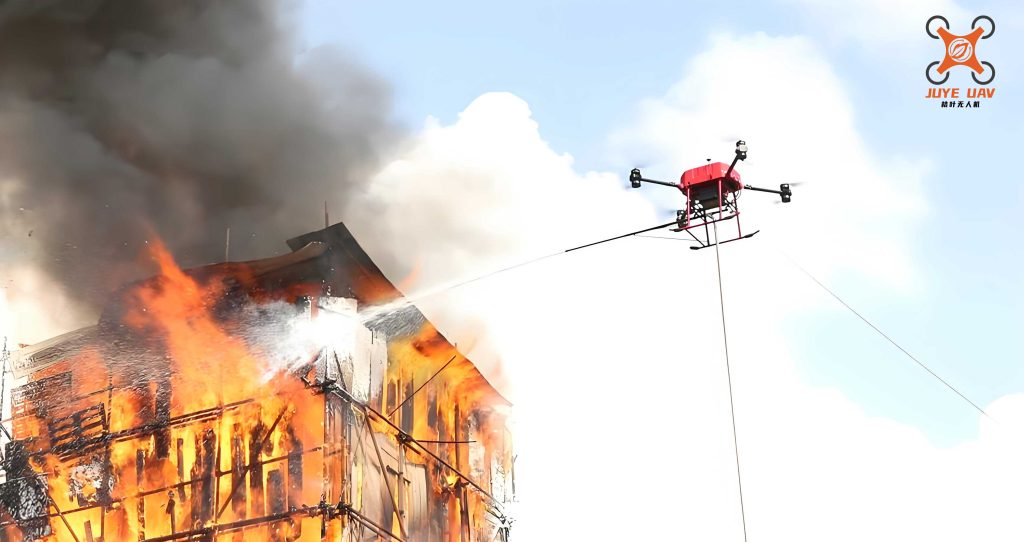
To appreciate the application of fire UAV technology, one must first understand its fundamental architecture. A typical fire UAV system comprises three primary subsystems: the airframe, the power supply system, and the flight management and control system (FMCS). The FMCS is the brain of the operation, ensuring stable flight, precise navigation, and seamless data transmission. Key onboard components include GPS modules, inertial navigation systems (INS), high-definition digital cameras, thermal imaging sensors, and specialized payloads like gas detectors or atmospheric samplers.
The advantages of deploying a fire UAV are manifold. Their compact size and agility allow for rapid deployment from confined spaces. Operational costs are substantially lower compared to manned aircraft, and maintenance routines are simpler. Most importantly, a fire UAV can operate in hazardous conditions—such as extreme heat, toxic smoke, or unstable structures—where sending personnel would be untenable. This capability directly enhances the safety margin for firefighters. The operational readiness of a fire UAV can be modeled by its availability function, often expressed as:
$$ A(t) = e^{-\lambda t} $$
where \( A(t) \) is the probability that the fire UAV is operational at time \( t \), and \( \lambda \) represents the failure rate. High reliability in harsh environments is a key design goal, making this exponential decay model crucial for mission planning.
The deployment scenarios for fire UAV systems are diverse and critical. Below is a comprehensive table summarizing the primary application domains, the typical sensor payloads used, and the operational benefits delivered.
| Application Domain | Typical Sensor Payload | Key Operational Benefit | Data Output |
|---|---|---|---|
| Disaster Reconnaissance | HD Video, Thermal Camera, LiDAR | Rapid situational awareness without risk to personnel | Real-time video feed, 3D terrain maps |
| Information Gathering & Monitoring | Multispectral Sensors, Gas Detectors, Weather Stations | Continuous monitoring of fire spread and hazardous conditions | Chemical concentration maps, temperature gradients |
| Command, Control & Communications (C3) | Communication Relay, Broadcasting System | Enhanced coordination among dispersed teams | Extended network coverage, live broadcast to command center |
| Search and Rescue (SAR) | Thermal Imager, Zoom Camera, Loudspeaker | Detection of survivors in obscured or vast areas | GPS coordinates of victims, two-way communication |
| Post-Incident Analysis | High-Resolution Photogrammetry Cameras | Detailed damage assessment and forensic investigation | Orthomosaic maps, digital surface models |
In the context of disaster reconnaissance, the fire UAV is indispensable. During the initial phase of a major incident, such as a chemical plant fire or a high-rise building collapse, the environment is often too volatile for scouts. A fire UAV can be airborne within minutes, transmitting live footage that reveals fire origin, intensity, spread vectors, and potential structural failures. The area covered by a fire UAV’s visual sensor in a single sortie can be approximated by the formula for the area of a circle, adjusted for altitude and field of view:
$$ A_{cov} = \pi \left( h \cdot \tan\left(\frac{\theta}{2}\right) \right)^2 $$
Here, \( A_{cov} \) is the ground coverage area, \( h \) is the flight altitude, and \( \theta \) is the camera’s horizontal field of view angle. This allows commanders to gauge how many fire UAV sorties are needed for complete scene documentation.
Information gathering extends beyond visual data. Modern fire UAV platforms can be fitted with modular payloads. For instance, in a hazardous materials (HazMat) scenario, a fire UAV equipped with a Fourier-transform infrared (FTIR) spectrometer or a photoionization detector (PID) can map gas plumes. The concentration \( C \) of a detected gas at a point \((x,y)\) can be modeled and relayed in real-time, creating a dynamic hazard map. The data fusion from multiple fire UAV units enables a comprehensive Common Operational Picture (COP).
The role in command and调度 is equally transformative. A fire UAV acting as an aerial communication node can overcome line-of-sight limitations in urban canyons or mountainous terrain, ensuring that all ground teams remain connected. This integrates seamlessly with incident command systems (ICS), making the fire UAV a central node in the信息化 firefighting network. The effectiveness of such a network can be analyzed using graph theory, where the fire UAV increases the connectivity \( \kappa(G) \) of the communication network graph \( G \), thereby improving overall system resilience.
To ensure these applications are successful, the fire UAV must meet stringent technical requirements. I have categorized these into four pillars: Reliability, Controllability, Stability, and Integration Compatibility. Each pillar encompasses specific performance metrics and design considerations.
1. Reliability: A fire UAV must operate flawlessly in extreme conditions. This involves redundancy in critical systems (e.g., dual GNSS, redundant flight controllers) and robust environmental sealing. The Mean Time Between Failures (MTBF) for a fire UAV intended for firefighting should exceed that of commercial models. Reliability engineering principles dictate that the system reliability \( R_s \) for a series configuration of \( n \) components is:
$$ R_s = \prod_{i=1}^{n} R_i $$
where \( R_i \) is the reliability of the i-th component. Therefore, every element, from the motor to the data link, must have a very high \( R_i \) to ensure the overall fire UAV system remains operational.
2. Controllability: The human-machine interface is crucial. Pilot workload must be minimized, especially in high-stress scenarios. This involves intuitive ground control station (GCS) software, semi-autonomous flight modes (like waypoint navigation), and robust fail-safe procedures (e.g., automatic return-to-home on signal loss). The control dynamics can be described by linearized state-space equations:
$$ \dot{\mathbf{x}} = A\mathbf{x} + B\mathbf{u} $$
$$ \mathbf{y} = C\mathbf{x} + D\mathbf{u} $$
where \( \mathbf{x} \) is the state vector (position, velocity, orientation), \( \mathbf{u} \) is the control input, and \( \mathbf{y} \) is the output. The matrices \( A, B, C, D \) are designed to ensure the fire UAV responds predictably to pilot commands despite atmospheric disturbances like thermal updrafts.
3. Stability: This refers to both aerodynamic stability in turbulent, hot air currents and operational stability of the data link. A fire UAV must maintain its position and attitude for clear imaging. This often requires advanced flight controllers with adaptive PID loops. The ability to withstand high temperatures is quantified by the thermal rating of its components. The heat flux \( \dot{q} \) from a fire that the fire UAV airframe can tolerate is a key parameter:
$$ \dot{q} = k \frac{\Delta T}{L} $$
where \( k \) is the thermal conductivity of the protective material, \( \Delta T \) is the temperature difference, and \( L \) is the material thickness. Materials with low \( k \) and adequate \( L \) are selected for the fire UAV hull.
4. Integration Compatibility: A fire UAV does not operate in isolation. It must be part of a larger ecosystem—compatible with existing command and control software, data standards (like GAIA), and other assets (e.g., ground robots, aerial tankers). This is often ensured through adherence to open communication protocols like MAVLink. The interoperability can be seen as a function of the number of standardized interfaces \( N \) it supports:
$$ I = \sum_{i=1}^{N} w_i \cdot C_i $$
where \( I \) is the interoperability score, \( w_i \) is the weight of the i-th interface (e.g., video streaming, telemetry), and \( C_i \) is its compliance level with the standard. A high \( I \) score is essential for any modern fire UAV system.
The technical specifications of different fire UAV types can vary significantly based on their intended role. The following table provides a comparative overview.
| UAV Type | Typical Size (Wingspan/Rotor Dia.) | Endurance (minutes) | Typical Payload Capacity (kg) | Key Sensor Suites | Primary Use Case |
|---|---|---|---|---|---|
| Multi-rotor (Quadcopter) | 0.5 – 1.5 m | 25 – 40 | 1 – 5 | Zoom Camera, Thermal Imager | Tactical Reconnaissance, Close-range Inspection |
| Fixed-wing | 2.0 – 3.5 m | 90 – 180 | 3 – 10 | Multispectral Camera, LiDAR | Large-area Surveillance, Mapping |
| VTOL Fixed-wing | 1.8 – 2.5 m | 60 – 120 | 2 – 8 | HD Video, Communication Relay | Versatile Operations requiring hover and range |
| Heavy-lift Multi-rotor | 1.5 – 2.5 m | 15 – 25 | 10 – 25 | Payload-specific (e.g., fire retardant dispenser) | Direct Intervention, Equipment Delivery |
Looking ahead, the evolution of the fire UAV is poised to accelerate. Trends include the development of swarm intelligence, where multiple fire UAV units collaborate autonomously to cover vast areas or perform complex tasks like creating a dynamic communication mesh or coordinated dropping of fire suppressants. The optimization of such a swarm for area coverage can be formulated as a multi-agent path planning problem, minimizing the time \( T \) to cover region \( \Omega \):
$$ \min T \quad \text{subject to} \quad \bigcup_{i=1}^{M} \text{path}(UAV_i, T) \supseteq \Omega $$
where \( M \) is the number of fire UAV units in the swarm. Artificial intelligence and machine learning are being integrated for automatic fire detection, spread prediction, and anomaly identification in real-time video feeds. Furthermore, advancements in battery technology and hybrid propulsion will extend the endurance of the fire UAV, making it possible for longer-duration missions.
Another promising area is the direct firefighting intervention using fire UAV platforms. While currently limited by payload capacity, heavy-lift fire UAV systems are being tested for precision delivery of extinguishing agents or for creating firebreaks. The momentum \( p \) of a water droplet released from a fire UAV affects its penetration into the fire plume, and its trajectory can be calculated considering drag and wind:
$$ m \frac{d\mathbf{v}}{dt} = m\mathbf{g} – \frac{1}{2} C_d \rho A |\mathbf{v}| \mathbf{v} + \mathbf{F}_{wind} $$
where \( m \) is the droplet mass, \( \mathbf{v} \) its velocity, \( C_d \) the drag coefficient, \( \rho \) air density, \( A \) cross-sectional area, and \( \mathbf{F}_{wind} \) the wind force. Optimizing this release is an active research area for fire UAV applications.
In conclusion, the integration of fire UAV technology into firefighting and rescue operations represents a monumental leap forward. From providing lifesaving reconnaissance to enabling data-driven command decisions, the fire UAV has proven its worth across countless incidents. The technical challenges—reliability in hellish environments, intuitive control, steadfast stability, and seamless integration—are being met with continuous innovation. As a practitioner, I am convinced that the future of emergency response will be increasingly aerial, collaborative, and intelligent, with the fire UAV at its core. The ongoing refinement of these systems, coupled with robust training and protocol development, will undoubtedly save more lives and protect more property, making our communities resilient against the ravages of fire.