
In recent years, the rapid advancement of drone technology has transformed both military and civilian operations, with single drones being widely used for tasks such as mapping, reconnaissance, and environmental monitoring. However, single drones are limited by their computational and communication capabilities, often resulting in low efficiency for complex missions. To address this, drone swarms—groups of multiple drones operating collaboratively—have emerged as a powerful solution, offering enhanced coverage, autonomy, and task performance. As a researcher and practitioner in this field, I have observed that while drone swarms enable efficient execution of missions like search-and-rescue or surveillance, their flight safety remains a critical concern. Incidents involving collisions, environmental hazards, or operational failures can lead to significant losses, especially in large-scale military applications. Therefore, ensuring safe flight in drone swarms is paramount, and I believe that comprehensive drone training—encompassing both technical algorithms and human operator skills—is key to mitigating risks. This article explores the current state of drone swarm development, delves into key technologies for safe flight, and discusses methods to enhance safety through control techniques and flight management, with a particular emphasis on drone training as a foundational element.
The evolution of drone swarms has been driven by global research initiatives, with countries like the United States leading in areas such as swarm-enabled tactics and collaborative operations in denied environments. These projects focus on improving human-swarm interaction, swarm perception, and autonomous logic, paving the way for more resilient systems. For instance, programs like OFFSET and CODE aim to reduce reliance on human operators and communication infrastructure, fostering greater autonomy. Similarly, domestic efforts have seen breakthroughs, such as large-scale fixed-wing drone swarm demonstrations involving hundreds of units, showcasing capabilities in formation flying and obstacle avoidance. These advancements highlight the growing complexity of drone swarms, but they also underscore the need for robust safety measures. From my perspective, the architecture of drone swarms—whether hierarchical or distributed—plays a crucial role in safety, as it influences how drones coordinate and respond to threats. As we push the boundaries of swarm technology, integrating safety-centric design and rigorous drone training protocols becomes essential to prevent accidents during takeoff, landing, and flight maneuvers.
One of the core challenges in drone swarm safety is managing inter-drone spacing to avoid collisions. Due to factors like communication latency, positioning errors, and dynamic environments, drones in a swarm can drift from their intended paths, leading to potential conflicts. To address this, several algorithmic approaches have been developed, which I categorize into three main types: artificial potential fields, optimization algorithms, and consensus-based methods. In artificial potential fields, virtual forces are introduced between drones and obstacles, creating repulsive and attractive fields to maintain safe distances. For example, a common formulation uses a potential function $U_{ij}$ between drone $i$ and drone $j$:
$$U_{ij} = \begin{cases}
\frac{1}{2} k \left( \frac{1}{d_{ij}} – \frac{1}{d_{safe}} \right)^2 & \text{if } d_{ij} \leq d_{safe} \\
0 & \text{if } d_{ij} > d_{safe}
\end{cases}$$
where $d_{ij}$ is the distance between drones, $d_{safe}$ is the minimum safe distance, and $k$ is a scaling factor. This method is computationally efficient but can suffer from local minima. Optimization algorithms, on the other hand, frame collision avoidance as a constrained optimization problem. For instance, in model predictive control (MPC), the trajectory of each drone is optimized over a time horizon to minimize a cost function while satisfying collision constraints:
$$\min_{u_i} \sum_{t=0}^{T} \left( \| x_i(t) – x_{ref}(t) \|^2 + \lambda \sum_{j \neq i} \max(0, d_{safe} – d_{ij}(t))^2 \right)$$
where $u_i$ is the control input, $x_i$ is the state, $x_{ref}$ is the reference trajectory, and $\lambda$ is a penalty weight. This approach allows for proactive conflict resolution but requires significant computational resources. Consensus algorithms leverage graph theory to ensure that all drones in a swarm converge to a common state, such as velocity or heading, while maintaining separation. A typical consensus protocol for velocity alignment is:
$$\dot{v}_i = -\sum_{j \in N_i} (v_i – v_j) – \nabla U_{ij}$$
where $v_i$ is the velocity of drone $i$, $N_i$ is its neighbor set, and $U_{ij}$ is a collision avoidance potential. These technologies are vital for safe swarm operations, but their effectiveness depends on proper calibration and integration, which can be enhanced through simulation-based drone training to test various scenarios.
To summarize these approaches, I present a comparison table highlighting their key characteristics:
| Algorithm Type | Key Principle | Advantages | Disadvantages | Suitability for Drone Training |
|---|---|---|---|---|
| Artificial Potential Fields | Virtual forces for repulsion/attraction | Simple, real-time implementation | Local minima, oscillations | Ideal for basic training in obstacle avoidance |
| Optimization Algorithms | Constrained optimization over trajectories | Proactive, handles complex constraints | Computationally heavy, requires tuning | Useful in advanced training for path planning |
| Consensus Algorithms | State convergence via neighbor interactions | Scalable, decentralized | Sensitive to communication delays | Effective in swarm coordination training |
Beyond inter-drone spacing, external risks such as environmental factors and airspace management pose significant threats to drone swarm safety. Environmental adaptability—including resistance to wind, rain, dust, temperature extremes, and corrosion—is critical for reliable flight. For example, wind gusts can destabilize drones, leading to collisions or crashes. To mitigate this, drones are often tested in simulated environments, where their performance is evaluated under various conditions. From my experience, incorporating these tests into drone training programs helps operators understand limitations and adjust flight parameters accordingly. A mathematical model for wind effects on drone dynamics can be described by adding disturbance terms to the equations of motion. For a quadrotor drone, the translational dynamics under wind influence are:
$$m \ddot{\mathbf{r}} = m\mathbf{g} + \mathbf{R} \mathbf{F}_b – \mathbf{D}_w$$
where $m$ is mass, $\mathbf{r}$ is position, $\mathbf{g}$ is gravity, $\mathbf{R}$ is the rotation matrix, $\mathbf{F}_b$ is the thrust vector in body frame, and $\mathbf{D}_w$ is the wind disturbance force, often modeled as $\mathbf{D}_w = \frac{1}{2} \rho C_d A \|\mathbf{v}_w\| \mathbf{v}_w$, with $\rho$ as air density, $C_d$ as drag coefficient, $A$ as frontal area, and $\mathbf{v}_w$ as wind velocity. Training operators to account for such disturbances through simulations can significantly improve safety. Additionally, airspace management regulations, such as altitude restrictions and no-fly zones, necessitate strict compliance. I advocate for integrating regulatory knowledge into drone training curricula, ensuring that operators are aware of legal frameworks to prevent unauthorized incursions and collisions with other aircraft.
To enhance drone swarm flight safety, a multi-faceted approach is required, combining technological innovations with robust management practices. From a control technology perspective, advancing algorithms for swarm autonomy is crucial. Machine learning techniques, such as reinforcement learning, can enable drones to learn optimal collision avoidance policies through trial and error. For instance, a deep Q-network (DQN) can be used to train a drone agent to navigate safely in a swarm environment. The reward function $R$ might include penalties for proximity violations:
$$R = R_{goal} – \alpha \sum_{j \neq i} \max(0, d_{safe} – d_{ij})$$
where $R_{goal}$ is reward for reaching a target, and $\alpha$ is a penalty coefficient. Such AI-driven methods promise higher adaptability, but they require extensive drone training in virtual environments before deployment. Moreover, improving hardware reliability—such as robust sensors and fault-tolerant controllers—can reduce technical failures. From a flight management standpoint, human factors play a pivotal role. Operator training is indispensable; I emphasize that comprehensive drone training should cover not only piloting skills but also swarm dynamics, emergency procedures, and maintenance protocols. For example, pre-flight checks for each drone in a swarm, including battery levels, communication links, and structural integrity, can prevent many accidents. A standardized training program might include modules on swarm simulation tools, where operators practice coordination tasks in risk-free settings.
In this context, visual aids can enhance understanding of swarm behaviors during training. For instance, the following image illustrates a scenario where drones are undergoing coordinated flight exercises, highlighting the importance of precise control and situational awareness:
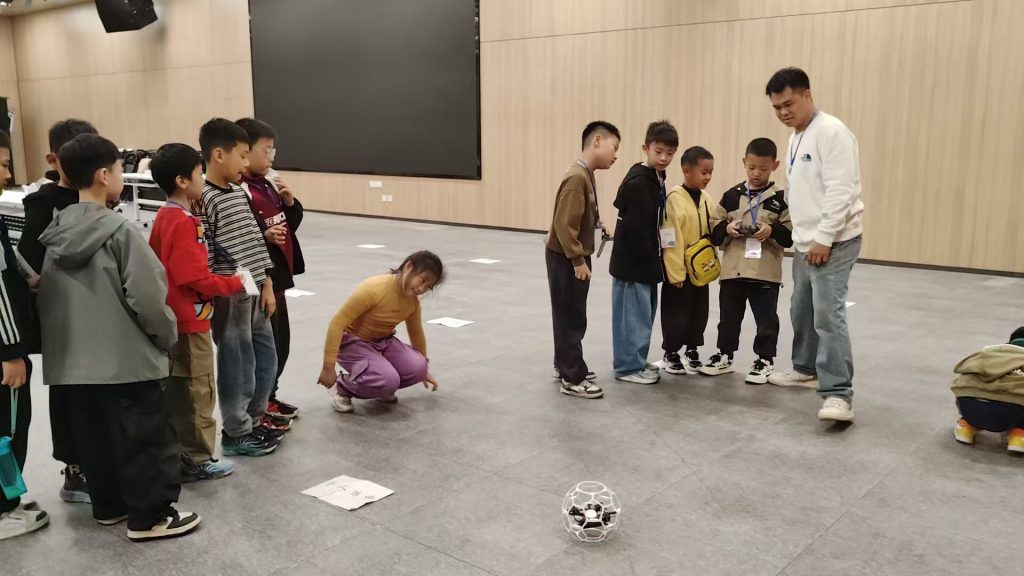
Furthermore, selecting appropriate drone models for swarm operations can mitigate risks. Cost-effective drones with redundant systems may be preferred for training exercises to minimize losses during learning phases. I recommend using simulation platforms to evaluate swarm algorithms before real-world deployment, which serves as a form of virtual drone training. These platforms can model complex interactions and environmental conditions, allowing for safe experimentation. For instance, a simulation might use differential equations to represent drone dynamics, such as:
$$\dot{\mathbf{x}}_i = f(\mathbf{x}_i, \mathbf{u}_i) + \sum_{j \neq i} g(\mathbf{x}_i, \mathbf{x}_j)$$
where $\mathbf{x}_i$ is the state vector of drone $i$, $\mathbf{u}_i$ is the control input, $f$ describes individual dynamics, and $g$ encodes inter-drone interactions. By training operators and algorithms in such simulated environments, we can build confidence and competence.
Looking ahead, the future of drone swarm safety hinges on continuous innovation and education. Technologically, we can expect more intelligent swarms with enhanced perception and decision-making capabilities, driven by advances in edge computing and 5G communications. However, these advancements must be paired with stringent safety standards and regulatory oversight. From my viewpoint, drone training will evolve to include adaptive learning systems that personalize instruction based on operator performance, using data analytics to identify weaknesses. For example, training modules might incorporate real-time feedback on swarm coordination metrics, such as mean inter-drone distance or collision risk indices. A formula to assess collision risk in real-time could be:
$$\text{Collision Risk Index} = \frac{1}{N} \sum_{i=1}^N \sum_{j \neq i} \exp\left(-\frac{d_{ij}^2}{2\sigma^2}\right)$$
where $N$ is the number of drones, $d_{ij}$ is distance, and $\sigma$ is a scaling parameter. By monitoring this index during training, operators can learn to maintain safer formations. Additionally, international collaboration on safety protocols and training certifications will foster global best practices. In conclusion, ensuring safe flight in drone swarms is a multifaceted challenge that requires synergies between cutting-edge control technologies and comprehensive drone training. As swarms become more prevalent in applications ranging from disaster response to precision agriculture, investing in safety through education and simulation will be paramount. By prioritizing training at all levels—from algorithm development to operator proficiency—we can unlock the full potential of drone swarms while minimizing risks, paving the way for a safer and more efficient future.