
The canvas is infinite, the brushes are intangible, and the palette is pure light. My studio is the open sky, and my medium is a fleet of synchronized drones. I am a drone light show choreographer, a planner who translates human narratives and celebrations into breathtaking aerial ballets. Every performance is a complex equation of art, technology, and physics, solved not on paper, but in the vast, dark expanse above us.
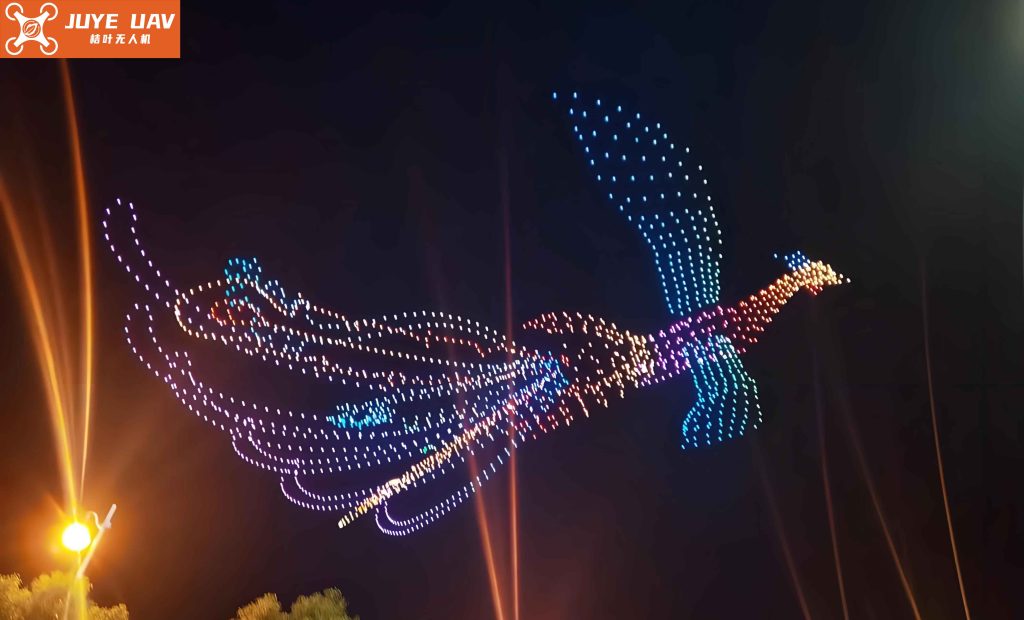
The genesis of every drone light show is not a line of code, but a story. A client approaches with a theme—perhaps a national holiday, a corporate logo launch, or a city’s anniversary. My first task is to become a dramaturg for the sky. Consider this challenge: create a narrative for Youth Day, infused with the spirit of a major sporting event, using only 500 luminous points. A human figure in motion is the intuitive choice, but a detailed 3D form is a voracious consumer of drones. A flat, 2D image feels static. The core creative constraint emerges immediately: how to achieve maximum emotional and visual impact with a strictly limited number of “pixels” in a three-dimensional space.
The initial design phase is an exercise in minimalist storytelling. I break down the grand narrative into a sequence of 10-13 keyframes, or “scenes,” each lasting mere seconds. For the Youth Day show, the storyboard unfolded like this: a structured lattice ascends, symbolizing order and potential; it morphs into aspirational text; stylized 2D figures of leaping youth appear in sequence; the centerpiece becomes a 3D heart, pulsing with life; finally, the narrative pivots to the sporting event with text and a rotating football. The 3D football was a strategic compromise—it provided depth and dynamism while being more efficient with drones than a full human form. This storyboarding process is summarized in the table below:
| Scene # | Visual Content | Narrative Purpose | Design Complexity |
|---|---|---|---|
| 1 | Cubic Matrix Ascension | Establish presence, show precision | Low (grid formation) |
| 2-3 | Text Display (“New Center · Big Future”) | Convey core message | Medium (font readability) |
| 4-5 | Text + Animated Paper Planes (“Youth Day”) | Inject playfulness, thematic link | High (coordinated independent motion) |
| 6-8 | Sequential 2D Jumping Youth Figures | Visualize energy and celebration | Medium (detailed vector art) |
| 9 | Pulsating 3D Heart | Emotional climax, show 3D capability | Very High (volumetric model & animation) |
| 10-11 | Text + Rotating 3D Football (“Welcome Games”) | Thematic resolution, dynamic closure | High (3D rotation pathing) |
With the storyboard approved, the real technical orchestration begins. I move into a virtual command center—specialized animation software adapted for drone swarm control. Here, the sky is mapped onto a coordinate grid. Each of my 500 drones is represented as a point in this digital space, initially resting at their takeoff position, a “home” coordinate $P_0(x_0, y_0, 0)$.
The first command is the synchronized takeoff. Safety is paramount. The software ensures a minimum separation distance $d_{min}$ (typically 1.9 meters) between any two drones during flight. If the ground spacing is $s$, the system calculates an ascent trajectory for each drone $i$ to its first target waypoint $P_1$ that satisfies the condition:
$$ \text{distance}(Drone_i(t), Drone_j(t)) \geq d_{min} \quad \forall i,j, \forall t $$
This is managed automatically, transforming the clustered ground points into a safe, layered airspace structure.
Now, to paint the first frame. I import a vector graphic of, say, the heart. The software can auto-assign drones to the shape’s outline, but the result is often imperfect—gaps or uneven density. Manual refinement is essential. I adjust the $(x, y, z)$ coordinates of each drone’s target position $P_{heart}$ to ensure a clean, recognizable silhouette. This process is akin to manually placing hundreds of stars to form a constellation.
Creating motion is the heart of the drone light show choreography. To make the heart “pulse,” I define keyframes. Let at time $t_1$, all drones are at their heart shape positions $P_{heart}$. At time $t_2$, I command each drone to move inward along a vector toward the shape’s centroid by a distance $\Delta r$. At $t_3$, they return to $P_{heart}$. The software’s pathfinding algorithm then computes the optimal flight path for each drone between these defined states. For drone $i$, moving from $P_{heart}^i$ to $P_{contracted}^i$, the system solves for a smooth curve (often a Bézier spline) that respects velocity $v_{max}$ and acceleration $a_{max}$ limits:
$$ \vec{path}_i(t) = f(\vec{P}_{start}^i, \vec{P}_{end}^i, v_{max}, a_{max}), \quad t_1 \leq t \leq t_2 $$
My role is to define the start and end states; the software handles the complex, collision-free interpolation for all 500 agents simultaneously.
The final layer is color. A drone light show is not monochrome. Each drone is an RGB LED. To transition the heart from orange to pink to red, I don’t just set three colors. I must define a color gradient over time. This is done by assigning a color value $C_i(t) = (R_i(t), G_i(t), B_i(t))$ to each drone at every keyframe. For a smooth gradient, the system interpolates these values. However, to ensure color accuracy—preventing a muddy transition—I often “bake” the gradient by defining color at more intermediate frames, effectively feeding the system a precise color map over time. The computational representation of this for a single drone across a 40-frame pulse-and-color-change sequence is substantial.
The sheer volume of data generated for a single 15-minute drone light show is staggering. The table below quantifies the scope of one performance:
| Aspect | Quantity/Volume | Description |
|---|---|---|
| Total Drones | 500 | Independent agents to coordinate |
| Total Show Duration | 900 seconds | 15 minutes of flight time |
| Key Scenes (Frames) | 10-13 | Major visual state changes |
| Individual Drone Waypoints | 50-100+ per drone | Positions defining its flight path |
| Total Commands Generated | 25,000 – 50,000+ | Individual instructions (position, color, time) |
| Pre-programming Time | 40-80 hours | For design, simulation, and testing |
Pre-flight, I run countless simulations. The software renders a virtual drone light show, allowing me to check for logical errors, timing issues, or unintended visual clutter. Only after a flawless simulation is the program compiled and uploaded to the ground control station and the drones themselves.
The transition from the digital realm to the physical world is where theory meets unpredictable reality. On-site, we conduct a meticulous pre-flight checklist. We survey for RF interference, verify GPS signal strength, and establish a secure communication link. The drones are laid out on the “stage” with millimeter precision, their positions corresponding exactly to the $P_0$ coordinates in my simulation. The crowd gathers, anticipation builds. With a deep breath, I initiate the sequence. A low hum fills the air as 500 drones ascend in unison, their navigation lights glowing. Then, as they reach altitude, the main LEDs ignite, and the story I penned in code begins to unfold across the night sky. The precision is mesmerizing; the transformation of abstract data into collective wonder is the ultimate reward.
However, this career is not without its profound challenges. The industry faces growing pains. A significant pressure is financial. While the operational costs are high—encompassing equipment depreciation, transportation, insurance, and skilled labor—fierce competition often triggers price wars, squeezing margins and potentially compromising on safety or creative investment. The table below outlines the primary risk categories inherent to executing a drone light show:
| Risk Category | Specific Threats | Mitigation Strategies | Residual Uncertainty |
|---|---|---|---|
| Environmental | Wind (> level 4), Rain, Lightning | Weather monitoring, Flight parameter margins | High (“Show must cancel” decisions) |
| Electromagnetic | RF Interference, GPS Jamming | Pre-show spectrum analysis, Redundant comms | Medium (Unpredictable local sources) |
| Technical | Single Drone Failure, Battery Variance | Robust BVLOS protocols, Health monitoring | Low (Managed by system redundancy) |
| Operational | Airspace Incursion, Crowd Safety | NOTAMs, Geo-fencing, Physical barriers | Low (Controlled through procedures) |
The most nerve-wracking moments come from unforeseen electromagnetic gremlins. I recall one show where a drone dropped just after takeoff. Post-mortem analysis suggested a transient surge from a nearby park lighting system, creating a localized interference field no pre-show scan could have detected. Furthermore, this profession is inherently at the mercy of the atmosphere. A week of meticulous programming and logistics can be rendered moot by a sudden weather front. This “on-the-weather” aspect requires not just technical skill, but also resilience and contingency planning.
Despite these hurdles, the future of the drone light show industry shines brightly. Its advantages over traditional pyrotechnics are compelling: zero chemical pollution, reusability, superior narrative capability through animated shapes, and much quieter operation. The demand is evolving from one-off spectacles towards sustainable, recurring installations at tourist sites, integral components of urban digital art landscapes, and sophisticated brand storytelling tools. As the technology matures and public familiarity grows, the role of the drone swarm flight planner will diversify and specialize, much like roles in film production. We may see specialists in 3D volumetric modeling, real-time interactive show designers, or experts in ultra-large-scale swarm logistics managing thousands of units.
Every time I watch my code take flight, I see more than just pretty lights. I see a proof of concept for coordinated systems, a fusion of art and engineering, and a new, environmentally conscious language for public celebration. The algorithm that governs the safe and beautiful motion of a drone light show is a dance of constraints and creativity, a symphony written not in notes, but in vectors and waypoints, illuminating the night with the precise magic of mathematics and imagination.