
As I step into the realm where architecture meets aeronautics, I am perpetually captivated by the narrative of flight. The design of spaces dedicated to UAV drones is not merely about exhibition; it is about crafting an immersive saga that mirrors the very essence of these technological marvels. In this first-person reflection, I delve into the philosophy and execution of creating environments that celebrate UAV drones, blending尖端科技 with精密制造 to evoke the boundless spirit of exploration. The core of such spaces lies in translating the冷峻 precision of engineering into a tangible, emotional experience—where every curve, texture, and light beam speaks the language of innovation.
The foundational concept revolves around embodying the dualities inherent in UAV drones: their sleek, metallic forms against the vast, ethereal skies. I envision spaces where “blue” symbolizes the infinite cosmos, and “silver” represents the meticulous骨架 of technology. Upon entry, visitors are immediately drawn into a future空域, with deep blue carpets mimicking starry nights and渐变 textures reminiscent of nebulae. The architecture soars, with metal frameworks reaching heights that echo the ambition of UAV drones to ascend beyond limits. A semi-transparent optical软膜 adorns the穹顶, refracting light into a soft silver haze that bathes the space, while metal片 matrices shimmer like constellations, breathing in sync with the rhythm of discovery.
To ground this ethereal vision, I integrate tangible elements that reflect the engineering prowess of UAV drones. The vertical circulation, such as staircases, employs alternating materials—deep blue and哑白—to soften footsteps and guide movement. These structures are designed with虚实相衬扶手, creating visual交叉 that enhance balance and flow. Along the ascent, displayed components of UAV drones are arranged like a theatrical narrative, revealing the internal精构工艺 that powers these machines. This approach transforms the space into a living教材, where every detail educates and inspires.
In the heart of the exhibition, the “wing展” zone serves as a精神图腾. Here, silver阳极氧化铝板 forms蜂巢状立体甲板, where concept UAV drones are poised for display. The walls curve in超现实姿态, mimicking the perfect arcs traced by UAV drones breaking sound barriers, with流轨体力学曲线凝固 as spatial sculptures. The surface treatment involves多层纳米蚀刻工艺, etching intricate patterns that resemble放大电路芯片脉络. These纹理 act as拓扑映射 of无人机传感器阵列, with each凹痕凸纹仿若机械神经元 awaiting activation. Under light, the蚀刻纹路 flow like silver data streams, symbolizing the silent communication within UAV drones.
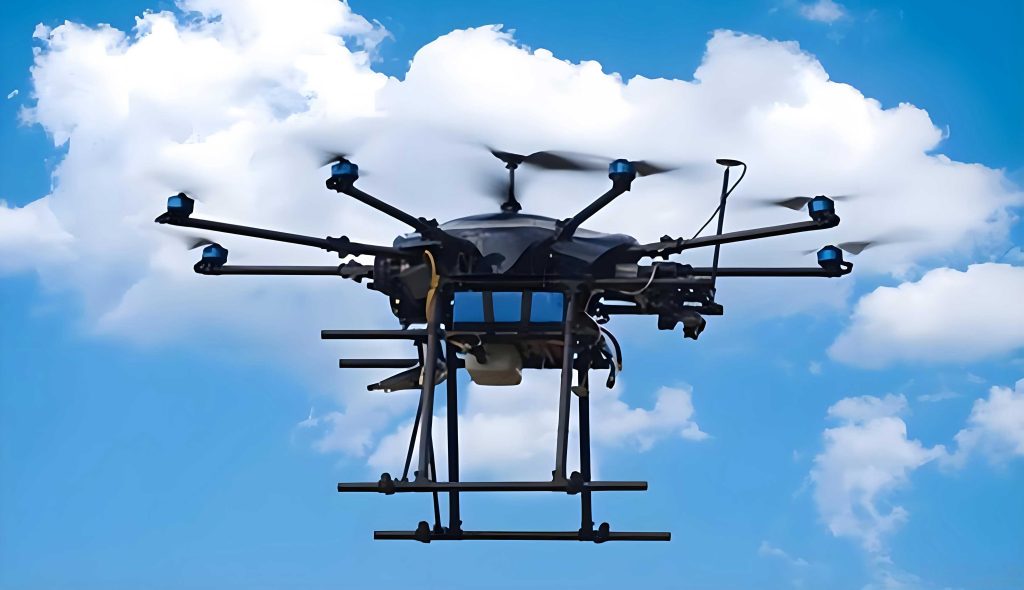
Adjacent to幕墙, a停机坪 extends with壮阔弧线, seemingly悬浮 like an星际港湾. Its底座 uses超薄钛合金片层叠合工艺, achieving蝉翼 lightness while bearing千钧承载力. The edges feature弧变收口压型处理, forming光滑曲面 with极窄倒角 that catch light in液态银光. Suspended钛合金拉杆 in仿生骨骼结构 support铝质照明悬臂灯, which double as力学传导节点—a metaphor for the integrated systems in UAV drones. This zone underscores how design mirrors the functionality of UAV drones, where aesthetics and engineering merge seamlessly.
To quantify the design principles, I often employ formulas that encapsulate the physics behind UAV drones. For instance, the lift generated by UAV drones can be expressed as: $$L = \frac{1}{2} \rho v^2 S C_L$$ where \(L\) is lift force, \(\rho\) is air density, \(v\) is velocity, \(S\) is wing area, and \(C_L\) is lift coefficient. This equation highlights the精密计算 underlying flight, a theme echoed in the spatial curves. Similarly, the drag force is given by: $$D = \frac{1}{2} \rho v^2 S C_D$$ with \(C_D\) as drag coefficient, reminding us of the challenges UAV drones overcome. In design terms, we can analogize this to energy efficiency in lighting, where luminous flux \(\Phi\) (in lumens) relates to power \(P\) (in watts) by efficacy \(\eta\): $$\Phi = \eta P$$ optimizing for the柔和的银辉 in the space.
The material palette is meticulously chosen to reflect the essence of UAV drones. Below is a table summarizing key materials and their symbolic roles:
| Material | Properties | Design Role | Connection to UAV Drones |
|---|---|---|---|
| Silver Anodized Aluminum | Lightweight, corrosion-resistant, conductive | Wall cladding, structural elements | Mimics UAV drone fuselage and circuitry |
| Blue Gradient Carpet | Textured, sound-absorbing, visual depth | Flooring for celestial effect | Represents skies explored by UAV drones |
| Translucent Optical Film | Diffuses light, semi-transparent | Ceiling canopy for ambient lighting | Evokes the ethereal airspace of UAV drones |
| Titanium Alloy Sheets | High strength-to-weight ratio, durable | Platform bases and悬浮 structures | Reflects the lightweight yet robust frame of UAV drones |
| White Stone Slabs | Smooth, reflective, minimalist | Accent surfaces and pathways | Symbolizes purity of innovation in UAV drones |
This table illustrates how each material contributes to the narrative, making the space a tactile extension of UAV drone technology. Beyond materials, the spatial layout is optimized for engagement. The exhibition flow follows a logical sequence,从引航 to翼展 to视界无界, guiding visitors through the evolution of UAV drones. In the product experience zone, interactive displays allow hands-on exploration of UAV drone controls, simulating flight dynamics. The integration of lighting design is crucial; using the inverse square law for illumination: $$E = \frac{I}{d^2}$$ where \(E\) is illuminance, \(I\) is luminous intensity, and \(d\) is distance, we calibrate lights to create焦点 on UAV drones while maintaining整体 harmony.
The concept of “infinite horizon” permeates the design, aiming to dissolve boundaries between observer and machine. As visitors navigate, they encounter zones that blur physical limits, such as mirrored surfaces that extend sightlines and open plans that encourage自由 movement. This mirrors the capability of UAV drones to transcend geographical constraints. To analyze visitor engagement, we can model人流 patterns using probability distributions. For example, the likelihood of a visitor spending time \(t\) at a UAV drone exhibit can be approximated by an exponential decay function: $$P(t) = \lambda e^{-\lambda t}$$ where \(\lambda\) is a rate parameter, reflecting the吸引 factor of UAV drones. This mathematical approach informs layout adjustments to enhance体验.
In the realm of acoustics, design considerations include noise reduction to emulate the quiet efficiency of modern UAV drones. The sound pressure level \(L_p\) in decibels is given by: $$L_p = 20 \log_{10}\left(\frac{p}{p_0}\right)$$ where \(p\) is sound pressure and \(p_0\) is reference pressure. By using吸收 materials like acoustic panels, we minimize \(L_p\), creating a serene environment that contrasts with the dynamic imagery of UAV drones in flight. This attention to detail ensures that every sensory input aligns with the theme of精密制造.
UAV drones are not just tools; they represent a paradigm shift in exploration. In the design process, I draw inspiration from their applications—from aerial mapping to disaster response. For instance, the flight endurance of UAV drones can be expressed as: $$T = \frac{E}{P}$$ where \(T\) is time aloft, \(E\) is energy capacity, and \(P\) is power consumption. This equation underscores the importance of efficiency, a principle mirrored in the space’s energy-efficient lighting and HVAC systems. The following table outlines key UAV drone parameters and their design analogies:
| UAV Drone Parameter | Typical Value Range | Design Analogy | Spatial Manifestation |
|---|---|---|---|
| Maximum Altitude | 0-10,000 meters | Vertical scale of space | High ceilings and layered platforms |
| Flight Speed | 10-50 m/s | Pace of visitor movement | Curved pathways that encourage flow |
| Payload Capacity | 1-20 kg | Structural load-bearing | Robust materials like titanium alloys |
| Battery Life | 20-60 minutes | Duration of engagement | Interactive zones with timed experiences |
| Sensor Resolution | 4K to 8K | Visual clarity in displays | High-definition screens and crisp lighting |
This interplay between UAV drone specs and design elements fosters a deeper appreciation for the technology. Moving to the experiential layer, the space incorporates dynamic elements that respond to visitor presence. For example, motion-activated lighting can be modeled using sensor algorithms: $$I_{\text{out}} = k \cdot \int_{0}^{t} m(\tau) d\tau$$ where \(I_{\text{out}}\) is light intensity output, \(k\) is a constant, and \(m(\tau)\) is motion signal over time \(\tau\). Such features make the environment feel alive, much like UAV drones adapting in real-time to their surroundings.
The philosophy of “natural美学” influences my approach, advocating for harmony between artificial constructs and organic forms. In the context of UAV drones, this translates to designs that emulate自然 patterns—like the蜂巢 structures that inspire lightweight frames or the星云 textures that adorn surfaces. This blend fosters a sense of wonder, reminding us that UAV drones, despite their冷峻 exteriors, are instruments of human curiosity. To quantify this balance, we can use an aesthetic ratio \(R_a\) defined as: $$R_a = \frac{A_{\text{organic}}}{A_{\text{geometric}}}$$ where \(A_{\text{organic}}\) and \(A_{\text{geometric}}\) are areas dominated by organic vs. geometric forms. In ideal spaces for UAV drones, \(R_a\) approaches 1, symbolizing equilibrium.
Lighting design plays a pivotal role in highlighting UAV drones. Using the principles of reflectance, we can calculate illuminance on surfaces: $$E_{\text{surface}} = \frac{\Phi \cdot \rho}{A}$$ where \(\Phi\) is luminous flux, \(\rho\) is reflectance factor, and \(A\) is area. By selecting materials with specific \(\rho\) values, we control how light dances across UAV drone displays, creating that晨雾般倾泻 effect. Additionally, color temperature \(T_c\) in Kelvin is tuned to evoke emotions—cool whites (5000K) for a tech-driven ambiance around UAV drones, and warm tones (3000K) in休息 areas to soften the experience.
In the broader narrative, UAV drones symbolize humanity’s quest to push boundaries. The design of exhibition spaces must capture this史诗 scale. I envision zones that transition from terrestrial to celestial, using optical illusions and perspective tricks. For instance, forced perspective can make UAV drones appear larger or more distant, playing with depth perception公式: $$d_{\text{perceived}} = \frac{f \cdot D}{f + D}$$ where \(d_{\text{perceived}}\) is perceived distance, \(f\) is focal length, and \(D\) is actual distance. This technique enhances the sense of exploration, making visitors feel as if they are launching into the未知 with UAV drones.
Sustainability is another core consideration, mirroring the efficiency goals of UAV drone technology. Energy consumption in the space can be optimized using Pareto efficiency models: $$\max U = \sum_{i} u_i(x_i) \text{ subject to } \sum_{i} c_i x_i \leq B$$ where \(U\) is total utility, \(u_i\) is utility from element \(i\), \(c_i\) is cost, \(x_i\) is resource allocation, and \(B\) is budget. This ensures that resources are allocated to features that best showcase UAV drones while minimizing environmental impact. Materials are chosen for recyclability, echoing the lifecycle of UAV drones that evolve with advancements.
The acoustical environment is tailored to complement the visual spectacle of UAV drones. Soundscaping involves layering ambient sounds—like subtle whirrs模仿 UAV drone propellers—with silence to create rhythm. The sound intensity \(I_s\) follows: $$I_s = \frac{P_{\text{acoustic}}}{4\pi r^2}$$ where \(P_{\text{acoustic}}\) is acoustic power and \(r\) is distance from source. By strategically placing speakers, we immerse visitors in an auditory journey that parallels UAV drone flight paths, from takeoff to巡航.
Interactive technology integrates seamlessly, allowing visitors to simulate piloting UAV drones. Using control theory, the response of a UAV drone to inputs can be modeled with transfer functions: $$G(s) = \frac{Y(s)}{U(s)}$$ where \(G(s)\) is the system transfer function, \(Y(s)\) is output (e.g., position), and \(U(s)\) is input (e.g., control signals). In exhibits, simplified versions let visitors experience the反馈 loops that stabilize UAV drones, fostering appreciation for the精工 involved. This hands-on approach demystifies UAV drones, making them accessible to all.
From a structural perspective, the design employs principles similar to UAV drone aerodynamics. For example, the use of cantilevered elements mimics the悬挑 wings of UAV drones, with stress distributions calculated via: $$\sigma = \frac{My}{I}$$ where \(\sigma\) is bending stress, \(M\) is moment, \(y\) is distance from neutral axis, and \(I\) is moment of inertia. This ensures safety while achieving轻盈 forms that visually resonate with UAV drones. Materials like木纹不锈钢 add warmth, contrasting with the冷峻 metals to humanize the technology.
The color psychology behind the palette is deliberate. Blue, associated with trust and infinity, dominates to reflect the skies traversed by UAV drones. Silver,代表科技 and precision, accents关键 elements. This duality is expressed through color mixing models: $$C_{\text{mix}} = w_1 C_1 + w_2 C_2$$ where \(C_{\text{mix}}\) is resulting color, \(C_1\) and \(C_2\) are base colors, and \(w_1, w_2\) are weights. In practice, we use渐变玻璃 to transition between hues, symbolizing the seamless integration of UAV drones into our world.
Visitor flow is optimized using queuing theory, especially for popular UAV drone exhibits. The average wait time \(W\) in an M/M/1 queue is: $$W = \frac{1}{\mu – \lambda}$$ where \(\mu\) is service rate and \(\lambda\) is arrival rate. By designing multiple interaction points and分散 pathways, we reduce \(W\), ensuring smooth engagement with UAV drones. This logistical precision mirrors the operational efficiency of UAV drones in real-world scenarios.
In concluding the spatial journey, the “视界无界” zone offers a contemplative space where visitors reflect on the future of UAV drones. Here, minimalist design principles prevail, using negative space to evoke boundlessness. The concept of infinity is mathematical represented by limits: $$\lim_{x \to \infty} f(x) = L$$ suggesting that the potential of UAV drones is ever-expanding. This zone may include digital art投影 that visualizes data from UAV drones, creating a dynamic壁画 that evolves with real-time inputs.
The design process itself is iterative, much like the development of UAV drones. We use feedback loops to refine elements, based on visitor analytics. For example, heat maps of movement can be analyzed using spatial statistics: $$I = \frac{N \sum_{i} \sum_{j} w_{ij} z_i z_j}{S_0 \sum_{i} z_i^2}$$ where \(I\) is Moran’s I for spatial autocorrelation, \(N\) is number of points, \(w_{ij}\) are weights, \(z_i\) are deviations, and \(S_0\) is a scaling factor. This helps identify hotspots around UAV drone displays, informing layout adjustments.
Ultimately, designing for UAV drones is about creating a dialogue between human aspiration and mechanical genius. Every material choice, every light beam, and every curve is a testament to the浪漫 behind the冰冷金属. As I envision these spaces, I strive to make them not just showcases, but sanctuaries where the spirit of flight is palpable. UAV drones, in their silent grace, inspire us to look upward and onward, and through design, I hope to ground that inspiration in experiences that resonate deeply. The future of UAV drones is boundless, and so too should be the spaces that celebrate them—a永恒 symphony of innovation and wonder.
To encapsulate key technical aspects, here is a final table summarizing design parameters and their correlations with UAV drone attributes:
| Design Parameter | Optimal Value | UAV Drone Attribute | Impact on Experience |
|---|---|---|---|
| Ceiling Height | 6-10 meters | Flight altitude capability | Enhances sense of freedom and scale for UAV drones |
| Lighting Temperature | 4000-5000 K | Sensor operation conditions | Creates a crisp, focused ambiance for viewing UAV drones |
| Acoustic Level | 30-40 dB | Noise emission of UAV drones | Ensures a serene environment that contrasts with UAV drone activity |
| Visitor Density | 0.1-0.3 persons/m² | Air traffic density for UAV drones | Allows comfortable interaction with UAV drone exhibits |
| Material Reflectance | 0.6-0.8 for metals | Surface reflectivity of UAV drones | Amplifies visual dynamism of UAV drones under light |
Through these multifaceted approaches, the design becomes a holistic embodiment of UAV drone technology. It is a space where equations come to life in forms, where tables of data translate into tactile journeys, and where every visitor leaves with a renewed awe for the UAV drones that are reshaping our world. The epic of flight continues, and in these designed realms, we all become part of its unfolding story.