
The evolution of precision agriculture demands application technologies that are labor-saving, efficient, and intelligent. In this context, the development of advanced spraying systems for Unmanned Aerial Vehicles (UAVs) is not merely an option but an imperative trend. The core objective is to achieve optimal deposition of agrochemicals—ensuring efficacy against pests and diseases while minimizing environmental drift and chemical waste. This study focuses on the critical task of parameter optimization for variable-rate spraying systems mounted on low-altitude, small-sized agricultural drone platforms. Through systematic field experiments on crops, key operational parameters were obtained and statistically analyzed to determine the optimal configuration for effective spray deposition.
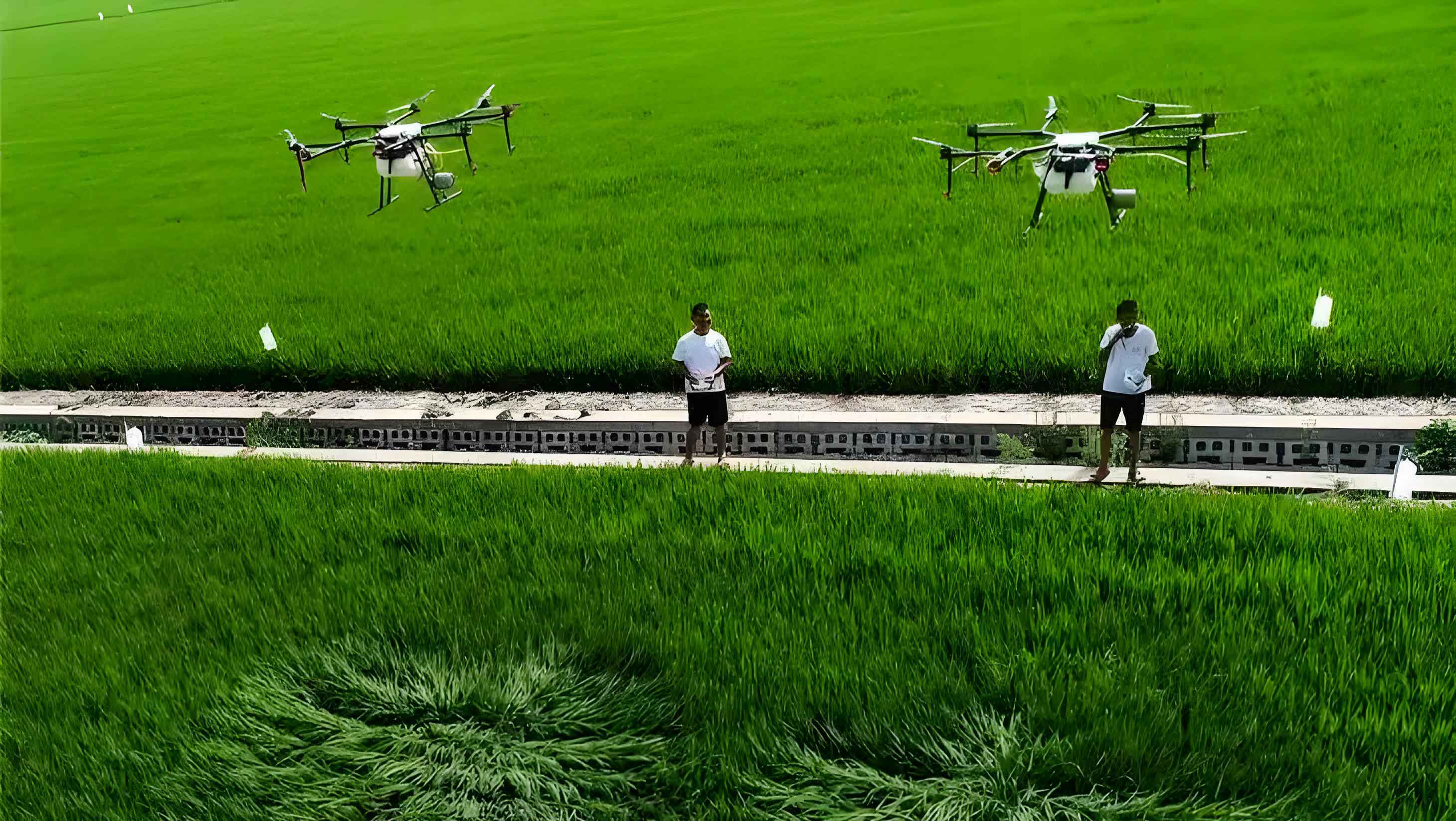
The adoption of agricultural drone technology for crop protection has seen rapid growth. However, the transition from uniform spraying to site-specific, variable-rate application presents significant technical challenges. The spraying performance is governed by a complex interaction of multiple factors: the characteristics of the spray liquid, the design and operation of the atomization device, the flight parameters of the agricultural drone, and the ambient environmental conditions. A key metric for performance is the droplet spectrum, particularly the Volume Median Diameter (VMD). According to the ‘Biological Optimum Droplet Size’ theory, droplets in the range of 40 to 100 μm are considered most effective for retention and coverage on plant foliage. Droplets smaller than this range are highly prone to drift, while larger droplets often lead to poor coverage and runoff. Therefore, the central research problem is to identify the combination of hardware settings and flight parameters for a agricultural drone variable-rate system that consistently produces droplets within this optimal range while ensuring uniform distribution across the plant canopy under different application rate requirements.
1. Materials and Methods
1.1 Centrifugal Atomizer Nozzle: Performance Characterization
The core of the liquid delivery system on many small agricultural drone platforms is the centrifugal atomizer. Its performance directly dictates the quality of the spray. The typical structure consists of a DC motor sealed within a housing, a rotating atomization disc connected to the motor shaft, a liquid guide tube, and a protective cover. When powered, the disc rotates at high speed. Liquid is fed via a pump through the guide tube onto the inner wall of the disc. It then moves outward through radial grooves or channels and is discharged from the serrated edge of the disc, where centrifugal force shears the liquid into fine droplets.
The droplet size (VMD) and effective swath width are primary functions of the disc’s rotational speed and the liquid flow rate. The relationship can be conceptually described by examining the balance of forces. The centrifugal force ($F_c$) acting on a liquid particle at the disc edge is given by:
$$F_c = m \omega^2 r$$
where $m$ is the mass of the liquid particle, $\omega$ is the angular velocity of the disc (directly proportional to the motor voltage), and $r$ is the effective radius of the disc. The opposing force is the liquid’s surface tension, which strives to hold the droplet together. Atomization occurs when $F_c$ overcomes the surface tension force. A higher $\omega$ (higher voltage) generally produces smaller droplets but also increases power consumption and potential for very fine, drift-prone droplets.
1.2 Experimental Design for Nozzle Calibration
To enable true variable-rate application, the spraying system must operate effectively across a defined range of flow rates. For this study, the variable-rate control system was programmed for four distinct flow rate levels: 160, 180, 200, and 220 mL/min. The goal of the nozzle calibration experiment was to identify the appropriate motor operating voltage for each flow rate that would produce droplets within the target spectrum (40-100 μm VMD) while maintaining a sufficient swath width (>1.5 m for a single nozzle) and considering motor efficiency.
The experiment measured three response variables at each combination of flow rate (Q) and motor voltage (V):
1. Droplet Size Distribution (VMD in μm).
2. Effective Spray Swath (m).
3. Motor Power Draw (Watts).
Water-sensitive papers (WSP) were placed on a stationary sampling rack downwind of the stationary nozzle. The nozzle was activated for a precise duration at a fixed height. The collected WSPs were scanned and analyzed using DepositScan image analysis software to determine droplet density and VMD. Swath was determined by measuring the lateral distance where droplet density exceeded a minimum threshold (e.g., 20 droplets/cm²).
1.3 Integrated Variable-Rate Spraying System and Field Trial Setup
Based on the nozzle calibration results, a stable 10V DC power supply module was integrated into the agricultural drone‘s variable-rate spraying control system. The complete system, comprising the centrifugal nozzles, liquid pumps, flow sensors, and the control unit, was mounted on a commercially available, small-sized, multi-rotor agricultural drone.
A field experiment was conducted in a crop field to evaluate the effect of key flight parameters on droplet deposition. The experimental plot measured 16m x 12m with a 3m buffer zone. The crop was at an early growth stage with an average height of 65 cm. Meteorological conditions during the trials were recorded: temperature ~31°C, relative humidity ~52%, and wind speed between 0.7 and 1.8 m/s.
A randomized block design with three replications was employed. The treatment factors were:
• Flight Height (H): 1.5 m, 2.0 m, 2.5 m (above crop canopy).
• Flight Speed (S): 1.0 m/s, 1.5 m/s, 2.0 m/s.
• Flow Rate (Q): 160, 180, 200, 220 mL/min (as set by the variable-rate controller).
The drone was programmed to fly autonomous “parallel track” paths over the plot. For deposition sampling, water-sensitive papers (5cm x 2cm) were attached using clips to plant leaves at 18 predetermined sampling points within the plot. At each point, samples were taken at two canopy levels: upper (approximately 50 cm above ground) and lower (approximately 20 cm above ground).
1.4 Data Collection and Analysis
After spray application, WSPs were collected 15 minutes post-treatment, allowed to dry, and stored in sealed bags. They were subsequently digitized and analyzed using DepositScan software to obtain:
• $D_i$: Droplet deposition density (droplets per cm²) for the i-th sample.
• $VMD_i$: Volume Median Diameter for the droplet population on the i-th sample.
The uniformity of droplet distribution across sampling points for a given treatment was assessed using the Coefficient of Variation (CV), calculated as:
$$CV = \frac{s}{\bar{D}} \times 100\%$$
where $s$ is the standard deviation of droplet densities ($D_i$) from all samples at a given canopy layer for a specific treatment, and $\bar{D}$ is the mean droplet density. A lower CV indicates more uniform distribution.
The data were subjected to multifactorial analysis of variance (ANOVA) using a general linear model to determine the significance of main effects (Flight Height, Flight Speed, Flow Rate, Canopy Layer) and their interactions on the response variables (Deposition Density, VMD, CV). Mean separation was performed using Tukey’s HSD test at a 5% significance level.
2. Results and Analysis
2.1 Centrifugal Nozzle Calibration Results
The nozzle calibration provided the foundational data for setting the agricultural drone system. The results are summarized in the tables below.
| Flow Rate (mL/min) | Motor Voltage = 8V | Motor Voltage = 10V | Motor Voltage = 12V | Motor Voltage = 14V |
|---|---|---|---|---|
| 160 | 125 | 92 | 78 | 55 |
| 180 | 132 | 96 | 82 | 58 |
| 200 | 140 | 105 | 88 | 62 |
| 220 | 148 | 112 | 94 | 65 |
The data shows that VMD is inversely related to motor voltage and directly related to flow rate. The target range of 80-100 μm is achieved at 10V and 12V for the lower flow rates (160, 180 mL/min), and at 12V for the higher flow rates (200, 220 mL/min). At 14V, droplets become too fine (<70 μm), increasing drift risk. At 8V, droplets are consistently too large (>120 μm).
| Flow Rate (mL/min) | Motor Voltage = 8V | Motor Voltage = 10V | Motor Voltage = 12V | Motor Voltage = 14V |
|---|---|---|---|---|
| 160 | 1.3 | 1.7 | 2.1 | 2.4 |
| 180 | 1.4 | 1.8 | 2.2 | 2.5 |
| 200 | 1.5 | 1.9 | 2.3 | 2.6 |
| 220 | 1.6 | 2.0 | 2.4 | 2.8 |
Swath width increases with both motor voltage and flow rate. The operational requirement for a single nozzle swath is >1.5 m. This condition is met for all flow rates at 10V and above. However, at 8V, the swath for the 160 mL/min rate is insufficient.
Considering both droplet size and swath width, and adding the criterion of motor efficiency (power draw increases quadratically with voltage, $P \propto V^2$), a motor voltage of 10V was selected as the optimal operating point for the integrated agricultural drone system across all four variable-rate levels. This setting provides a good compromise: droplets are within or near the optimal size range, swath is adequate, and energy consumption is managed.
2.2 Field Experiment: Effect of Flight Parameters on Deposition
2.2.1 Effect of Flight Height (H)
The ANOVA confirmed that Flight Height had a highly significant (p < 0.001) effect on droplet deposition density ($D$) and on the uniformity of distribution (CV). Canopy Layer (upper vs. lower) was also a highly significant factor for deposition density.
The relationship between mean deposition density and flight height can be modeled for a constant speed and flow rate. A simplified representation shows a quadratic trend:
$$ \bar{D}(H) \approx aH^2 + bH + c $$
where the coefficients are negative for the quadratic term and positive for the linear term within the tested range, indicating a peak deposition at an intermediate height.
| Canopy Layer | Metric | Flight Height 1.5m | Flight Height 2.0m | Flight Height 2.5m |
|---|---|---|---|---|
| Upper | Dep. Density | 42 ± 8 | 58 ± 6 | 35 ± 9 |
| CV% | 28% | 18% | 25% | |
| Lower | Dep. Density | 18 ± 7 | 32 ± 5 | 22 ± 6 |
| CV% | 45% | 22% | 35% |
The data reveals that a flight height of 2.0 m resulted in the highest deposition density and the most uniform distribution (lowest CV) in both the upper and lower canopy layers. At 1.5 m, the powerful downwash airflow from the agricultural drone‘s rotors caused excessive canopy turbulence, which led to poor droplet capture and localized “washing” effects, resulting in lower overall density and high variability. At 2.5 m, while uniformity was better than at 1.5 m, the increased distance allowed for greater droplet dispersion and evaporation, leading to a significant reduction in deposition density. The downwash effect at 2.0 m appears to be optimal, providing enough energy to penetrate the canopy and deposit droplets in the lower layers without causing excessive disturbance.
2.2.2 Effect of Flight Speed (S)
Flight Speed had a highly significant (p < 0.001) linear effect on deposition density. The relationship is inverse:
$$ \bar{D}(S) \approx \frac{k}{S} $$
where $k$ is a constant aggregating factors like flow rate and sprayer efficiency. As speed increases, the time available for droplets to settle onto a given area decreases, directly reducing deposition.
| Canopy Layer | Flight Speed 1.0 m/s | Flight Speed 1.5 m/s | Flight Speed 2.0 m/s |
|---|---|---|---|
| Upper | 62 ± 7 | 48 ± 5 | 31 ± 6 |
| Lower | 35 ± 6 | 27 ± 4 | 18 ± 5 |
The Coefficient of Variation for deposition uniformity was not significantly different between 1.0 m/s and 1.5 m/s but increased notably at 2.0 m/s. This suggests that while slower speeds naturally yield higher density, there is a practical lower limit to speed dictated by battery life and operational efficiency. The speed of 1.0 m/s provided the best absolute deposition. The agricultural drone‘s downwash appears to maintain adequate droplet transport and distribution at this speed.
2.2.3 Effect of Variable Flow Rate (Q)
The variable-rate system successfully modulated the application volume. ANOVA showed that Flow Rate was a significant factor for deposition density (p < 0.01), but its effect was secondary to Flight Height and Speed. The deposition increased with flow rate, but not linearly, as the increased liquid volume also led to slightly larger droplet sizes (as per nozzle calibration data) which can affect capture efficiency. The key finding is that the system maintained effective deposition across all four prescribed rates when the optimal flight parameters were used, validating the functionality of the variable-rate agricultural drone system.
3. Discussion
The optimization of a agricultural drone spraying system is a multi-variable problem. This study demonstrates that a systems approach—calibrating the nozzle first, then testing the integrated system in the field—is essential. The selection of 10V for the centrifugal nozzle motor was critical. This voltage produced a droplet spectrum centered in the 90-110 μm range for most flow rates, which, while slightly above the theoretical optimum’s upper bound, proved effective in the field where slight coarseness can improve deposition stability and reduce off-target drift.
The identified optimal flight height of 2.0 m is consistent with the aerodynamics of multi-rotor drones. The downwash velocity profile decays with distance from the rotors. At 1.5 m, the velocity is too high, causing deflection and bounce-off of droplets. At 2.5 m, the velocity is too low to ensure good canopy penetration. The 2.0 m height represents a “sweet spot” where the downwash facilitates deposition without causing disruption. This parameter is likely somewhat specific to the rotor size, number, and arrangement of the test agricultural drone, but the methodology for finding it is universally applicable.
The inverse relationship between flight speed and deposition density is fundamental. For a agricultural drone operator, the choice of speed becomes a trade-off between coverage rate (hectares per hour) and application quality. For high-efficacy applications, such as fungicides or systemic insecticides, a slower speed (1.0 m/s) is justified. For contact herbicides or defoliants where lower density might be acceptable, a higher speed (1.5 m/s) could be used to improve operational efficiency. The variable-rate system adds another dimension to this optimization, allowing the flow to be increased at slower speeds for dense canopy penetration or decreased at higher speeds to prevent over-application.
The significant difference between upper and lower canopy deposition underscores a persistent challenge for aerial application, even with agricultural drone downwash. While the drone improved lower canopy deposition compared to traditional fixed-wing aerial spraying, achieving uniform vertical distribution in dense crops may require additional strategies, such as alternating flight directions or using adjuvants to improve droplet adhesion and spreading.
4. Conclusion
This research provides a validated framework for parameter optimization of variable-rate spraying systems on low-altitude, small-sized agricultural drone platforms. Through structured experimentation, the following optimal parameters were determined for the tested system under the described field conditions:
- Centrifugal Nozzle Operating Voltage: 10V DC. This setting generated droplets predominantly within the 90-110 μm VMD range across all variable-rate levels (160-220 mL/min), provided a sufficient swath width (>1.7 m), and optimized motor power consumption.
- Flight Height: 2.0 meters above the crop canopy. This height leveraged the agricultural drone‘s downwash airflow to maximize droplet deposition density and distribution uniformity throughout the plant canopy, minimizing both drift losses at higher altitudes and turbulence-induced inefficiencies at lower altitudes.
- Flight Speed: 1.0 meter per second. While slower speeds reduce operational area coverage, this speed resulted in the highest droplet deposition density, which is crucial for the efficacy of many agrochemicals. For operations where slightly lower density is permissible, a speed of 1.5 m/s may be a suitable compromise for efficiency.
The integration of these optimized parameters into the flight and control systems of an agricultural drone enables precise, efficient, and effective variable-rate application. This contributes directly to the goals of sustainable agriculture by promoting targeted chemical use, reducing environmental impact, and improving crop protection outcomes. Future work should focus on real-time, adaptive parameter adjustment based on canopy sensing and the development of dynamic deposition models for different crop architectures and growth stages.