
In observing the contemporary urban landscape, one phenomenon increasingly cuts through the nocturnal sky, not as a tool for logistics or surveillance, but as a spectacle of light and collective wonder: the drone light show. Moving beyond its utilitarian origins, the drone has been reconfigured into a profound medium of expression, a cultural apparatus that re-codes reality itself. From my perspective, this practice represents a pivotal evolution in what media philosopher Vilém Flusser termed the “apparatus” — a shift from the photographic to the programmable, and crucially, from the representational screen to the embodied, architectural interface. The drone light show is not merely entertainment; it is a technical-aesthetic practice that performs a triple operation: it encodes the sky through digital choreography, re-interfaces the city as a site of immersive communication, and re-constructs a sense of public culture through collective, aesthetic experience.
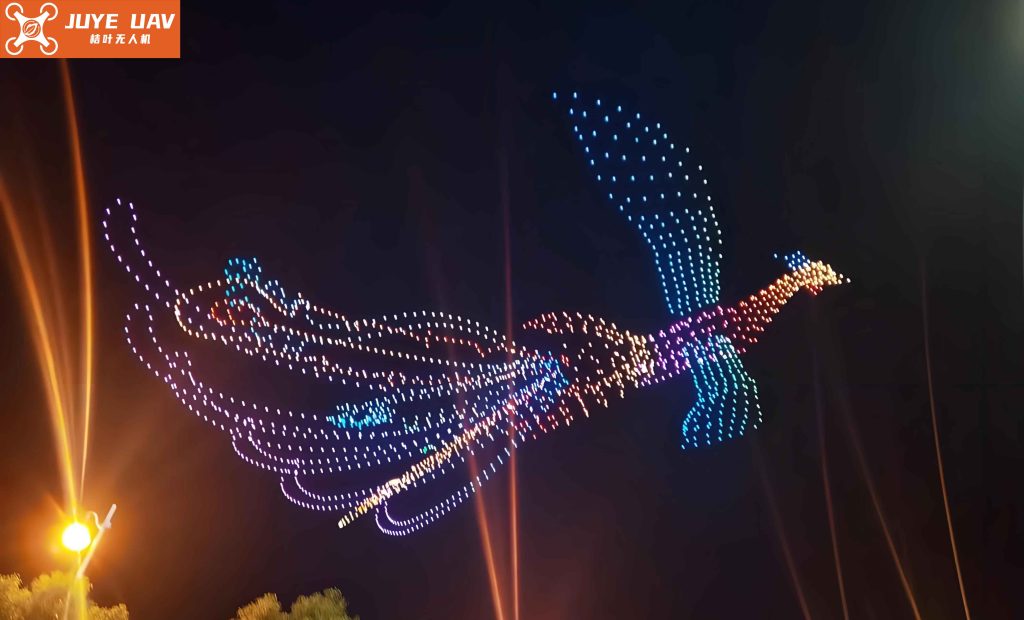
At its core, a drone light show is a manifestation of what Flusser foresaw as the age of the “technical image,” but with a radical, material twist. While Flusser analyzed how apparatuses like cameras generate images by automating human intention into a program, the drone light show operates on a more complex, layered logic of codification. It involves a double datafication process: first, human artistic intent (a shape, a logo, a narrative sequence) is translated into a software program—a set of algorithmic instructions. This code does not merely simulate an image on a screen; it executes a second datafication, translating those instructions into machine commands for a swarm of physical drones. Each drone, equipped with an LED light, becomes a single, dynamic pixel in a three-dimensional, aerial display. The physical flight path and light state of drone i at time t are direct functions of its programmed coordinates and commands.
This can be formalized. Let a swarm S consist of n drones: S = {D1, D2, …, Dn}. For a given performance duration T, the state of the swarm is defined by a four-dimensional matrix encompassing spatial position and luminous output:
$$ State(S, t) = \begin{bmatrix}
\vec{P_1}(t) & L_1(t, c, i)\\
\vec{P_2}(t) & L_2(t, c, i)\\
\vdots & \vdots\\
\vec{P_n}(t) & L_n(t, c, i)
\end{bmatrix}, \quad t \in [0, T] $$
Where:
- $\vec{P_i}(t) = (x_i(t), y_i(t), z_i(t))$ is the 3D spatial coordinate of drone i at time t.
- $L_i(t, c, i)$ is the luminous function for drone i, dependent on time t, color channel c, and intensity i.
The entire performance is the temporal unfolding of this matrix, a pre-computed but physically enacted “film” in volumetric space. The drones are “digital objects” in a precise sense; their meaningful existence as parts of a dragon, a globe, or a word is purely relational and contingent upon their programmed position within the swarm’s operational network. They are individual particles that gain significance only through their orchestrated combination, forming what Gilles Deleuze might call a digital “fold”—a continuously transforming, heterogeneous multiplicity. The formula for the centroid of a formed image at any moment highlights this relational nature:
$$ \vec{C_{image}}(t) = \frac{1}{m} \sum_{j=1}^{m} \vec{P_j}(t) $$
where the summation is over the m drones currently constituting a recognizable shape within the larger swarm S. The drone light show is thus an art of real-time, spatial pixel management, a triumph of code over physical inertia.
The second, and perhaps more culturally significant, operation of the drone light show is the interfacing of the city. Traditional media possess interfaces—screens, pages, canvases—that present a separate, framed world. The drone light show dissolves this frame. It does not create an image of the city or on a screen within the city; it actively uses the city’s own spatial volume—its skyscape, its architectural silhouettes—as its primary interface. The urban night sky, typically a passive, dark backdrop, is transformed into an active, luminous “screen” for technical images. This turns the city itself into a massive, ambient media apparatus. The experience it creates is not one of isolated viewing on a personal device but of embodied immersion. One does not merely watch a drone light show; one is spatially surrounded by it, walking under its luminous narrative as a flâneur in a Benjaminian “arcade” of light. This embodied interface demands and captivates attention in a qualitatively different way than a handheld screen. The spectacle operates through what I term ambient intentionality: it projects its dynamic images and synchronized soundscapes outward, actively seizing the collective gaze of everyone within its sensory domain, pulling them into a shared temporal rhythm dictated by its programmed sequence.
| Interface Type | Example | Space of Engagement | Bodily Posture | Attention Structure |
|---|---|---|---|---|
| Framed Canvas | Painting, Photograph | Frontal, Delimited | Static, Contemplative | Focused, Directed by viewer |
| Screen-Based | TV, Smartphone | Window-like, Virtual | Often Sedentary | Captive but Fragmented (multi-tasking) |
| Ambient-Architectural (Drone Light Show) | Urban Sky Display | Volumetric, Surrounding | Mobile, Ambulatory | Collective, Environmentally Seized |
This leads to the third operation: cultural (re)construction. In an era where public space is often eroded by privatized digital consumption on personal screens, the drone light show acts as a powerful engine for re-creating a temporary but potent public sphere. It functions as a colossal, collective screen that reclaims public attention. The content it displays is typically not personalized but collective—cultural totems, national symbols, celebratory messages, or local narratives (e.g., a dragon for Chinese New Year, a historic monument for a city’s anniversary). This performative act does several things culturally, which can be summarized as a function of collective affect generation:
$$ A_{collective}(t) \approx \int_{0}^{t} \left[ I_{visual}(S, \tau) + I_{audio}(\tau) + \rho \cdot E_{shared}(\tau) \right] d\tau $$
Where $A_{collective}$ is the accumulated affective intensity, $I_{visual}$ and $I_{audio}$ are the sensory intensities of the light and sound, $E_{shared}$ is the observable energy of the surrounding crowd (gasps, cheers, applause), and $\rho$ is a coupling coefficient representing the susceptibility to social contagion. This formula illustrates how the drone light show generates a feedback loop between the spectacle and its audience, fusing them into a temporary “micro-public.”
Furthermore, the drone light show creates what I call a “poetic interruption” in the normalized, utilitarian rhythms of urban life. By commandeering the skyline and transforming familiar cityscapes into stages for fantasy, it breaks the linear, work-oriented tempo of the city. For the duration of the performance, the space is re-enchanted. This fosters what phenomenologists might describe as a “co-being” or “being-with” others, a shared temporal experience centered on aesthetic wonder rather than transactional purpose. The cultural functions are multifaceted:
| Function | Mechanism | Outcome |
|---|---|---|
| Attention Reclamation | Uses spectacular scale & beauty to pull focus from personal screens to shared sky. | Creation of a temporary, focused public. |
| Symbolic Reinforcement | Displays culturally resonant icons (flags, myths, landmarks) in a novel, awe-inspiring format. | Strengthening of communal identity and shared memory. |
| Spatial Re-enchantment | Transforms mundane urban geometry (sky, buildings) into a magical, narrative canvas. | Generation of “poetic moments” that break routine; enhances “spirit of place.” |
| Catalyst for Co-presence | Provides a common focal point that triggers synchronized crowd reactions (cheers, silence). | Fosters embodied social cohesion and a visceral sense of community. |
In conclusion, the drone light show is far more than a technological novelty. It is a symptomatic media practice of our deeply mediatized age. It realizes Flusser’s vision of a programmed universe of technical images, but extends it beyond the virtual domain to graft code directly onto reality. As an interface, it successfully turns the city into an immersive, affective medium. As a cultural form, it counters the centrifugal forces of digital individualism by providing a centripetal, awe-inspiring experience of shared presence. The drone light show thus stands as a compelling example of how media technologies, when oriented towards public artistry rather than private consumption, can actively re-code not just images, but the very experience of urban life and collective belonging. Its ascending patterns in the night sky trace the contours of a new, hybrid public sphere—one woven from equal parts algorithm, light, and collective gaze.