
From my perspective as a researcher and practitioner in the field of technological applications for emergency services, the integration of unmanned aerial vehicles (UAVs), specifically fire drone systems, has ushered in a transformative era for firefighting and rescue operations. The escalating complexity of modern urban environments, characterized by high-density populations, intricate architectural designs, and concentrated industrial parks, presents unprecedented challenges. Traditional firefighting methods often place personnel in extreme peril, especially when confronted with hazardous materials, unstable structures, or inaccessible terrain. The imperative to safeguard both civilian lives and responder safety while enhancing operational efficacy has driven the rapid adoption and evolution of the fire drone as an indispensable tool. This analysis delves deeply into the technological foundations, multifaceted advantages, expansive application domains, and future trajectory of fire drone systems in emergency response.
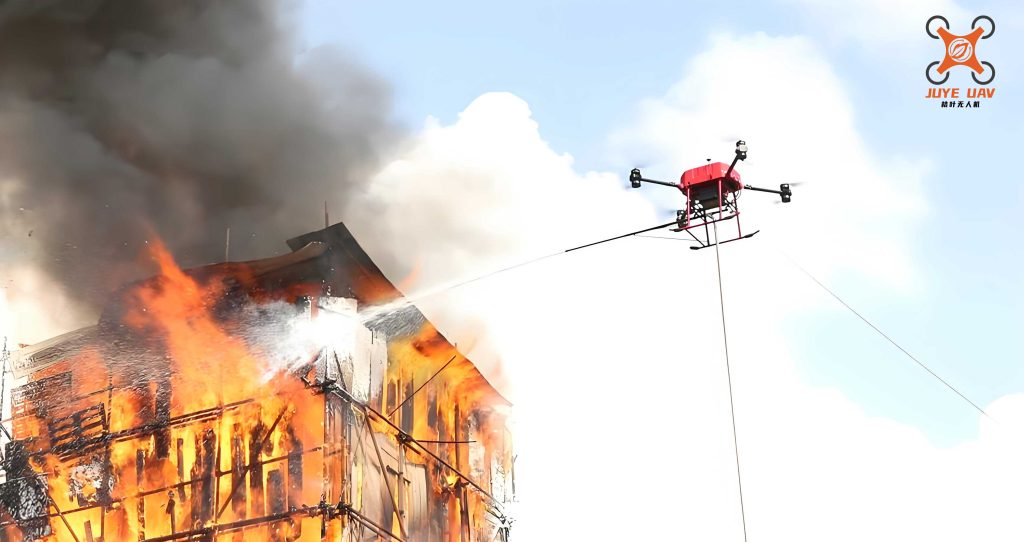
The core operational principle of a fire drone rests on a synergistic integration of three primary systems: the Airframe Platform System (APS), the Ground Control System (GCS), and the Payload System (PS). The performance envelope of a fire drone is defined by the interplay between these systems. We can model a simplified representation of a multi-rotor fire drone‘s thrust requirement for stable hover, a critical parameter for persistent observation, using the following equation:
$$ T_{hover} = \frac{m \cdot g}{n \cdot \cos(\phi)} $$
Where \( T_{hover} \) is the thrust per motor, \( m \) is the total mass of the drone (airframe + payload + battery), \( g \) is gravitational acceleration, \( n \) is the number of rotors, and \( \phi \) is the tilt angle of the rotor disk (approximately 0 in hover). This highlights how payload capacity directly impacts power requirements. The classification of fire drone platforms is extensive, tailored to diverse mission profiles, as summarized in the table below.
| Classification Basis | Types | Key Characteristics & Fire/Rescue Applications |
|---|---|---|
| Platform Configuration | Multi-Rotor (e.g., Quadcopter, Hexacopter, Octocopter) | Vertical Take-Off and Landing (VTOL), exceptional stability for low-altitude hovering, ideal for close-range reconnaissance, structure inspection, and precision payload delivery. Higher rotor count increases redundancy and payload capacity. |
| Fixed-Wing | Long endurance and high-speed forward flight, superior for large-area surveillance (e.g., forest fire perimeter mapping), pipeline patrols, and pre-incident surveys over vast terrains. Requires runway or launcher for take-off. | |
| Hybrid VTOL (Convertible/Transitional) | Combines hover capability of rotors with efficient forward flight of fixed wings. Suitable for missions requiring both long-range transit and detailed, stationary inspection of a target zone. | |
| Operational Radius | Close-Range, Short-Range, Medium-Range, Long-Range | Defines the maximum distance from the Ground Control Station (GCS). Determines communication technology needs (radio line-of-sight vs. satellite link) and mission scope, from tactical building fires to expansive wildfire campaigns. |
| Service Ceiling (Altitude) | Very Low Level (VLL), Low Level, Medium Altitude, High Altitude | Altitude selection is mission-critical. VLL for interior or dense urban canyon reconnaissance; Medium/High altitude for wide-area situational awareness, thermal hotspot detection over forests, or providing temporary communication relays. |
The strategic advantages of deploying a fire drone are profound and multi-dimensional, fundamentally altering the risk calculus of emergency response.
1. Dramatic Reduction in Personnel Risk: The most salient benefit is the removal of first responders from immediately life-threatening environments. A fire drone can be deployed into zones with extreme heat, structural instability, toxic gas concentrations, or radiological hazards, performing initial assessment without endangering human life. This aligns with the core principle of “risk-aware operations.” The operational cost, including potential vehicle loss, is invariably lower than the human and institutional cost of a responder injury or fatality.
2. Rapid Deployment and Situational Awareness (SA): A fire drone can be airborne within minutes of arrival on scene, providing incident commanders with a real-time, God’s-eye view of the incident. This rapid SA is crucial for accurate size-up, identifying exposure hazards, locating fire origin, and spotting potential victims. The data link latency \( \tau_{dl} \) is a key performance metric for effective command and control:
$$ \tau_{dl} = \tau_{processing} + \tau_{transmission} + \tau_{propagation} $$
Minimizing \( \tau_{dl} \) ensures that the video feed and sensor data presented to the commander are as close to real-time as possible, enabling dynamic decision-making.
3. Multi-Sensor Intelligence, Surveillance, and Reconnaissance (ISR): The true power of a modern fire drone lies in its modular payload capability. By swapping mission-specific sensors, a single platform can fulfill numerous roles. The table below illustrates common payloads and their functions.
| Sensor/Payload Type | Physical Principle / Technology | Primary Application in Fire & Rescue |
|---|---|---|
| Electro-Optical/Infrared (EO/IR) Gimbal | Visible-light & Thermal Imaging Cameras | Core reconnaissance. Thermal cameras detect heat signatures through smoke, identifying hotspots, hidden fire spread, and human survivors via body heat. The detected radiant power \( P \) from a hotspot follows the Stefan-Boltzmann law approximation: \( P \approx \epsilon \sigma A T^4 \), where \( \epsilon \) is emissivity, \( \sigma \) is the constant, \( A \) is pixel area, and \( T \) is temperature. |
| Gas Detection Sensors | Electrochemical, PID, or NDIR Sensors | Hazard identification. Detects and quantifies concentrations of toxic (e.g., CO, HCN) and combustible (e.g., CH₄, LPG) gases, mapping plume dispersion to establish safe zones and approach paths for responders. |
| LiDAR (Light Detection and Ranging) | Laser pulse time-of-flight measurement | 3D mapping and modeling. Creates high-resolution point clouds of disaster scenes (collapsed buildings, landslide areas) for structural analysis, volume calculation of debris, and planning technical rescue operations. |
| Communication Relay Payload | Miniaturized cellular (LTE) or mesh network node | Overcoming communication dead zones. Acts as an aerial cell tower, restoring command network coverage for ground teams in areas where infrastructure is damaged or non-existent (e.g., wildfires, earthquakes). |
| Delivery Mechanisms | Winch systems, gravity-drop mechanisms | Life-saving supply. Delivers emergency flotation devices, personal protective equipment (PPE), medicines, or two-way radios to trapped individuals in water, on cliffs, or in structurally compromised buildings. |
The application spectrum of the fire drone spans the entire incident lifecycle, from prevention and preparedness to active response and post-incident analysis.
1. Active Firefighting and Urban Search & Rescue (USAR): During structure fires, a fire drone provides continuous exterior and, where possible via openings, interior monitoring. It tracks fire progression, identifies potential flashover or backdraft conditions, and verifies the effectiveness of fire streams. Thermal imaging guides overhaul operations by pinpointing remaining hot spots within walls and voids. In USAR scenarios following collapses, a fire drone equipped with LiDAR and a high-resolution camera can perform rapid structural damage assessment, identifying void spaces and creating 3D models for shoring and extraction planning. The use of a fire drone for victim location, combining thermal imaging with visual analytics, significantly accelerates the critical “golden hour” of rescue.
2. Wildland Fire Management: This is a domain where the fire drone offers revolutionary capabilities. Fixed-wing or long-endurance hybrid fire drone systems are deployed for perimeter mapping, calculating fire spread rate \( R \) based on sequential geotagged imagery:
$$ R = \frac{\Delta d}{\Delta t} $$
where \( \Delta d \) is the change in fire front position and \( \Delta t \) is the time between observations. This data feeds into predictive fire behavior models. Multi-rotor fire drones can perform targeted ignition for backburning operations with far greater precision and safety than ground crews. They also monitor firefighter crew positions and provide escape route surveillance.
3. Hazardous Materials (HazMat) Response: In chemical, biological, radiological, or nuclear (CBRN) incidents, sending personnel into the hot zone for initial detection is highly dangerous. A fire drone fitted with appropriate spectrometers or radiation detectors can conduct remote sampling and mapping of contaminant dispersion, defining the plume model and identifying epicenters of release without exposing responders.
4. Post-Incident Investigation and Forensics: After a fire is extinguished, a fire drone conducts comprehensive aerial documentation of the scene. Using photogrammetry software, hundreds of overlapping high-resolution images are processed to create orthomosaics (2D maps) and detailed 3D models. These digital replicas allow investigators to navigate the scene virtually, take precise measurements, and analyze burn patterns to determine the origin and cause of the fire with a level of detail previously unattainable.
5. Public Information and Operational Support: A fire drone with a loudspeaker can broadcast evacuation instructions or safety warnings to affected populations. At night, drones equipped with powerful LED arrays, especially tethered fire drone systems providing unlimited flight time, can illuminate large work areas for ground crews, enhancing safety and operational continuity.
| Application Domain | Typical Fire Drone Configuration | Key Payloads | Primary Operational Mode |
|---|---|---|---|
| Structural Fire Attack Support | Robust Multi-Rotor (Hexa/Octocopter) | EO/IR Zoom Gimbal, Gas Sensor | Manual Piloting for dynamic tracking; Pre-set orbits for continuous monitoring. |
| Wildfire Mapping & Monitoring | Fixed-Wing or Long-Endurance Hybrid VTOL | Wide-area Thermal Camera, Visual Camera | Fully Autonomous Grid/Perimeter Flight Plans. |
| Technical Rescue (Flood, Mountain) | Multi-Rotor with high thrust-to-weight ratio | High-power Light, Loudspeaker, Delivery Winch | Manual Piloting for precise positioning; Assisted GPS hold for stable hover during delivery. |
| HazMat Incident Assessment | Multi-Rotor with sealed electronics | Specific Gas/Radiation Detector, Visual Camera | Autonomous waypoint sampling at varying altitudes; Live data telemetry. |
| Disaster Damage Assessment | Multi-Rotor | High-resolution Camera, LiDAR | Automated Photogrammetry Capture Flight Path. |
Despite the clear advantages, the operational integration of fire drone systems is not without challenges. Airspace coordination in congested urban environments or near airports is a complex regulatory hurdle. Ensuring secure, jam-resistant data links is paramount to maintain control and data integrity. Adverse weather conditions, particularly high winds and heavy precipitation, can limit fire drone operations. Furthermore, the vast amount of data (video, sensor, geospatial) generated requires robust processing, analysis, and secure storage platforms to translate raw data into actionable intelligence.
The future trajectory of fire drone technology points towards greater autonomy, swarm intelligence, and advanced human-machine teaming. Research is focused on enabling a single operator to manage a swarm of heterogeneous fire drones, each performing a specialized task—one mapping, one monitoring gases, one providing comms relay—through collaborative algorithms. The control logic for a simple two-drone collaborative search over an area \( A \) can be conceptualized to maximize coverage efficiency \( \eta \):
$$ \eta = \frac{C_{total}}{A \cdot t_{total}} $$
where \( C_{total} \) is the total area effectively covered by the drones’ sensors and \( t_{total} \) is the mission time. Advancements in artificial intelligence will allow fire drones to automatically recognize critical objects (e.g., fire hydrants, victims, hazardous leaks) in real-time video feeds. Integration with Building Information Modeling (BIM) and real-time fire modeling software will enable predictive analytics, where the fire drone not only shows the current state but simulates and visualizes potential fire spread and structural failure points.
In conclusion, the fire drone has evolved from a novel reconnaissance gadget into a cornerstone of modern fire and rescue strategy. Its ability to enhance situational awareness, reduce risk to personnel, and perform a growing array of specialized tasks makes it an invaluable force multiplier. The ongoing convergence of robotics, sensor miniaturization, artificial intelligence, and data analytics promises to further unlock the potential of the fire drone. The ultimate goal is a seamless, intelligent aerial partner that empowers incident commanders with superior knowledge and extends the safe, effective reach of every fire and rescue team, fundamentally redefining the art of the possible in saving lives and protecting property.