
From my practical experience in modern policing, the integration of technology, particularly Police Unmanned Aerial Vehicles (Police UAVs), has become indispensable. As the strategic push for “technology empowering the police” deepens and the constraints of human resources grow more acute, police departments are actively exploring the intelligent application of Police UAVs. The focus is on deeply developing autonomous mission execution capabilities to enhance the practical effectiveness of Police UAVs in target recognition and tracking, achieving precise identification and efficient monitoring of subjects. This shift is not merely about adopting new tools but about fundamentally transforming operational methodologies to be more proactive, data-driven, and resilient.
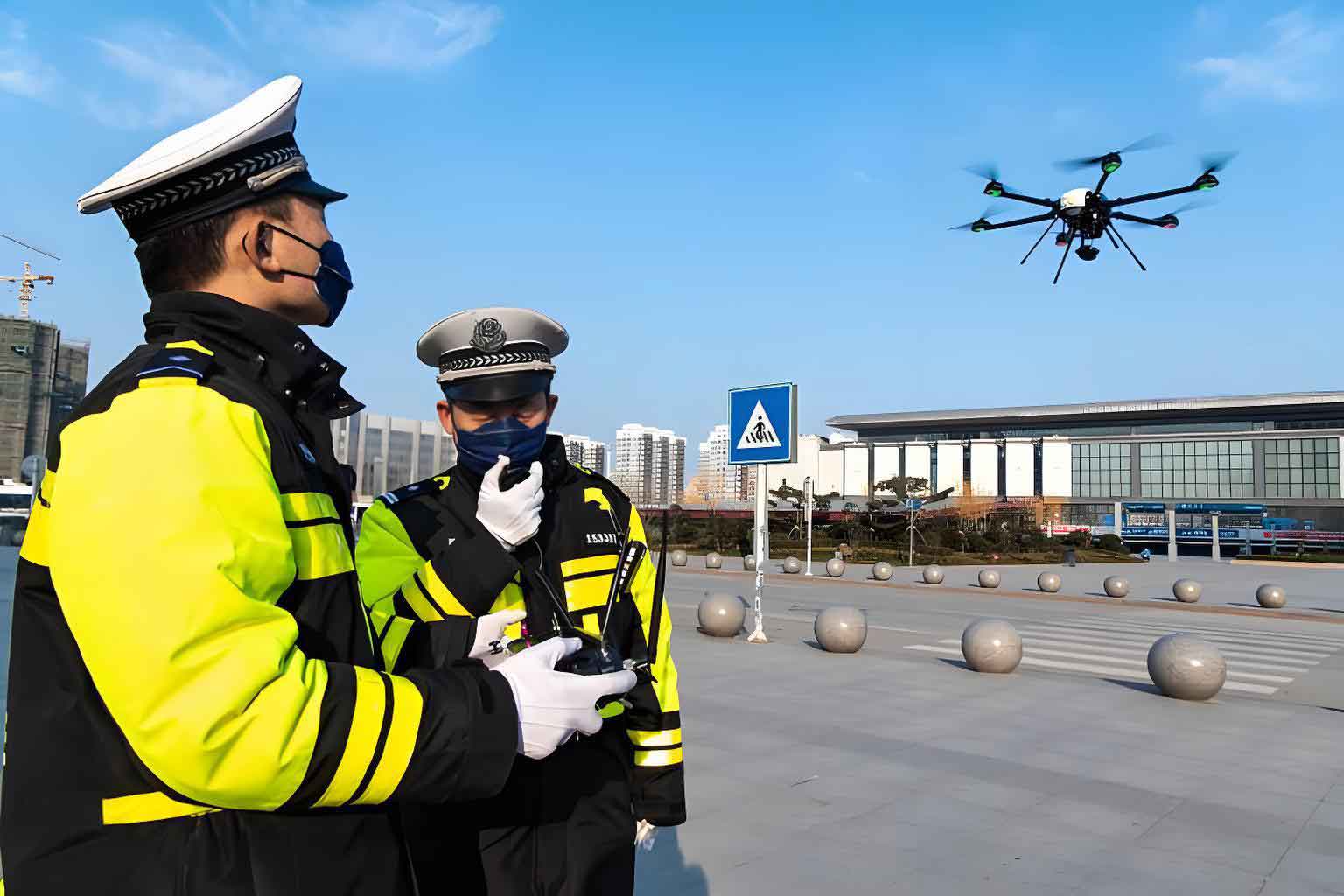
The core value of a Police UAV lies in its ability to serve as an agile, intelligent, and persistent aerial sensor platform. Unlike static infrastructure, a Police UAV provides dynamic perspective, rapid deployment, and access to areas challenging for ground units. The ultimate goal is to evolve from remote-controlled data collectors to autonomous systems capable of complex perception, reasoning, and coordinated action. This journey involves overcoming significant technical and systemic hurdles, which I will explore by first examining the inherent advantages, then the current practical challenges, and finally, a roadmap for future development.
Operational Advantages of Police UAVs in Target Missions
In field operations, the deployment of Police UAVs for target recognition and tracking offers distinct tactical advantages that directly address contemporary policing challenges. The benefits manifest in strategic deployment depth, analytical intelligence, and systemic integration.
1. Swarm Operations for Comprehensive Area Denial and Control
Traditional video surveillance networks are often plagued by gaps due to geographical, economic, and technical limitations. Inter-connectivity and upgrades are cumbersome. A fleet of Police UAVs, operating as a coordinated swarm, overcomes these “re-construction” issues and resource waste. A single Police UAV has value, but a networked swarm creates a dynamic, intelligent sensor mesh. This enables multi-angle, multi-perspective data acquisition for comprehensive target profiling. The operational hierarchy is clear: multiple Police UAVs work in concert, fusing data to analyze target characteristics, dynamically track movement, and map trajectories. This synthetic, multi-track investigation, when integrated with ground forces, elevates the practical application of Police UAVs to a new level of operational awareness.
2. Deep Learning Integration for Enhanced Recognition and Predictive Analysis
The true intelligence of a modern Police UAV stems from its fusion with deep learning algorithms, granting it significant environmental adaptability. In adverse conditions—rain, wind, low light—these algorithms process “noisy” data distributions. They perform crucial pre-processing: filling missing values, removing duplicates, and cleaning erroneous data. This maximizes the fidelity of extracted target features for reliable tracking.
Mathematically, a deep neural network in a Police UAV processes an input image or sensor feed \( I \) through a series of convolutional layers to extract a feature map \( F \). For target recognition, the network learns a function \( f \) such that:
$$ f(I; \theta) = P(C | I) $$
where \( \theta \) represents the learned parameters (weights and biases) of the network, and \( P(C | I) \) is the probability distribution over target classes \( C \) (e.g., person, vehicle, specific model). For tracking, the system often employs algorithms like correlation filters or deep siamese networks to learn a similarity function \( s \):
$$ s(F_t, F_{t+1}) = \text{similarity score} $$
where \( F_t \) is the target feature template at time \( t \) and \( F_{t+1} \) is a candidate feature in the next frame. This allows the Police UAV to maintain track despite occlusion or appearance changes, moving beyond simple motion detection to model-based tracking.
This capability is crucial against subjects employing counter-surveillance tactics. The Police UAV can analyze data at a deeper level—identifying behavioral patterns, anomalous stops, or associations with other subjects—building a “perception net” that enables predictive analysis and deeper investigative leads.
3. Systemic Fusion for Networked Data Dominance
A Police UAV is not an isolated tool; its power multiplies when deeply integrated with existing police business systems and databases. Traditional CCTV systems often have one-way, shallow data flow into central databases. In contrast, a properly integrated Police UAV platform enables bidirectional, real-time data fusion. It can query databases (e.g., for facial recognition, license plate matching) while simultaneously ingesting and updating them with new field data. Furthermore, direct integration with command and control systems allows for real-time tasking and intelligence dissemination to officers on the ground.
This creates a grid-based operational unit. The Police UAV, acting as the aerial node, and ground forces form a cohesive mesh that enhances not only strike precision but also data control and security. With built-in access monitoring and log auditing, the Police UAV system can help regulate operational conduct, mitigate risks of data tampering or illegal intrusion, and balance public safety, data governance, and privacy concerns.
| Advantage Area | Core Capability | Practical Impact |
|---|---|---|
| Strategic Deployment | Swarm Coordination & Dynamic Sensor Mesh | Comprehensive area coverage, multi-angle tracking, resilient network. |
| Analytical Intelligence | Deep Learning for Feature Extraction & Tracking | Robust performance in adverse conditions, behavioral analysis, predictive leads. |
| Systemic Integration | Bidirectional Data Fusion with Police Databases & C2 | Real-time intelligence, grid-based operations, enhanced data security and auditability. |
Current Practical Challenges and Limitations
Despite the clear advantages, the day-to-day deployment of Police UAVs for sophisticated target recognition and tracking faces several significant hurdles that limit their full potential.
1. Insufficient Autonomy and Fragmented Swarm Intelligence
Too often, the Police UAV is still perceived as merely a “flying camera.” Its operational paradigm remains heavily reliant on human pilots and analysts. True autonomy—where the Police UAV can independently identify, decide, and track—is limited. The integration with advanced AI is not deep enough; performance degrades severely in complex, unstructured environments. When multiple Police UAVs are deployed, the lack of robust inter-machine communication and collective intelligence protocols means data remains “siloed” on individual platforms. There is no automatic synthesis of a unified target track from multiple sensor nodes. The swarm behaves as a collection of “dumb” data feeders, requiring massive, labor-intensive backend analysis to “assemble” the intelligence picture. Moreover, swarm resilience is low; the loss of a node often cripples the network’s coverage without an autonomous repair mechanism, leading to lost tracks and missed opportunities.
2. Inadequate Database Support and Cybersecurity Vulnerabilities
The effectiveness of a Police UAV’s recognition engine is wholly dependent on the quality and accessibility of backend databases. Two critical prerequisites exist: comprehensive, high-quality data for comparison, and seamless, high-bandwidth integration between the Police UAV and these databases. In practice, data “islands” are prevalent. Standards vary across jurisdictions, and sharing is hampered by bureaucratic and technical barriers. When a Police UAV operates across regions or needs to identify subjects from other databases, the process of data format conversion and access authorization can be slow, defeating the purpose of rapid response.
Furthermore, the cybersecurity of the Police UAV system itself is a paramount concern. As a wireless node operating in contested electromagnetic space, the Police UAV is vulnerable to jamming, spoofing, and hacking. Current “anti-hijacking” and encryption measures on many platforms are not robust enough. A compromised Police UAV can lead not only to mission failure but also to the leakage or manipulation of sensitive police data, with severe consequences.
3. Immature Management Ecosystems and Low Routine Adoption
A common pitfall in police technology is “emphasis on procurement, neglect of management.” Police UAVs require specialized maintenance, regular software updates, and skilled operators. Given general resource constraints, dedicated support structures are often lacking. The shortage of personnel skilled in UAV operation, data analysis, hardware repair, and system administration hinders sustained effectiveness. Additionally, high perceived complexity and operational costs discourage routine use. In many units, Police UAVs become specialty items reserved for major incidents, while daily surveillance relies on fixed cameras. This under-utilization stifles the development of proficiency and prevents the technology from becoming a true force multiplier.
| Challenge Category | Specific Issue | Consequence |
|---|---|---|
| Technical Autonomy | Low AI integration, poor swarm coordination, lack of self-healing networks. | High human dependency, fragmented intelligence picture, poor resilience. |
| Data & Security | Database silos, incompatible standards, weak cyber defenses. | Slow cross-jurisdictional tracking, data inaccessibility, risk of compromise. |
| Organizational & Management | Lack of specialized training, high maintenance burden, “special event” mentality. | Low routine adoption, skill gaps, technology underutilization. |
Development Pathway Towards Full Operationalization
To transform the Police UAV from a promising tool into a cornerstone of practical policing, a multi-faceted development approach is necessary. This path focuses on creating intelligent systems, ensuring robust support, and fostering an enabling ecosystem.
1. Constructing a “Seamless Perception” Network and a New “Command-Chain + Operational-Flow” Model
The future lies in perceiving a fleet of Police UAVs not as individual units but as nodes in a resilient, self-configuring aerial sensor network. This network must provide omni-directional coverage and possess the intelligence to autonomously repair itself by re-routing data flows when nodes are lost.
• Building the Intelligent Sensor Mesh: Each Police UAV functions as a mobile sensor node. The network uses algorithms for data fusion, employing techniques like:
$$ \hat{T} = \arg \max_{T} \sum_{i=1}^{N} w_i \cdot \text{Sim}(D_i, M(T)) $$
where \( \hat{T} \) is the estimated target state, \( D_i \) is data from the i-th Police UAV, \( M \) is a world model, \( \text{Sim} \) is a similarity function, and \( w_i \) is a weight based on node reliability. Data preprocessing (cleaning, reduction, correlation) happens distributively to build a cohesive target signature.
• Establishing Integrated Command: Data from the Police UAV network feeds a unified operational picture. Command flows bidirectionally: from headquarters to the swarm, and from the swarm’s collective intelligence back to ground commanders. This creates a “Command-Chain + Operational-Flow” paradigm where strategic direction and tactical reality are constantly aligned. The swarm can be organized hierarchically, with lead Police UAVs managing sub-swarms for specific tasks like perimeter holding or focused pursuit, all synchronized with ground unit movements.
2. Fusing Advanced “Deep Learning” and Building a “Big Platform + Cloud Policing” Architecture
The breakthrough in practical application hinges on advancements in core AI and data infrastructure.
• Advancing Core Algorithms: Research must focus on making deep learning models on Police UAVs more robust, efficient, and explainable. This includes developing lightweight convolutional neural networks (CNNs) for real-time onboard processing and recurrent models for trajectory prediction:
$$ \vec{v}_{pred}(t+1) = \text{GRU}(\vec{v}(t), \vec{v}(t-1), …; \phi) $$
where \( \vec{v} \) is the target’s kinematic state and \( \phi \) are the model parameters. Training must use diverse, realistic datasets simulating all environmental conditions to ensure the Police UAV’s adaptability moves from the lab to the field.
• Creating Unified Data Foundations: A national or regional “Big Platform” with standardized, shared databases is non-negotiable. This platform must be accessible to any authorized Police UAV system in near real-time. The Police UAV then acts as the key enabler of “Cloud Policing”—extending sensory and analytical capabilities into the sky. Highly integrated application modules (for forensics, traffic analysis, crowd monitoring) can be invoked autonomously by the Police UAV based on mission context, creating a powerful, unified investigative capability.
3. Institutionalizing “Frontline Empowerment” and Cultivating “High-Ground Control + Anti-Compromise” Capabilities
Technology alone is insufficient. We must ensure it is usable, used, and secure.
• Empowering the Frontline: This involves reducing costs through scaled production, developing intuitive control interfaces, and establishing pervasive training and exercise regimens. Maintenance and logistics must be systematized. Standardized data protocols are essential to enable seamless cross-regional tracking, allowing a Police UAV from one jurisdiction to effectively continue a track into another.
• Ensuring Information Dominance and Security: While the Police UAV provides the tactical “high ground,” we must fiercely protect that advantage. This requires:
– Robust encryption for all data links (command & video).
– Secure boot and software validation for each Police UAV.
– Advanced anti-spoofing technologies (e.g., for GPS).
– Systems capable of detecting intrusion attempts and initiating automated countermeasures, such as isolating compromised nodes and triggering forensic logging.
The control of data—from capture to transmission to analysis—must remain unequivocally with law enforcement. A holistic security framework turns the Police UAV network from a potential vulnerability into a resilient, controlled asset.
| Development Pillar | Key Initiatives | Expected Outcome |
|---|---|---|
| Network-Centric Operations | Develop self-healing swarm protocols; Integrate C2 systems for bidirectional flow. | Resilient, omni-directional sensor mesh; Synchronized air-ground operations. |
| AI & Data Infrastructure | Invest in robust, efficient deep learning models; Build standardized, shared “Big Platform” databases. | Autonomous recognition/tracking in all conditions; Real-time, cross-jurisdictional data access. |
| Ecosystem & Security | Frontline training & cost reduction; Implement end-to-end encryption & anti-compromise systems. | High routine adoption & proficiency; Secure, resilient Police UAV operations maintaining data control. |
In conclusion, the journey of the Police UAV in target recognition and tracking is one of continuous evolution from a tool to a teammate. The practical advantages are undeniable, offering strategic depth, intelligent analysis, and systemic force multiplication. However, realizing this potential fully demands that we honestly address the challenges of autonomy, data integration, and cybersecurity. By focusing on building intelligent, networked systems grounded in robust data platforms and secured by resilient protocols, and by empowering frontline officers to use them routinely, we can truly harness the power of the Police UAV. This will cement its role as a transformative asset for modern public safety, enabling a future where policing is more proactive, precise, and safe for both officers and the communities they serve.