
The construction of specialized discipline clusters stands as a core task in advancing the development of national and provincial-level exemplary higher vocational institutions. With the continuous implementation of initiatives like the “High-Level Vocational Schools and Majors with Chinese Characteristics” plan, vocational education has entered a new era of opportunity. Drone application technology, as an emerging field, has seen its scope of use expand dramatically alongside technological progress, presenting significant prospects for the industry. In this favorable environment, a critical question arises: how can higher vocational colleges effectively construct drone-related discipline clusters? The answer lies in leveraging industry-education integration and cooperative talent cultivation models to maximize the cluster’s efficacy, which forms the central focus of this exploration from a first-person perspective.
I. Imperative Analysis: Aligning Drone Training with National Strategic Needs
The necessity of developing drone application programs to serve rural revitalization is multi-faceted, grounded in policy, educational reform, and practical socioeconomic demands.
Policy Drivers and Macro-Frameworks: National strategies consistently highlight technological empowerment for agriculture. Key documents emphasize enhancing agricultural equipment R&D and application, specifically calling for intelligent machinery and overcoming weaknesses in hillside farming. This creates a direct policy conduit for drone-based solutions like precision crop protection. Furthermore, goals such as raising the comprehensive mechanization rate of crop plowing, planting, and harvesting to over 75% establish clear quantitative benchmarks where drone training can contribute significantly.
Vocational Education System Alignment: The reform of vocational education mandates that institutions align their offerings with regional and national pillar industries. Guidelines stipulate the establishment of dynamic discipline clusters, typically comprising 3-5 interrelated majors. For higher vocational colleges, constructing a scientifically rational drone technology cluster is not optional but a fundamental requirement to meet industrial demands and achieve institutional development goals. This systemic push makes specialized drone training programs a strategic imperative.
Addressing Core Rural Challenges: As a major agricultural country facing rural labor migration, China experiences a growing demand for automated and intelligent farming solutions. The expansion of drone application scenarios in agriculture—from spraying to mapping—has led to rapid market growth. The integration of digitalization and intelligent technology with drones presents a powerful kinetic energy for modernizing agriculture. The potential impact can be modeled as a function of technology penetration and skill availability:
$$
\text{Agricultural Modernization Gain} (G) = \int_{t_0}^{t} [ \alpha T_p(t) + \beta S_a(t) ] \, dt
$$
Where $T_p(t)$ represents the penetration rate of drone technology, $S_a(t)$ represents the availability of skilled operators (output of drone training), and $\alpha$ and $\beta$ are weighting coefficients for technology and human capital, respectively. Maximizing $G$ requires concurrent advancement in both variables.
| Driver Category | Key Objective | Implication for Drone Training |
|---|---|---|
| National Policy | Agricultural mechanization & intelligent equipment adoption | Creates demand for precision agriculture skills (spraying, sensing). |
| Educational Reform | Industry-aligned, dynamic discipline cluster formation | Mandates structured programs in UAV tech, maintenance, and application. |
| Socioeconomic Need | Countering rural labor shortage; boosting productivity | Requires training to operationalize drones as force multipliers on farms. |
II. Expansive Application Domains: The Versatility of Trained Drone Operations
The utility of drones in rural revitalization spans far beyond primary production, permeating tourism, environmental management, and rural planning.
A. Catalyzing Agricultural Modernization:
- Precision Crop Protection: With 20 billion mu of farmland, the scale of need is immense. Drone “aerial defense” offers a transformative shift from manual methods. Its advantages include precision, efficiency, and automated operation. Critically, it reduces chemical usage and generates valuable geotagged data on application rates and coverage. This data facilitates analysis and predictive management, forming a closed-loop intelligent system. The operational efficiency can be expressed as:
$$
E_{op} = \frac{A_c}{t_{op} \cdot (C_{lab} + C_{chem} + C_{drone})}
$$
Here, $E_{op}$ is operational efficiency, $A_c$ is area covered, $t_{op}$ is operation time, and $C$ terms represent costs related to labor, chemicals, and drone operation. Drone training optimizes $t_{op}$ and minimizes $C_{drone}$ through proficient piloting and maintenance.
- Field and Soil Monitoring: Drones equipped with multispectral or near-infrared sensors enable comprehensive soil analysis and crop health assessment. This overcomes limitations of traditional ground-based scouting—limited scope, access difficulties, and higher costs. The resulting data supports informed decision-making, paving the way for truly立体化 (three-dimensional) farm management.
B. Enabling Rural Tourism and Cultural Promotion:
- High-Resolution Mapping: Drone photogrammetry allows for the rapid, cost-effective creation of detailed and attractive rural tourism maps. Compared to traditional surveying, it offers superior speed, coverage, and economic benefit, providing tourists with comprehensive spatial information.
- Content Creation for Marketing: Drones are powerful tools for capturing stunning aerial footage that highlights the unique landscapes and cultural heritage of rural areas. Professionally shot photos and videos can be used to craft compelling narratives, design scenic routes, and promote local festivals or crafts on digital platforms, attracting urban visitors and fostering cultural exchange.
C. Supporting Ecological Conservation and Rural Planning:
- Environmental Surveillance: The safety, flexibility, and relatively low cost of drone platforms make them ideal for monitoring air quality, detecting pollution sources, and observing ecological changes. They serve as “smart” tools for routine environmental protection and are invaluable in emergencies like forest fires or illegal straw burning, providing real-time data for emergency response.
- Photogrammetry for Village Planning: Accurate geographical information is the bedrock of sound rural planning. Drone-based low-altitude surveying efficiently collects data on topography, land use, and settlement patterns, filling critical information gaps. This data is essential for scientific planning of infrastructure, land allocation, and beautification projects in rural construction.
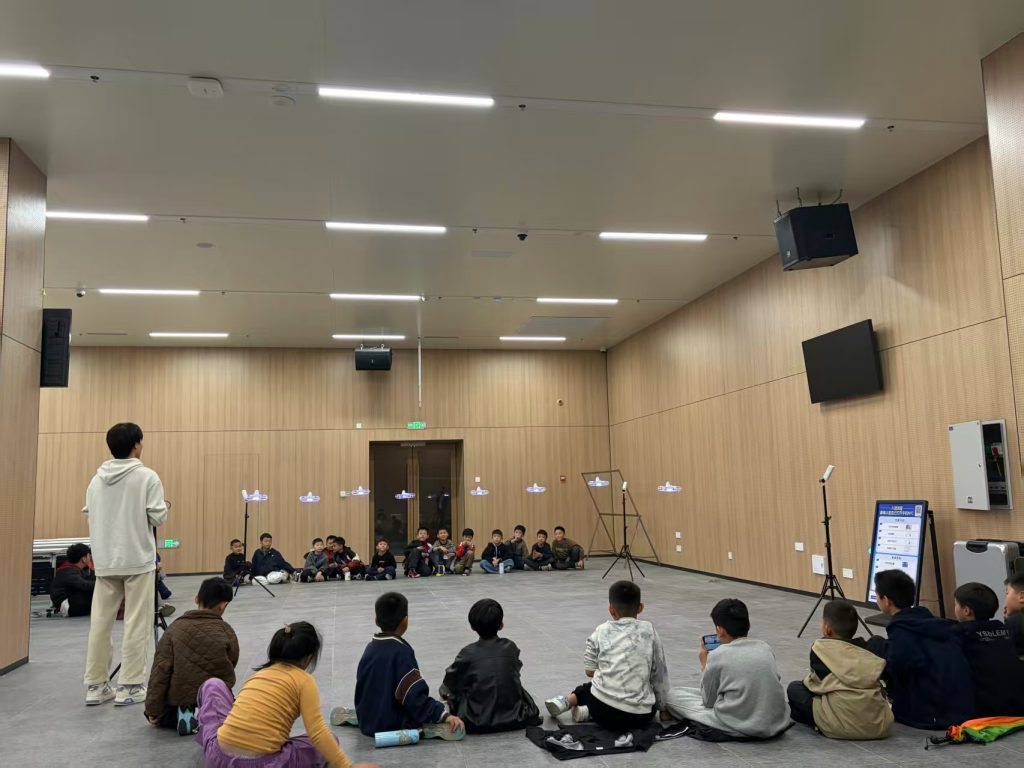
This image encapsulates the practical, hands-on component essential to effective drone training, where theory meets application in a controlled environment.
III. Prevailing Challenges in Deploying Drone Expertise for Rural Service
Despite clear potential, significant hurdles impede the effective alignment of drone education with rural revitalization needs.
A. Superficial Industry-Education Integration: While many colleges have established drone majors, collaboration with enterprises often remains shallow, frequently limited to co-hosting certification workshops (e.g., for AOPA licenses). There is a lack of deep, co-constructed curricula, shared training bases, and long-term win-win mechanisms that genuinely blend academic theory with cutting-edge industry practice. This gap results in a misalignment between graduate skills and real-world job requirements.
B. Deficient Faculty Capacity: The explosive growth in drone programs—from 2 in 2013 to over 400—has outpaced the supply of qualified instructors. The absence of dedicated graduate-level drone disciplines forces institutions to reassign teachers from related fields like electronics or aviation. These educators often lack comprehensive, systematic knowledge of UAV systems and, crucially, hands-on industry experience, which constrains the quality and practical relevance of drone training.
C. Fragmented and Narrow Training Models: Many existing programs focus narrowly on piloting, assembly, and maintenance, producing technicians for the drone economy itself. However, they often fail to create interdisciplinary linkages. The true power for rural service lies at the intersection of drone technology with agronomy, ecology, sports (e.g., for event coverage), tourism management, and economics. Current training schemes lack this synergistic design, preventing the formation of “T-shaped” talent with deep technical skills and broad application knowledge.
| Dimension | Current Common State | Requirement for Effective Rural Service |
|---|---|---|
| Industry Links | Transactional (certification-focused), short-term. | Deep, strategic partnerships; co-development of resources and standards. |
| Faculty Profile | Theory-heavy, limited practical UAV industry experience. | Strong “dual-qualified” teachers with both academic and applied expertise. |
| Curriculum Design | Discipline-siloed, focused on core UAV tech. | Interdisciplinary, flexible, integrating agri-tech, mapping, data analysis, etc. |
| Student Competency | Skilled operator/technician. | Solution-oriented specialist who can apply drone tech to solve rural sector problems. |
IV. Pathway Exploration: Building a High-Impact Drone Training Ecosystem
To overcome these challenges and fully harness the potential of drones for rural revitalization, a multifaceted, systemic approach is required.
A. Forging Deep, Strategic Industry-Education Communities: Institutions must move beyond ad-hoc partnerships to establish long-term, strategic alliances with leading enterprises across the drone value chain. This involves co-developing industry-relevant standards, curricula, and teaching materials; co-sharing experts and facilities; and co-managing practical training. The goal is to create a symbiotic “community of shared future” where the school’s theoretical training is continuously informed and upgraded by real-world industry dynamics.
B. Constructing Open, Shared Practical Platforms: A layered practical training system is vital. This includes:
- On-campus virtual simulation labs for safe, cost-effective practice in flight dynamics, mission planning, and failure simulation.
- On-campus physical training bases for hands-on assembly, debugging, maintenance, and data processing exercises.
- Off-campus industry training bases established with local drone service companies, agriculture cooperatives, or surveying firms, providing students with authentic work environments for internships and project-based learning.
The efficacy of this blended model can be conceptualized as:
$$
\text{Skill Mastery Index} (SMI) = w_1 \cdot \text{Sim}_{score} + w_2 \cdot \text{Lab}_{comp} + w_3 \cdot \text{Intern}_{eval}
$$
where $w_1$, $w_2$, $w_3$ are weights assigned to performance in simulation, lab, and internship components, respectively.
C. Optimizing the Discipline Cluster Around Industry Needs: The curriculum must be reconstructed with a “future-oriented, demand-satisfying” philosophy. Beyond core UAV technology courses, specialized application tracks must be developed and offered, such as:
- Agricultural Remote Sensing and Precision Application
- Infrastructure Inspection (Power Lines, Solar Farms)
- Geographic Information Systems (GIS) and Photogrammetry
- Emergency Response and Public Safety Operations
- Aerial Cinematography for Cultural/Tourism Promotion
This ensures drone training is contextualized within specific vocational pathways.
D. Co-building a High-Caliber “Dual-Qualified” Teaching Team: A multi-pronged strategy is needed:
- Introduce master technicians and engineers from industry as full-time or part-time faculty.
- Train existing teachers through mandatory enterprise placements, participation in high-level skills competitions, and certification in advanced drone applications.
- Incentivize a culture of continuous professional development linked to industry innovation.
E. Implementing a Flexible, Competency-Based Talent Cultivation Model: The training model must embrace flexibility and interdisciplinarity.
- Promote “1+X” certificate systems, where “1” is the academic diploma and “X” represents multiple vocational skill certificates in areas like agricultural spraying or surveying.
- Explore credit bank systems to recognize diverse learning experiences, including online courses, competition awards, and internship achievements.
- Establish a dynamic feedback mechanism where curriculum is regularly adjusted based on graduate employment data, industry advisory board input, and technological trends.
F. Proactively Enhancing Social Service Capability: Institutions should position themselves as active service providers for rural revitalization. This involves:
- Collaborating with local governments to offer drone training workshops for farmers, village officials, and entrepreneurs.
- Organizing student-led service projects, such as providing free crop health assessment for local cooperatives or creating promotional videos for rural tourism sites.
- Conducting applied R&D with enterprises to solve localized problems, such as developing optimal flight parameters for pesticide application in terraced fields.
This not only enhances student skills but also cements the institution’s role as a direct contributor to local economic and social development.
In conclusion, an effective drone discipline cluster is not merely an aggregation of related majors. It is a dynamic, integrated ecosystem engineered to generate synergistic development. Led by a core application technology major, it leverages shared resources, deep industry integration, and an interdisciplinary approach to build a high-quality talent production system. Through strategic drone training that is responsive, practical, and broad-based, vocational education can fulfill its critical mission and make a substantive, lasting contribution to the national strategy of rural revitalization.