
As I observe the modern battlefield, the proliferation of unmanned aerial vehicles (UAVs) has fundamentally altered the nature of conflict. From small commercial drones to sophisticated tactical systems, these platforms pose a significant threat to military operations, infrastructure, and personnel. The urgency to develop effective anti-drone systems has never been greater, driven by the evolving landscape of asymmetric warfare. In this article, I will explore the future of anti-drone technologies, focusing on the integration of various countermeasures to address the complex challenges posed by drone swarms, precision-guided munitions, and autonomous systems. The anti-drone ecosystem must evolve rapidly, leveraging advancements in directed energy, electronic warfare, kinetic solutions, and integrated networks to ensure comprehensive protection.
The threat spectrum is vast, encompassing medium reconnaissance aircraft, small and micro-drones, and even consumer-grade UAVs repurposed for combat. In recent conflicts, drones have been used for intelligence, surveillance, target acquisition, and reconnaissance (ISTAR), as well as direct attacks, including kamikaze-style loitering munitions. This has led to an unprecedented scale of drone warfare, with tens of thousands deployed in ongoing conflicts. The cost asymmetry between traditional air defense systems and inexpensive drones makes anti-drone solutions a financial imperative. For instance, a single anti-aircraft missile can cost over $400,000, while a commercial drone may be only a few hundred dollars, highlighting the need for cost-effective anti-drone measures. This disparity can be expressed with a simple cost ratio formula: $$ C_{\text{ratio}} = \frac{\text{Cost of Anti-Drone Missile}}{\text{Cost of Drone}} $$ For example, if a missile costs $400,000 and a drone $500, then $$ C_{\text{ratio}} = \frac{400000}{500} = 800 $$ This underscores the inefficiency of relying solely on kinetic interceptors for anti-drone defense.
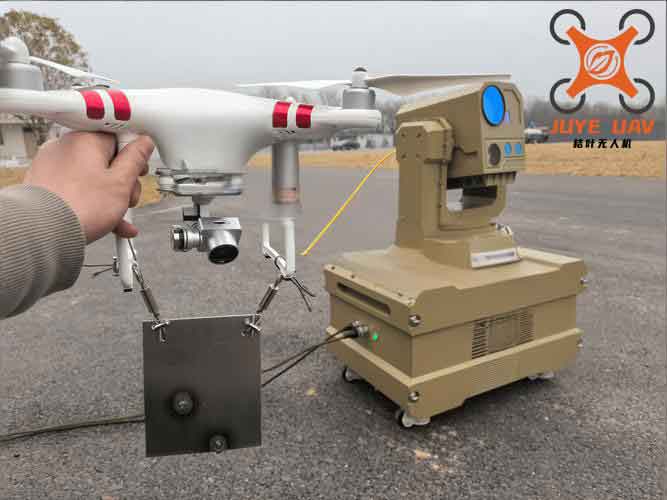
Electronic warfare (EW) remains a cornerstone of anti-drone strategies, primarily through radio frequency (RF) jamming. By disrupting control signals or GPS navigation, jamming systems can neutralize drones with relatively low cost and wide coverage. However, as drones become more autonomous and incorporate frequency-hopping techniques, the effectiveness of EW-based anti-drone measures may diminish. I have analyzed various EW systems, and their performance can be summarized in the following table, which compares key parameters for anti-drone applications:
| EW System Type | Coverage Range | Effectiveness Against Autonomous Drones | Mobility | Typical Use Case |
|---|---|---|---|---|
| Portable Jammers | 1-5 km | Low to Moderate | High | Infantry squads |
| Vehicle-Mounted Jammers | 5-20 km | Moderate | Medium | Armored units |
| Fixed-Site Jammers | 20-50 km | High | Low | Base defense |
The effectiveness of jamming can be modeled using signal-to-interference ratio formulas, such as $$ \text{SIR} = \frac{P_{\text{signal}}}{P_{\text{interference}}} $$ where a lower SIR indicates better jamming performance. However, with drones employing advanced anti-jamming techniques, future anti-drone EW systems must enhance power output and spectrum agility. The Pentagon’s plans to deploy jammers at platoon levels reflect this trend, but I believe that EW alone is insufficient for comprehensive anti-drone defense, especially against autonomous swarms.
Directed energy weapons, particularly high-energy lasers (HELs), offer a promising anti-drone solution due to their “unlimited magazine” depth and low cost per engagement. Lasers can disable drones by burning through critical components or blinding optical sensors. The energy required to neutralize a target depends on laser power and dwell time, expressed as $$ E_{\text{required}} = P_{\text{laser}} \times t_{\text{dwell}} $$ where \( P_{\text{laser}} \) is the laser power in watts and \( t_{\text{dwell}} \) is the time in seconds. For example, a 50 kW laser needing 5 seconds to destroy a drone delivers $$ E = 50000 \times 5 = 250000 \text{ Joules} $$. However, atmospheric conditions, range limitations, and beam dispersion challenge laser effectiveness. Current anti-drone laser systems have effective ranges around 1 km, and their performance degrades in adverse weather. The following table compares various laser-based anti-drone systems under development:
| Laser System | Power Output | Effective Range | Target Types | Status |
|---|---|---|---|---|
| DE M-SHORAD | 50 kW | 1-2 km | Small drones, RAM | Testing |
| IFPC-HEL | 100+ kW | 2-5 km | Drones, missiles | Prototype Phase |
| Low-Power Lasers | 10-20 kW | 0.5-1 km | Micro-drones | Deployed |
To achieve reliable anti-drone capabilities, lasers must overcome these hurdles through adaptive optics and higher power levels, potentially reaching megawatt-class outputs. I envision that future anti-drone lasers will integrate with other systems for layered defense, but they are not a silver bullet.
High-power microwave (HPM) weapons represent another innovative anti-drone technology, capable of disabling entire drone swarms with single pulses by frying electronic components. These systems emit electromagnetic pulses that can disrupt navigation and control systems. The effectiveness of an HPM weapon against a drone swarm can be described by the coverage area formula $$ A_{\text{coverage}} = \pi r^2 $$ where \( r \) is the effective radius, and the number of drones neutralized depends on power density. For instance, the Epirus Leonidas system uses digital beamforming to focus energy on specific targets, enhancing anti-drone precision. HPM weapons are particularly suited for fixed-site defense, but mobile versions are emerging. The table below outlines key HPM anti-drone systems:
| HPM System | Peak Power | Swarm Neutralization Capacity | Mobility | Development Stage |
|---|---|---|---|---|
| Leonidas | High (Classified) | Up to 50 drones | Vehicle-Mounted | Prototype Delivered |
| THOR | Megawatt-range | Small to medium swarms | Containerized | Testing |
| Mjölnir | Enhanced THOR | Large swarms | Fixed/Semi-fixed | In Development |
HPM weapons complement other anti-drone measures by providing wide-area coverage, but they may be limited against drones with hardened electronics. I anticipate that future anti-drone HPM systems will incorporate AI-driven targeting to minimize collateral damage, as seen in software that processes blue-force tracking data.
Kinetic solutions remain vital for anti-drone defense, especially when electronic or directed energy methods fail. These include automated cannons with programmable airburst ammunition, machine guns, and interceptors. The probability of kill (\( P_k \)) for a kinetic anti-drone system can be modeled using $$ P_k = 1 – e^{-\lambda A} $$ where \( \lambda \) is the threat density and \( A \) is the engagement area. For example, 30mm cannons firing proximity-fused rounds have shown promise against drone swarms. The cost-effectiveness of kinetic systems is lower than directed energy, but they provide a reliable last line of defense. The following table compares kinetic anti-drone options:
| Kinetic System | Caliber/Type | Engagement Range | Ammunition Capacity | Suitability for Anti-Drone |
|---|---|---|---|---|
| 30mm Auto Cannon | 30mm airburst | 2-4 km | High | High for swarms |
| Machine Guns | 7.62mm-12.7mm | 1-2 km | Moderate | Low to Moderate |
| Interceptor Drones | Kamikaze/Net-based | 5-10 km | Single-use or multi-shot | High for precision strikes |
Armed interceptor drones, such as the MIDAS or Coyote systems, offer a unique anti-drone approach by engaging threats in mid-air. These can be deployed from ground, air, or sea platforms, and some carry HPM payloads for non-kinetic effects. The effectiveness of interceptor drones against swarms can be expressed with swarm engagement models, such as $$ N_{\text{intercepted}} = \min(S, I \times E) $$ where \( S \) is the swarm size, \( I \) is the number of interceptors, and \( E \) is the efficiency per interceptor. I believe that interceptor drones will become a key component of mobile anti-drone units, providing flexible response options.
Integrating these technologies into a layered “system of systems” is essential for robust anti-drone defense. No single solution can address all threats, as drones evolve in autonomy and resilience. A layered anti-drone network combines sensors, effectors, and command systems to create overlapping coverage. This can be visualized as a defensive matrix where each layer addresses specific threat tiers, from long-range detection to close-in engagement. The overall effectiveness \( E_{\text{total}} \) of such an anti-drone system can be approximated by $$ E_{\text{total}} = 1 – \prod_{i=1}^{n} (1 – E_i) $$ where \( E_i \) is the effectiveness of each layer, and \( n \) is the number of layers. For instance, a three-layer anti-drone system with EW, lasers, and kinetics might have \( E_1 = 0.7 \), \( E_2 = 0.8 \), and \( E_3 = 0.9 \), yielding $$ E_{\text{total}} = 1 – (0.3 \times 0.2 \times 0.1) = 0.994 $$ or 99.4% effectiveness. This mathematical model underscores the value of integration in anti-drone strategies.
Looking ahead, the future of anti-drone warfare will be shaped by advancements in artificial intelligence, autonomous systems, and resilient navigation. Drones are becoming smarter, with AI enabling swarm coordination and target recognition, which challenges traditional anti-drone methods. To counter this, anti-drone systems must also leverage AI for predictive targeting and adaptive responses. For example, AI algorithms can analyze drone behavior patterns to anticipate attacks and optimize countermeasure deployment. Additionally, the development of anti-drone systems capable of countering rocket, artillery, and mortar (C-RAM) threats will see growing overlap, as many technologies serve dual purposes. However, C-RAM poses unique challenges due to the high speed and inertia of projectiles, requiring even faster engagement times. The energy required to neutralize a RAM projectile can be estimated with $$ E_{\text{RAM}} = \frac{1}{2} m v^2 $$ where \( m \) is mass and \( v \) is velocity, highlighting the need for powerful effectors in anti-drone and C-RAM roles.
In conclusion, the evolution of anti-drone systems is a critical imperative for modern militaries. From electronic warfare to directed energy and kinetic solutions, a multi-faceted approach is necessary to defeat diverse and evolving drone threats. I emphasize that anti-drone defense must be proactive, integrating emerging technologies like HPM weapons and interceptor drones into cohesive networks. The anti-drone landscape will continue to expand, driven by innovation and lessons from conflicts worldwide. As we advance, the focus should remain on creating adaptable, cost-effective, and layered anti-drone architectures that can withstand the onslaught of autonomous swarms and precision munitions. The journey toward comprehensive anti-drone dominance is ongoing, and collaboration across sectors will be key to success.