
In the ever-evolving landscape of modern military technology, the rise of unmanned aerial systems (UAS) has presented unprecedented challenges. From my analysis of current trends, it is evident that drones have transitioned from niche tools to pervasive threats, necessitating robust anti-drone strategies. As I delve into this domain, I will explore the multifaceted aspects of countering drone threats, emphasizing technological innovations, tactical adaptations, and future directions. The keyword ‘anti-drone’ must be at the forefront of our discourse, as it encapsulates the essence of defending against these agile and cost-effective adversaries. This article aims to provide a comprehensive overview, utilizing tables and formulas to distill complex concepts into actionable insights, all from a first-person viewpoint that reflects on the urgency of this mission.
The proliferation of drones, particularly small and commercial variants, has reshaped battlefield dynamics. I observe that their low cost, ease of deployment, and versatility make them attractive for both state and non-state actors. In my assessment, the anti-drone imperative stems from the need to protect critical assets, from military bases to urban infrastructure. The U.S. military’s focus on anti-drone capabilities, as highlighted in recent developments, underscores a global recognition of this threat. As I proceed, I will break down the challenges, solutions, and innovations that define the anti-drone landscape, ensuring that the term ‘anti-drone’ is reiterated to reinforce its significance. Let’s begin by examining the exponential growth of drones and the consequent demands on anti-drone systems.
The challenge posed by drones is not merely quantitative but qualitative. I have noted that their numbers are soaring, with estimates suggesting millions of units in circulation globally. This surge complicates anti-drone efforts, as traditional防空 systems are often ill-suited to detect and engage low, slow, and small (LSS) targets. From my perspective, the anti-drone community must grapple with the diversity of drone types, each with unique characteristics that evade conventional radar and surveillance. To illustrate, I present a table categorizing drones based on weight, size, and operational parameters, which is crucial for tailoring anti-drone responses.
| Drone Class | Weight Range | Typical Use | Anti-Drone Detection Difficulty | Recommended Anti-Drone Measures |
|---|---|---|---|---|
| Class I (Micro) | < 2 kg | Hobbyist, reconnaissance | High (low radar cross-section) | Electronic jamming, nets, lasers |
| Class II (Mini) | 2-25 kg | Commercial, surveillance | Moderate to High | Kinetic interceptors, directed energy |
| Class III (Small Tactical) | 25-150 kg | Military squad-level ops | Moderate | Integrated air defense, cyber attacks |
| Class IV (Medium Tactical) | 150-600 kg | Brigade-level operations | Low to Moderate | Missile systems, advanced radar |
| Class V (Large Strategic) | > 600 kg | Theater-level missions | Low (conventional防空 sufficient) | Existing防空 weapons |
As shown in Table 1, the anti-drone focus often centers on Classes I-III, where traditional systems falter. In my view, this classification aids in prioritizing resources for anti-drone development. The rapid adoption of drones is fueled by advancements in 3D printing, open-source software, and battery technology, which I believe lower barriers to entry for malicious actors. Consequently, anti-drone strategies must evolve to address these accessible threats. I will now delve into the specific identification challenges that hinder effective anti-drone operations.
Identifying drones amidst clutter is a paramount hurdle for anti-drone systems. From my experience studying sensor technologies, the radar cross-section (RCS) of small drones is minuscule, making them blend into background noise. The probability of detection \(P_d\) for a radar system can be modeled using the following formula, which highlights the anti-drone dilemma:
$$P_d = 1 – e^{-\frac{RCS}{4\pi r^2 \sigma_n^2}}$$
Here, \(r\) is the range to the drone, \(\sigma_n^2\) represents the noise variance, and RCS is the radar cross-section. For Class I drones, RCS can be as low as 0.001 m², drastically reducing \(P_d\) at practical ranges. This mathematical insight underscores why anti-drone radar must enhance sensitivity without increasing false alarms. Additionally, drones exhibit diverse flight patterns, from hovering to high-speed maneuvers, complicating tracking algorithms. In my analysis, multi-sensor fusion—combining radar, electro-optical, and acoustic sensors—is key to improving anti-drone identification. I propose that anti-drone systems employ adaptive filtering techniques, such as Kalman filters, to predict drone trajectories:
$$\hat{x}_{k|k-1} = F_k \hat{x}_{k-1|k-1} + B_k u_k$$
$$\Sigma_{k|k-1} = F_k \Sigma_{k-1|k-1} F_k^T + Q_k$$
where \(\hat{x}\) is the state estimate, \(F\) is the state transition matrix, and \(Q\) is process noise covariance. By integrating these methods, anti-drone platforms can achieve real-time threat assessment. Furthermore, the rise of autonomous drone swarms adds layers of complexity, as anti-drone measures must disrupt coordinated behaviors without centralized control. I will explore swarm-specific anti-drone tactics later, but first, let’s consider the broader spectrum of countermeasures.
To counter drone threats, a multi-faceted anti-drone approach is essential. From my perspective, solutions span kinetic, electronic, and directed energy domains. Kinetic anti-drone methods involve physical interception, such as missiles or projectiles, but cost-effectiveness is a concern for small drones. Electronic anti-drone techniques, like jamming GPS and communication links, offer non-kinetic alternatives. Directed energy anti-drone systems, including lasers and microwaves, promise precision and low cost-per-shot. I have compiled a table comparing these anti-drone technologies based on effectiveness, cost, and deployment speed.
| Anti-Drone Technology | Mechanism | Advantages | Limitations | Effectiveness vs. Drone Classes |
|---|---|---|---|---|
| Kinetic Interceptors | Physical destruction | High lethality | Expensive, collateral risk | Classes III-V |
| Electronic Jamming | Signal disruption | Non-kinetic, reusable | Range-dependent, legal issues | Classes I-III |
| Directed Energy (Laser) | Thermal ablation | Precision, low cost-per-shot | Atmospheric attenuation | Classes I-III |
| Directed Energy (Microwave) | EMP-like effects | Area denial, fast engagement | Power requirements | Classes I-II (swarms) |
| Net-based Systems | Capture and recovery | Minimal damage, evidence collection | Short range, single target | Classes I-II |
This table illustrates that no single anti-drone solution is silver-bullet; instead, layered defenses are crucial. In my view, integrating these technologies into a cohesive anti-drone architecture enhances resilience. For instance, jamming can suppress drone controls while lasers neutralize them. The anti-drone community is also exploring cyber attacks on drone software, which I find promising for scalable defense. As I reflect on these options, the importance of innovation cannot be overstated—anti-drone research must stay ahead of adversarial adaptations. Now, let’s examine specific advancements in anti-drone systems, particularly those driven by military research.
The pursuit of advanced anti-drone capabilities has led to significant breakthroughs in high-energy lasers and microwaves. From my observations, these directed energy weapons represent a paradigm shift in anti-drone warfare, offering speed-of-light engagement and deep magazines. The effectiveness of a laser anti-drone system can be quantified by the power density required for damage:
$$I = \frac{P}{A} = \frac{4P}{\pi d^2}$$
where \(I\) is irradiance (W/m²), \(P\) is laser power, and \(d\) is beam diameter at the target. For typical drones, an irradiance of \(10^6\) W/m² can cause structural failure within seconds. This formula guides anti-drone laser design, balancing power and beam control. Similarly, high-power microwave anti-drone systems rely on field strength to disrupt electronics:
$$E = \frac{V}{d} = \sqrt{\frac{2P}{c \epsilon_0 A}}$$
where \(E\) is electric field strength, \(P\) is power, \(c\) is speed of light, and \(\epsilon_0\) is permittivity of free space. Achieving sufficient \(E\) for anti-drone effects demands compact generators and antennas. I believe that these technologies, while maturing, will redefine anti-drone engagements in urban and open terrains. To visualize the integration of such systems, consider the following image that depicts a modular anti-drone setup, showcasing how sensors and effectors coalesce into a unified defense.
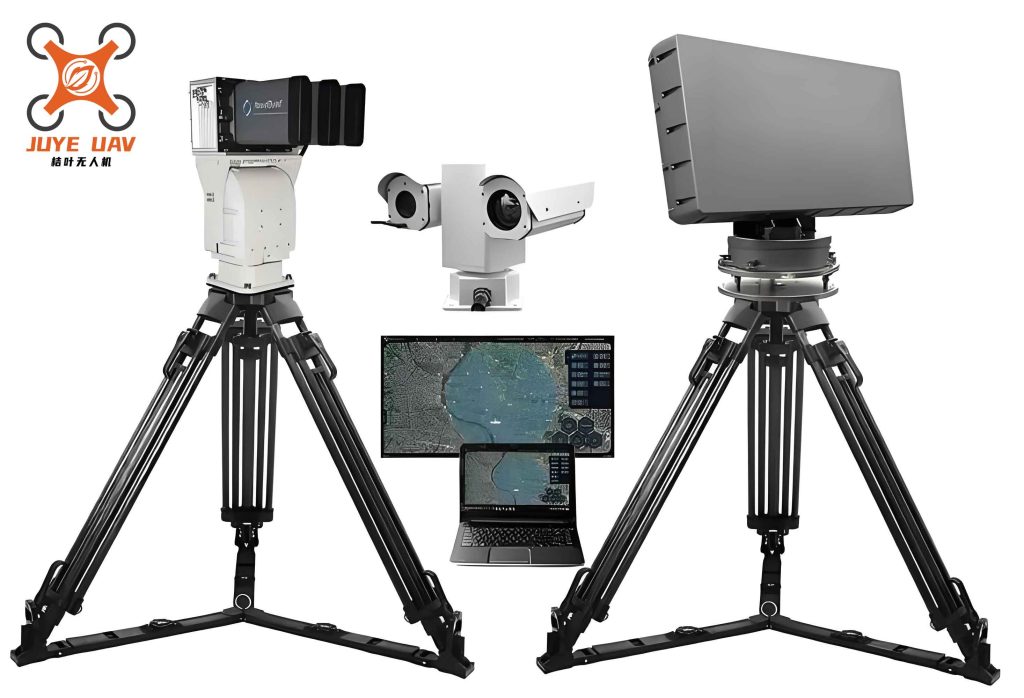
This image encapsulates the synergy required for effective anti-drone operations, from detection to neutralization. In my analysis, the deployment of such systems in conflict zones has proven valuable, but scalability remains a challenge. The anti-drone ecosystem also encompasses tactical manuals and training, which I see as force multipliers. For example, standardizing anti-drone protocols across units enhances coordination and response times. As I delve deeper, the role of artificial intelligence in anti-drone systems cannot be ignored—it enables predictive analytics and autonomous decision-making, crucial for countering swarm attacks.
Drone swarms represent a quantum leap in threat complexity, demanding adaptive anti-drone strategies. From my research, swarms operate via decentralized control, making them resilient to single-point failures. Anti-drone measures against swarms must therefore employ disruption at scale. I propose using network theory to model swarm vulnerabilities for anti-drone planning. The connectivity of a drone swarm can be represented as a graph \(G = (V, E)\), where vertices \(V\) are drones and edges \(E\) are communication links. An anti-drone attack aiming to fragment the swarm seeks to minimize the graph’s connectivity:
$$\min |E’| \text{ such that } G’ = (V, E \setminus E’) \text{ is disconnected}$$
By targeting key links with electronic warfare, anti-drone systems can degrade swarm coherence. Additionally, anti-drone lasers with rapid slew rates can engage multiple targets sequentially, governed by the engagement time formula:
$$T_{\text{engage}} = \sum_{i=1}^{n} \left( t_{\text{point}} + \frac{E_{\text{damage}}}{I_i} \right)$$
where \(n\) is the number of drones, \(t_{\text{point}}\) is pointing time, and \(E_{\text{damage}}\) is energy required for damage. Optimizing this for anti-drone swarms involves parallel targeting and power management. In my view, future anti-drone systems will leverage machine learning to predict swarm behaviors, using reinforcement learning algorithms:
$$Q(s,a) \leftarrow Q(s,a) + \alpha [r + \gamma \max_{a’} Q(s’,a’) – Q(s,a)]$$
where \(Q\) is the action-value function, \(s\) is state, \(a\) is action (e.g., jam or strike), and \(\alpha, \gamma\) are learning parameters. This enables anti-drone platforms to adapt to evolving tactics. Beyond technology, I emphasize the need for international cooperation in anti-drone efforts, as drones transcend borders and require shared standards.
The legal and ethical dimensions of anti-drone operations are equally critical. From my standpoint, anti-drone activities must balance security with privacy and sovereignty. Jamming signals, for instance, may interfere with civilian communications, necessitating regulated anti-drone zones. I advocate for frameworks that define proportional anti-drone responses, especially in populated areas. Moreover, the anti-drone community should consider counter-surveillance measures to protect against drone espionage. In practice, anti-drone training for personnel enhances situational awareness and rapid deployment. I recall that simulated anti-drone exercises have improved readiness, highlighting the human element in this technological race.
Looking ahead, the anti-drone landscape will be shaped by emerging technologies like 5G and quantum sensing. 5G networks could extend drone control ranges, complicating anti-drone interception, but also offer new avenues for detection via network monitoring. Quantum radars, with enhanced sensitivity, might revolutionize anti-drone detection by reducing clutter. I predict that anti-drone systems will become more autonomous, integrating into broader air defense networks. The convergence of anti-drone capabilities with space-based sensors could provide global coverage, albeit with policy hurdles. In my final analysis, the key to sustained anti-drone superiority lies in continuous innovation and cross-domain synergy.
In conclusion, the anti-drone mission is a dynamic and multifaceted endeavor that demands holistic solutions. From my first-person perspective, I have outlined the challenges, technologies, and strategies that define modern anti-drone warfare. By leveraging tables and formulas, I have distilled complex concepts into actionable insights, always emphasizing the term ‘anti-drone’ to reinforce its centrality. The path forward requires collaboration across military, industry, and academia to stay ahead of adversarial drone advancements. As drones evolve, so too must our anti-drone paradigms, ensuring security in an increasingly automated world. This journey through anti-drone developments underscores a simple truth: in the realm of defense, adaptability is the ultimate weapon against emerging threats.