
As a researcher deeply involved in the field of precision agriculture, I have witnessed the transformative potential of unmanned aerial vehicles (UAVs) in crop protection. The effective control of pests, diseases, weeds, and rodents is indispensable for ensuring food safety and security, directly impacting both yield and quality. Traditional ground-based spraying methods, often reliant on manual or small-scale machinery, are increasingly inadequate due to labor shortages and the demand for higher efficiency. In this context, aerial application technology emerges as a critical modern plant protection tool, epitomizing agricultural modernization. Among these, agricultural UAV spraying stands out for its high efficiency, superior coverage, minimal crop damage, low labor intensity, and versatility. Particularly in regions with complex terrains like paddy fields and hilly areas in southern China, agricultural UAV systems offer promising applications. However, the development of agricultural UAV spraying in China remains at a nascent stage, necessitating a thorough analysis of global trends and local challenges to chart a path forward.
The global landscape of agricultural UAV spraying is marked by advanced technologies and mature frameworks. In the United States, a leader in agricultural aviation, the integration of GPS navigation, electrostatic spraying, and variable-rate application has made agricultural UAV operations highly precise and environmentally friendly. For instance, GPS-guided systems enable accurate route planning, minimizing overlaps and gaps. The spray deposition can be modeled using diffusion equations, where the concentration of droplets at a point \((x, y, z)\) downwind is given by:
$$ C(x,y,z) = \frac{Q}{2\pi\sigma_y\sigma_z u} \exp\left(-\frac{y^2}{2\sigma_y^2} – \frac{z^2}{2\sigma_z^2}\right) $$
Here, \(C\) represents the droplet concentration, \(Q\) is the source strength (emission rate), \(\sigma_y\) and \(\sigma_z\) are the horizontal and vertical diffusion coefficients, and \(u\) is the wind speed. This model helps optimize parameters like flight height and speed to reduce drift. Similarly, Japan has pioneered agricultural UAV use since the 1990s, with over 2,000 registered unmanned helicopters covering vast areas. Their success lies in tailored equipment for small-scale farms, achieving spray rates of 7–10 hectares per hour. Korea and European nations have also adopted agricultural UAV technologies, focusing on精细化种植 and environmental monitoring. Below is a table summarizing key international advancements:
| Country/Region | Key Advantages | Primary UAV Types | Applied Technologies | Main Applications |
|---|---|---|---|---|
| United States | High precision, low environmental impact | Fixed-wing aircraft, multi-rotor UAVs | GPS navigation, electrostatic spraying, variable-rate control | Pesticide spraying, crop monitoring |
| Japan | Adaptability to small farms, mature systems | Unmanned helicopters | Autonomous flight, specialized nozzles | Spraying, seeding, fertilization |
| Korea | Rapid adoption in aging rural areas | Multi-rotor UAVs | Remote sensing,精准 application | Pesticide spraying, disease detection |
| Europe | Cost-effective imaging and mapping | Fixed-wing UAVs, gliders | Pre-programmed flight paths, image analysis | Agricultural measurement,环保 monitoring |
Recent research hotspots in developed countries revolve around enhancing agricultural UAV spraying efficacy. These include computational fluid dynamics (CFD) simulations to model airflow and droplet dispersion, integration of multi-sensor data for real-time adjustments, and development of专用 components like centrifugal atomizers and electric pumps. For example, the droplet size distribution from a nozzle can be described by the Rosin-Rammler equation:
$$ R(d) = \exp\left[-\left(\frac{d}{d_m}\right)^n\right] $$
where \(R(d)\) is the fraction of droplets larger than diameter \(d\), \(d_m\) is the median diameter, and \(n\) is the spread parameter. Optimizing these parameters ensures uniform coverage. Moreover, variable-rate technology adjusts spray output based on GPS coordinates and sensor inputs, formalized as:
$$ Q_{\text{adjusted}} = Q_{\text{base}} \times f(\text{NDVI}, \text{wind}, \text{terrain}) $$
Here, \(Q_{\text{adjusted}}\) is the modulated flow rate, \(Q_{\text{base}}\) is the baseline rate, and \(f\) is a function incorporating vegetation indices and environmental factors. Such innovations underscore the sophistication of global agricultural UAV systems.
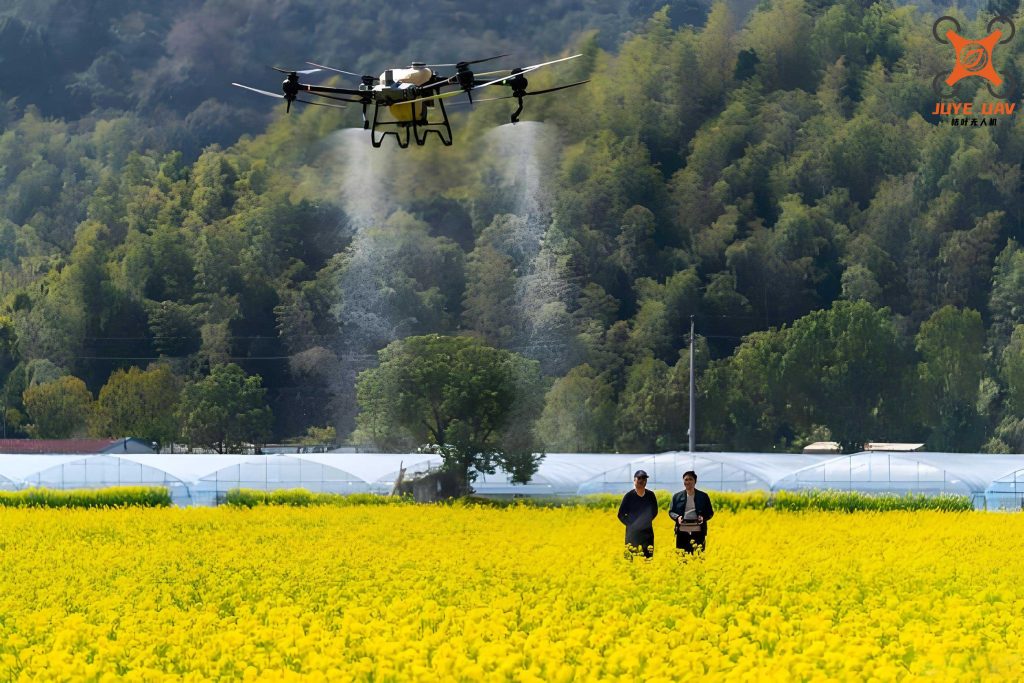
In contrast, China’s journey with agricultural UAV spraying is characterized by exploratory efforts and significant hurdles. Research institutions, such as the Nanjing Agricultural Mechanization Research Institute, have developed autonomous navigation systems for low-altitude spraying, achieving sub-meter accuracy in swath alignment. Field trials in Hainan for hybrid rice pollination and pest control demonstrated the potential of agricultural UAV platforms. Similarly, universities like South China Agricultural University have explored UAV-based remote sensing for nutrient management. However, these initiatives are often constrained by reliance on imported or modified UAV platforms, leading to issues like unstable low-altitude flight, short battery life, limited payload capacity, and high operational skill requirements. Theoretical underpinnings are also lacking; for instance, comprehensive studies on the aerodynamics of agricultural UAV spray plumes are scarce, hindering optimized design. The deposition and drift of droplets are influenced by multiple factors, which can be modeled as:
$$ D_{\text{deposition}} = \int_0^T \int_A C(x,y,t) \, dA \, dt $$
where \(D_{\text{deposition}}\) is the total deposited mass over time \(T\) and area \(A\), and \(C\) is the time-varying concentration. Without robust empirical data, parameter selection remains suboptimal. Additionally,专用 spraying equipment, such as atomization systems and ultra-concentrated pesticides, lags behind international standards. The table below outlines these challenges and proposed remedies:
| Existing Problems in China | Recommended Solutions | Key Metrics for Improvement |
|---|---|---|
| Unstable platforms with short endurance | Develop indigenous UAV platforms tailored to local farms | Flight stability index \(S > 0.95\), battery life \(> 30\) minutes |
| Insufficient theoretical research on spray dynamics | Conduct CFD simulations and wind tunnel tests | Model accuracy \(R^2 > 0.85\) for deposition predictions |
| Inferior专用 components and formulations | Innovate nozzles, pumps, and compatible pesticides | Droplet spectrum uniformity \(U < 20\%\), drift reduction \(> 30\%\) |
| Inadequate technical规范和 training | Establish national standards and certification programs | Operator proficiency scores \(> 80\%\), accident rates \(< 0.1\%\) |
| Limited data on parameter effects | Perform large-scale field trials across diverse crops | Dataset size \(> 10^4\) samples, covering major agro-ecologies |
The effectiveness of agricultural UAV spraying is governed by operational parameters, which can be optimized through systematic experimentation. For instance, the relationship between spray height \(h\), wind speed \(v_w\), and deposition efficiency \(\eta\) can be expressed as:
$$ \eta = \alpha \cdot \exp(-\beta h) + \gamma \cdot v_w^{-1} $$
where \(\alpha\), \(\beta\), and \(\gamma\) are constants derived from regression analysis. Similarly, the swath width \(W\) for a multi-rotor agricultural UAV depends on rotor diameter \(D_r\) and downwash velocity \(v_d\):
$$ W = k \cdot D_r \cdot \sqrt{\frac{v_d}{g}} $$
with \(k\) as a proportionality factor and \(g\) as gravitational acceleration. By validating such models, China can develop tailored guidelines for rice, corn, and hilly terrains. Furthermore, the integration of IoT and AI promises real-time monitoring; for example, a feedback control system for spray rate can be modeled as:
$$ u(t) = K_p e(t) + K_i \int_0^t e(\tau) \, d\tau + K_d \frac{de(t)}{dt} $$
where \(u(t)\) is the control signal (e.g., pump voltage), \(e(t)\) is the error between desired and actual deposition, and \(K_p\), \(K_i\), \(K_d\) are PID gains. This aligns with the global trend toward smart agricultural UAV ecosystems.
Looking ahead, the development trajectory for agricultural UAV spraying in China must prioritize innovation, integration, and sustainability. The overarching goal is to achieve “low volume, low pollution, high efficiency, and high efficacy” in pesticide application. Firstly, R&D should focus on next-generation UAV airframes with enhanced stability and payload, coupled with专用 components like air-assisted sprayers and electrostatic modules. The economic viability can be assessed via a cost-benefit ratio:
$$ \text{CBR} = \frac{\sum_{i=1}^n B_i}{\sum_{j=1}^m C_j} $$
where \(B_i\) are benefits (e.g., yield increase, labor savings) and \(C_j\) are costs (e.g., UAV purchase, maintenance). Targeting a CBR > 2 would encourage adoption. Secondly, multidisciplinary research should deepen understanding of spray physics. For example, the drift potential \(P_{\text{drift}}\) can be quantified as:
$$ P_{\text{drift}} = \frac{\int_{z>h_c} C \, dz}{\int_{\text{all space}} C \, dz} $$
integrating concentration \(C\) above crop height \(h_c\). Minimizing \(P_{\text{drift}}\) through nozzle design and flight protocols is crucial. Thirdly, standardization is imperative; technical规范 should cover aspects from flight operations to spray calibration, akin to ISO norms for agricultural UAV systems. A compliance score \(S_c\) could be defined as:
$$ S_c = \sum_{k=1}^p w_k \cdot I_k $$
with weights \(w_k\) for indicators \(I_k\) like droplet density (drops/cm²) and coverage uniformity. Lastly, business models—such as UAV leasing cooperatives—must be explored to scale deployment. The future adoption rate \(A(t)\) might follow a logistic growth curve:
$$ A(t) = \frac{A_{\text{max}}}{1 + e^{-r(t-t_0)}} $$
where \(A_{\text{max}}\) is the saturation level, \(r\) the growth rate, and \(t_0\) the inflection point. By addressing these facets, China can harness the full potential of agricultural UAV technology.
In conclusion, as an advocate for precision agriculture, I believe that agricultural UAV spraying represents a paradigm shift in crop protection. Its advantages—speed, efficiency, and adaptability—are especially pertinent for China’s diverse landscapes. While challenges persist in platform reliability, theoretical foundations, and规范 development, the path forward is clear: through dedicated innovation and learning from global best practices, China can cultivate a robust agricultural UAV industry. This will not only elevate plant protection mechanization but also contribute to sustainable food systems. The journey of the agricultural UAV is just beginning, and its evolution will undoubtedly reshape farming for generations to come.