
In recent years, the rapid proliferation of unmanned aerial vehicles (UAVs), commonly known as drones, has posed significant challenges to global security. As an analyst focusing on defense technologies, I have closely monitored the evolution of anti-drone capabilities within the U.S. military. This article delves into the development of anti-drone systems, emphasizing the technological advancements, strategic implementations, and future directions. The term “anti-drone” will be frequently highlighted, as it encapsulates the core of these efforts. From detection to neutralization, anti-drone technologies encompass a multi-layered approach, integrating sensors, electronic warfare, kinetic weapons, and directed energy systems. The U.S. Department of Defense and its branches have invested heavily in anti-drone solutions, driven by the increasing threat from low, slow, and small drones, as well as drone swarms. In this analysis, I will explore the overall landscape of anti-drone technologies, detail progress across military branches, and discuss broader defense initiatives, all while incorporating tables and formulas to summarize key concepts.
The threat posed by drones is multifaceted. Drones can be used for intelligence, surveillance, reconnaissance, and even offensive operations, making anti-drone measures a critical component of modern warfare. Anti-drone systems must address various drone classes, from large Category 4 and 5 UAVs to small Category 1-3 drones, which are particularly challenging due to their minimal signatures and low-altitude flight profiles. The concept of anti-drone warfare extends beyond mere destruction; it involves detecting, identifying, tracking, and engaging drones through a combination of methods. In my assessment, the effectiveness of an anti-drone system can be modeled using probability theory. For instance, the probability of detecting a drone, \(P_d\), can be expressed as a function of sensor range and drone cross-section. A simplified formula is: $$P_d = 1 – e^{-\frac{R}{\lambda \cdot \sigma}}$$ where \(R\) is the detection range, \(\lambda\) is a sensor-specific constant, and \(\sigma\) is the radar cross-section of the drone. This highlights the difficulty in detecting small drones with low \(\sigma\) values, underscoring the need for advanced anti-drone sensors.
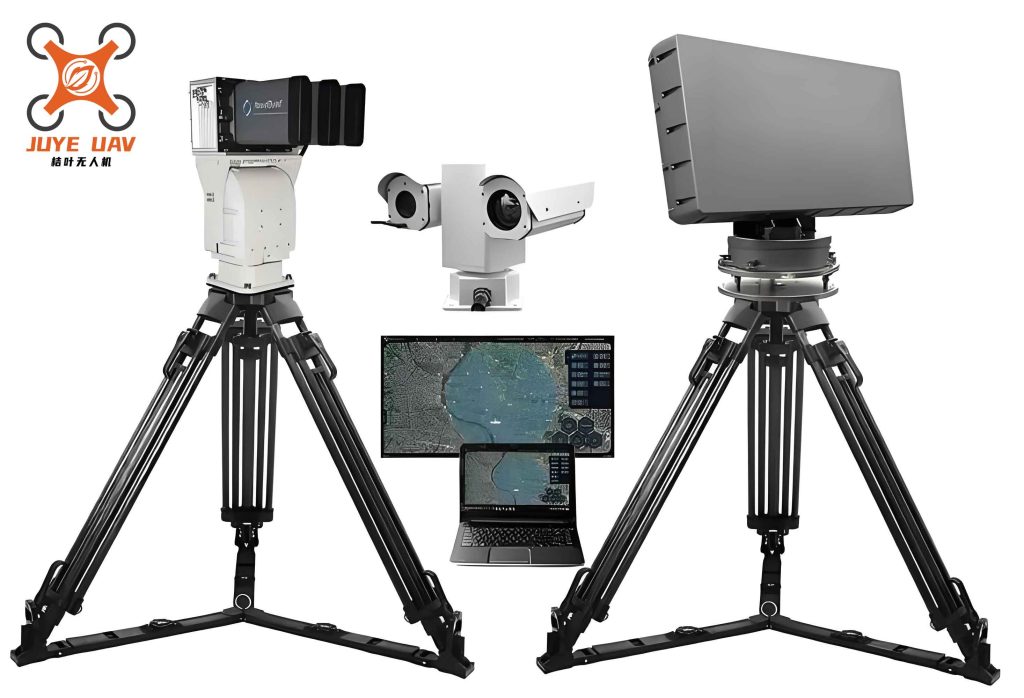
To better understand the anti-drone technology landscape, I have categorized the primary methods into detection and neutralization. Detection relies on sensors such as electro-optical/infrared (EO/IR), acoustic, radar, and radio frequency (RF) systems. Neutralization includes electronic jamming, kinetic impact (e.g., guns and nets), directed energy weapons (lasers and high-power microwaves), and even trained birds. The integration of these elements forms a layered defense, which is essential for robust anti-drone capabilities. Below is a table summarizing common anti-drone technologies and their characteristics:
| Technology Type | Method | Advantages | Limitations | Typical Use Case |
|---|---|---|---|---|
| Detection | EO/IR Sensors | High resolution, works in day/night | Limited by weather, requires line-of-sight | Perimeter security |
| Detection | RF Sensors | Detects control signals, passive operation | Ineffective against autonomous drones | Urban environments |
| Detection | Radar Systems | Long range, all-weather capability | Difficulty with small cross-sections | Military bases |
| Neutralization | Electronic Jamming | Non-kinetic, reusable | May affect friendly communications | Portable anti-drone devices |
| Neutralization | Kinetic Weapons | Immediate destruction | Risk of collateral damage | Vehicle-mounted systems |
| Neutralization | Directed Energy | Speed-of-light engagement, low cost per shot | High power requirements, atmospheric interference | Ship-based anti-drone defense |
Transitioning to the U.S. military’s specific efforts, each branch has developed unique anti-drone systems tailored to its operational needs. The Air Force, for instance, has been at the forefront of testing directed energy weapons for anti-drone purposes. In my observation, the High-Energy Laser Weapon System (HELWS) represents a significant advancement in mobile anti-drone technology. This system, mounted on an all-terrain vehicle, uses EO/IR sensors and high-power microwaves for detection, followed by a laser to disable drones within seconds. The Air Force’s approach emphasizes versatility, with plans for airborne anti-drone systems as outlined in their “Small Unmanned Aircraft Systems Flight Plan.” The effectiveness of such laser-based anti-drone systems can be analyzed using energy transfer equations. For example, the time required to disable a drone, \(t_d\), depends on laser power \(P\), drone material absorption coefficient \(\alpha\), and spot size \(A\): $$t_d = \frac{E_{th}}{P \cdot \alpha \cdot A}$$ where \(E_{th}\) is the threshold energy for drone malfunction. This formula illustrates the trade-offs in designing anti-drone lasers.
The Navy’s anti-drone initiatives have focused on deploying solid-state laser weapons on ships. I have followed the progression from the Laser Weapon System (LaWS) to the more advanced High-Energy Laser with Integrated Optical-dazzler and Surveillance (HELIOS). These systems are designed to counter drones and other asymmetric threats. The Navy’s strategy involves incremental upgrades, starting with sensor dazzling and progressing to hard-kill capabilities. A key aspect of naval anti-drone warfare is the integration with existing defense systems, which can be modeled as a network-centric approach. The probability of successfully engaging a drone swarm, \(P_{swarm}\), might be calculated using combinatorial methods: $$P_{swarm} = 1 – \prod_{i=1}^{n} (1 – P_{engage,i})$$ where \(n\) is the number of drones in the swarm, and \(P_{engage,i}\) is the engagement probability for each drone. This highlights the challenge of anti-drone defense against coordinated attacks.
The Marine Corps has pursued anti-drone capabilities through programs like the Marine Air Defense Integrated System (MADIS). This system combines jamming and machine guns to neutralize drones, and it has been deployed on various platforms, including the MRZR all-terrain vehicle. In my analysis, the Marine Corps prioritizes mobility and rapid deployment, making their anti-drone solutions suitable for expeditionary operations. Additionally, the Compact Laser Weapon System (CLaWS) provides a scalable laser option, with power levels from 2kW to 10kW. The Marine Corps’ emphasis on portable anti-drone technologies, however, faces constraints due to power and weight limitations. To optimize such systems, one might use efficiency formulas, such as the overall system efficiency \(\eta\): $$\eta = \frac{P_{out}}{P_{in}} \times 100\%$$ where \(P_{out}\) is the effective anti-drone power output, and \(P_{in}\) is the input power from generators or batteries. This is crucial for field-deployable anti-drone units.
The Army has developed a comprehensive anti-drone strategy, articulated in their “Counter-Unmanned Aircraft System Techniques” document. Their layered defense concept includes systems like the Blade Low-Altitude UAV Engagement System (BLADE), Multi-Mission High-Energy Laser (MMHEL), and Next-Generation Fires Radar. I have studied how the Army integrates anti-drone capabilities into its broader air and missile defense framework. For example, the MMHEL aims to mount high-energy lasers on Stryker vehicles, enhancing mobility. The Army’s focus on cost-effective solutions is evident in programs like Low-Cost Extended Range Air Defense (LOWERAD), which seeks to develop smaller, cheaper interceptors for drones and cruise missiles. The performance of such kinetic anti-drone systems can be evaluated using intercept probability models. A common formula is: $$P_{intercept} = P_{detect} \times P_{track} \times P_{hit}$$ where \(P_{detect}\) is detection probability, \(P_{track}\) is tracking probability, and \(P_{hit}\) is hit probability. This underscores the importance of each stage in the anti-drone kill chain.
Beyond individual branches, the U.S. Department of Defense coordinates anti-drone research through agencies like the Defense Advanced Research Projects Agency (DARPA). Projects such as “Counter-Swarm AI” and “Multi-Azimuth Defense Fast Intercept Round Engagement System” aim to address emerging drone threats, including autonomous swarms. In 2019, the DoD centralized anti-drone efforts under the Army’s leadership, aiming to standardize and optimize systems across the military. This consolidation reflects a strategic shift from fragmented development to integrated anti-drone solutions. From my perspective, the DoD’s approach involves balancing innovation with practicality, ensuring that anti-drone technologies are both advanced and deployable. To quantify this, one might use a cost-effectiveness index \(CEI\) for anti-drone systems: $$CEI = \frac{E \times R}{C}$$ where \(E\) is engagement effectiveness, \(R\) is reliability, and \(C\) is lifecycle cost. This index helps in comparing different anti-drone options during procurement.
Looking at the broader technological trends, anti-drone systems are increasingly leveraging artificial intelligence and machine learning for improved detection and response. AI algorithms can analyze sensor data to distinguish drones from birds or other clutter, reducing false alarms in anti-drone operations. Additionally, network-centric warfare enables shared situational awareness, allowing multiple anti-drone assets to collaborate. For instance, a drone detected by a Navy ship’s radar could be engaged by an Army laser system via a secure network. This interoperability is vital for comprehensive anti-drone defense. In mathematical terms, the overall system reliability \(R_{sys}\) for a networked anti-drone architecture can be expressed as: $$R_{sys} = 1 – \prod_{j=1}^{m} (1 – R_{node,j})$$ where \(m\) is the number of nodes in the network, and \(R_{node,j}\) is the reliability of each node. This highlights the robustness of distributed anti-drone systems.
Another critical aspect is the legal and ethical considerations of anti-drone operations. As drones become more accessible to non-state actors, rules of engagement must evolve. The U.S. military’s anti-drone policies emphasize proportionality and collateral damage avoidance, especially in civilian areas. From my analysis, this influences technology choices; for example, non-kinetic anti-drone methods like jamming are preferred in urban environments. The effectiveness of such methods can be modeled using signal-to-noise ratio (SNR) calculations for jamming: $$SNR_{jam} = \frac{P_{signal}}{P_{jam} + N}$$ where \(P_{signal}\) is the drone’s control signal power, \(P_{jam}\) is the jamming power, and \(N\) is background noise. A low SNR indicates successful anti-drone jamming.
In conclusion, the development of U.S. military anti-drone technologies is a dynamic and multifaceted endeavor. Through this analysis, I have highlighted key systems, from directed energy weapons to electronic jammers, all aimed at countering the evolving drone threat. The integration of detection and neutralization methods into layered defenses is essential for effective anti-drone operations. The lessons learned from U.S. efforts—such as the need for standardization, cost-effectiveness, and technological diversity—can inform global anti-drone strategies. As drones continue to advance, so too must anti-drone capabilities, requiring ongoing innovation and collaboration. The future of anti-drone warfare will likely see greater use of AI, swarm tactics, and space-based sensors, making this field a critical area of defense investment.
To further summarize the advancements, here is a table comparing anti-drone systems across U.S. military branches:
| Military Branch | Key Anti-Drone System | Technology Used | Status | Primary Target |
|---|---|---|---|---|
| Air Force | High-Energy Laser Weapon System (HELWS) | Laser, EO/IR, RF sensors | Overseas testing | Small drones |
| Navy | HELIOS | 60kW laser, optical dazzler | Planned deployment on DDG-88 | Drones, small boats |
| Marine Corps | Marine Air Defense Integrated System (MADIS) | Jamming, machine guns | Operational | Low-altitude drones |
| Army | Multi-Mission High-Energy Laser (MMHEL) | High-energy laser, integrated on Stryker | Development | Drones, rockets, mortars |
| DoD-Wide | Counter-Swarm AI | Artificial intelligence, networking | Research phase | Autonomous drone swarms |
Finally, the mathematical modeling of anti-drone systems provides a framework for optimization. For instance, the overall effectiveness \(E\) of an anti-drone system can be approximated as: $$E = \sum_{k=1}^{K} w_k \cdot f_k(x)$$ where \(w_k\) are weights assigned to different factors (e.g., detection range, engagement speed), \(f_k(x)\) are performance functions, and \(K\) is the number of criteria. This holistic view underscores the complexity of designing and deploying effective anti-drone solutions. As the threat landscape evolves, continuous evaluation and adaptation will be paramount for maintaining superiority in anti-drone warfare.