
As I reflect on the nearly century-long journey of unmanned aerial vehicles, I am struck by their transformative impact on modern warfare. From their humble beginnings in 1917 as rudimentary targets, military UAVs have evolved into sophisticated systems that redefine aerial operations. In my analysis, the proliferation of these assets across over 30 nations, with more than 400 models developed or in service, underscores a global shift toward autonomous combat capabilities. I believe that the integration of advanced sensors, stealth technologies, and weapon systems has positioned military UAVs as cornerstone assets in achieving tactical superiority while minimizing human risk. This article delves into the current state, emerging trends, and future combat roles of military UAVs, drawing from extensive observations and predictive modeling to outline their path forward.
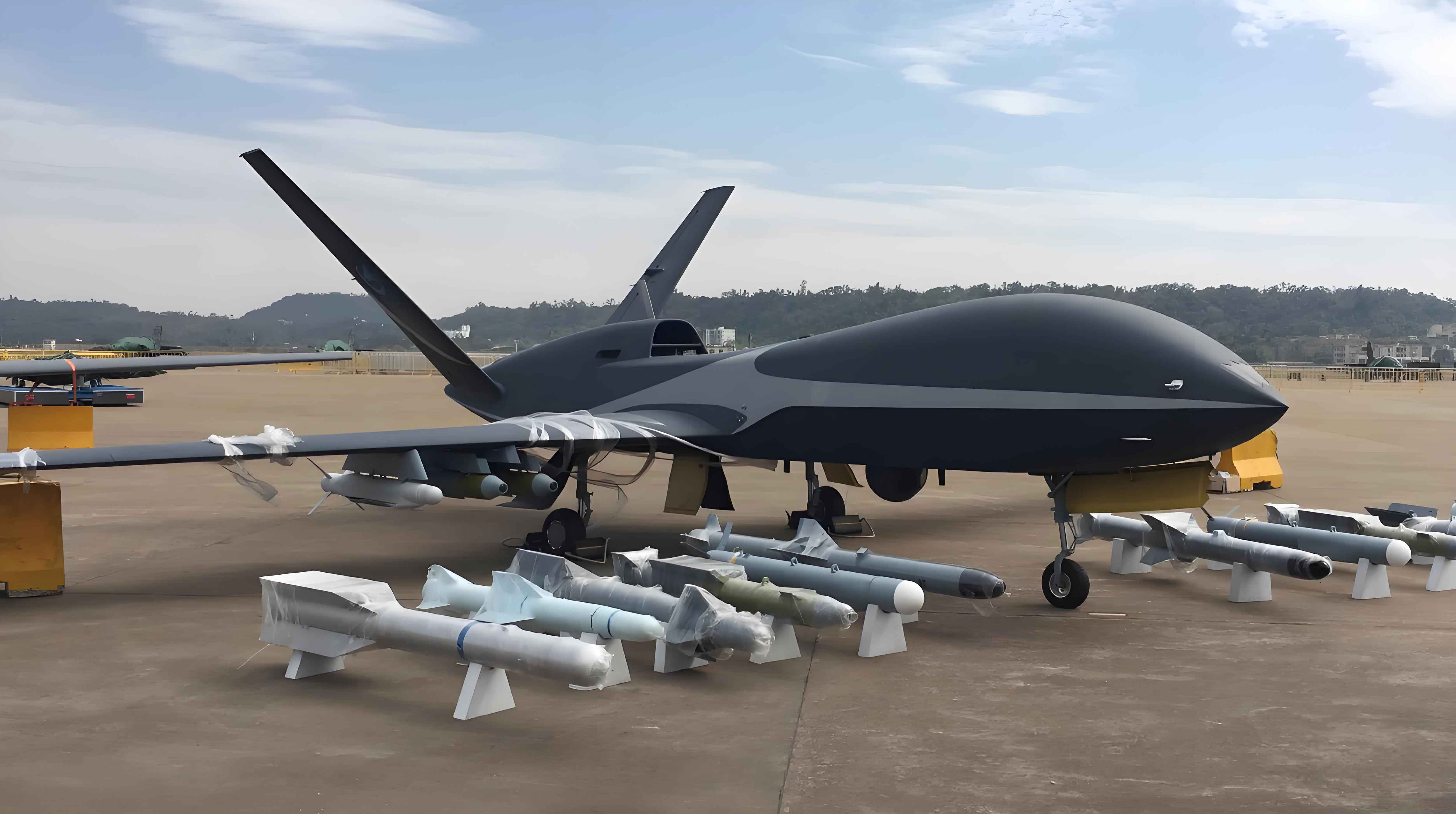
In my assessment, the defining characteristics of contemporary military UAVs stem from their unique design freedoms, unconstrained by human pilot limitations. I have categorized these attributes into structural, performance, control, and operational aspects, which collectively enhance their versatility in hostile environments. Below, I present a detailed table summarizing the key features of modern military UAVs, based on aggregated data from various deployments.
| Feature Category | Specific Attributes | Typical Values/Ranges | Impact on Missions |
|---|---|---|---|
| Structural Design | Wing configuration, material composition, radar cross-section | Carbon-fiber composites, monoplane or biplane tails, sub-1 m² RCS | Reduced detectability, enhanced durability in low-mass frames |
| Flight Performance | Altitude, speed, endurance, maneuverability | 0–20 km altitude, 50–635 km/h speed, up to 50 hours endurance, ≤20 g overload | Enables prolonged ISR, high-altitude evasion, and rapid response |
| Control Systems | Guidance modes, launch/recovery methods | Programmed waypoints with real-time remote override, catapult/parachute systems | Facilitates flexible deployment in contested areas without runways |
| Mission Profiles | Reconnaissance, electronic warfare, strike roles | Optical/IR imaging, radar jamming, missile payloads (e.g., Hellfire derivatives) | Allows multi-role adaptation from surveillance to direct attack |
From my perspective, the flight dynamics of military UAVs can be modeled mathematically to optimize their deployment. For instance, the endurance \( T \) of a military UAV is governed by the energy balance: $$T = \frac{E_{\text{total}}}{P_{\text{avg}}},$$ where \( E_{\text{total}} \) represents the total onboard energy (e.g., from fuel or batteries) and \( P_{\text{avg}} \) is the average power consumption during flight. Similarly, the maximum operational range \( R \) correlates with velocity \( v \) and loiter time: $$R = v \cdot T \cdot \eta,$$ with \( \eta \) denoting efficiency factors from atmospheric conditions. These equations highlight how military UAVs outperform manned aircraft in persistence, as human fatigue limits typically cap endurance at under 24 hours. I have observed that such performance leaps are driven by innovations in propulsion—such as hybrid-electric systems—and aerodynamic shaping, which reduce drag coefficients \( C_d \) to below 0.05 for some stealth designs.
Looking ahead, I foresee several dominant trends shaping the next generation of military UAVs. These trajectories emphasize enhanced survivability, multi-role functionality, and cost-effective scalability. In my evaluation, the convergence of high-altitude long-endurance (HALE) platforms, attritable swarm systems, and dedicated combat airframes will redefine aerial battlegrounds. The following table outlines these developmental vectors with projected capabilities.
| Trend | Key Objectives | Technological Enablers | Expected Timeline |
|---|---|---|---|
| High-Speed & Stealth | Achieve Mach 10+ speeds, reduce radar signature | Scramjet propulsion, radar-absorbent materials, faceted geometries | 2030s for operational deployment |
| Attack-Oriented UCAVs | Carry 1000–2000 kg payloads for SEAD/DEAD missions | Autonomous targeting algorithms, internal weapons bays, carrier compatibility | Mid-2020s for initial IOC |
| Miniaturization | Develop palm-sized UAVs for urban reconnaissance | Nano-electromechanical systems (NEMS), biomimetic designs, low-power sensors | Ongoing, with proto-types already testing |
| Cost Reduction | Lower unit price below $1M for expendable swarms | Additive manufacturing, modular components, commercial off-the-shelf parts | 2025 onward for mass production |
I posit that the evolution toward attack-centric military UAVs, or unmanned combat aerial vehicles (UCAVs), will be particularly transformative. The kinetic impact of a military UAV equipped with guided munitions can be approximated by the damage radius \( r_d \): $$r_d = \sqrt[3]{\frac{E_k}{\rho \cdot C}},$$ where \( E_k \) is the kinetic energy upon impact, \( \rho \) is target density, and \( C \) is a material constant. This formula underscores why militaries are investing in heavier payload capacities—allowing a single military UAV to neutralize multiple targets per sorrie. Moreover, stealth enhancements are quantified through the radar equation: $$P_r = \frac{P_t G_t G_r \lambda^2 \sigma}{(4\pi)^3 R^4},$$ where \( \sigma \) is the radar cross-section (RCS). By minimizing \( \sigma \) through shaping and coatings, military UAVs can penetrate defended airspace with detection probabilities below 10%, a feat I consider critical for future strikes.
In my view, the operational horizons for military UAVs extend far beyond traditional roles. I anticipate four novel combat applications that will emerge as technologies mature: communications countermeasures, cruise missile interception, space domain engagement, and direct UAV-on-UAV warfare. Each domain presents unique challenges that military UAVs are uniquely suited to address due to their endurance, adaptability, and risk-tolerant design.
First, I envision military UAVs conducting communications anti-radiation attacks. Unlike jamming, which temporarily disrupts signals, a military UAV could precisely locate and physically destroy enemy transmitters using onboard seekers. The effectiveness of such a mission depends on the probability of detection \( P_d \) and kill \( P_k \): $$P_{\text{success}} = P_d \cdot P_k \cdot (1 – P_{\text{evade}}),$$ where \( P_{\text{evade}} \) accounts for enemy countermeasures. By loitering near communication hubs, military UAVs could degrade command networks persistently—a tactic I believe will become standard in electronic warfare.
Second, intercepting cruise missiles represents a natural extension for military UAVs. Deployed as airborne sentinels, they could engage threats during boost or mid-course phases. The engagement dynamics can be modeled using pursuit curves: $$\frac{dy}{dx} = \frac{v_m \sin \theta – v_c \sin \phi}{v_m \cos \theta – v_c \cos \phi},$$ where \( v_m \) and \( v_c \) are velocities of the military UAV and cruise missile, respectively, with \( \theta \) and \( \phi \) as their heading angles. I estimate that a swarm of military UAVs, each costing under $500,000, could achieve interception probabilities over 0.8 against subsonic cruise missiles, making them a cost-effective layer in integrated air defenses.
Third, I speculate on military UAVs venturing into the space domain. While international treaties currently restrain antisatellite actions, conflicts may see military UAVs deployed to harass or disable low-Earth orbit assets. The energy required for such an ascent is given by the Tsiolkovsky rocket equation modified for air-breathing stages: $$\Delta v = I_{\text{sp}} g_0 \ln \frac{m_0}{m_f} – \int D \, dt,$$ with \( I_{\text{sp}} \) as specific impulse, \( g_0 \) gravitational constant, \( m_0/m_f \) mass ratio, and \( D \) drag losses. High-altitude military UAVs operating at 30 km could serve as launch platforms for micro-satellite killers, a concept I find plausible within two decades.
Fourth, I predict direct engagements between opposing military UAVs will become commonplace. Air-to-air combat algorithms will rely on sensor fusion and predictive targeting. The likelihood of victory in a drone duel can be expressed as: $$V = \frac{S_a \cdot F_a}{S_d \cdot F_d} \cdot e^{-\lambda t},$$ where \( S \) denotes sensor acuity, \( F \) firepower, and \( \lambda \) an agility decay factor over time \( t \). I contend that investments in AI-driven autonomy will decide these encounters, with each military UAV iteratively learning from adversarial interactions—a stark departure from today’s remotely piloted norms.
To quantify the systemic impact of these advancements, I have developed a cost-benefit framework for military UAV deployment. The total utility \( U \) of a military UAV fleet over its lifecycle is: $$U = \sum_{i=1}^n \left( \frac{M_i \cdot A_i}{C_i} \right) \cdot T_i,$$ where for each UAV type \( i \), \( M_i \) is mission success rate, \( A_i \) is area coverage per sortie, \( C_i \) is operational cost per hour, and \( T_i \) is fleet size. This model reinforces why nations are prioritizing military UAVs: they offer superior area-denial and intelligence gathering at a fraction of the cost of manned squadrons. Below, a comparative table illustrates this advantage across mission types.
| Mission Type | Manned Aircraft Cost per Sortie | Military UAV Cost per Sortie | Effectiveness Ratio (UAV/Manned) |
|---|---|---|---|
| Close Surveillance | $50,000–$100,000 | $5,000–$20,000 | 1.8–2.5 |
| Suppression of Enemy Air Defenses | $10M+ (including risk to pilot) | $1M–$3M | 3.0–4.0 |
| Long-Endurance Patrol | $30,000/hour | $3,000/hour | 2.2–3.0 |
| Swarm Attack | Not feasible with current tech | $500,000 per 10-unit swarm | ∞ (unique capability) |
In my concluding thoughts, the trajectory for military UAVs is unequivocally toward greater autonomy, lethality, and integration into joint forces. I assert that the era of military UAVs as mere adjuncts is over; they are now pivotal instruments for achieving air dominance in contested environments. The formulas and tables presented herein encapsulate my projections, but real-world evolution will hinge on sustained innovation in AI, materials science, and network-centric warfare. As I monitor developments globally, I am convinced that military UAVs will continue to surpass expectations, ultimately reshaping doctrines and strategies for decades to come. The imperative for defense planners is to embrace these changes, investing not only in hardware but also in the conceptual frameworks that maximize the potential of every military UAV deployed.