
As a researcher deeply involved in the field of unmanned aerial systems, I have always been fascinated by the intricate ballet of formation drone light shows. The seamless synchronization of hundreds, sometimes thousands, of drones painting the night sky with dynamic, three-dimensional shapes is a testament to advanced control and planning algorithms. My work focuses on translating robust multi-UAV formation control theories into practical, reliable systems capable of executing these mesmerizing aerial performances. A formation drone light show is not merely a visual spectacle; it is a complex cyber-physical system where path planning, collision avoidance, and formation integrity are paramount. The core challenge lies in managing the fleet as a cohesive unit that can navigate its performance space, maintain artistic shapes, and react to unforeseen obstacles—all in real-time.
The foundation of any automated formation drone light show is a reliable formation control methodology. Among the established approaches—leader-follower, behavior-based, and virtual structure—the virtual structure method offers distinct advantages for creating precise, large-scale patterns. In my implementation, I treat the entire formation as a single, rigid geometric body defined virtually. For a classic pattern like a diamond, which is a staple in many formation drone light show designs, I define a virtual leader that represents the geometric center of this shape. The desired positions for all other drones, called Virtual Control Points (VCPs), are calculated relative to this leader.
Let the virtual leader’s position in 3D space be denoted by the vector:
$$ \mathbf{C} = [x_c, y_c, z_c]^T $$
For a diamond formation with major and minor axis lengths \(a\) and \(b\), the primary vertex VCPs are generated using direction vectors from the center:
$$
\begin{align*}
\mathbf{L_1} &= [0, -a, 0]^T \\
\mathbf{L_2} &= [-b, 0, 0]^T \\
\mathbf{L_3} &= [0, a, 0]^T \\
\mathbf{L_4} &= [b, 0, 0]^T
\end{align*}
$$
The coordinates of the primary vertices are then:
$$ \mathbf{P_{z,i}} = \mathbf{C} + \mathbf{L_i}, \quad i = 1,2,3,4 $$
Additional VCPs for edge midpoints or interior points can be interpolated. For example, the midpoints of the diamond edges can be calculated as:
$$ \mathbf{P_{z,5}} = \frac{1}{2}(\mathbf{P_{z,1}} + \mathbf{P_{z,2}}), \quad \mathbf{P_{z,6}} = \frac{1}{2}(\mathbf{P_{z,2}} + \mathbf{P_{z,3}}), \quad \text{etc.} $$
When the show initializes, physical drones are often not in their perfect VCP positions. To assign drones to VCPs optimally (minimizing total initial movement energy), I employ the Hungarian algorithm. Once assigned, each drone must be attracted to its designated VCP while repelling from others and any obstacles. This is where the Artificial Potential Field (APF) method comes into play for local control. The total force on drone \(i\) at position \(\mathbf{q_i}\) is:
$$ \mathbf{F_{total,i}} = \mathbf{F_{att,i}} + \mathbf{F_{rep,obstacles}} + \sum_{j \neq i} \mathbf{F_{rep, drones}} $$
The attractive force towards its VCP \(\mathbf{P_{z,i}}\) is:
$$ \mathbf{F_{att,i}} = k_{att} (\mathbf{P_{z,i}} – \mathbf{q_i}) $$
The repulsive force from a nearby obstacle or another drone at \(\mathbf{q_{ob}}\) is active within a threshold distance \(d_0\):
$$ \mathbf{F_{rep}} =
\begin{cases}
k_{rep} \left( \frac{1}{\|\mathbf{q_{ob}} – \mathbf{q_i}\|} – \frac{1}{d_0} \right) \frac{1}{\|\mathbf{q_{ob}} – \mathbf{q_i}\|^2} \cdot \frac{\mathbf{q_i} – \mathbf{q_{ob}}}{\|\mathbf{q_i} – \mathbf{q_{ob}}\|}, & \text{if } \|\mathbf{q_{ob}} – \mathbf{q_i}\| \leq d_0 \\
0, & \text{if } \|\mathbf{q_{ob}} – \mathbf{q_i}\| > d_0
\end{cases} $$
This combination allows the fleet to smoothly coalesce into and maintain the desired formation, such as a diamond, which is a fundamental building block for more complex formation drone light show choreography.
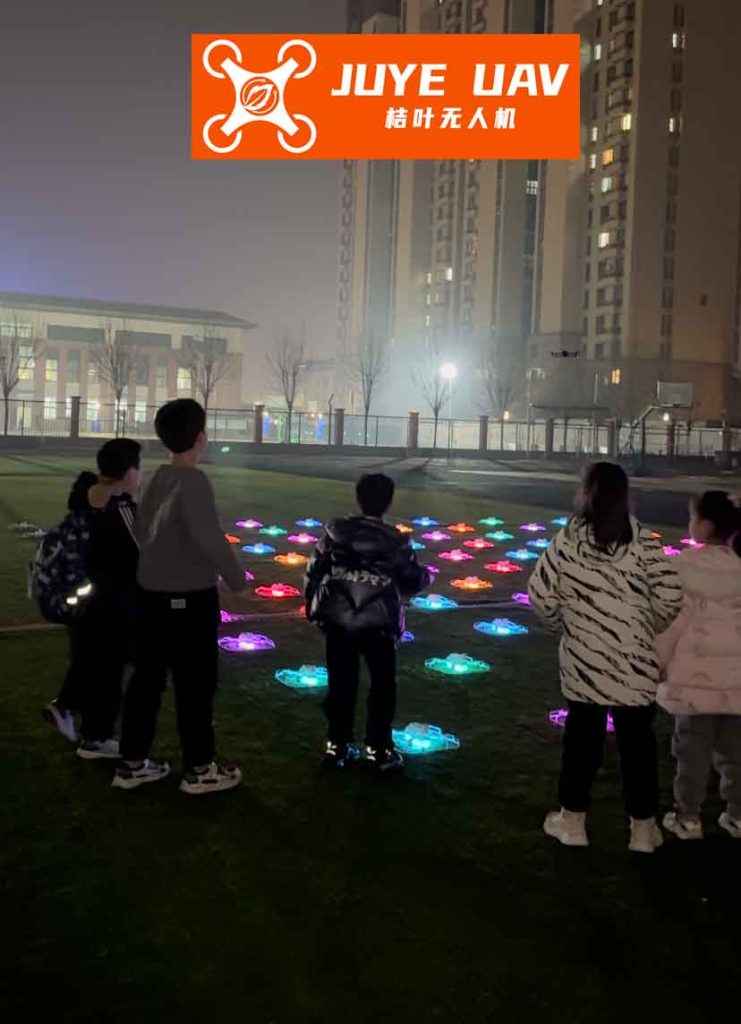
The global choreography of a formation drone light show involves planning the trajectory for the entire formation’s virtual leader through the performance space, which may contain known no-fly zones or permanent structures. This is a path planning optimization problem. I formulate the cost for a candidate path \( \Gamma \) composed of waypoints as a weighted sum of path length and threat cost:
$$ \text{Fitness}(\Gamma) = \omega_1 \cdot D(\Gamma) + \omega_2 \cdot T(\Gamma), \quad \omega_1 + \omega_2 = 1 $$
Where the path length \(D\) and threat cost \(T\) for \(n\) waypoints and \(m\) known obstacles are:
$$ D(\Gamma) = \sum_{i=1}^{n} \sqrt{(x_i – x_{i-1})^2 + (y_i – y_{i-1})^2 + (z_i – z_{i-1})^2} $$
$$ T(\Gamma) = \sum_{j=1}^{m} \sum_{i=1}^{n} \frac{1}{(x_i – x_{ob,j})^2 + (y_i – y_{ob,j})^2} \quad \text{for } d_{i,j} < d_{safe} $$
To solve this, I use a Particle Swarm Optimization (PSO) algorithm. The swarm finds an optimal path for the virtual leader that is short and maintains a safe distance from known obstacles. The entire formation, defined by its VCPs, then follows this path. A critical step is ensuring that the calculated VCPs do not themselves lie inside an obstacle. If a VCP \(\mathbf{P_z}\) is within a safety distance \(d_{se}\) of an obstacle center \(\mathbf{C_{ob}}\), it is projected outward along the vector connecting them:
$$ \mathbf{P_{new}} = \mathbf{P_z} + \frac{\overrightarrow{\mathbf{C_{ob}P_z}}}{\|\overrightarrow{\mathbf{C_{ob}P_z}}\|} (d_{se} – \|\overrightarrow{\mathbf{C_{ob}P_z}}\|) $$
This pre-processing guarantees that the formation shape is physically feasible throughout the planned global trajectory, a non-negotiable requirement for a flawless formation drone light show.
During a live formation drone light show, the unexpected is inevitable. A temporary ground structure, a sudden weather change causing localized wind obstacles, or even a bird flock can appear. The global plan is insufficient here; real-time local re-planning is essential. While traditional APF is reactive, it suffers from local minima (drones getting stuck) and oscillations near obstacles. For my formation drone light show system, I developed an Improved APF (IAPF) specifically for unknown static obstacles.
When the formation’s sensors detect an unknown cluster of points, I first use K-means clustering to estimate its centroid \(\mathbf{q_{cd}}\). The standard repulsive force \(\mathbf{F_{rep}}\) from this centroid is computed. The key innovation is the introduction of two additional guiding forces to navigate around the obstacle intelligently. First, based on the drone’s heading and the obstacle’s relative position, I establish a local coordinate frame. Within this frame, I select a sensor return point at the farthest angular extent from the obstacle’s center as an “Anchor Point” \(\mathbf{q_{ap}}\). This point, located on the perceived edge of the obstacle, exerts an attractive force:
$$ \mathbf{F_{ap}} = k_{ap} (\mathbf{q_{ap}} – \mathbf{q}) $$
Simultaneously, to guide the formation back to its original global path and prevent aimless wandering, I define a “Target Point” \(\mathbf{q_{tg}}\) on the far side of the obstacle, roughly along the intended direction of travel. This point provides a longer-range attractive pull:
$$ \mathbf{F_{tg}} = k_{tg} (\mathbf{q_{tg}} – \mathbf{q}) $$
The total guiding force for local avoidance in my IAPF becomes:
$$ \mathbf{F_{guide}} = \mathbf{F_{rep}} + \mathbf{F_{ap}} + \mathbf{F_{tg}} $$
This triad of forces effectively pushes the formation away from the obstacle while pulling it tangentially along the obstacle’s boundary and ultimately back towards its original course. The entire formation, governed by the virtual leader reacting to this composite force, performs a smooth, coordinated detour.
The following table summarizes the core forces at play in the different stages of controlling a formation drone light show:
| Control Stage | Primary Objective | Key Forces / Algorithms | Outcome |
|---|---|---|---|
| Formation Assembly | Arrange drones from initial positions into show shape. | Hungarian Assignment, APF Attraction to VCPs, Inter-drone Repulsion. | Stable, geometric formation (e.g., diamond). |
| Global Choreography | Plan optimal path for the entire formation through known space. | PSO optimizing path length and threat cost. | Smooth, safe nominal trajectory for the virtual leader. |
| Local Obstacle Avoidance | React to unknown, static obstacles in real-time. | Improved APF (IAPF): Obstacle Repulsion + Anchor Point Attraction + Target Point Attraction. | Coordinated detour with minimal deviation, returning to original path. |
To validate the performance of my IAPF for local path planning—a critical component for a resilient formation drone light show—I conducted comparative simulations against several classic real-time planning algorithms. The scenario involved navigating from a start point to a goal point with an unknown circular obstacle blocking the direct path. The metrics were path length and computational time. The parameters used for my IAPF in this test are listed below:
| Parameter | Symbol | Value |
|---|---|---|
| Repulsive Gain Coefficient | \(k_{rep}\) | 500 |
| Anchor Point Attractive Gain | \(k_{ap}\) | 0.20 |
| Target Point Attractive Gain | \(k_{tg}\) | 0.17 |
| Potential Field Influence Range | \(d_{0}\) | 15 m |
The results were compelling. My IAPF generated a smooth, near-optimal path around the obstacle. The quantitative comparison is summarized in the following table:
| Algorithm | Path Length (m) | Computation Time (s) | Key Observations |
|---|---|---|---|
| A* | 54.53 | 1.02 | Fast but path is jagged with many turns, unsuitable for smooth drone flight. |
| RRT | 62.87 | 6.43 | Very long and erratic path; high computation time. |
| RRT* | 52.92 | 18.21 | Path length slightly shorter than IAPF, but computation time is over 5x longer, and path is not as smooth. |
| DWA | 54.20 | 6.60 | Generates a smooth path but requires significant time to compute. |
| Proposed IAPF | 53.78 | 3.41 | Balanced performance: very smooth path, competitive length, and computation time ~50% faster than DWA/RRT and ~81% faster than RRT*. |
The synergy between the virtual structure-based formation control and the improved APF for local avoidance creates a powerful framework for autonomous formation drone light show systems. The virtual structure ensures the artistic integrity and global coordination of the fleet, while the IAPF provides the necessary robustness and real-time reactivity to handle the uncertainties of outdoor live performances. The ability to perform a coordinated detour and seamlessly reintegrate into the pre-planned choreography is what elevates a mere drone display to a resilient and intelligent formation drone light show.
Looking forward, the challenges for next-generation formation drone light show systems are even more dynamic. My current research is focused on extending this framework to environments with multiple moving obstacles, such as other authorized aerial vehicles or changing wind patterns. Furthermore, integrating real-time communication latency models and fault-tolerant protocols is crucial for scaling to ultra-large-scale fleets. The goal is to create a system where the formation drone light show is not just pre-programmed art but an adaptive, intelligent entity capable of responding gracefully to a dynamic world, ensuring both spectacle and safety under any condition.