
The escalating threat of forest fires to human life, property, and ecosystems demands a paradigm shift in firefighting technology. Traditional ground-based methods are often impeded by inaccessible terrain and extreme environmental hazards, creating a critical window during which a nascent fire can grow into an uncontrollable conflagration. The integration of unmanned aerial systems into firefighting arsenals presents a transformative opportunity. This article details the research, design, and validation of a large-scale, 200 kg class aerial fire extinguishing bomb designed for deployment from fixed-wing fire drones, representing a significant leap towards achieving rapid, remote, and effective aerial fire suppression.
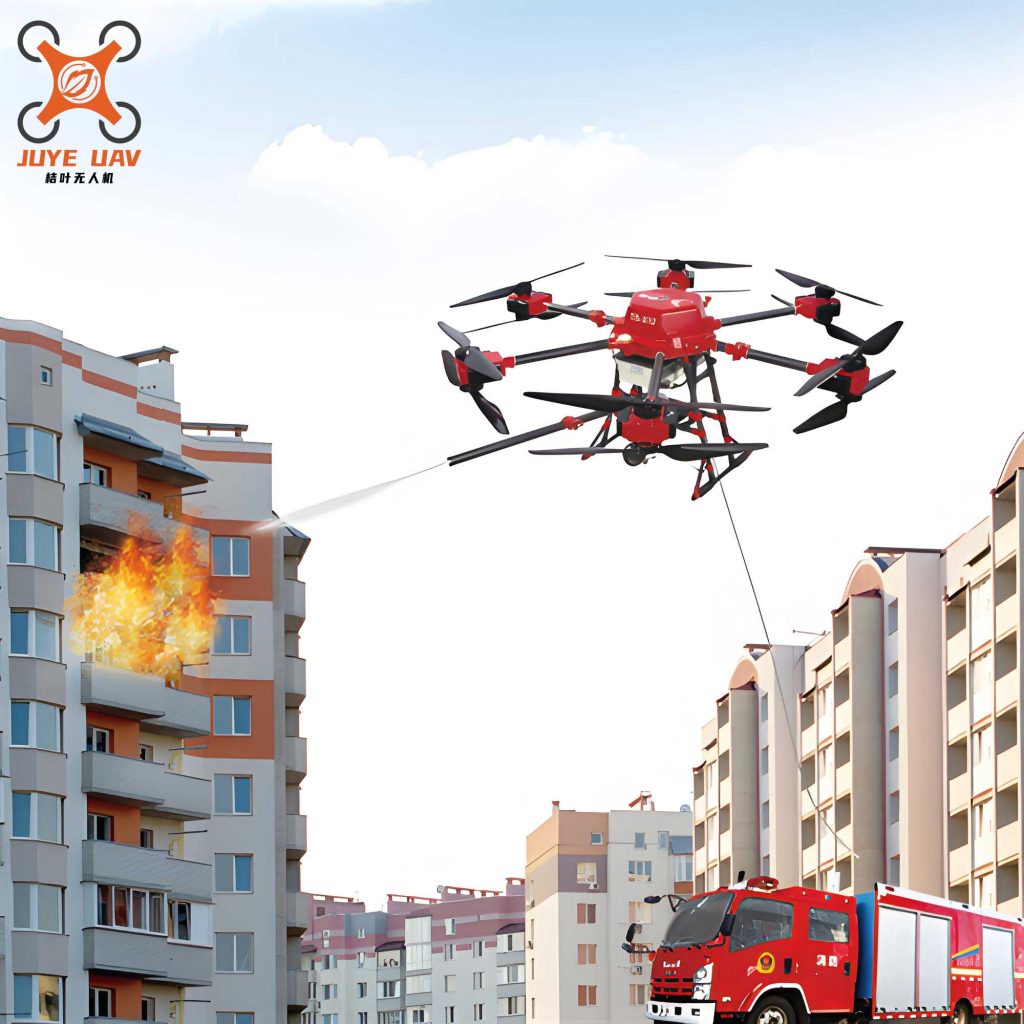
The core concept hinges on utilizing a high-endurance, fixed-wing fire drone as a responsive launch platform. This fire drone can patrol vast forested areas, identify incipient fires through onboard sensors, and immediately deploy its payload. The munition itself is not a simple container but a precisely engineered system designed to maximize the dispersal and efficacy of its extinguishing agent over a target area. The effectiveness of such a system is governed by several interlinked factors: the chemical and physical properties of the extinguishing agent, the optimal detonation altitude, the precise energy required for agent dispersal, and the structural mechanics of the munition itself.
I. Critical Factors Governing Fire Suppression Efficacy
1.1 Extinguishing Agent: Beyond Water
The choice of extinguishing agent is fundamental. While water is ubiquitous, its high surface tension and low viscosity limit its adherence to vertical and complex surfaces, causing rapid runoff and inefficiency. For this fire drone system, a specialized water-based fire extinguishing agent was selected. Its superior performance stems from additive packages that modify its key physical properties.
The effectiveness can be partly modeled by comparing the mass required to extinguish a standard fuel load. The test involved a 0.25 m² crib of seasoned pine wood. The mass of agent (Mreq) required for extinction is a function of the agent’s heat capacity, latent heat of vaporization, and its ability to form a cohesive barrier on the fuel. The ratio of the mass of water to the mass of water-based agent needed for the same task defines a performance multiplier, η.
$$ \eta = \frac{M_{req,\ water}}{M_{req,\ water-based}} $$
Experimental data yields a stark contrast:
| Test Sequence | Extinguishing Agent | Fuel Pre-burn Time (s) | Mass of Agent Consumed (kg) | Performance Multiplier (η) |
|---|---|---|---|---|
| 1 | Water-Based Agent | 60 | 0.13 | – |
| 2 | Water | 60 | 0.86 | ~6.6 |
This demonstrates that the specialized agent is approximately 6.6 times more efficient by mass than water for this fuel type. The underlying physics involves reduced surface tension (σ), increased viscosity (μ), and possibly film-forming properties. The modified surface tension improves wetting and spreading, described by relationships like the Washburn equation for penetration into porous fuel, while increased viscosity enhances adhesion, reducing runoff.
1.2 Optimal Detonation Height: Maximizing Coverage
Detonating the munition at a precise altitude above the fire is critical for creating an optimal dispersal pattern. Detonation too low results in a concentrated, narrow splash zone with limited coverage. Detonation too high disperses the agent over too large an area, reducing the delivered density below the critical threshold for extinction. The goal is to find the height H that maximizes the covered area A while maintaining a sufficient agent surface density ρa (kg/m²).
A simplified model for the radial spread of agent droplets can be derived from explosive dispersal mechanics. Assuming a spherical dispersal of droplets with initial velocity v0 and accounting for aerodynamic drag, the radial distance R of a droplet from the burst point at time t is complex. However, the final covered area on the ground for a burst at height H is approximately a circle of radius Reff. For a given agent mass Magent, the average agent surface density is:
$$ \rho_a = \frac{M_{agent}}{\pi R_{eff}^2} $$
There exists a functional relationship \(R_{eff} = f(H, E, M_{agent}, C_d)\), where E is the dispersal energy and Cd is a drag coefficient. Through iterative static burst testing, an optimum operational height of approximately 5 meters above the canopy/fire was determined. This height balances the competing factors of coverage area and agent density. Achieving this precision reliably requires an advanced proximity sensor. A millimeter-wave radar altimeter/ fuze was integrated, allowing the fire drone‘s munition to sense the ground and initiate at the programmed height with minimal error, a feature impractical for simple time fuzes given variable terminal velocity.
1.3 Filling Ratio: The Precision of Dispersal Energy
The filling ratio (FR) is a key design parameter defined as the ratio of the mass of the explosive dispersing charge (Mexp) to the mass of the extinguishing agent (Magent).
$$ FR = \frac{M_{exp}}{M_{agent}} \times 100\% $$
This ratio dictates the specific energy imparted to the agent. Insufficient energy leads to incomplete rupture of the casing and poor dispersal. Excessive energy over-pulverizes the agent into a fine mist or aerosol, which has low momentum, is easily carried away by thermal updrafts, and has reduced heat capacity per unit volume due to excessive air inclusion. The ideal energy creates coherent droplets with enough mass to penetrate the fire plume and reach the fuel bed.
For the selected water-based agent and a specific casing design, a series of tests were conducted with different charge diameters (directly related to Mexp). The results are summarized below:
| Test No. | Charge Diameter (mm) | Magent (kg) | Filling Ratio (FR) | Dispersal Character | Observed Efficacy |
|---|---|---|---|---|---|
| 1 | 10.0 | 150 | ~0.13% | Complete but over-atomized; agent largely mist. | Poor. Mist fails to penetrate/cover fuel. |
| 2 | 8.5 | 150 | ~0.094% | Partial atomization; mixed mist and droplets. | Moderate. ~50% of test fires extinguished. |
| 3 | 7.0 | 150 | ~0.064% | Optimal droplet formation; minimal mist. | Excellent. Majority of test fires extinguished. |
The finding that an FR as low as 0.064% is effective highlights the efficiency of the design. It necessitates a highly uniform and predictable fracturing of the composite casing, which is addressed in the structural design. The required energy Ereq can be related to the work needed to fracture the casing and accelerate the agent: \(E_{req} \propto G_c \cdot A_c + \frac{1}{2} M_{agent} v_0^2\), where Gc is the casing material’s fracture toughness and Ac is the total fractured area.
1.4 Explosive Dispersal Assembly: Safety and Function Integration
The dispersal assembly is the heart of the munition, integrating safety, sensing, and energetic functions. A key design principle is the physical separation of the energetic components (the explosive charge and fuze) from the main agent-filled body during storage and handling. This ensures the system is inert until armed before flight on the fire drone. The assembly features a central burst tube made of high-strength, sealed material that contains the shaped dispersing charge. This tube ensures the explosive energy is directed radially outward into the agent, not axially, and provides a safe barrier. The millimeter-wave proximity fuze is housed in the nose, connected to the central charge. The structural interface between the burst tube and the composite shell is engineered to facilitate predictable fragmentation along pre-determined weakness lines.
II. Integrated Munition System Design
Synthesizing the optimal parameters from the factor analysis leads to the final munition design for the fire drone.
Structure & Materials: The primary body is a filament-wound glass fiber reinforced polymer (GFRP) cylinder. GFRP offers an exceptional strength-to-weight ratio, minimizing inert mass to maximize agent payload. Crucially, its fracture behavior can be controlled. Axial and circumferential scoring (micro-grooves) are machined into the interior or exterior surface to create predictable fracture lines, ensuring the casing shatters into small, relatively harmless fragments under the precisely calculated dispersal energy.
Key Specifications:
• Total Mass: 200 kg
• Agent Payload Mass: ~185 kg (Varies with specific agent density)
• Overall Length: 2500 mm
• Maximum Diameter: 320 mm
• Dispersal Charge Mass (RDX): ~0.12 kg (FR ≈ 0.065%)
• Designed Detonation Height: 5 m AGL
Aerodynamic & Integration Features: The munition incorporates tail fins for aerodynamic stability during its drop from the fire drone, ensuring a predictable trajectory and attitude (angle of attack) at the moment of detonation. This stability is vital for the consistent performance of the radial dispersal pattern. Hardpoints or lugs are integrated for secure carriage and release from the fire drone‘s payload bay or external pylon.
III. Experimental Validation and Performance Analysis
3.1 Static Burst (Ground) Test
A full-scale static test was conducted to validate the integrated design. The munition was suspended 4 meters above ground at a 70° angle, simulating its terminal trajectory. Twelve standardized 0.25 m² fuel cribs were arranged in concentric circles at radial distances of 2m, 4m, 7m, and 9m from the ground projection point.
Results: Detonation resulted in complete and symmetrical fragmentation of the GFRP body. The extinguishing agent was dispersed primarily as a cohesive “rain” of droplets, with minimal undesirable misting. The effective wetting radius exceeded 15 meters, covering an area \(A_{covered} = \pi \times (15)^2 \approx 706\ m^2\). Of the 12 target fires, 9 were completely extinguished immediately. The remaining 3 showed only residual, non-propagating flames, indicating a dramatic reduction in fire intensity. This test confirmed the effectiveness of the low filling ratio, the scoring pattern for fragmentation, and the agent’s adhesive properties.
3.2 Dynamic Aerial Drop Test
To evaluate performance under real deployment conditions from the fire drone, an aerial drop test was performed. A target grid of 0.25 m² fires was laid over a 30m x 30m area (225 test fires total). The fire drone released the munition on a calculated glide path.
Results: The munition functioned as designed. The observed dispersal area was notably larger than in the static test. The munition casing demonstrated even more complete fragmentation. This performance enhancement can be attributed to two dynamic factors:
1. Increased Kinetic Energy: The munition possesses significant downward velocity (\(v_z\)) at detonation. When the agent is dispersed, its radial velocity vector \(v_r\) from the explosion combines with this existing downward vector, resulting in a higher resultant velocity \(v_{total} = \sqrt{v_r^2 + v_z^2}\) for each droplet. This increases its momentum and penetration capability through the fire plume.
2. Unconstrained Fragmentation: In free flight, the casing fragments are unhindered, allowing them to fly radially outward without the tethering effect present in the suspended static test. This allows for more efficient energy transfer to the agent.
The combined effect was a widespread, high-density application of extinguishing agent, achieving rapid suppression over a significant portion of the target grid. Post-impact analysis confirmed the viability of the fire drone delivery concept.
IV. Discussion: Advantages and Future Trajectory for Fire Drone Systems
The development of this 200 kg aerial suppression munition represents a significant milestone in the evolution of fire drone technology. Its principal advantages are:
• Rapid Response & Access: A fire drone can bypass terrain obstacles and deliver a substantial suppressant payload to remote ignition points within minutes, attacking the fire during its initial growth phase.
• Safety: It removes firefighters from direct exposure to the most dangerous frontal zones of a wildfire.
• Efficiency: The use of a highly effective water-based agent, combined with precision dispersal mechanics, ensures maximum effect per kilogram deployed.
• Scalability: The design principles are scalable. Smaller or larger variants could be developed for different fire drone platforms and fire intensities.
Future research and development directions for such fire drone systems include:
1. Advanced Agent Formulations: Research into “smart” gels or additives that provide even longer-lasting residual protection against re-ignition, potentially including fire-retardant chemicals for specific fuel types (e.g., canopy vs. ground fuel).
2. Swarm Coordination: Developing protocols for multiple fire drone platforms to operate in concert. A swarm could saturate a larger fire perimeter simultaneously or perform sequenced attacks to cut off a fire’s spread path. Coordination algorithms would need to manage deconfliction and optimal targeting.
3. Enhanced Sensing & AI Targeting: Integrating more sophisticated onboard processing (AI) with thermal and multispectral cameras on the fire drone. This would enable automatic fire front detection, intensity mapping, and dynamic selection of the optimal aim point and burst height for each munition based on real-time fire behavior.
4. Improved Munition Dynamics: Exploring guided or steerable munition designs for the fire drone, using small canards or reaction jets, to compensate for wind drift and achieve even greater accuracy in complex, windy fire environments.
5. Environmental Impact Studies: Conducting long-term ecological studies on the impact of repeated application of the specific water-based agents on soil chemistry, water systems, and vegetation recovery.
In conclusion, the integration of large-capacity, intelligently designed aerial fire suppression munitions with long-range fire drone platforms forms a powerful new tool in wildland fire management. By enabling rapid, remote, and precise application of extinguishing agents, this technology has the potential to alter the strategic timeline of fire response, shifting the advantage from the fire to the firefighter. The continuous refinement of the agent, delivery mechanics, and platform intelligence will further solidify the role of the autonomous fire drone as an indispensable asset in protecting our forested ecosystems.