
In this work, I study how a UAV drone can serve multiple ground users reliably and securely when the UAV drone suffers from unavoidable mechanical jitter. I adopt rate-splitting multiple access, robust beamforming, second-order Taylor expansion, S-Procedure, Bernstein-type inequality, and penalty-based rank-one recovery to build tractable designs. Throughout the article, I use the term UAV drone frequently because the jitter effect is tightly coupled with the physical vibration, aerodynamic instability, and attitude perturbation of a UAV drone. My goal is to answer a practical question: how can a UAV drone maintain quality of service, reduce energy consumption, and protect confidential information when its antenna array is not perfectly aligned?
1. Motivation and Technical Perspective
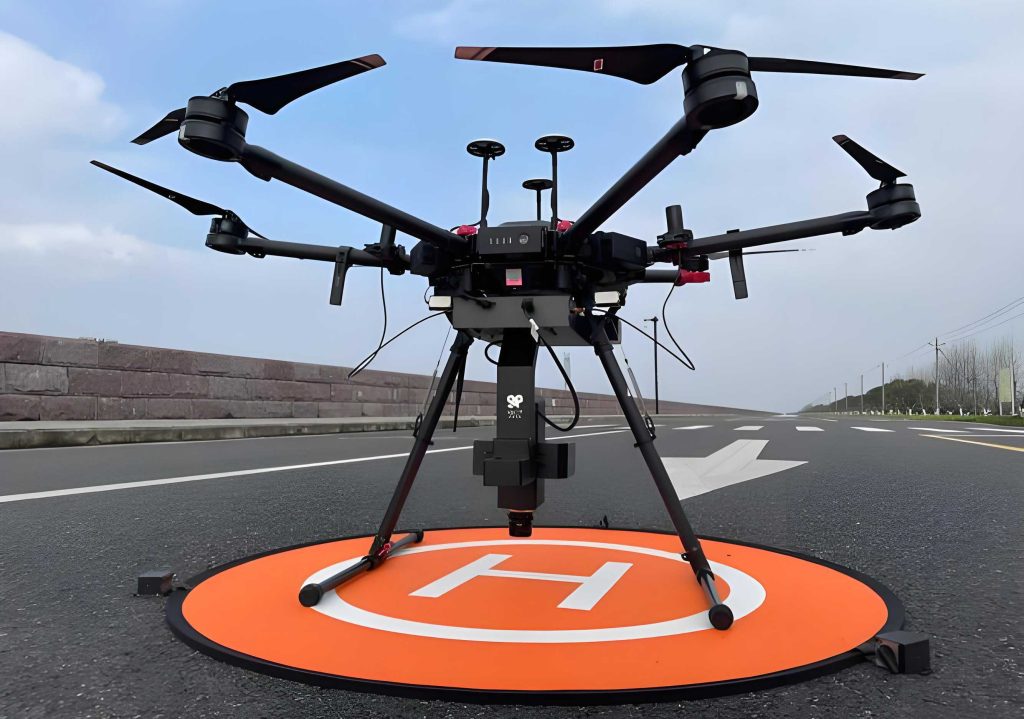
I begin with the observation that a UAV drone is not a static tower. A UAV drone moves, hovers, rotates, and vibrates. Even when the UAV drone is intended to hover, wind gusts, rotor imbalance, payload movement, and control-loop delay create small but non-negligible angular perturbations. For a beamforming system, these perturbations translate into angle-of-departure errors. If I ignore them, the beam of the UAV drone may point slightly away from the intended user. The result is reduced beamforming gain, higher outage probability, and wasted transmit power. Therefore, my first design target is energy minimization under jitter, and my second design target is secrecy capacity maximization under jitter.
I also consider rate-splitting multiple access because it provides a flexible interference-management bridge between space-division multiple access and non-orthogonal multiple access. In rate-splitting multiple access, each user message is divided into a common part and a private part. The common parts are combined into a common stream that can be decoded by multiple users, while each private stream is decoded only by its intended user. This structure allows the UAV drone to split interference, partially decode it, and partially treat it as noise. For a low-power UAV drone, this flexibility is valuable because it can reduce transmit power while satisfying user rates.
| Symbol | Meaning in My UAV Drone Model |
|---|---|
| \(N\) | Number of antenna elements in a uniform linear array |
| \(N_x,N_y\) | Rows and columns of a uniform planar array |
| \(M\) | Number of ground users served by the UAV drone |
| \(\mathbf{h}_m\) | Channel vector from the UAV drone to user \(m\) |
| \(\mathbf{w}_c\) | Common-stream beamforming vector |
| \(\mathbf{w}_m\) | Private-stream beamforming vector for user \(m\) |
| \(\theta_m,\phi_m\) | Pitch and azimuth angles from the UAV drone to user \(m\) |
| \(\Delta\theta_m,\Delta\phi_m\) | Angular jitter errors caused by UAV drone vibration |
| \(\sigma_m^2\) | Noise power at user \(m\) |
| \(R_{c,m},R_{p,m}\) | Common and private achievable rates at user \(m\) |
| \(R_{sec,m}\) | Secrecy rate for user \(m\) |
2. UAV Drone Downlink Model with Rate-Splitting Multiple Access
I consider a downlink scenario in which one UAV drone acts as an aerial base station. The UAV drone is equipped with an antenna array and serves \(M\) single-antenna ground users. I assume that the UAV drone hovers at a fixed altitude \(h_u\), which is high enough to provide a strong line-of-sight path. The horizontal position of the UAV drone is \(\mathbf{q}_u=[x_u,y_u]^T\), and the position of user \(m\) is \(\mathbf{q}_m=[x_m,y_m]^T\). The distance between the UAV drone and user \(m\) is
$$ d_m = \sqrt{\|\mathbf{q}_u-\mathbf{q}_m\|_2^2 + h_u^2 }. $$
The channel from the UAV drone to user \(m\) is modeled as
$$ \mathbf{h}_m = \sqrt{\eta} d_m^{-2} \mathbf{a}_m, $$
where \(\eta\) is the channel gain at the reference distance, and \(\mathbf{a}_m\) is the array response vector. For a uniform linear array with \(N\) elements, I write
$$ \mathbf{a}_m = \left[1,e^{-j\pi \cos\theta_m},e^{-j2\pi \cos\theta_m},\ldots,e^{-j(N-1)\pi \cos\theta_m}\right]^T. $$
When the UAV drone jitters, the actual angle is not exactly the estimated angle. I therefore write
$$ \theta_m = \bar{\theta}_m + \Delta\theta_m, $$
where \(\bar{\theta}_m\) is the estimated direction and \(\Delta\theta_m\) is the jitter-induced angle error. This single expression captures the core physical effect that motivates my robust design: the UAV drone array response is uncertain because the UAV drone orientation is uncertain.
The UAV drone transmits a common stream and \(M\) private streams:
$$ \mathbf{x} = \mathbf{w}_c s_c + \sum_{m=1}^{M}\mathbf{w}_m s_{p,m}. $$
I assume that \(\mathbb{E}\{|\mathbf{s}|^2\}=\mathbf{I}\), where \(\mathbf{s}=[s_c,s_{p,1},\ldots,s_{p,M}]^T\). The received signal at user \(m\) is
$$ y_m = \mathbf{h}_m^H\mathbf{x}+n_m, $$
where \(n_m\sim\mathcal{CN}(0,\sigma_m^2)\). I expand the received signal as
$$ y_m = \mathbf{h}_m^H\mathbf{w}_c s_c + \mathbf{h}_m^H\mathbf{w}_m s_{p,m} + \sum_{i\ne m}\mathbf{h}_m^H\mathbf{w}_i s_{p,i} + n_m. $$
User \(m\) first decodes the common stream by treating all private streams as interference. The common-stream signal-to-interference-plus-noise ratio is
$$ \gamma_{c,m} = \frac{|\mathbf{h}_m^H\mathbf{w}_c|^2}{\sum_{i=1}^{M}|\mathbf{h}_m^H\mathbf{w}_i|^2+\sigma_m^2}. $$
After successfully decoding the common stream, user \(m\) removes it by successive interference cancellation and then decodes its private stream. The private-stream signal-to-interference-plus-noise ratio is
$$ \gamma_{p,m} = \frac{|\mathbf{h}_m^H\mathbf{w}_m|^2}{\sum_{i\ne m}|\mathbf{h}_m^H\mathbf{w}_i|^2+\sigma_m^2}. $$
The corresponding achievable rates are
$$ R_{c,m} = \log_2\left(1+\gamma_{c,m}\right), \qquad R_{p,m} = \log_2\left(1+\gamma_{p,m}\right). $$
Because the common stream must be decoded by all users, its rate is constrained by the worst common-rate user:
$$ R_c = \min_{m} R_{c,m}. $$
| Rate Component | Expression | Role in My UAV Drone Design |
|---|---|---|
| Common rate | \(R_c=\min_m R_{c,m}\) | Guarantees that all users can decode the common stream |
| Private rate | \(R_{p,m}=\log_2(1+\gamma_{p,m})\) | Provides user-specific data and quality of service |
| Total user rate | \(R_m=R_{c,m}+R_{p,m}\) | Measures the service level of each user |
| Secrecy rate | \(R_{sec,m}=[R_{c,m}-R_{c,e}]^+ + [R_{p,m}-R_{p,e}]^+\) | Measures confidential transmission in the presence of an eavesdropper |
3. Energy Minimization Under UAV Drone Jitter
My first robust design minimizes the total transmit power of the UAV drone while satisfying common and private rate constraints. I formulate the problem as
$$ \min_{\mathbf{w}_c,\{\mathbf{w}_m\}} \|\mathbf{w}_c\|_2^2 + \sum_{m=1}^{M}\|\mathbf{w}_m\|_2^2 $$
$$ \text{s.t. } R_{c,m} \ge R_{c,m}^{th}, \quad R_{p,m} \ge R_{p,m}^{th}, \quad \forall m. $$
This problem is difficult because the rate constraints are non-convex and because the channel depends on uncertain jitter angles. I introduce positive semidefinite matrices
$$ \mathbf{W}_c = \mathbf{w}_c\mathbf{w}_c^H, \qquad \mathbf{W}_m = \mathbf{w}_m\mathbf{w}_m^H. $$
Then I rewrite the power objective as
$$ \operatorname{tr}(\mathbf{W}_c) + \sum_{m=1}^{M}\operatorname{tr}(\mathbf{W}_m). $$
The rate constraints become quadratic forms such as \(\mathbf{a}_m^H\mathbf{W}_c\mathbf{a}_m\) and \(\mathbf{a}_m^H\mathbf{W}_m\mathbf{a}_m\). The rank-one constraints are
$$ \operatorname{rank}(\mathbf{W}_c)=1, \qquad \operatorname{rank}(\mathbf{W}_m)=1, \qquad \mathbf{W}_c\succeq 0, \quad \mathbf{W}_m\succeq 0. $$
3.1 Elliptical Angle Error Model for a UAV Drone
I first model the jitter angle error as an elliptical bounded uncertainty:
$$ \Delta\theta_m^T\Delta\theta_m \le \varepsilon_m^2, $$
where \(\varepsilon_m\) is the maximum angular deviation caused by UAV drone jitter. This bounded model represents the worst-case jitter. It is useful because it protects the UAV drone communication link against every angle error inside the ellipse. However, it can be conservative because extreme jitter may occur rarely in practice.
3.2 Probabilistic Angle Error Model for a UAV Drone
I also consider a probabilistic jitter model in which the angle error follows a Gaussian distribution:
$$ \Delta\theta_m \sim \mathcal{N}(0,\sigma_m^2). $$
In this model, I impose an outage probability constraint:
$$ \Pr\left\{R_{p,m} \ge R_{p,m}^{th}\right\} \ge 1-\rho, $$
where \(\rho\) is the maximum allowed outage probability. This probabilistic design is often less conservative than the bounded worst-case design, and it matches the random nature of UAV drone vibration more closely.
| Error Model | Uncertainty Description | Design Implication | |
|---|---|---|---|
| Elliptical bounded error | \(\Delta\theta_m^T\Delta\theta_m \le \varepsilon_m^2\) | Robust for every angle error in the set | |
| Probabilistic error | \(\Delta\theta_m \sim \mathcal{N}(0,\sigma_m^2)\) | Controls outage probability and reduces conservatism | |
| Worst-case viewpoint | \(\max_{\Delta\theta_m}\Delta\theta_m\) | Useful for safety-critical UAV drone links | |
| Outage viewpoint | \(\Pr\{R_{p,m}<r_{p,m}^{th}\}\le\rho\) | Useful for statistical quality-of-service guarantees |
3.3 Second-Order Taylor Expansion of the UAV Drone Beamforming Gain
To handle the angle uncertainty, I approximate the beamforming gain \(\mathbf{a}^H\mathbf{W}\mathbf{a}\) by a second-order Taylor expansion around the estimated angle. I write
$$ \mathbf{a}^H\mathbf{W}\mathbf{a} \approx p(\Delta\theta)^2 + q\Delta\theta + r. $$
Here, \(p\), \(q\), and \(r\) depend on the estimated angle, the array geometry, and the beamforming matrix. This approximation is important because it converts a nonlinear array-response function into a quadratic polynomial in the jitter error. After this step, the uncertain constraints become inequalities involving \(\Delta\theta\). I can then apply S-Procedure or Bernstein-type inequality to obtain tractable convex constraints.
For bounded jitter, I use S-Procedure. If a first quadratic inequality implies a second quadratic inequality, then there exists a nonnegative scalar \(\delta\) such that a linear matrix inequality holds. In my UAV drone problem, I use this to convert infinitely many uncertain constraints into a finite set of linear matrix inequalities.
$$ \mathbf{x}^H\mathbf{A}_1\mathbf{x}+2\operatorname{Re}\{\mathbf{x}^H\mathbf{b}_1\}+c_1 \le 0 \Rightarrow \mathbf{x}^H\mathbf{A}_2\mathbf{x}+2\operatorname{Re}\{\mathbf{x}^H\mathbf{b}_2\}+c_2 \le 0 $$
$$ \exists \delta\ge 0:\quad \begin{bmatrix} \mathbf{A}_2+\delta\mathbf{A}_1 & \mathbf{b}_2+\delta\mathbf{b}_1 \\ \mathbf{b}_2^H+\delta\mathbf{b}_1^H & c_2+\delta c_1 \end{bmatrix} \preceq 0. $$
For probabilistic jitter, I use the Bernstein-type inequality. It provides a safe approximation of a chance constraint by a set of linear matrix inequalities and second-order cone constraints. This allows me to control the outage probability of the UAV drone link.
$$ \Pr\left\{\mathbf{x}^H\mathbf{A}\mathbf{x}+2\operatorname{Re}\{\mathbf{x}^H\mathbf{b}\}+c \ge 0\right\} \ge 1-\rho. $$
3.4 Rank-One Recovery and Penalty Function
After the robust transformations, the remaining non-convex part is the rank-one constraint. I replace it by a penalty term. The key identity is
$$ \operatorname{rank}(\mathbf{W})=1 \Longleftrightarrow \operatorname{tr}(\mathbf{W}) – \lambda_{\max}(\mathbf{W}) = 0. $$
Because \(\lambda_{\max}(\mathbf{W})\) is convex, I linearize it by a first-order Taylor expansion around the previous iterate \(\mathbf{W}^{(i)}\):
$$ \lambda_{\max}(\mathbf{W}) \ge \lambda_{\max}(\mathbf{W}^{(i)}) + \operatorname{tr}\left(\mathbf{u}_{\max}(\mathbf{W}^{(i)})\mathbf{u}_{\max}^H(\mathbf{W}^{(i)})(\mathbf{W}-\mathbf{W}^{(i)})\right), $$
where \(\mathbf{u}_{\max}(\mathbf{W}^{(i)})\) is the eigenvector corresponding to the largest eigenvalue. I then add the penalty term
$$ \Phi(\mathbf{W},\mathbf{W}^{(i)}) = \operatorname{tr}(\mathbf{W}) – \lambda_{\max}(\mathbf{W}^{(i)}) – \operatorname{tr}\left(\mathbf{u}_{\max}(\mathbf{W}^{(i)})\mathbf{u}_{\max}^H(\mathbf{W}^{(i)})(\mathbf{W}-\mathbf{W}^{(i)})\right). $$
With a sufficient penalty factor \(\mu\), the semidefinite relaxation tends to produce rank-one solutions. I solve the resulting convex problem by standard convex programming tools.
3.5 Algorithm Summary for Energy Minimization
| Step | Operation in My UAV Drone Design |
|---|---|
| 1 | Initialize beamforming matrices and set the penalty factor |
| 2 | Build the ULA channel model with UAV drone jitter angle error |
| 3 | Transform rate constraints by second-order Taylor expansion |
| 4 | For bounded jitter, apply S-Procedure to obtain linear matrix inequalities |
| 5 | For probabilistic jitter, apply Bernstein-type inequality to obtain safe convex constraints |
| 6 | Add penalty term for rank-one recovery |
| 7 | Solve the convex problem and update the beamforming matrices |
| 8 | Repeat until convergence and extract \(\mathbf{w}_c,\mathbf{w}_m\) |
3.6 Complexity and Convergence
I evaluate complexity by the number of variables, the number of constraints, and the iteration cost. For the bounded-error energy-minimization design, the iteration complexity scales with \(M\), and the per-iteration cost depends on the number of linear matrix inequality constraints and the array dimension \(N\). I write the overall complexity as
$$ \mathcal{O}\left( M^4 \left( (M+1)N + 2M \right) \left( 16(M+1)N + 8(M+1)N \right) \ln(1/\epsilon) \right). $$
For the probabilistic design, the per-iteration cost includes second-order cone constraints, so the complexity is
$$ \mathcal{O}\left( 10M \left( n^3 + 20M n + 7M n \right) \ln(1/\epsilon) \right), $$
where \(n\) is the total number of scalar optimization variables. The convergence follows because each convex approximation produces a feasible point for the next iteration, and the objective is non-increasing while remaining bounded below by zero.
3.7 Simulation Insights for Energy Minimization
I simulate a UAV drone serving three ground users. The UAV drone altitude is \(100\) m, the carrier frequency is \(2\) GHz, and the ULA has \(8\) elements. I compare my robust rate-splitting multiple access design with robust space-division multiple access, robust non-orthogonal multiple access, and a non-robust rate-splitting multiple access baseline.
| Parameter | Value Used in My Simulation |
|---|---|
| Number of users \(M\) | 3 |
| ULA elements \(N\) | 8 |
| UAV drone altitude \(h_u\) | 100 m |
| Carrier frequency \(f_c\) | 2 GHz |
| Noise power \(\sigma_m^2\) | -110 dBm |
| Bounded angle error \(\varepsilon_m\) | 1 degree |
| Outage probability \(\rho\) | 0.1 |
| Penalty factor \(\mu\) | 1 |
I observe that the robust rate-splitting multiple access beamformer directs the common beam toward all users, while each private beam is directed toward its intended user. This confirms that the UAV drone can still shape beams effectively when jitter is considered. I also observe that the robust design satisfies the rate thresholds for most random jitter realizations, whereas the non-robust design often fails. In the probabilistic case, the cumulative distribution of private rates shows that my robust design satisfies the quality-of-service constraint with probability above ninety percent.
| Scheme | Quality-of-Service Protection | Transmit Power Behavior |
|---|---|---|
| Robust rate-splitting multiple access | Strong under UAV drone jitter | Lower than robust SDMA and robust NOMA in most rate regions |
| Non-robust rate-splitting multiple access | Weak under UAV drone jitter | Low nominal power but frequent rate violation |
| Robust space-division multiple access | Moderate | Higher power as rate thresholds increase |
| Robust non-orthogonal multiple access | Moderate but sensitive to decoding order | Competitive only at low rate thresholds |
The power ratio between private and common streams reveals an important behavior. As the rate threshold increases, the UAV drone allocates more power to private streams to protect user-specific quality of service. The common stream still plays a critical role in interference management. In my robust design, the common stream uses less power than in the non-robust design because the robust beamformer already accounts for jitter and does not need to over-protect the common stream.
4. Secure Robust Beamforming for a UAV Drone with Eavesdroppers
My second design considers a more challenging scenario: a UAV drone serves multiple users while an eavesdropper attempts to intercept the transmission. I assume that the UAV drone is equipped with a uniform planar array because a planar array provides more degrees of freedom in both azimuth and elevation. This is important for a UAV drone because the aerial base station must cover a three-dimensional region, not merely a horizontal plane.
The channel from the UAV drone to user \(m\) is
$$ \mathbf{H}_m = \sqrt{\eta} d_m^{-2} \mathbf{a}_m, $$
and the channel from the UAV drone to the eavesdropper is
$$ \mathbf{H}_e = \sqrt{\eta} d_e^{-2} \mathbf{a}_e. $$
For a uniform planar array, the response vector depends on both pitch and azimuth:
$$ \mathbf{a}_i = \left[ e^{j\pi\left((n_x-1)\sin\theta_i\cos\phi_i+(n_y-1)\sin\theta_i\sin\phi_i\right)} \right]_{n_x,n_y}, \quad i\in\{m,e\}. $$
The actual angles are
$$ \theta_i = \bar{\theta}_i + \Delta\theta_i, \qquad \phi_i = \bar{\phi}_i + \Delta\phi_i. $$
I collect the angular error as
$$ \mathbf{e}_i = [\Delta\theta_i,\Delta\phi_i]^T, \qquad \|\mathbf{e}_i\|_2^2 \le \varepsilon_i^2. $$
The received signal at user \(m\) is
$$ y_m = \mathbf{H}_m^H\mathbf{x}+n_m, $$
and the received signal at the eavesdropper is
$$ y_e = \mathbf{H}_e^H\mathbf{x}+n_e. $$
The user common-stream and private-stream signal-to-interference-plus-noise ratios are
$$ \gamma_{c,m} = \frac{|\mathbf{H}_m^H\mathbf{w}_c|^2}{\sum_{i=1}^{M}|\mathbf{H}_m^H\mathbf{w}_i|^2+\sigma_m^2}, $$
$$ \gamma_{p,m} = \frac{|\mathbf{H}_m^H\mathbf{w}_m|^2}{\sum_{i\ne m}|\mathbf{H}_m^H\mathbf{w}_i|^2+\sigma_m^2}. $$
The eavesdropper signal-to-interference-plus-noise ratios are
$$ \gamma_{c,e} = \frac{|\mathbf{H}_e^H\mathbf{w}_c|^2}{\sum_{i=1}^{M}|\mathbf{H}_e^H\mathbf{w}_i|^2+\sigma_e^2}, $$
$$ \gamma_{p,e} = \frac{|\mathbf{H}_e^H\mathbf{w}_m|^2}{\sum_{i\ne m}|\mathbf{H}_e^H\mathbf{w}_i|^2+|\mathbf{H}_e^H\mathbf{w}_c|^2+\sigma_e^2}. $$
The achievable user rates are
$$ R_{c,m} = \log_2(1+\gamma_{c,m}), \qquad R_{p,m} = \log_2(1+\gamma_{p,m}), $$
and the eavesdropper rates are
$$ R_{c,e} = \log_2(1+\gamma_{c,e}), \qquad R_{p,e} = \log_2(1+\gamma_{p,e}). $$
The secrecy rate for user \(m\) is
$$ R_{sec,m} = [R_{c,m}-R_{c,e}]^+ + [R_{p,m}-R_{p,e}]^+. $$
I maximize the minimum secrecy rate among all users:
$$ \max_{\mathbf{w}_c,\{\mathbf{w}_m\}} \min_m R_{sec,m} $$
$$ \text{s.t. } R_{c,m} \ge R_{c,m}^{th}, \quad \operatorname{tr}(\mathbf{W}_c)+\sum_{m=1}^{M}\operatorname{tr}(\mathbf{W}_m) \le P_{\max}. $$
4.1 Two-Stage Bisection and Inner Power Minimization
I solve the max-min secrecy problem by a two-stage iterative method. In the outer stage, I introduce an auxiliary secrecy target \(C_P\) and use bisection to search for the best feasible value. In the inner stage, I solve a power minimization problem for a fixed \(C_P\). This separation is useful because the outer problem is one-dimensional, while the inner problem retains the same robust beamforming structure as the energy-minimization design.
The outer bisection updates the lower and upper bounds of \(C_P\) according to feasibility:
$$ C_P^{\min} \le C_P \le C_P^{\max}. $$
If the inner problem is feasible for \(C_P^{mid}\), I set \(C_P^{\min}=C_P^{mid}\); otherwise, I set \(C_P^{\max}=C_P^{mid}\). The inner problem is
$$ \min_{\mathbf{W}_c,\{\mathbf{W}_m\}} \operatorname{tr}(\mathbf{W}_c)+\sum_{m=1}^{M}\operatorname{tr}(\mathbf{W}_m) $$
$$ \text{s.t. } R_{c,m}-R_{c,e} \ge R_{c,m}^{th}, \quad R_{p,m}-R_{p,e} \ge C_P, \quad \forall m. $$
I introduce auxiliary variables \(f_{c,m},g_{c,m},s_{c,m},t_{c,m}\) for the common constraint and \(f_{p,m},g_{p,m},s_{p,m},t_{p,m}\) for the private constraint. These variables represent exponential transformations of the signal-to-interference-plus-noise ratio terms. In this way, the logarithmic secrecy constraints become linear inequalities with additional convex constraints.
| Auxiliary Variable | Purpose in My Secrecy Design |
|---|---|
| \(f_{c,m}\) | Lower bound on the common signal plus interference plus noise at user \(m\) |
| \(g_{c,m}\) | Upper bound on the common signal plus interference plus noise at the eavesdropper |
| \(s_{c,m}\) | Lower bound on interference plus noise at user \(m\) for the common stream |
| \(t_{c,m}\) | Upper bound on interference plus noise at the eavesdropper for the common stream |
| \(f_{p,m},g_{p,m},s_{p,m},t_{p,m}\) | Analogous quantities for the private stream |
After the auxiliary transformation, I apply the same second-order Taylor expansion to the UPA response. I then use S-Procedure to convert infinitely many bounded angle-error constraints into linear matrix inequalities. Finally, I apply the penalty method to recover rank-one beamforming matrices.
4.2 Complexity and Convergence for Secure UAV Drone Beamforming
The secure design requires more constraints than the energy-minimization design because each user has both common and private secrecy constraints, and each angle has pitch and azimuth uncertainty. The iteration complexity scales with \(M\), and the per-iteration complexity depends on the number of three-dimensional linear matrix inequalities and the number of scalar variables.
$$ \mathcal{O}\left( 26M \left( n^3 + 164M n + 56M n \right) \ln(1/\epsilon) \right). $$
Convergence is obtained because the inner convex approximation is feasible for the next iteration, the secrecy target increases or remains feasible through bisection, and the power objective is bounded below by zero. The bisection stage terminates when the upper and lower secrecy bounds differ by less than a small threshold.
4.3 Simulation Insights for Secure UAV Drone Beamforming
I simulate a UAV drone with a \(6\times 6\) uniform planar array. Three legitimate users are randomly located, and one eavesdropper is present. The carrier frequency is \(2\) GHz, the UAV drone altitude is \(100\) m, and the noise power is \(-110\) dBm. The bounded angle error is \(2\) degrees.
| Parameter | Value Used in My Secure Simulation |
|---|---|
| UPA dimensions | \(6\times 6\) |
| Number of users \(M\) | 3 |
| Number of eavesdroppers | 1 |
| UAV drone altitude | 100 m |
| Carrier frequency | 2 GHz |
| Common rate threshold | 1 bps/Hz |
| Angle error bound | 2 degrees |
| Noise power | -110 dBm |
I first validate the Taylor approximation by comparing the exact array gain with the second-order approximation. For small angle errors, the difference is extremely small. As the error bound increases, the difference grows slightly but remains small. This supports the use of second-order Taylor expansion in the UAV drone jitter problem.
I then examine the beam patterns. The common beam points toward all legitimate users, while the private beam for a selected user points toward that user and places a deep null toward the eavesdropper. This is a key result: the UAV drone can protect private data while still serving the common stream to all users.
| Scheme | Average Secrecy Capacity | Robustness to UAV Drone Jitter |
|---|---|---|
| Robust rate-splitting multiple access | Highest among the compared schemes | Strong |
| Non-robust rate-splitting multiple access | Lower than robust RSMA | Weak |
| Robust space-division multiple access | Moderate | Moderate |
| Robust non-orthogonal multiple access | Lower in my widely separated user layout | Moderate |
I observe that the average secrecy capacity increases with the maximum transmit power. The robust rate-splitting multiple access scheme achieves a higher secrecy capacity than the non-robust scheme and the robust space-division multiple access and non-orthogonal multiple access baselines. Because the users are widely separated in my simulation, robust space-division multiple access performs better than robust non-orthogonal multiple access, but both remain below robust rate-splitting multiple access.
5. Comparative Analysis and Design Lessons
I now summarize the main lessons I learned from the two designs. The first design minimizes transmit power for a UAV drone under jitter while satisfying common and private rate thresholds. The second design maximizes the minimum secrecy rate for a UAV drone under jitter in the presence of an eavesdropper. Both designs use rate-splitting multiple access, robust beamforming, second-order Taylor expansion, S-Procedure, and penalty-based rank-one recovery. The main difference is the objective and the additional secrecy constraints.
| Design Aspect | Energy Minimization Design | Secrecy Maximization Design |
|---|---|---|
| Array type | Uniform linear array | Uniform planar array |
| Main objective | Minimize transmit power | Maximize minimum secrecy rate |
| Uncertainty model | Elliptical bounded and probabilistic angle error | Elliptical bounded angle error in both pitch and azimuth |
| Core constraints | Common and private rate thresholds | Common and private secrecy rate thresholds |
| Main solution tools | Taylor expansion, S-Procedure, Bernstein-type inequality, penalty method | Bisection, auxiliary variables, Taylor expansion, S-Procedure, penalty method |
| Primary performance metric | Transmit power | Average secrecy capacity |
I also note that the robust design is not free. It requires additional transmit power or reduced secrecy capacity compared with a non-robust design that assumes perfect angle information. However, the non-robust design violates quality-of-service and secrecy constraints when the UAV drone jitters. Therefore, the robust design provides a more reliable and secure operating point for a practical UAV drone.
| Performance Trade-off | Observation from My Study |
|---|---|
| Power versus robustness | Robustness increases power slightly but prevents outage |
| Secrecy versus common rate | Common stream helps interference management but may leak to eavesdropper |
| Bounded versus probabilistic jitter | Probabilistic design usually requires less power than bounded worst-case design |
| Linear versus planar array | Planar array provides more spatial degrees of freedom for secure UAV drone communication |
| Rate-splitting versus orthogonal access | Rate-splitting multiple access offers better interference balancing and lower power in many regimes |
6. Algorithmic Details and Mathematical Structure
I present the mathematical structure of my robust beamforming algorithms in more detail. The core idea is to replace uncertain constraints with safe convex approximations. I use the following sequence:
| Step | Mathematical Operation | Reason |
|---|---|---|
| 1 | Rewrite beamforming vectors as positive semidefinite matrices | Converts quadratic beamforming terms into linear traces |
| 2 | Approximate array gain by second-order Taylor expansion | Makes angle-error dependence quadratic |
| 3 | Apply S-Procedure for bounded error | Converts infinitely many constraints into linear matrix inequalities |
| 4 | Apply Bernstein-type inequality for probabilistic error | Converts chance constraints into safe convex constraints |
| 5 | Add penalty for rank-one constraint | Recovers beamforming vectors from matrices |
| 6 | Solve convex problem iteratively | Produces a feasible robust solution |
For the energy-minimization design, the main convex problem has the form
$$ \min_{\mathbf{W}_c,\mathbf{W}_m,\delta} \operatorname{tr}(\mathbf{W}_c)+\sum_{m=1}^{M}\operatorname{tr}(\mathbf{W}_m)+\mu\sum_{m}\Phi(\mathbf{W}_m,\mathbf{W}_m^{(i)}) $$
$$ \text{s.t. } \text{linear matrix inequalities from S-Procedure or Bernstein-type inequality}. $$
For the secrecy-maximization design, the inner convex problem has the form
$$ \min_{\mathbf{W}_c,\mathbf{W}_m,\mathbf{f},\mathbf{g},\mathbf{s},\mathbf{t}} \operatorname{tr}(\mathbf{W}_c)+\sum_{m=1}^{M}\operatorname{tr}(\mathbf{W}_m)+\mu\sum_{m}\Phi(\mathbf{W}_m,\mathbf{W}_m^{(i)}) $$
$$ \text{s.t. } \text{secrecy auxiliary constraints and robust linear matrix inequalities}. $$
I emphasize that the penalty factor must be chosen carefully. If it is too small, the solution may not be rank one. If it is too large, the numerical conditioning may degrade. In my simulation, a moderate penalty factor works well.
7. Key Equations for Implementation
I list the most important equations that I use when implementing the UAV drone jitter-aware robust beamforming designs.
$$ d_m = \sqrt{\|\mathbf{q}_u-\mathbf{q}_m\|_2^2+h_u^2} $$
$$ \mathbf{h}_m = \sqrt{\eta}d_m^{-2}\mathbf{a}_m $$
$$ \mathbf{a}_m = \left[1,e^{-j\pi\cos\theta_m},\ldots,e^{-j(N-1)\pi\cos\theta_m}\right]^T $$
$$ \theta_m = \bar{\theta}_m+\Delta\theta_m $$
$$ \mathbf{x} = \mathbf{w}_c s_c+\sum_{m=1}^{M}\mathbf{w}_m s_{p,m} $$
$$ \gamma_{c,m} = \frac{|\mathbf{h}_m^H\mathbf{w}_c|^2}{\sum_{i=1}^{M}|\mathbf{h}_m^H\mathbf{w}_i|^2+\sigma_m^2} $$
$$ \gamma_{p,m} = \frac{|\mathbf{h}_m^H\mathbf{w}_m|^2}{\sum_{i\ne m}|\mathbf{h}_m^H\mathbf{w}_i|^2+\sigma_m^2} $$
$$ R_{c,m} = \log_2(1+\gamma_{c,m}) $$
$$ R_{p,m} = \log_2(1+\gamma_{p,m}) $$
$$ R_{sec,m} = [R_{c,m}-R_{c,e}]^+ + [R_{p,m}-R_{p,e}]^+ $$
$$ \operatorname{rank}(\mathbf{W})=1 \Longleftrightarrow \operatorname{tr}(\mathbf{W})-\lambda_{\max}(\mathbf{W})=0 $$
$$ \lambda_{\max}(\mathbf{W}) \ge \lambda_{\max}(\mathbf{W}^{(i)})+\operatorname{tr}\left(\mathbf{u}_{\max}(\mathbf{W}^{(i)})\mathbf{u}_{\max}^H(\mathbf{W}^{(i)})(\mathbf{W}-\mathbf{W}^{(i)})\right) $$
$$ \mathcal{O}\left( \operatorname{Iter}\cdot \operatorname{Comp}\cdot \ln(1/\epsilon) \right) $$
8. Practical Implications for UAV Drone Networks
My study has several practical implications for UAV drone networks. First, jitter is not a minor effect. Even a few degrees of angular error can shift the beam away from a user and reduce the received signal-to-noise ratio. A robust beamforming design is therefore necessary for a UAV drone that must operate in windy or turbulent conditions. Second, rate-splitting multiple access is a natural fit for a UAV drone because it provides flexible interference management without requiring the UAV drone to fully decode all private streams. Third, physical-layer security is a realistic complement to cryptographic methods, especially for a UAV drone with limited computational resources. Fourth, a uniform planar array is preferable for secure UAV drone communication because it can steer beams in both azimuth and elevation.
| Practical Challenge | My Design Response |
|---|---|
| UAV drone vibration | Robust angle-error modeling and second-order Taylor approximation |
| Limited onboard energy | Power minimization with rate constraints |
| Presence of eavesdropper | Secrecy rate maximization with robust beamforming |
| Imperfect channel state information | S-Procedure and Bernstein-type inequality |
| Non-convex beamforming design | Semidefinite relaxation and penalty-based rank-one recovery |
| Multiple ground users | Rate-splitting multiple access with common and private streams |
I also note that the algorithms are not limited to a single UAV drone. They can be extended to a swarm of UAV drones, where each UAV drone coordinates its beamforming with neighboring UAV drones. In such a swarm, jitter can be correlated across UAV drones, and robust beamforming can exploit spatial diversity. This is an interesting direction for future work.
9. Limitations and Future Work
I acknowledge several limitations of my current work. First, I assume that the UAV drone hovers at a fixed altitude. In practice, a UAV drone may change altitude, which changes the elevation angle and therefore the array response. Second, I consider a small number of users and one eavesdropper. A dense network with many users and multiple eavesdroppers would require more scalable algorithms. Third, I focus on digital beamforming. Hybrid beamforming may be more practical for large arrays because it reduces the number of radio-frequency chains. Fourth, I do not jointly optimize the UAV drone trajectory and beamforming. A moving UAV drone could improve both energy efficiency and secrecy by repositioning itself. Fifth, I treat the angle error distribution as known. In practice, the distribution may be unknown or time-varying, which suggests the use of learning-based robust beamforming.
| Future Direction | Why It Matters for a UAV Drone |
|---|---|
| Joint trajectory and beamforming optimization | A moving UAV drone can improve channel conditions and reduce jitter impact |
| Hybrid beamforming | Reduces power consumption and hardware complexity for large arrays |
| Multiple eavesdroppers | More realistic security threat in urban and battlefield environments |
| Probabilistic secrecy constraints | Provides statistical secrecy guarantees under random jitter |
| Learning-based robust design | Handles unknown or time-varying jitter distributions |
| UAV drone swarm coordination | Improves coverage and secrecy through distributed beamforming |
10. Conclusion
In this article, I investigated robust beamforming for rate-splitting multiple access in UAV drone jitter scenarios. I developed two designs. The first design minimizes transmit power while satisfying common and private rate constraints under elliptical bounded and probabilistic angle errors. The second design maximizes the minimum secrecy rate in the presence of an eavesdropper under bounded pitch and azimuth errors. Both designs use second-order Taylor expansion to handle the nonlinear array response, S-Procedure or Bernstein-type inequality to handle uncertainty, and penalty-based rank-one recovery to obtain beamforming vectors. I verified through simulation that the proposed robust rate-splitting multiple access designs outperform non-robust and orthogonal baselines in terms of quality-of-service protection, energy consumption, and secrecy capacity. I conclude that robust rate-splitting multiple access beamforming is a promising technique for future UAV drone communication networks, especially when the UAV drone must operate reliably and securely despite unavoidable jitter.
For future work, I plan to extend my framework to joint trajectory and beamforming optimization, hybrid beamforming architectures, multiple eavesdroppers, and learning-based uncertainty models. I believe these extensions will bring robust rate-splitting multiple access for UAV drone networks closer to practical deployment.