
In my extensive experience conducting security inspection and explosive detection (SIED) operations for major events, I have consistently encountered a critical and persistent challenge: the thorough screening of specific high-altitude and structurally complex areas. Traditional SIED methodologies, while effective on ground level, face significant limitations when tasked with inspecting locations such as the vast interior spaces of railway bridges, the undersides of stadium canopies, the intricate ceiling voids of large conference halls, and the deep, often water-filled culverts along transportation routes. These areas represent dangerous security blind spots, as they are physically difficult, time-consuming, and hazardous for personnel to access manually. The rise of accessible drone technology has paradoxically increased this threat vector, as malicious actors could potentially use commercial drones to place threats in these very locations. However, this same technology, when harnessed and adapted for law enforcement, presents a transformative solution. Through practical application and modification, I have found that police UAVs (Unmanned Aerial Vehicles) are not only capable of performing these tasks but do so with superior efficiency, enhanced officer safety, and lower operational costs, despite current limitations in endurance and payload versatility.
The Inadequacy of Traditional Methods in High-altitude and Confined Spaces
Traditional SIED operations rely on a combination of manual visual inspection, handheld tools like extendable inspection mirrors, and electronic detectors such as non-linear junction detectors (NLJD) and trace explosive detectors. While indispensable for many scenarios, their application to the “specific high-altitude areas” is fraught with problems:
- Physical Inaccessibility: Many bridge interiors, ceiling cavities, and roof structures simply cannot be reached safely or at all by human personnel without erecting complex scaffolding, which is time-prohibitive for most security timelines.
- Operational Inefficiency: Manually inspecting hundreds of potential threat locations along a several-kilometer railway or highway route is an immense drain on personnel resources and time. The sheer scale makes comprehensive coverage nearly impossible.
- Safety Risks: Sending officers into dark, confined, or structurally unstable spaces (like old culverts) poses significant personal safety risks from falls, structural collapse, or direct exposure to an undetected threat.
- Tool Limitations: Handheld mirrors have limited reach and field of view. Electronic detectors require close proximity to the target, which is unachievable in these areas without physical access.
The following table summarizes the core limitations:
| Traditional Method/Equipment | Limitation in High-altitude/Confined Space Inspection |
|---|---|
| Manual Visual Inspection | Impossible without physical access; high risk. |
| Extendable Inspection Mirrors | Limited range and angular view; cannot navigate complex interiors. |
| Explosive Detection Canines | Cannot access areas; effectiveness decreases with area scale and duration. |
| Handheld Trace Detectors | Require direct or very close proximity to surface, which is unattainable. |
| Long-Range Detection Systems | Can only identify a general suspicious zone (e.g., 300-500m radius), not a precise location within a complex structure. |
Selection, Adaptation, and Application of Police UAVs
Recognizing this operational gap, I focused on identifying a UAV platform suitable for police SIED adaptation. The key criteria were portability, stability, high-quality imaging, and potential for safe operation near structures. Commercial quadcopters, particularly the DJI Mavic series, emerged as a prime candidate due to their compact size, reliable flight controllers, and excellent camera systems. However, their stock configuration is designed for open-air cinematography, not for navigating the tight, obstacle-rich environments of bridge trusses or ceiling voids.
The critical adaptation was the addition of a propeller guard cage. This simple yet effective modification fundamentally alters the police UAV‘s capabilities for this mission:
- Collision Tolerance: The guard allows the UAV to safely bump into beams, cables, or walls without catastrophic rotor failure, enabling flight within dense structures.
- Proximity Flight: It grants the pilot the confidence to fly the UAV directly along surfaces, pressing its camera-equipped nose against gaps or into corners for an optimal view, effectively acting as a flying, articulate inspection mirror.
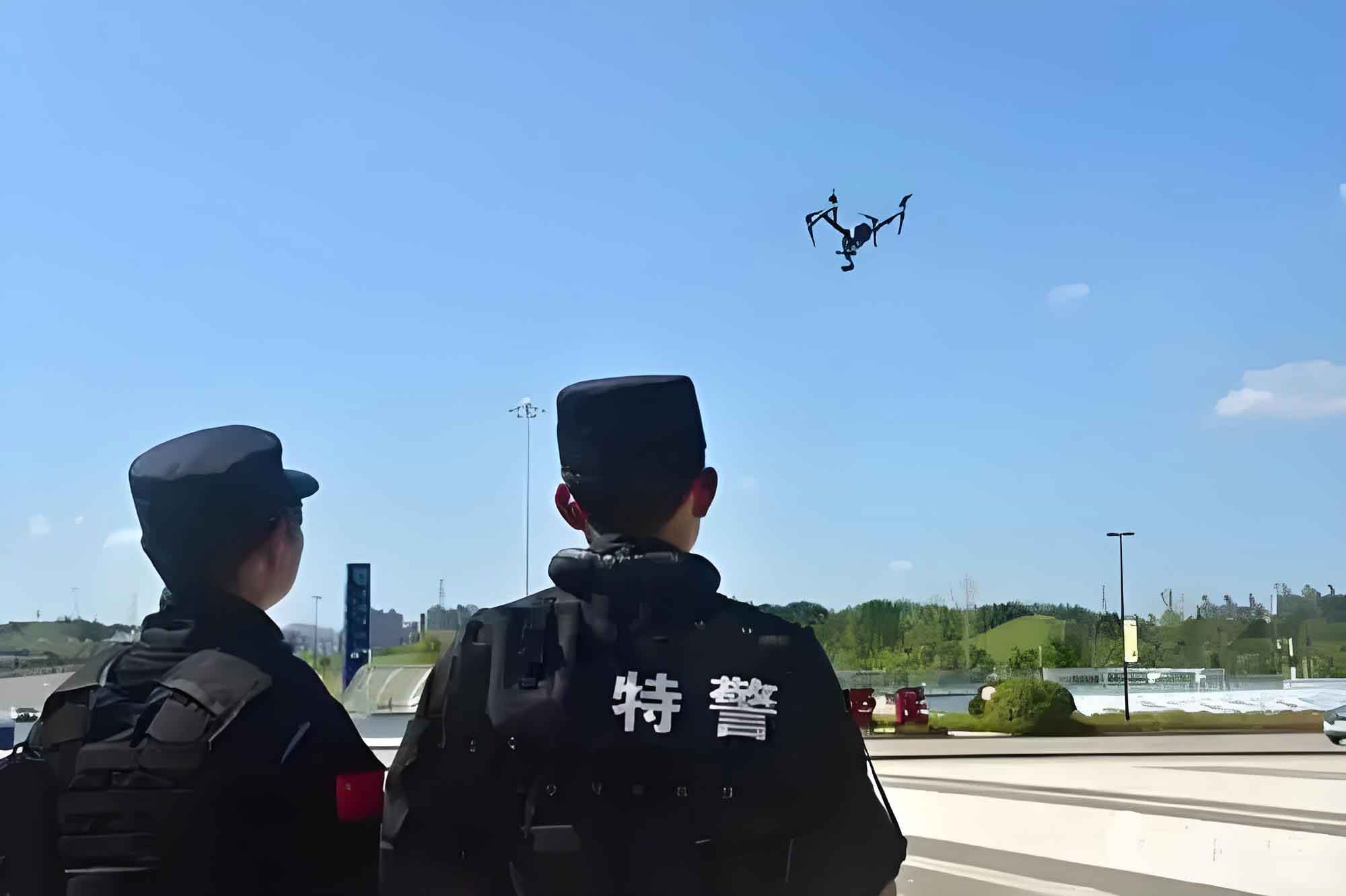
Equipped with a high-resolution visible-light camera and a powerful spotlight module, this modified police UAV becomes a remote sensory platform. The live video feed provides real-time situational awareness, allowing the operator to visually scan for suspicious items, disturbances in dust, or anomalous objects in areas previously considered blind spots.
Comparative Analysis: Adapted Police UAV vs. Dedicated Systems
The adapted police UAV solution presents a compelling profile when analyzed against dedicated, commercially available industrial inspection drones.
| Parameter | Adapted Commercial UAV (e.g., DJI Mavic with cage) | Purpose-Built Industrial Inspection UAV |
|---|---|---|
| Primary Advantage | Extreme cost-effectiveness, high portability, ease of maintenance. | Often more robust, potentially longer flight time, may offer factory-integrated payload options. |
| Acquisition & Maintenance Cost | Very Low (Few thousand USD total). Uses widely available consumer parts. | High (Tens of thousands of USD). Specialized parts can be costly and slow to procure. |
| Portability & Deployment Speed | Excellent. Fits in a small case, can be airborne in under 2 minutes. | Variable. Often larger, requiring more assembly time. |
| Proximity Flight & Maneuverability | Excellent with cage. Can make direct contact with surfaces for close-up inspection. | Good, but often larger size may hinder navigation in extremely tight spaces. |
| Payload Flexibility | Low. Typically limited to manufacturer’s camera/light modules. | Higher. May support custom sensor integration from the factory. |
| Operational Risk | Low financial risk. Loss or damage is relatively affordable to replace. | High financial risk. Loss represents a significant capital investment. |
Operational Advantages and Quantifiable Benefits
The deployment of a modified police UAV in SIED tasks for high-altitude areas yields significant tactical advantages:
1. Enhanced Efficiency and Coverage: A police UAV can visually inspect a large bridge interior or a long stretch of roof line in a fraction of the time required for a manual team to set up and perform the same task. The time saved can be modeled as an efficiency gain factor. If a manual inspection of a location takes time $T_m$, and the UAV inspection takes time $T_u$, the efficiency gain $G$ is:
$$ G = \frac{T_m}{T_u} $$
where $G$ is typically significantly greater than 1, often by an order of magnitude for extensive or multiple sites.
2. Maximized Personnel Safety: This is the paramount advantage. The police UAV acts as a force multiplier that removes the officer from the most dangerous phase of the operation—initial reconnaissance of an unsecured, inaccessible space. The risk reduction $R_r$ can be conceptually framed by comparing the probability of an incident with personnel present ($P_m$) versus with only the UAV ($P_u$), where $P_u \approx 0$ for threats like concealed explosives during the search phase:
$$ R_r = P_m – P_u \approx P_m $$
This represents a direct and substantial mitigation of operational risk.
3. Improved Inspection Quality: The UAV’s camera can provide high-definition, zoomable video and still images of areas that are impossible to see with the naked eye from any ground position. Suspicious items can be identified, recorded, and analyzed remotely before any personnel approach.
4. Cost-Effectiveness: As shown in the table, the adapted platform represents a minimal investment compared to specialized systems or the logistical cost of alternative access methods (like crane lifts). The total cost of ownership (TCO) is low, making it an accessible tool for many units.
Case Applications and Effectiveness
In practical deployments for high-profile security events, the adapted police UAV has proven its value across diverse scenarios:
- Large Venue Interiors: The UAV is flown into the ceiling void above conference halls and auditoriums. It navigates between ductwork, electrical conduits, and structural beams, providing a complete panoramic video record of the space, ensuring no compromise to the integrity of lightweight ceiling tiles and leaving no area unobserved.
- Transportation Infrastructure: This is where the police UAV shines. Inspecting the interior lattice of a railway bridge involves flying the UAV through the open truss work, documenting every joint, ledge, and potential hiding spot. For culverts, especially those with water, the UAV can hover at the entrance and traverse the length, inspecting the crown and walls without any officer needing to enter a confined, potentially hazardous space.
- Exterior High Points: Stadium canopy undersides, the peaked roofs of ceremonial buildings, and the tops of perimeter walls are all efficiently scanned. The UAV’s spotlight is indispensable for illuminating dark corners and shadowed areas during these inspections.
The operational outcome is a comprehensive visual audit of previously “uncheckable” areas, drastically reducing the probability of an oversight. The mission success probability $P_{success}$ when combining traditional ground sweeps with UAV-based aerial inspection can be expressed as:
$$ P_{success} = 1 – [(1 – P_g) \cdot (1 – P_a)] $$
where $P_g$ is the probability of threat detection by ground methods and $P_a$ is the probability of detection by the aerial police UAV inspection. By making $P_a$ significantly greater than zero for the critical blind-spot areas, the overall $P_{success}$ approaches 1 much more reliably.
Current Limitations and Future Trajectory
Despite its advantages, the current implementation of police UAV technology in SIED has clear limitations that define the frontier for development:
- Short Endurance: Flight times of 25-30 minutes per battery necessitate careful mission planning and logistic support for battery swaps on extended operations, potentially creating gaps in coverage.
- High Pilot Skill Requirement: Flying in GPS-denied, obstacle-dense environments (like inside a bridge) often requires switching to manual/attitude mode, disabling automated hovering and obstacle avoidance. This demands advanced pilot training and constant practice.
- Limited Payload Integration: Currently, the primary sensor is visual (RGB camera). The true potential of a police UAV as a remote sensing platform will be unlocked by integrating spectroscopic sensors (for chemical vapor detection), radiological detectors, or advanced imaging like hyperspectral cameras to identify specific material signatures from a distance.
The future of police UAVs in SIED lies in overcoming these hurdles through:
- Technological Integration: Developing modular, lightweight payload systems that allow a single UAV to carry visual, chemical, and non-linear junction detection sensors. Miniaturization is key.
- Operational Simplification: Advancing onboard processing and AI to enable robust autonomous navigation within defined, complex structures (e.g., “scan this bridge truss pattern”), reducing pilot cognitive load.
- Endurance Solutions: Adoption of hybrid power systems or automated battery-swapping stations for large-area inspections.
- Cross-Disciplinary Training: Fostering a new generation of operators who are not only skilled pilots but also understand the principles of explosive hazards, crime scene investigation, and sensor data interpretation. The human element remains irreplaceable.
Conclusion
The adaptation and deployment of police UAVs for inspecting bridges, culverts, and other specific high-altitude areas represent a pragmatic and highly effective evolution in security methodology. They directly address a critical vulnerability in traditional SIED protocols by providing safe, efficient, and cost-effective access to historical blind spots. While current platforms are primarily visual tools, their role as a foundational remote sensing platform is established. The trajectory is clear: the convergence of advancements in UAV durability, battery technology, sensor miniaturization, and artificial intelligence will inevitably lead to more autonomous, multi-sensor police UAV platforms. These future systems will not only show officers where to look but will also analyze the environment in real-time, detecting threats based on chemical, visual, and radiological signatures. For now, the modified police UAV stands as an indispensable tool, transforming once-impossible inspection tasks into routine operations and significantly elevating the standard of security for protected persons, critical infrastructure, and public events. Continued exploration and integration of this technology is not merely an option but a necessary progression for modern security and law enforcement agencies.