
As a legal and technology researcher, I have closely monitored the integration of police drones into law enforcement, particularly during the COVID-19 pandemic. The shift from two-dimensional to three-dimensional policing, driven by technological advancements, has positioned police drones as critical tools for non-contact执法, enhancing safety and efficiency. In this article, I will explore the applications, inherent problems, and regulatory needs of police drones in pandemic response, using tables and formulas to summarize key points. The keyword “police drone” will be emphasized throughout to highlight its centrality in modern执法 strategies.
The concept of a police drone refers to an unmanned aerial vehicle (UAV) equipped and operated by law enforcement agencies for警务执法 activities. According to industry standards, police drones are categorized into fixed-wing, helicopter, and multi-rotor types, each with distinct characteristics. Multi-rotor police drones, for instance, are favored for their hover capability and ease of use in urban environments, despite limitations in endurance and payload. To illustrate, I have compiled a comparison table below:
| Type of Police Drone | Advantages | Disadvantages | Typical执法 Applications |
|---|---|---|---|
| Fixed-wing Police Drone | Long endurance, high speed | Requires runway, poor hover | Large-area surveillance, border patrol |
| Helicopter Police Drone | Vertical take-off, precise hover | High cost, mechanical complexity | Search and rescue, targeted inspections |
| Multi-rotor Police Drone | Easy deployment, stable hover | Short battery life, limited payload | Urban patrol, crowd monitoring, pandemic response |
In pandemic conditions, traditional警务执法 methods face significant drawbacks, such as slow response times, limited coverage, and high infection risks for officers. Police drones address these issues through non-contact operations. For example, the efficiency of a police drone in patrol can be modeled mathematically. Let the efficiency \( E_{drone} \) be defined as the coverage area per unit time, adjusted for cost and risk reduction:
$$E_{drone} = \frac{A_{coverage}}{t_{time}} \times \frac{1}{C_{cost} + R_{risk}}$$
Here, \( A_{coverage} \) is the area monitored, \( t_{time} \) is the operation time, \( C_{cost} \) represents operational costs, and \( R_{risk} \) denotes the infection risk factor. Compared to traditional patrols, police drones often yield higher \( E_{drone} \) values due to faster response and lower human exposure. I have observed that police drones reduce contact risks by enabling remote surveillance and temperature screening, with infrared sensors achieving accuracy rates above 90%. The integration of AI enhances this further; for instance, facial recognition algorithms in police drones can process data at speeds quantified by:
$$P_{AI} = \frac{N_{faces}}{t_{process}} \times \alpha_{accuracy}$$
where \( P_{AI} \) is the processing power, \( N_{faces} \) is the number of faces detected, \( t_{process} \) is the processing time, and \( \alpha_{accuracy} \) is the accuracy coefficient (typically near 0.95 for advanced systems). These capabilities make police drones indispensable in pandemic settings, as summarized in the table below on advantages and disadvantages:
| Advantages of Police Drones in Pandemic执法 | Disadvantages and Challenges |
|---|---|
| Lower contact risk for officers (reduces infection rates) | Shortage of trained personnel (pilots, technicians) |
| Higher command efficiency (real-time data transmission) | Limited执法能力 in adverse weather or technical failures |
| Improved防控效率 (covers large areas quickly) | Privacy concerns and potential data breaches |
| Enhanced safety系数 (hardware reliability in harsh conditions) | Regulatory gaps in flight permissions and airspace management |
| Alleviates警力不足 (automates routine tasks) | High initial costs and maintenance requirements |
During the pandemic, police drones have been deployed in various实战应用 scenarios. For巡逻, they use thermal cameras to measure body temperatures from a distance, with the temperature detection formula being:
$$T_{detected} = T_{ambient} + \Delta T_{infrared} \times \beta_{calibration}$$
where \( T_{ambient} \) is the ambient temperature, \( \Delta T_{infrared} \) is the infrared reading, and \( \beta_{calibration} \) is a calibration factor. This allows police drones to identify feverish individuals without physical contact. In宣传 operations, a single police drone can broadcast messages over areas equivalent to 20 patrol vehicles, with efficiency calculated as:
$$E_{broadcast} = \frac{A_{area}}{t_{duration}} \times V_{volume}$$
Here, \( A_{area} \) is the coverage area, \( t_{duration} \) is the broadcast time, and \( V_{volume} \) is the audio volume factor. For运输, police drones deliver medical supplies, reducing human exposure; the payload capacity \( P_{max} \) for a typical police drone is given by:
$$P_{max} = m_{drone} \times g \times \gamma_{lift}$$
where \( m_{drone} \) is the drone mass, \( g \) is gravity, and \( \gamma_{lift} \) is the lift coefficient (often around 1.5 for multi-rotor models). In保洁, police drones disinfect large spaces, with spray efficiency \( S_{rate} \) expressed as:
$$S_{rate} = \frac{V_{disinfectant}}{t_{spray}} \times \eta_{coverage}$$
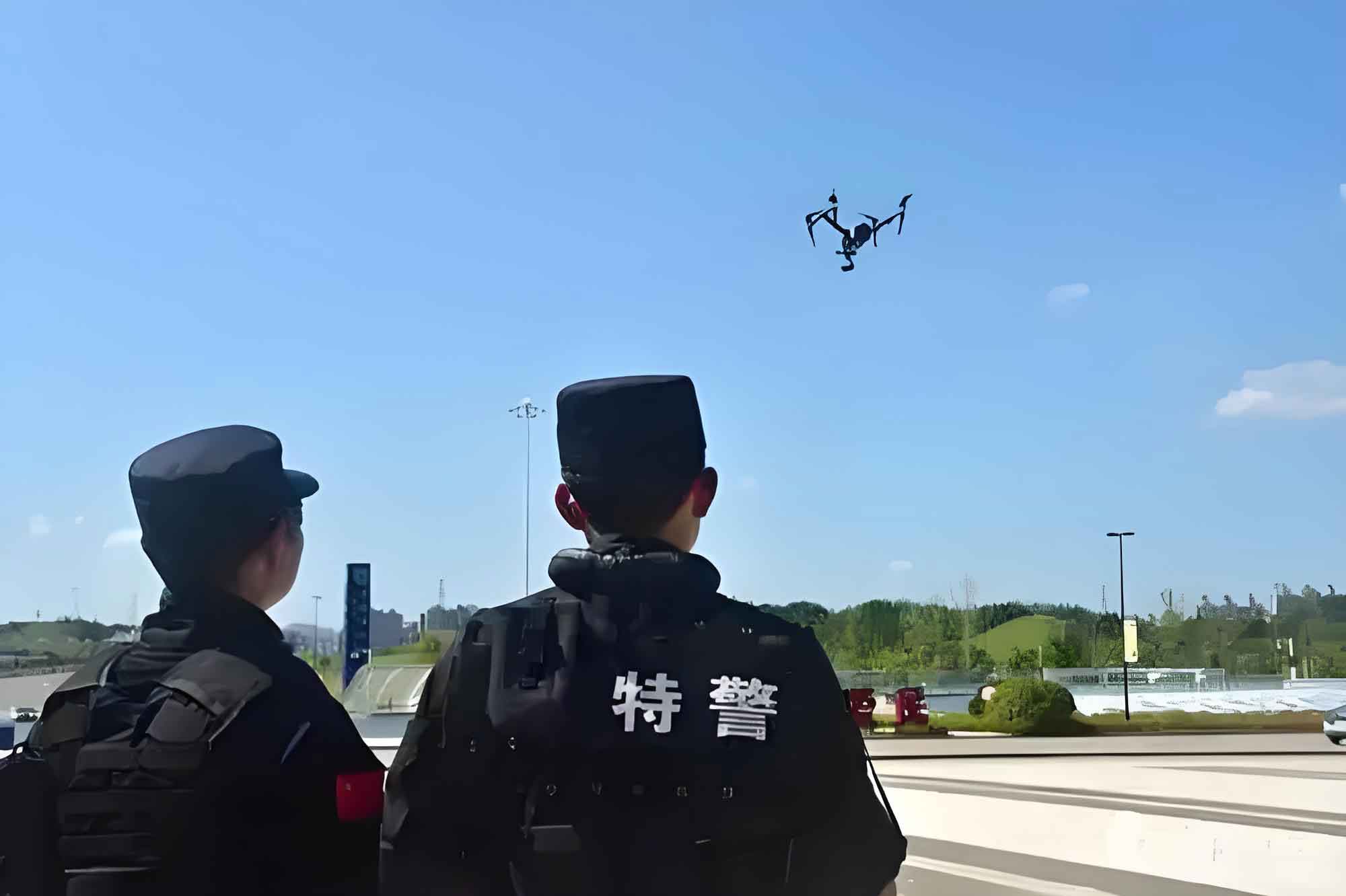
where \( V_{disinfectant} \) is the disinfectant volume, \( t_{spray} \) is the spray time, and \( \eta_{coverage} \) is the coverage efficiency (up to 95% for optimized nozzles). To visualize these applications, I include an image of a police drone in action:
The workflow of police drone执法 involves multiple steps: alert reception, drone deployment, data collection, analysis, and decision-making. This process can be modeled as a system with feedback loops, where the response time \( t_{response} \) is critical:
$$t_{response} = t_{deploy} + t_{flight} + t_{data} + t_{decision}$$
Each component depends on factors like drone speed and network latency. AI integration, such as with vehicle recognition systems, enhances this by processing data at rates exceeding 1000 frames per second, using GPU clusters for real-time analysis.
However, the effective use of police drones requires robust监管 frameworks. Based on my analysis, I propose a tripartite approach focusing on “person,” “machine,” and “operation.” For the “person” aspect, pilot certification is essential. The qualification process can be represented as a function \( Q_{pilot} \):
$$Q_{pilot} = f(Health, Training, Exam, License)$$
where Health includes vision and hearing tests, Training involves at least 100 hours of flight practice, Exam covers theoretical and practical tests, and License is categorized into levels A (expert), B (elite), and C (beginner). A table summarizing this is provided:
| Pilot Level | Minimum Experience | Allowed Tasks | Renewal Requirements |
|---|---|---|---|
| Level C (Beginner) | 1 year, 100+ flight hours | Basic patrols in low-risk areas | Annual refresher courses |
| Level B (Elite) | 3 years, 300+ flight hours | Complex operations, night flights | Biannual assessments |
| Level A (Expert) | 5 years, 500+ flight hours | All tasks, including emergency response | Continuous training and audits |
For the “machine” aspect, police drones must be registered and marked with police insignia to avoid confusion. The registration system ensures traceability, with each police drone assigned a unique ID \( U_{ID} \) stored in a national database. Maintenance cycles are also crucial; the operational lifespan \( L_{drone} \) can be estimated as:
$$L_{drone} = \frac{T_{total}}{t_{usage}} \times \delta_{maintenance}$$
where \( T_{total} \) is the total operational time, \( t_{usage} \) is the average usage per mission, and \( \delta_{maintenance} \) is a maintenance factor (typically 0.9 for well-serviced police drones). Production standards should mandate safety features, such as encryption for data transmission, to prevent breaches.
Regarding “operation,” flight rules must be established to govern police drone activities. This includes no-fly zones, altitude limits (e.g., below 120 meters for most operations), and real-time monitoring via satellite signals. The risk of privacy infringement can be mitigated by defining permissible surveillance areas, with penalties for violations. A regulatory matrix for police drone operations is shown below:
| Regulatory Area | Requirements for Police Drones | Penalties for Non-Compliance |
|---|---|---|
| Flight Permissions | Pre-flight authorization from command centers | Warnings, fines, or license suspension |
| Privacy Protection | Data encryption, limited recording in private zones | Legal action, data deletion mandates |
| Airspace Management | Avoidance of restricted areas (e.g., airports) | Grounding of police drones, pilot retraining |
| Emergency Protocols | Automatic return-to-base in system failures | Incident reviews and corrective measures |
In conclusion, police drones have proven transformative in pandemic执法, offering non-contact solutions that enhance safety and efficiency. From my perspective, the continued evolution of police drone technology hinges on addressing challenges like personnel training and privacy concerns through comprehensive监管. By implementing structured frameworks for pilots, machines, and operations, law enforcement agencies can harness the full potential of police drones while safeguarding public trust. Future research should focus on AI advancements and international regulatory harmonization to ensure police drones remain assets in global crisis response.
To further elaborate, the economic impact of police drones can be analyzed using cost-benefit models. For instance, the total cost of ownership \( C_{total} \) for a police drone fleet over time \( t \) is:
$$C_{total} = \sum_{i=1}^{n} (C_{acquisition} + C_{operation} + C_{maintenance})_i \times e^{-r t}$$
where \( r \) is the discount rate, and \( n \) is the number of police drones. Benefits include reduced officer injuries and faster response times, quantified as \( B_{social} \) in terms of lives saved or crimes prevented. Additionally, the scalability of police drone operations allows for deployment in diverse scenarios, from urban centers to remote areas, making them versatile tools in law enforcement arsenals. As technology progresses, I anticipate that police drones will integrate more advanced sensors and autonomous capabilities, further revolutionizing警务执法 in pandemics and beyond.