
In recent years, the proliferation of unmanned aerial vehicles (UAVs), particularly small drones, has posed significant challenges to air defense systems worldwide. Traditional anti-aircraft measures often struggle to effectively counter large-scale swarms of low-cost, small suicide drones. As a result, there is a growing interest in passive detection technologies that offer stealth and cost-effectiveness. Among these, anti-drone acoustic detection systems have emerged as a promising auxiliary tool, leveraging sound waves to identify and track UAVs. In this article, we delve into the principles, current state, and future trends of anti-drone acoustic detection, drawing insights from global developments. We aim to provide a comprehensive analysis that highlights the potential of these systems in enhancing anti-drone capabilities, despite limitations such as limited detection range. Through detailed explanations, formulas, and tables, we summarize key aspects and explore technological breakthroughs that could propel anti-drone acoustic systems into mainstream defense applications.
Anti-drone acoustic detection systems operate by using microphones or microphone arrays to listen for specific acoustic signals generated by drone motors or rotors. These signals typically fall within a frequency range of 0.2 to 20 kHz. The systems employ sound sensors to capture, process, and match the collected signals against a database of drone audio fingerprints, enabling detection and classification. This passive approach offers inherent stealth, as it does not emit active signals, making it difficult for drones to detect the monitoring system. However, the effectiveness of anti-drone acoustic detection is constrained by factors like environmental noise and weather conditions, which we will discuss in detail.
The core principle of acoustic detection involves analyzing the time difference of arrival (TDOA) of sound waves at multiple microphones to locate a drone. This can be expressed mathematically using the following formula for a simple two-microphone setup:
$$ \Delta t = \frac{d}{c} $$
where $\Delta t$ is the time difference between sound arrival at two microphones, $d$ is the distance difference between the drone and each microphone, and $c$ is the speed of sound (approximately 343 m/s at room temperature). For more accurate localization in three-dimensional space, a microphone array with multiple elements is used, and beamforming techniques are applied. The beamformed output $y(t)$ can be represented as:
$$ y(t) = \sum_{i=1}^{N} w_i x_i(t – \tau_i) $$
where $N$ is the number of microphones, $w_i$ are weighting coefficients, $x_i(t)$ are the input signals, and $\tau_i$ are time delays adjusted to steer the beam toward the sound source. This allows for precise direction finding, with accuracy comparable to GPS in ideal conditions. However, the maximum detection range for typical anti-drone acoustic systems is around 500 meters, which limits their standalone utility. To overcome this, researchers are exploring networked systems and multi-sensor fusion, which we will cover later.
Background noise and adverse weather conditions significantly impact the performance of anti-drone acoustic detection. For instance, precipitation and high winds can attenuate sound waves, while urban environments introduce complex background noise that masks drone signatures. Studies show that in high-noise areas like commercial airports, the detection probability can drop substantially. Therefore, anti-drone acoustic systems often incorporate advanced signal processing algorithms, including machine learning, to improve robustness. We will examine how various countries have implemented such technologies in their anti-drone initiatives.
Globally, several nations have developed and deployed anti-drone acoustic detection systems, each with unique features and applications. Below, we summarize key systems in a table to provide a quick overview, followed by detailed descriptions.
| Country/Region | System Name | Key Components | Detection Range | Special Features | Status/Cost |
|---|---|---|---|---|---|
| Ukraine | Acoustic Fortress (Zvook) | Distributed acoustic sensors, parabolic mirrors, microphones, Android phones | ~5 km for drones, ~7 km for cruise missiles | AI-based threat identification, low false alarm rate (~1.6%), large-scale network | Deployed (10,000+ units), ~$500 per sensor |
| Russia | Malik | Four microphones, processing unit, RS485 interface | Not specified | Portable and fixed versions, continuous database updates | Testing phase |
| United States | D2TAS (by Raytheon) | Acoustic signature analysis, portable design | 100-500 m or more | Provides azimuth and elevation tracking | Developed and operational |
| Australia | DroneShield System | Multi-sensor fusion (radar and acoustic) | Not specified | Patented, reduces false alarms through correlation | Patented, in use |
| Norway | Discovair G2 | 128-microphone array, optical camera | Not specified | Lightweight, low power, for extreme environments | Deployed in various scenarios |
| Denmark | Komodo | Acoustic sensors, mobile or fixed deployment | 250 m radius per unit | 360° monitoring, integrates with other C2 systems | Tested in NATO exercises |
In Ukraine, the anti-drone acoustic system known as Zvook has been widely deployed to counter low-altitude threats like cruise missiles and drones. It consists of thousands of acoustic sensors distributed across the country, forming a large-scale passive sonar network. Each sensor unit includes a parabolic mirror, microphone, Android smartphone, backup battery, and software, with dimensions around 30.48 cm × 30.48 cm × 5.08 cm. Installed at heights of 10-12 meters, these sensors use triangulation and machine learning algorithms to detect and classify targets. The system demonstrated rapid deployment and effectiveness, with the first sensor detecting an incoming cruise missile within four hours of installation. The low cost of approximately $500 per sensor, reducible with bulk orders, has enabled mass deployment, showcasing the scalability of anti-drone acoustic networks.
Russia’s Malik acoustic detector, developed by a design bureau, is designed to detect drones operating on any radio frequency. It comprises four microphones and a processing-transmission unit, with data sent via mobile networks or wireless channels. The inclusion of an RS485 interface ensures robust data transmission over distances up to 1,200 meters at lower speeds. The system offers both fixed and portable versions, with ongoing updates to its acoustic signature database to incorporate new drone models. While still in testing, Malik represents a focused effort to enhance anti-drone capabilities through acoustic means.
In the United States, Raytheon’s D2TAS system exemplifies portable anti-drone acoustic detection, capable of tracking quadcopters and octocopters at slant ranges of 100-500 meters or more. It provides angular information for sustained tracking, filling gaps in other detection methods. Australia’s DroneShield system employs a multi-sensor approach, combining radar and acoustic sensors to improve accuracy and reduce false alarms. This fusion technique is critical for anti-drone operations in cluttered environments. Norway’s Discovair G2 directional acoustic array features 128 microphones and an optical camera, offering “super hearing” and enhanced situational awareness in harsh conditions. Denmark’s Komodo system enables 360° acoustic monitoring over a 250-meter radius per unit and can be networked for larger area coverage, as validated in NATO trials.
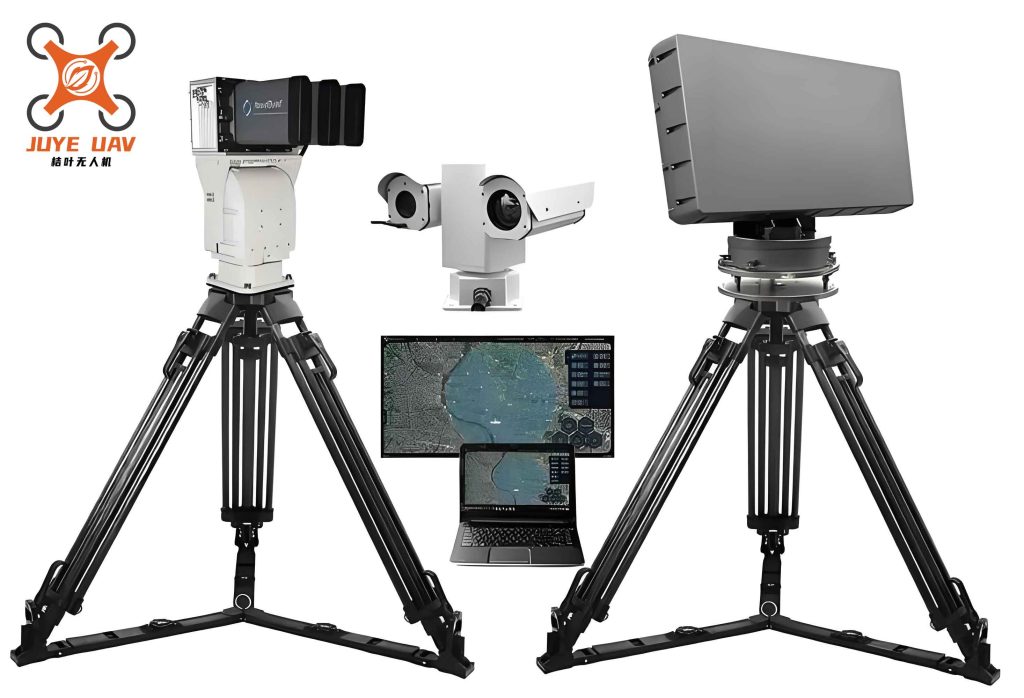
The evolution of anti-drone acoustic detection is driven by two main trends: intelligence and networking. Intelligence refers to the integration of artificial intelligence (AI) and machine learning algorithms to enhance target recognition. For instance, Ukraine’s Zvook system uses AI to distinguish between different types of aerial threats, achieving high success rates. As drone technology advances, AI will play a pivotal role in overcoming the limitations of acoustic detection, such as limited range and susceptibility to noise. We can model the improvement in detection probability $P_d$ with AI using a logistic function:
$$ P_d = \frac{1}{1 + e^{-k(S – \theta)}} $$
where $S$ is the signal-to-noise ratio (SNR), $\theta$ is a detection threshold, and $k$ is a scaling factor that AI optimizes. By training on diverse audio datasets, anti-drone systems can better isolate drone signatures from background clutter, thereby extending effective detection ranges in complex scenarios.
Networking involves the deployment of distributed acoustic sensor networks to amplify coverage and accuracy. Instead of relying on single points, multiple sensors are interconnected to form a mesh that triangulates drone positions over wider areas. This can be described using a network localization formula based on least squares estimation:
$$ \min_{\mathbf{p}} \sum_{i=1}^{M} \sum_{j=1}^{N} (t_{ij} – \frac{\|\mathbf{p} – \mathbf{s}_j\|}{c})^2 $$
where $\mathbf{p}$ is the drone’s position vector, $\mathbf{s}_j$ are sensor locations, $t_{ij}$ are measured time delays, $M$ is the number of drones, and $N$ is the number of sensors. Such networked anti-drone systems, when fused with radar, RF, and visual sensors, create a comprehensive defense grid. For example, future systems could leverage Internet of Things (IoT) technologies to deploy thousands of low-cost acoustic nodes, enabling real-time, large-scale monitoring of low-altitude airspace.
Despite progress, anti-drone acoustic detection faces inherent challenges. The limited detection range, typically under 1 km, restricts its use as a primary detection method. Environmental factors like wind and rain can degrade performance, as sound propagation is affected by atmospheric conditions. The attenuation of sound intensity $I$ over distance $r$ can be expressed as:
$$ I(r) = I_0 e^{-\alpha r} $$
where $I_0$ is the initial intensity and $\alpha$ is the attenuation coefficient, which increases with humidity and precipitation. To mitigate this, anti-drone systems must incorporate adaptive filtering and multi-modal sensing. Additionally, the proliferation of drone swarms presents a challenge, as acoustic systems may struggle to distinguish individual units in a group. Research into advanced array processing and deep learning is ongoing to address these issues.
Looking ahead, the future of anti-drone acoustic detection lies in hybrid architectures that combine various technologies. For instance, maritime platforms like buoys or ships could host acoustic sensors to monitor coastal areas, complementing radar systems that have blind spots at low altitudes. The integration formula for a fused system might be:
$$ F = w_a A + w_r R + w_o O $$
where $F$ is the fused output, $A$ is the acoustic detection score, $R$ is the radar detection score, $O$ is the optical score, and $w_a$, $w_r$, $w_o$ are weighting factors optimized via machine learning. Such systems would enhance anti-drone capabilities in strategic regions, from urban centers to border areas.
In conclusion, anti-drone acoustic detection systems offer a valuable, stealthy supplement to traditional air defense methods. While currently limited by range and environmental factors, advancements in AI and networked sensors are poised to overcome these hurdles. The global developments surveyed in this article demonstrate a trend toward intelligent, distributed systems that can operate in diverse conditions. For effective anti-drone defense, we recommend investing in multi-sensor fusion, algorithmic optimization, and scalable deployment strategies. By doing so, nations can bolster their ability to detect and counter low-altitude drone threats, ensuring security in an era of evolving aerial warfare. The continuous innovation in anti-drone technology will likely see acoustic systems playing an increasingly vital role in integrated defense networks.