
As a researcher deeply immersed in the field of smart policing and technological integration, I have witnessed firsthand the transformative impact of police drones on law enforcement operations. The advent of the Internet of Things (IoT), big data, cloud computing, and artificial intelligence (AI) has fundamentally reshaped policing strategies, giving rise to the concept of smart policing. In this context, police drones have emerged as critical mobile assets, providing unparalleled aerial perspectives and real-time data acquisition capabilities. They serve as force multipliers, enhancing efficiency in criminal investigation, traffic management, large-scale event security, and emergency response. However, the rapid adoption of police drones also exposes systemic challenges related to standardization, regulation, and integration. This article explores the practical requirements, applications, challenges, and strategic solutions for police drone deployment from a first-person perspective, emphasizing the need for规范化,专业化, and法制化 development within the broader smart policing ecosystem.
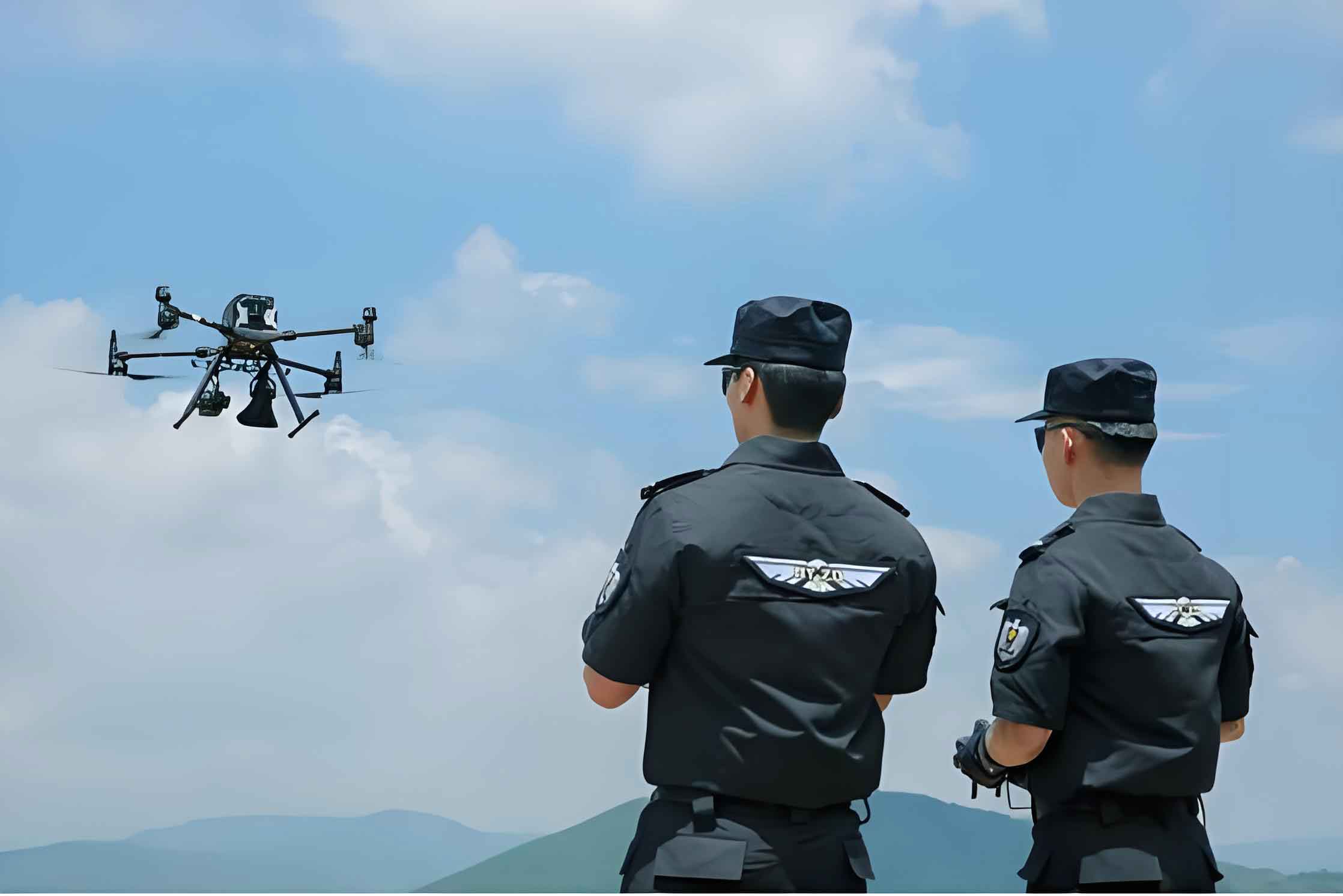
The integration of police drones into smart policing frameworks is not merely an additive process but a synergistic one. Smart policing relies on pervasive sensing, interconnected devices, and data fusion to enable predictive analytics and real-time decision-making. Police drones act as aerial nodes in this network, collecting multidimensional data that enriches the intelligence landscape. From a requirements standpoint, the effectiveness of a police drone system can be modeled using key performance indicators (KPIs). For instance, the operational efficiency $E$ of a police drone in patrol missions can be expressed as:
$$E = \frac{A_c \cdot R_d}{T_f \cdot C_o}$$
where $A_c$ is the area covered, $R_d$ is the data resolution (e.g., video quality), $T_f$ is the flight time, and $C_o$ is the operational cost. Under smart policing, police drones must exhibit enhanced interoperability, standardized communication protocols, and advanced AI functionalities such as automatic target recognition and tracking. The convergence of police drone data with centralized command platforms is essential for achieving situational awareness and coordinated responses. We must recognize that police drone development is transitioning from fragmented, ad-hoc use toward规模化, systematic integration, where each drone contributes to a cohesive aerial intelligence grid.
In practical terms, police drone applications have demonstrated significant value across diverse scenarios. Through observations and case studies, I have noted that police drones are routinely deployed for surveillance, evidence collection, crowd monitoring, and search-and-rescue operations. For example, in traffic management, police drones equipped with high-resolution cameras can monitor congestion and accidents, relaying data to ground units for rapid intervention. The data acquired by police drones often follows a logarithmic growth pattern, as the volume $V_d$ of information gathered over time $t$ can be approximated by:
$$V_d(t) = V_0 \cdot e^{kt}$$
where $V_0$ is the initial data volume and $k$ is a constant dependent on the drone’s sensor suite and mission profile. To illustrate common applications, the table below summarizes key use cases of police drones and their associated technological demands:
| Application Scenario | Primary Police Drone Function | Required Technology | Typical Data Output |
|---|---|---|---|
| Criminal Investigation | Aerial reconnaissance and forensic mapping | High-resolution cameras, LiDAR, thermal imaging | 3D models, geotagged imagery |
| Large Event Security | Real-time crowd monitoring and threat detection | AI-based video analytics, long-endurance platforms | Live video feeds, anomaly alerts |
| Traffic Management | Accident scene documentation and flow analysis | Automatic number plate recognition, streaming capabilities | Traffic reports, violation evidence |
| Emergency Response | Search and rescue, disaster assessment | Thermal sensors, loudspeakers, payload delivery systems | Victim locations, damage assessments |
Despite these advancements, the deployment of police drones faces multifaceted challenges that hinder their full potential. From a structural perspective, issues in team building, equipment standardization, and management frameworks are prevalent. The effectiveness of a police drone unit often depends on the skill level of operators, which can be quantified by a proficiency score $P_s$ that combines training hours $H_t$, certification level $C_l$, and实战 experience $E_x$:
$$P_s = \alpha \cdot \ln(H_t) + \beta \cdot C_l + \gamma \cdot E_x$$
where $\alpha$, $\beta$, and $\gamma$ are weighting coefficients. However, many agencies lack dedicated police drone teams, leading to inconsistent operations and safety risks. Equipment-wise, the absence of unified technical standards results in a heterogeneous fleet of police drones with varying capabilities. This fragmentation complicates maintenance, data integration, and interoperability. For instance, the encryption strength $S_e$ of police drone communications is critical for operational security, yet many systems use vulnerable民用 frequencies, exposing them to interception. The risk $R_i$ can be modeled as:
$$R_i = 1 – \frac{S_e}{S_{max}}$$
where $S_{max}$ is the maximum achievable security level. Furthermore, regulatory gaps surrounding police drone执法 activities, such as privacy concerns and evidentiary admissibility, create legal ambiguities. The table below delineates core challenges in police drone deployment:
| Challenge Category | Specific Issues | Impact on Police Drone Operations |
|---|---|---|
| Team Building | Shortage of certified pilots, uneven training, lack of specialized units | Reduced mission readiness and increased operational errors |
| Equipment Construction | Inadequate funding, non-standardized hardware, insecure data links | Limited functionality and compromised data integrity |
| Management Systems | Fragmented oversight, inefficient flight approval processes, weak R&D mechanisms | Delayed responses and hindered technological innovation |
| Legal and Ethical Frameworks | Unclear regulations on surveillance, privacy infringement risks, lack of执法 guidelines | Public distrust and potential legal challenges |
To address these challenges, a holistic strategy centered on institutionalization, innovation, and integration is essential. From my perspective, the first step is establishing dedicated police drone units at municipal levels, equipped with standardized fleets and trained personnel. The operational capacity $O_c$ of such a unit can be enhanced through economies of scale, expressed as:
$$O_c = N_d \cdot \overline{P_s} \cdot I_s$$
where $N_d$ is the number of police drones, $\overline{P_s}$ is the average operator proficiency, and $I_s$ is the integration level with smart policing platforms. Funding should be allocated systematically, with police drone investments embedded in broader smart city budgets. Moreover, fostering collaborative R&D between law enforcement agencies, academic institutions, and technology firms is crucial for developing tailored solutions. For example, AI algorithms for automatic罂粟 detection using police drones can be optimized through machine learning models, such as a convolutional neural network (CNN) with an accuracy function $A$:
$$A(\theta) = \frac{TP + TN}{TP + TN + FP + FN}$$
where $\theta$ represents model parameters, and TP, TN, FP, FN denote true positives, true negatives, false positives, and false negatives, respectively. By pooling resources, the cost $C_{dev}$ of developing such specialized police drone applications can be reduced through shared innovation:
$$C_{dev} = \frac{C_0}{n}$$
where $C_0$ is the initial development cost and $n$ is the number of collaborating entities. Additionally, a comprehensive training ecosystem for police drone operators must be instituted, covering basic flight skills, advanced tactical maneuvers, and legal compliance. The competency growth $G_c$ over time $t$ can be described by a logistic function:
$$G_c(t) = \frac{L}{1 + e^{-r(t – t_0)}}$$
where $L$ is the maximum competency level, $r$ is the learning rate, and $t_0$ is the inflection point. On the regulatory front, clear guidelines for police drone执法 are imperative, addressing airspace access, data management, and ethical use. The legitimacy $L_g$ of police drone operations can be framed as a function of transparency $T_r$, proportionality $P_p$, and accountability $A_c$:
$$L_g = w_1 T_r + w_2 P_p + w_3 A_c$$
with $w_1$, $w_2$, $w_3$ as权重 coefficients summing to 1. The following table outlines strategic solutions for enhancing police drone systems:
| Strategic Area | Proposed Measures | Expected Outcomes for Police Drone Efficacy |
|---|---|---|
| Professionalization of Teams | Create municipal police drone units, mandate certifications, conduct regular drills | Improved coordination and higher mission success rates |
| Equipment Standardization | Adopt unified technical specs for police drones, secure encrypted communication channels | Enhanced interoperability and robust data protection |
| Research and Development | Establish public-private partnerships for AI-driven police drone applications | Cost-effective innovation and customized functionalities |
| Training and Education | Develop tiered training programs with simulations and实战 scenarios | Skilled operators adaptable to complex environments |
| Legal and Ethical Frameworks | Enact clear laws on police drone use, ensure privacy safeguards, define执法 protocols | Increased public trust and legal clarity |
In conclusion, the evolution of police drones within smart policing is an ongoing journey marked by technological promise and practical hurdles. As we look ahead, the integration of police drones into holistic law enforcement strategies will depend on concerted efforts to build robust institutions, foster innovation, and uphold ethical standards. The future trajectory of police drone development will likely see greater autonomy, seamless data fusion with IoT networks, and enhanced public acceptance through transparent governance. By addressing current limitations proactively, police drones can truly become indispensable aerial assets, empowering law enforcement to serve communities more effectively and safely. The continuous refinement of police drone systems, guided by empirical insights and collaborative wisdom, will undoubtedly shape the next frontier of modern policing.