
As a professional deeply involved in modern agricultural practices, I have witnessed firsthand the transformative impact of technology on crop management. Corn, being a staple cereal crop of global importance, faces persistent threats from a myriad of pests and diseases. Effective management of these biotic stresses is paramount to securing yield and ensuring grain quality. Traditional ground-based spraying methods, while foundational, present significant challenges including labor intensity, operator safety risks, uneven chemical application, and environmental contamination. In this context, the emergence and adoption of agricultural UAVs (Unmanned Aerial Vehicles), commonly known as crop protection drones, represent a paradigm shift. This article delves into the multifaceted role of agricultural UAVs in corn pest and disease control, analyzing their technical advantages, current limitations, strategies for optimization, and future trajectories, supported by quantitative frameworks and systematic comparisons.
1. Introduction: The Imperative for Precision in Corn Protection
Corn cultivation is a cornerstone of global food, feed, and biofuel systems. The productivity of this vital crop is continually besieged by insect pests (e.g., corn borers, armyworms, aphids) and fungal/bacterial diseases (e.g., northern corn leaf blight, gray leaf spot, rust). The economic threshold for intervention is often narrow, requiring timely and precise application of control measures. Conventional knapsack or tractor-mounted sprayers struggle with efficiency, especially in dense canopy stages or under wet field conditions, and pose considerable drift hazards. The integration of agricultural UAVs into integrated pest management (IPM) strategies offers a compelling alternative. These remotely piloted or autonomous systems enable targeted aerial application, promising enhanced efficacy, operational safety, and ecological sustainability. The evolution from broad-scale chemical coverage to site-specific, dose-optimized application is at the core of this technological advancement.
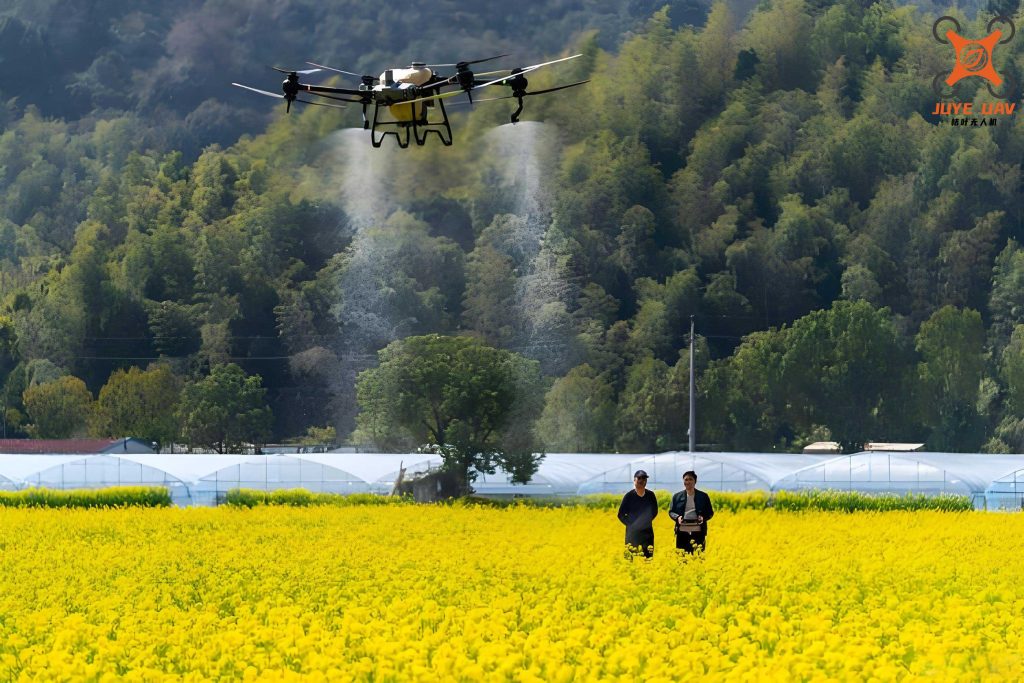
2. Technical Foundations and Operational Mechanics of Agricultural UAVs
The effectiveness of an agricultural UAV in pest management is governed by its system architecture and the physics of droplet dispersal. A standard system comprises several integrated subsystems.
| Subsystem | Components | Primary Function |
|---|---|---|
| Airframe & Propulsion | Multirotor (quadcopter, hexacopter, octocopter) frame; Brushless DC motors; Propellers | Provides lift, stability, and maneuverability. Determines payload capacity and wind resistance. |
| Navigation & Control | Global Navigation Satellite System (GNSS: GPS, Beidou); Inertial Measurement Unit (IMU); Flight Controller; Remote Controller/Tablet with mission planning software | Enables autonomous, pre-programmed flight along geofenced routes with centimeter-level accuracy. Ensures consistent swath width and overlap. |
| Spraying System | Liquid tank; Pump; Pressure regulator; Spray bar with nozzles (usually hydraulic or air-induced) | Stores and delivers the pesticide formulation. Nozzle type and size control droplet spectrum (Volume Median Diameter, VMD). |
| Sensing & Intelligence | RGB, multispectral, or hyperspectral cameras; Light Detection and Ranging (LiDAR); Real-time kinematic (RTK) positioning module | Facilitates crop health monitoring, biomass estimation, and variable-rate application based on sensor data. |
| Power System | High-density Lithium Polymer (LiPo) or Lithium-ion batteries; Power distribution board | Supplies electrical energy. Flight endurance is a critical limiting factor tied to battery technology. |
The key to superior performance lies in the aerodynamic interaction between the UAV’s downwash airflow and the spray droplets. The rotors generate a coherent downward air current that penetrates the crop canopy.
The downwash velocity ($v_d$) aids in droplet deposition and canopy penetration, reducing off-target drift. The effective deposition rate on the target (e.g., leaf underside) can be conceptually modeled as a function of multiple variables:
$$
\eta_d = f(D_{vmd}, v_d, H, \rho_{canopy}, U_{wind})
$$
Where:
$\eta_d$ = Effective deposition efficiency
$D_{vmd}$ = Volume Median Diameter of the droplet spectrum
$v_d$ = Induced downwash velocity at canopy level
$H$ = Flight height above canopy
$\rho_{canopy}$ = Canopy density/Leaf Area Index (LAI)
$U_{wind}$ = Ambient wind speed
Optimal operation requires balancing these parameters. For instance, a finer droplet size ($D_{vmd}$ ~ 100-200 µm) increases coverage but is more prone to drift; the downwash ($v_d$) must be sufficient to counteract this. The swath width ($SW$) and area coverage rate ($A_{rate}$) are given by:
$$
SW = N \cdot s
$$
$$
A_{rate} = SW \cdot v_{gnd} \cdot \eta_{overlap}
$$
Where $N$ is the effective number of nozzles, $s$ is nozzle spacing, $v_{gnd}$ is the ground speed of the agricultural UAV, and $\eta_{overlap}$ is the effective factor accounting for swath overlap (typically 1.1-1.3 for 20-30% overlap).
| Parameter | Manual Knapsack/Tractor | Agricultural UAV |
|---|---|---|
| Application Rate (L/ha) | 300-500 | 10-30 |
| Working Speed (km/h) | 2-5 / 6-10 | 20-40 |
| Area Coverage (ha/h) | 0.5-1 / 5-10 | 20-60 |
| Canopy Penetration | Moderate (from ground) | Enhanced (top-down with downwash) |
| Water Consumption | Very High | Very Low (Ultra-Low Volume, ULV) |
| Operator Exposure Risk | High (direct contact) | Very Low (remote operation) |
3. Multifaceted Advantages in Corn Pest and Disease Management
The application of agricultural UAVs confers a suite of strategic advantages that address the core inefficiencies of traditional methods.
3.1 Unmatched Operational Efficiency and Timeliness
The most salient benefit is speed. An agricultural UAV can treat vast areas in a single flight cycle, with operational efficiency exceeding manual labor by a factor of 40-100. This is critical for managing fast-proliferating pests like fall armyworm or explosive fungal outbreaks following conducive weather. The rapid response capability, often within a critical 24-48 hour window, can prevent economic damage that slower methods cannot avert.
3.2 Enhanced Application Precision and Efficacy
Precision is engineered into the system. GNSS-RTK guidance ensures accurate flight paths with minimal overlap or skip. The downwash effect, as described, forcibly directs droplets onto both the adaxial (upper) and abaxial (lower) leaf surfaces—the latter being a common infestation site for pests and pathogens. This results in superior canopy coverage and deposition uniformity, directly translating to higher biological efficacy of the applied agrochemicals. Studies show that under optimal conditions, an agricultural UAV can achieve comparable or better pest control with 20-50% less active ingredient compared to conventional ground sprayers.
3.3 Drastic Reduction in Human Health and Safety Risks
Safety is a non-negotiable priority. Agricultural UAV operation physically decouples the farmer from the chemical handling and spraying process. Operators control the drone from the edge of the field, eliminating dermal exposure, inhalation of spray aerosols, and the risks associated with working in high temperatures while carrying heavy equipment. This represents a fundamental improvement in occupational health for agricultural workers.
3.4 Economic Rationalization: Lower Input and Operational Costs
While the initial capital outlay is significant, the total cost of operation over time becomes favorable. The economics are driven by:
- Chemical Savings: Ultra-Low Volume (ULV) application and targeted deposition minimize chemical waste.
- Labor Savings: One operator can manage what previously required multiple laborers.
- Resource Efficiency: Drastic reduction in water usage (from ~400 L/ha to ~15 L/ha).
- Reduced Crop Damage: No wheel traffic or trampling from ground equipment, preserving soil structure and plant stands.
The net effect is a lower cost-per-hectare for pest control interventions in the medium to long term.
3.5 Positive Environmental Footprint
The environmental benefits are twofold: reduced chemical load and minimized drift. Precise application ensures more pesticide lands on the intended target, lowering the amount that enters soil and water systems. Lower drift also protects adjacent non-target crops, natural habitats, and sensitive areas. This aligns with the principles of sustainable intensification and responsible chemical use.
| Aspect | Traditional Ground Spraying | Agricultural UAV Spraying |
|---|---|---|
| Efficacy & Coverage | Variable, often poor underside coverage | High, uniform top and underside coverage |
| Operational Speed | Slow | Extremely Fast |
| Input Use Efficiency | Low (high waste) | High (precise delivery) |
| Operator Safety | Low | High |
| Environmental Impact | Higher risk of runoff and drift | Lower risk, targeted application |
| Field Accessibility | Limited by terrain, crop height, moisture | High (independent of ground conditions) |
4. Current Challenges and Limitations in Widespread Adoption
Despite the clear advantages, the path to ubiquitous adoption of agricultural UAVs is not without obstacles. These challenges are primarily socio-economic and technical-infrastructural.
4.1 High Initial Capital Investment and Policy Support Gaps
The upfront cost of a capable agricultural UAV system, including batteries, charger, and spare parts, remains a significant barrier for individual smallholder farmers. While government subsidy programs exist in many regions, the subsidy amount often covers only a fraction (10-20%) of the total system cost. This limits ownership to larger farms, cooperatives, or specialized service providers. More robust and inclusive subsidy frameworks are needed to democratize access.
4.2 Technical Complexity and Skill Gaps
Operating an agricultural UAV effectively is not trivial. It requires knowledge of flight planning, calibration, battery management, basic maintenance, and, crucially, the principles of aerial application (droplet size, weather windows, chemistry compatibility). A lack of standardized, accessible training programs can lead to suboptimal application, safety incidents, or equipment damage, eroding user confidence.
4.3 Limited After-Sales Service and Support Networks
In many agricultural regions, the supply chain for spare parts, repairs, and technical support is underdeveloped. Downtime during critical pest control windows due to a lack of local service can be devastating. Building a robust ecosystem of dealers, service centers, and trained technicians is as important as selling the drones themselves.
4.4 Regulatory and Airspace Management Hurdles
Airspace regulations for unmanned aircraft are evolving. Compliance requirements related to pilot licensing, vehicle registration, flight altitude restrictions, and no-fly zones add layers of complexity. Streamlined, agriculture-specific regulatory frameworks are essential for scaling operations.
4.5 Awareness and Perceived Need Among Smallholders
For farmers with fragmented, small plots, the cost-benefit analysis may not favor personal ownership. Raising awareness about the availability and benefits of UAV-based spraying services, rather than just ownership, is key to driving adoption in these contexts.
| Internal (Attributes of the Technology) | External (Market & Environment) | |
|---|---|---|
| Strengths | High speed, precision, safety, low water use, canopy penetration, data collection capability. | Growing labor scarcity, increasing focus on sustainable agriculture, demand for traceability. |
| Weaknesses | High initial cost, limited flight endurance/battery life, technical skill requirement, sensitivity to strong winds. | Fragmented smallholder landscapes, low farmer technical literacy in some regions. |
| Opportunities | Development of AI for scouting, multi-functional platforms (spraying, seeding, fertilizing), improved battery tech. | Government “Smart Agriculture” initiatives, carbon credit markets for reduced chemical use, growth of service provider models. |
| Threats | Rapid technological obsolescence, cybersecurity risks for autonomous systems. | Stringent/unclear regulations, chemical label restrictions for aerial use, competition from other precision tech (e.g., automated ground sprayers). |
5. Strategies for Optimizing the Role of Agricultural UAVs in Corn IPM
To fully integrate agricultural UAVs as a core tool in corn IPM, a concerted, multi-stakeholder approach is required.
5.1 Strengthening Policy and Financial Support Mechanisms
Governments and financial institutions should design holistic support packages. This includes:
- Increasing direct purchase subsidies to lower the entry barrier.
- Offering low-interest loans or leasing programs for farmers and service providers.
- Developing insurance products tailored for agricultural UAV operations and potential liability.
- Funding demonstration plots and field trials to generate localized efficacy data.
5.2 Building Comprehensive Capacity and Training Ecosystems
Establishing accredited training centers is crucial. Curricula should cover:
- Basic UAV piloting and safety protocols.
- Advanced aerial application agronomy: calibration, droplet physics, chemical mixing, and weather assessment.
- Basic troubleshooting, maintenance, and data management.
- Integration of UAV-derived scouting data into IPM decision-making.
Certification upon completion can professionalize the operator role.
5.3 Fostering Research and Development for Tailored Solutions
Collaboration between academia, UAV manufacturers, and agrochemical companies is needed to:
- Develop and register pesticide formulations specifically optimized for ULV aerial application (e.g., with anti-evaporants, deposition aids).
- Refine AI models for real-time pest/disease identification from UAV imagery.
- Create decision-support systems that translate sensor data into variable-rate prescription maps for the agricultural UAV.
5.4 Promoting the Service-Provider Model
For regions dominated by smallholders, the most viable model is often not ownership, but access to professional spraying services. Encouraging entrepreneurship to establish local agricultural UAV service companies can bring the technology’s benefits to a wide farmer base without the need for individual investment or technical expertise.
6. Future Trajectories: The Intelligent and Multi-Functional Agricultural UAV
The future of the agricultural UAV extends far beyond being a simple spray platform. It is evolving into an intelligent field robot and a central data node in the farm management system.
6.1 Advanced Autonomy and Swarm Intelligence
Future systems will feature heightened autonomy. This includes advanced obstacle avoidance (for trees, power lines), automated take-off/landing/recharging at base stations, and the ability to modify flight plans in real-time based on live sensor feedback. Swarm technology, where multiple drones coordinate to cover a field, will dramatically scale operational capacity. The control paradigm could shift from direct piloting to fleet management via centralized software.
6.2 Multi-Sensor Fusion and Hyper-Precise Analytics
The payload will diversify. Beyond spray systems, drones will routinely carry high-resolution multispectral, thermal, and hyperspectral sensors. Data fusion from these sources will enable incredibly precise analytics:
- Early stress detection before visual symptoms appear.
- Differentiation between nutrient deficiency, water stress, and pest/disease damage.
- Species-level identification of weeds for targeted spot-spraying, modeled by AI algorithms.
The precision of application will thus be driven by real-time, centimeter-scale data.
6.3 Platform Versatility and Multi-Role Capability
A single agricultural UAV platform will be modular, capable of quick payload swaps to perform disparate tasks throughout the crop cycle:
- Pre-planting: Soil sampling, field mapping.
- Planting: Precision seeding of cover crops or main crops in suitable terrains.
- Growth Stage: Pest/disease scouting and spraying, variable-rate nitrogen top-dressing.
- Pollination: Deploying pollen or pollinator attractants (experimental).
This maximizes the return on the hardware investment.
6.4 Sustainability Integration: Biologicals and Green Chemistry
As agriculture moves towards biological inputs (microbial insecticides, biofungicides) and softer chemistry, agricultural UAVs are ideally suited for their application. These products often require careful, timely, and uniform application—conditions that drones can meet efficiently. This positions the agricultural UAV as a key enabler for regenerative and organic farming systems.
6.5 Breakthroughs in Endurance and Payload
Technological leaps in energy storage (e.g., solid-state batteries, hydrogen fuel cells) and efficient aerodynamic design will progressively increase flight time and payload capacity. The governing equation for operational throughput will shift favorably:
$$
\text{Total Daily Coverage} = (Payload_{chemical} / Application_{rate}) \times (Flight_{time} / Cycle_{time})
$$
Where $Cycle_{time}$ includes flight, refill, and battery swap. Improvements in both $Payload_{chemical}$ and $Flight_{time}$ will linearly increase productivity.
7. Conclusion
The integration of agricultural UAVs into corn pest and disease management is a definitive step toward a more efficient, safe, and sustainable production paradigm. By transcending the limitations of ground-based equipment, these aerial systems offer unparalleled advantages in speed, precision, and operator safety, while simultaneously reducing environmental impact through targeted chemical delivery. The challenges to widespread adoption—centered on cost, skills, and infrastructure—are significant but surmountable through coordinated policy support, capacity building, and continued technological innovation. Looking ahead, the convergence of AI, advanced sensors, and robotics will see the agricultural UAV evolve from a specialized spraying tool into an intelligent, multi-role field assistant, becoming an indispensable component of data-driven, precision agriculture. The ongoing development and thoughtful integration of this technology are therefore critical for enhancing the resilience and productivity of global corn systems, ensuring food security in an era of mounting climatic and economic pressures.