
In recent years, the rapid advancement of drone technology has revolutionized various industries, from agriculture and environmental monitoring to logistics and disaster response. As a result, there is a growing demand for skilled professionals who can design, operate, and maintain unmanned aerial vehicles (UAVs). In this context, vocational education institutions play a crucial role in preparing the workforce for this evolving sector. However, traditional training models often fall short in aligning with industry needs, leading to gaps in practical skills and theoretical knowledge. From my perspective, addressing these challenges requires a fundamental shift toward industry-education integration, where educational programs are closely intertwined with real-world applications. This article explores the pathways to optimize drone training programs in vocational colleges, emphasizing the synergy between academia and industry to foster high-quality talent development.
The concept of industry-education integration has gained prominence as a key strategy for enhancing educational outcomes and economic growth. It refers to the deep collaboration between enterprises and educational institutions, where both parties contribute resources, expertise, and insights to create a holistic learning environment. In the realm of drone training, this integration is particularly vital because the technology is rapidly evolving, and industry standards are constantly shifting. By embedding industry practices into the curriculum, students gain hands-on experience with cutting-edge tools and methodologies, thereby increasing their employability and innovation capabilities. Moreover, such collaboration allows educators to stay updated on trends, ensuring that drone training programs remain relevant and effective. As I delve into this topic, I will examine how industry-education integration can transform drone training, from curriculum design to assessment methods, and provide actionable insights for educators and policymakers.
To understand the current state of drone training in vocational education, it is essential to analyze both its strengths and weaknesses. On the positive side, drone training programs often emphasize specialized skills, such as flight control, data analysis, and maintenance, which are highly valued in the job market. Students typically receive foundational knowledge in areas like aerodynamics, electronics, and computer programming, enabling them to tackle diverse challenges in UAV applications. However, several limitations persist. For instance, many programs lack sufficient practical components due to limited access to equipment or outdated teaching methods. Additionally, the curriculum may not fully reflect the interdisciplinary nature of modern drone operations, which often require expertise in fields like geospatial analysis, artificial intelligence, and regulatory compliance. From my observations, these gaps highlight the urgent need for a more dynamic and industry-aligned approach to drone training.
Industry demand for drone professionals is multifaceted, encompassing roles such as pilots, technicians, data analysts, and developers. According to market analyses, employers seek individuals who not only possess technical proficiency but also demonstrate problem-solving abilities, teamwork, and adaptability. This aligns with the broader trend toward competency-based education, where learning outcomes are tied to real-world performance. In drone training, this means going beyond theoretical lectures to incorporate project-based learning, internships, and collaborative research with companies. By doing so, vocational colleges can produce graduates who are ready to contribute immediately to the workforce, driving innovation and efficiency in sectors that rely on UAV technology. As I explore optimization paths, I will emphasize how industry-education integration can bridge the gap between academic preparation and industry expectations.
One of the core elements in optimizing drone training is the redesign of curriculum and teaching methodologies. Traditional approaches often rely on passive learning, but modern education advocates for active engagement through innovative methods. For example, a modular curriculum structure can be implemented to organize courses into cohesive units that build upon each other. Below is a table summarizing a proposed modular system for a drone training program, which I have developed based on industry feedback and educational best practices.
| Module Type | Course Category | Key Courses |
|---|---|---|
| Foundation Module | Public Core Courses | Ethics and Law, Physical Education, Mental Health, Career Guidance, Computer Basics, Foreign Languages |
| Basic Technical Courses | Mathematics for Engineers, Introduction to Drones, Mechanical Drawing, Programming Fundamentals | |
| Specialization Module | Core Professional Courses | Drone Flight Dynamics, GNSS and Positioning, UAV Control Systems, Sensor Technology, Data Processing |
| Advanced Electives | Drone Photography, Agricultural Applications, Disaster Management, AI for UAVs, Regulatory Frameworks | |
| Practical Module | Hands-on Training | Flight Simulation Labs, Field Operations, Internships with Companies, Capstone Projects, Certification Prep |
This modular approach allows for flexibility, enabling students to progress from basic concepts to advanced applications while integrating industry-relevant content. In terms of teaching methods, I advocate for a blend of case studies, project-based learning, and flipped classrooms. For instance, students might analyze real-world scenarios where drones are used for crop monitoring, then design and execute their own missions. Such activities not only enhance technical skills but also foster critical thinking and creativity. Furthermore, digital tools like simulators and virtual reality can supplement hands-on drone training, providing safe and scalable practice environments. By incorporating these innovations, educators can create a more engaging and effective learning experience that mirrors the complexities of the drone industry.
Another critical aspect is strengthening practical training through industry partnerships. Vocational colleges should establish collaborations with drone manufacturers, service providers, and research institutions to provide students with authentic learning opportunities. These partnerships can take various forms, such as joint labs, internship programs, or co-developed courses. For example, a college might partner with a local agriculture company to offer students hands-on experience in using drones for precision farming. This not only enhances practical skills but also exposes students to the business and ethical dimensions of drone applications. To quantify the impact of such collaborations, I propose a simple formula that measures the effectiveness of drone training programs:
$$ E = \alpha \cdot K + \beta \cdot S + \gamma \cdot A $$
Here, \( E \) represents the overall effectiveness of the drone training program, \( K \) denotes knowledge acquisition (assessed through exams and quizzes), \( S \) signifies skill development (evaluated via practical tasks and projects), and \( A \) stands for attitude and professionalism (measured through peer reviews and industry feedback). The coefficients \( \alpha \), \( \beta \), and \( \gamma \) are weights assigned based on industry priorities, with typical values like \( \alpha = 0.3 \), \( \beta = 0.5 \), and \( \gamma = 0.2 \) to emphasize skills. This formula highlights the multifaceted nature of drone training, where success depends not just on theoretical understanding but on practical competencies and professional demeanor.
Inserting the provided hyperlink in a relevant section, such as when discussing practical training resources, can visually enhance the article. For instance, in the context of hands-on learning, an image of UAV training can illustrate the immersive environment that students engage in:
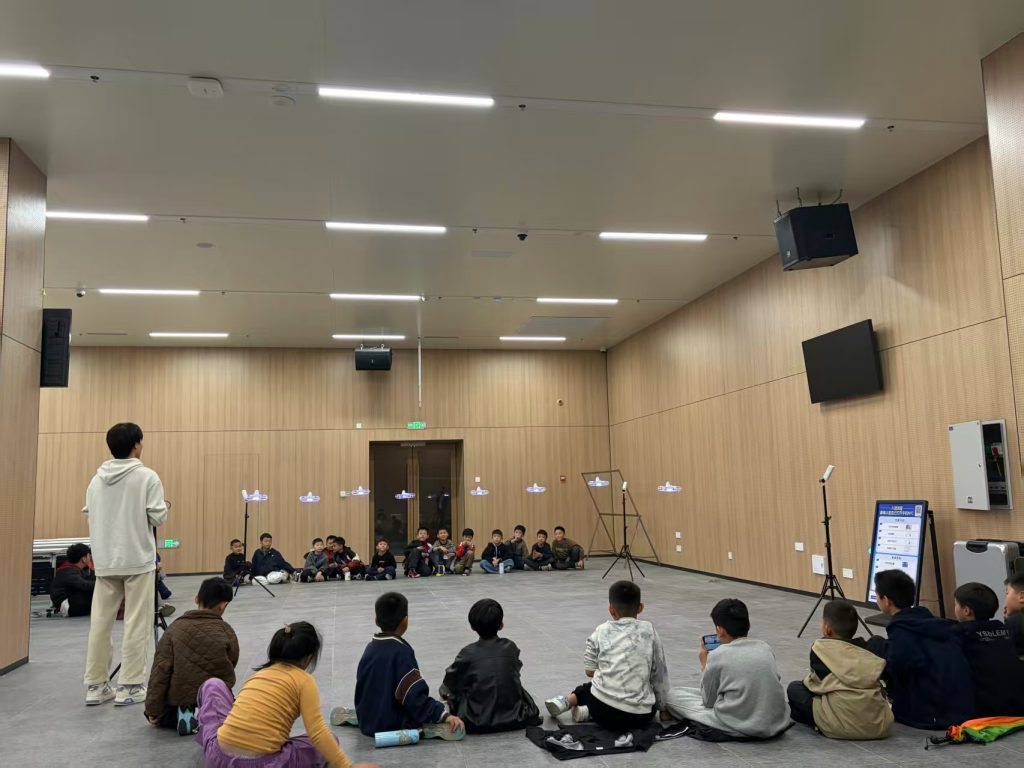
This image captures the essence of practical drone training, showing students interacting with equipment in a field setting. Such visual aids reinforce the importance of experiential learning in developing competent drone professionals. Beyond imagery, institutions should invest in state-of-the-art facilities, including flight test areas, repair workshops, and data analysis labs, to support comprehensive drone training. By leveraging industry partnerships, these resources can be continuously updated to reflect technological advancements, ensuring that students are trained on the latest UAV systems and software.
Faculty development is equally crucial for optimizing drone training programs. Instructors must possess both academic expertise and industry experience to effectively guide students. Therefore, vocational colleges should implement continuous professional development initiatives, such as workshops, industry secondments, and collaborative research projects. For example, teachers might spend semesters working with drone companies to gain insights into emerging trends, then incorporate those insights into their teaching. Additionally, hiring practitioners as adjunct faculty can bring real-world perspectives into the classroom. From my experience, a diverse teaching team that includes engineers, pilots, and entrepreneurs enriches the learning environment and provides students with role models for their careers. To assess faculty performance, institutions can use metrics like student feedback, industry engagement levels, and contributions to curriculum innovation, ensuring that educators remain aligned with the goals of industry-education integration.
Student assessment in drone training should be multidimensional, moving beyond traditional exams to include portfolios, project demonstrations, and industry certifications. A comprehensive evaluation system might involve the following components, which I have designed to capture various competencies:
| Assessment Type | Description | Weight in Final Grade |
|---|---|---|
| Theoretical Knowledge | Written tests on drone principles, regulations, and safety protocols | 30% |
| Practical Skills | Flight missions, maintenance tasks, data analysis projects | 40% |
| Professional Attitude | Teamwork evaluations, communication during internships, ethical conduct | 20% |
| Innovation and Research | Capstone projects, participation in competitions, patent applications | 10% |
This table illustrates how diverse assessment methods can provide a holistic view of student progress in drone training. By incorporating industry standards into these assessments—such as requiring students to obtain certifications like the FAA Part 107 in the U.S. or local equivalents—programs can enhance their credibility and graduate employability. Moreover, regular feedback from industry partners during internships or joint projects can help identify areas for improvement, creating a continuous loop of quality enhancement in drone training.
To illustrate the implementation of industry-education integration in drone training, consider a hypothetical case study based on successful models. In this scenario, a vocational college partners with multiple drone companies to create an “innovation hub” where students, teachers, and industry professionals collaborate on real-world projects. The hub operates on a work-study model, allowing students to alternate between classroom learning and on-the-job training. For instance, students might spend mornings studying aerodynamics and afternoons assisting in drone assembly lines or field testing. This approach not only reinforces theoretical concepts but also builds practical skills and professional networks. Additionally, the hub can serve as a research center, where teams develop new UAV applications for sectors like environmental conservation or urban planning. Such initiatives demonstrate how deep industry-education integration can transform drone training into a dynamic, outcome-oriented process.
The benefits of this integrated approach extend beyond individual students to the broader economy. By producing graduates who are well-versed in both theory and practice, vocational colleges contribute to a skilled workforce that can drive innovation in the drone industry. Companies benefit from access to tailored talent, reducing onboarding costs and accelerating project timelines. Furthermore, society gains from the responsible deployment of UAV technology in areas like disaster response and sustainable agriculture. From my analysis, the synergy between education and industry in drone training creates a virtuous cycle: as programs adapt to market needs, they attract more students and investment, leading to further improvements in curriculum and facilities. This cycle can be modeled using a feedback loop equation, where the quality of drone training \( Q \) at time \( t+1 \) depends on current industry engagement \( I_t \) and educational innovations \( E_t \):
$$ Q_{t+1} = Q_t + \delta (I_t + E_t) – \lambda C_t $$
In this equation, \( \delta \) represents the growth rate from integration efforts, \( \lambda \) is a decay factor for challenges like funding constraints \( C_t \), and \( Q_t \) is the baseline quality. By maximizing \( I_t \) and \( E_t \) through sustained partnerships, institutions can ensure continuous improvement in their drone training programs.
Looking ahead, the future of drone training in vocational education will likely involve greater emphasis on interdisciplinary competencies and digital literacy. As drones become more integrated with technologies like IoT, 5G, and machine learning, training programs must evolve to cover these intersections. For example, courses might combine drone piloting with data science, teaching students to analyze aerial imagery using AI algorithms. Additionally, global trends such as sustainability and smart cities will shape new applications for UAVs, requiring curricula that address ethical, environmental, and social considerations. From my perspective, ongoing industry-education integration will be key to navigating these changes, as it provides a mechanism for rapid curriculum updates and resource sharing. Vocational colleges should also explore international collaborations to expose students to diverse practices and standards in drone training, preparing them for a globalized job market.
In conclusion, optimizing drone training models through industry-education integration offers a promising path to address the skills gap in the UAV sector. By reimagining curricula, enhancing practical training, developing faculty, and implementing robust assessment systems, vocational colleges can produce graduates who are not only technically proficient but also innovative and adaptable. The integration of industry insights ensures that drone training remains relevant and responsive to technological advancements, ultimately benefiting students, employers, and society. As I reflect on this exploration, I believe that sustained collaboration between educators and industry leaders is essential for building a future where drone training programs are dynamic, inclusive, and aligned with the ever-evolving demands of the drone industry. Through continuous innovation and partnership, we can foster a generation of drone professionals who will drive progress in countless fields, from agriculture to emergency services, making the most of this transformative technology.