
In recent decades, the rapid advancement of unmanned aerial vehicles (UAVs), or drones, has revolutionized both military and civilian operations. From surveillance and reconnaissance to search and rescue missions, drones have proven to be invaluable assets. However, as tasks become more complex—such as large-scale environmental monitoring, coordinated strikes, or persistent target tracking—single drones often fall short due to limitations in sensing, endurance, or capability. This has led to a paradigm shift toward multi-drone systems, where a group of drones collaborates to achieve common objectives. Among the various cooperative strategies, drone formation control stands out as a fundamental enabler, allowing multiple drones to maintain specific geometric patterns while adapting to dynamic environments. In this article, I explore the consensus-based approach to drone formation control, delving into its theoretical foundations, current research trends, and future directions. The integration of consensus theory with drone formation has emerged as a powerful distributed control method, leveraging local information exchange to achieve global coordination without centralized oversight.
The concept of drone formation involves multiple drones moving in a coordinated manner, preserving a desired shape or relative positions. This is crucial for applications like aerial imaging, where formation flying ensures complete coverage, or in military operations, where formations enhance stealth and effectiveness. Traditional formation control methods, such as leader-follower, behavior-based, and virtual structure approaches, have been widely studied. However, these methods often overlook the critical role of communication networks among drones. In contrast, consensus-based formation control explicitly accounts for information exchange, making it highly robust and scalable. Consensus theory, rooted in multi-agent systems, aims to achieve agreement among agents on certain states through local interactions. When applied to drone formation, it enables drones to synchronize their velocities and positions with offsets, effectively forming and maintaining formations even under changing conditions. This article will provide an in-depth analysis of how consensus theory transforms drone formation control, supported by mathematical models, comparative tables, and empirical insights.
To understand the significance of consensus in drone formation, it’s essential to grasp the basics of multi-agent systems. A multi-agent system comprises autonomous entities that interact via a communication topology, often modeled using graph theory. For a drone formation, each drone is an agent, and the communication links between them define a graph—either undirected (bidirectional) or directed (unidirectional). The Laplacian matrix of this graph plays a key role in consensus analysis. In a typical consensus protocol, each drone updates its state based on the differences with its neighbors. For a first-order integrator model, where each drone’s dynamics are represented by position alone, the consensus protocol can be expressed as:
$$ \dot{x}_i = u_i, \quad u_i = \sum_{j \in N_i} a_{ij} (x_j – x_i) $$
Here, \(x_i\) is the position of drone \(i\), \(N_i\) is its set of neighbors, and \(a_{ij}\) are elements of the adjacency matrix representing communication weights. For drone formation, we extend this to include velocity consensus and formation offsets. Consider a second-order model, where each drone has position and velocity states. The consensus-based formation control law might be:
$$ \dot{x}_i = v_i, \quad \dot{v}_i = u_i, \quad u_i = \sum_{j \in N_i} a_{ij} \left[ (v_j – v_i) + \alpha (x_j – x_i – d_{ij}) \right] $$
In this equation, \(v_i\) is the velocity, \(\alpha\) is a positive gain, and \(d_{ij}\) is the desired offset between drones \(i\) and \(j\) to define the formation shape. This approach ensures that drones not only align their velocities but also maintain relative positions, leading to a stable drone formation. The convergence of such protocols depends on the connectivity of the communication graph. For undirected graphs, convergence is guaranteed if the graph is connected; for directed graphs, stronger conditions like containing a spanning tree are required. This mathematical framework underpins much of the research in consensus-based drone formation, allowing for rigorous stability analysis and controller design.
Research in drone formation control has evolved significantly, with consensus theory offering a unifying perspective. Early methods like leader-follower, where one drone leads and others follow, suffer from single-point failures and lack of feedback. Behavior-based methods, inspired by animal swarms, assign weights to behaviors like obstacle avoidance but lack analytical rigor. Virtual structure methods treat the formation as a rigid body, but require global information. In contrast, consensus-based methods distribute control across all drones, using only local neighbor information. This enhances robustness and scalability, key for large-scale drone formations. For instance, in a consensus-based drone formation, if a drone loses communication with some neighbors, the formation can often adapt through remaining links. This resilience is critical in real-world scenarios where communication dropouts are common.
To illustrate the differences, consider Table 1, which compares various formation control methods for drone formation applications.
| Method | Key Principle | Advantages | Disadvantages | Suitability for Drone Formation |
|---|---|---|---|---|
| Leader-Follower | One drone (leader) dictates motion; others follow with offsets. | Simple design, intuitive structure. | Vulnerable to leader failure, error propagation, poor robustness. | Small-scale, stable environments. |
| Behavior-Based | Weighted combination of behaviors (e.g., formation keeping, collision avoidance). | Adaptable to dynamic environments, biologically inspired. | Difficult to analyze mathematically, formation precision low. | Applications requiring flexibility over precision. |
| Virtual Structure | Formation as a rigid body with virtual reference points. | High precision, easy to define complex shapes. | Requires global information, synchronization challenges. | Precision tasks with reliable communication. |
| Consensus-Based | Local agreement on states (e.g., velocity, position with offsets). | Distributed, robust to failures, scalable, analytical tractability. | Sensitive to communication topology, design complexity for directed graphs. | Large-scale, adaptive drone formations in uncertain networks. |
Consensus theory has been applied to drone formation in various forms, addressing challenges like switching topologies, time delays, and external disturbances. For switching topologies, where communication links change over time—common in mobile drone networks—the consensus protocol must ensure convergence under arbitrary switches. A typical condition is that the union of graphs over a bounded interval is connected. The control law might adapt as:
$$ u_i(t) = \sum_{j \in N_i(t)} a_{ij}(t) \left[ (v_j(t) – v_i(t)) + \beta (x_j(t) – x_i(t) – d_{ij}) \right] $$
Here, \(N_i(t)\) and \(a_{ij}(t)\) vary with time, and \(\beta\) is a control gain. Stability can be proven using Lyapunov methods or linear matrix inequalities (LMIs). For time delays, which occur due to communication latency, the protocol incorporates delayed states:
$$ u_i(t) = \sum_{j \in N_i} a_{ij} \left[ (v_j(t-\tau) – v_i(t-\tau)) + \gamma (x_j(t-\tau) – x_i(t-\tau) – d_{ij}) \right] $$
where \(\tau\) is the delay. Research shows that consensus for drone formation can tolerate bounded delays if the gains are appropriately tuned. External disturbances, such as wind gusts, are mitigated using robust consensus protocols, like \(H_\infty\) control, which minimizes the effect of disturbances on formation errors. The \(H_\infty\) consensus problem for drone formation can be formulated as finding a control law that satisfies:
$$ \| T_{zw} \|_\infty < \eta $$
where \(T_{zw}\) is the transfer function from disturbances to formation errors, and \(\eta\) is a performance level. This involves solving LMIs derived from the drone dynamics and communication graph.
The versatility of consensus-based drone formation is evident in experimental implementations. For example, quadrotor drones have been deployed in labs to demonstrate dynamic formations, with drones arranging into circles, lines, or even shifting patterns in real-time. These experiments often use onboard sensors and wireless communication to implement consensus algorithms. The drones adjust their thrust and orientation based on neighbor information, achieving precise coordination without central commands. Such setups validate the theoretical models and highlight practical considerations, like actuator saturation and noise. In one case, a consensus protocol with integral action was used to compensate for biases, ensuring steady formation flight. This hands-on progress underscores the transition from theory to application in drone formation control.
Looking at the research landscape, consensus-based drone formation has expanded to include heterogeneous systems, where drones have different dynamics or capabilities. This is relevant for mixed teams of drones, such as combining fast scouts with heavy lifters. The consensus protocol must account for varying parameters, often through adaptive control. For heterogeneous drone formation, an adaptive consensus law might be:
$$ u_i = c_i \sum_{j \in N_i} a_{ij} \left[ (v_j – v_i) + \delta (x_j – x_i – d_{ij}) \right], \quad \dot{c}_i = \kappa \left( \sum_{j \in N_i} a_{ij} (v_j – v_i)^2 \right) $$
where \(c_i\) is an adaptive gain updated online, and \(\kappa\) is a positive constant. This allows drones to self-tune based on local interactions, promoting formation convergence despite heterogeneity. Another advancement is event-triggered consensus, where drones communicate only when necessary, reducing bandwidth usage. In event-triggered drone formation, control updates occur when a triggering condition is met, such as when the formation error exceeds a threshold. This conserves energy and extends mission duration, crucial for large-scale drone formations.
Despite progress, challenges remain in consensus-based drone formation. One key issue is collision avoidance within the formation. While consensus ensures coordination, it doesn’t inherently prevent drones from colliding. Researchers have integrated artificial potential fields or barrier functions into consensus protocols. For instance, a repulsive potential can be added to the control law:
$$ u_i = \sum_{j \in N_i} a_{ij} \left[ (v_j – v_i) + \alpha (x_j – x_i – d_{ij}) \right] – \nabla U_{ij}(x_i, x_j) $$
where \(U_{ij}\) is a potential function that increases as drones get too close, pushing them apart. However, this can lead to local minima or oscillations, requiring careful design. Another challenge is input saturation, as drone actuators have limits. Consensus protocols with high gains may demand excessive thrust, leading to saturation and instability. Solutions include saturated control laws or reference governors that modify commands to stay within limits. For drone formation, this means balancing formation accuracy with physical constraints.
To quantify the performance of consensus-based drone formation, we can define metrics like formation error and convergence time. Let the formation error for drone \(i\) be:
$$ e_i = \sum_{j \in N_i} \| (x_i – x_j) – d_{ij} \|^2 $$
The overall formation error is \(\sum_i e_i\). Under a consensus protocol, this error should decay to zero exponentially for fixed formations, or track a bounded signal for time-varying formations. Convergence time depends on the algebraic connectivity of the communication graph, denoted by \(\lambda_2\) (the second smallest eigenvalue of the Laplacian). Larger \(\lambda_2\) implies faster convergence, guiding the design of communication topologies for efficient drone formation. For time-varying formations, where offsets \(d_{ij}(t)\) change over time, the drones must track these changes. A consensus protocol with feedforward terms can be used:
$$ u_i = \sum_{j \in N_i} a_{ij} \left[ (v_j – v_i) + \alpha (x_j – x_i – d_{ij}(t)) \right] + \dot{d}_{ij}(t) $$
assuming drones have access to the derivative of offsets. This enables smooth transitions between shapes, essential for adaptive drone formation in missions like reconfiguring for obstacle avoidance.
Future trends in consensus-based drone formation point toward increased autonomy and resilience. One direction is learning-based consensus, where drones use machine learning to optimize communication weights or predict neighbor states. Reinforcement learning, for example, could adapt consensus gains online based on environmental feedback, enhancing drone formation in unknown terrains. Another trend is secure consensus, protecting against cyber-attacks that disrupt communication. Techniques like resilient consensus algorithms can exclude malicious drones, ensuring formation integrity. Additionally, integrating consensus with other technologies, such as swarm intelligence or blockchain for decentralized trust, could revolutionize large-scale drone formation operations. These advancements will push drone formation toward more intelligent and robust systems.
In summary, consensus-based drone formation represents a cornerstone of multi-drone coordination, offering a distributed, scalable, and analytically sound approach. By leveraging local interactions, drones can achieve complex formations without central control, adapting to dynamic environments and communication constraints. From theoretical models to real-world experiments, research in this field continues to address challenges like collision avoidance, saturation, and heterogeneity. As drones become ubiquitous in applications from agriculture to defense, consensus-based formation control will play a pivotal role in enabling efficient and reliable operations. The journey from simple leader-follower schemes to sophisticated consensus algorithms highlights the evolution of drone formation toward greater autonomy and collaboration. With ongoing innovations, the future of drone formation promises even more seamless integration into our airspace, transforming how we perceive and utilize aerial systems.
To further elucidate the mathematical foundations, let’s consider a detailed model for consensus-based drone formation. Suppose we have \(N\) drones with second-order dynamics:
$$ \dot{x}_i = v_i, \quad \dot{v}_i = u_i + w_i $$
where \(w_i\) is an external disturbance. The goal is to achieve a formation defined by offsets \(d_i\) relative to a virtual leader or a common reference. In consensus terms, we want \(x_i – d_i \to x_j – d_j\) and \(v_i \to v_j\) for all \(i,j\). Define the formation error states:
$$ \xi_i = x_i – d_i – \frac{1}{N} \sum_{k=1}^N (x_k – d_k), \quad \zeta_i = v_i – \frac{1}{N} \sum_{k=1}^N v_k $$
The consensus protocol can be designed as:
$$ u_i = -K_1 \sum_{j \in N_i} a_{ij} (\xi_i – \xi_j) – K_2 \sum_{j \in N_i} a_{ij} (\zeta_i – \zeta_j) $$
where \(K_1\) and \(K_2\) are control gain matrices. Using graph Laplacian \(L\), the closed-loop dynamics can be written in vector form:
$$ \dot{\xi} = \zeta, \quad \dot{\zeta} = -(L \otimes K_1) \xi – (L \otimes K_2) \zeta + w $$
where \(\otimes\) denotes Kronecker product, and \(\xi, \zeta\) are stacked vectors. Stability analysis involves showing that \(\xi\) and \(\zeta\) converge to zero, implying formation achievement. For undirected graphs, if \(L\) is positive semi-definite with a simple zero eigenvalue, and \(K_1, K_2\) are chosen such that the matrix:
$$ A = \begin{bmatrix} 0 & I \\ -L \otimes K_1 & -L \otimes K_2 \end{bmatrix} $$
is Hurwitz, then consensus is achieved. This can be verified via Lyapunov functions or eigenvalue analysis. For directed graphs, similar conditions involve the Laplacian’s left eigenvectors. This framework generalizes to various scenarios, making consensus a versatile tool for drone formation.
Another aspect is the impact of communication topology on drone formation performance. Table 2 summarizes key topology types and their effects on consensus-based drone formation.
| Topology Type | Description | Connectivity Condition | Convergence Speed | Robustness in Drone Formation |
|---|---|---|---|---|
| Undirected Connected | Bidirectional links; graph is connected. | \(\lambda_2 > 0\) (algebraic connectivity). | Moderate; depends on \(\lambda_2\). | High; tolerates link failures if connectivity maintained. |
| Directed Spanning Tree | Unidirectional links; a root can reach all nodes. | Laplacian has a simple zero eigenvalue. | Slower due to asymmetric information flow. | Moderate; sensitive to root node failures. |
| Switching Topologies | Links change over time (e.g., due to mobility). | Union of graphs over intervals is connected. | Variable; can be analyzed using dwell time. | Lower; requires adaptive protocols. |
| Time-Delayed | Links have constant or varying delays. | Depends on delay bounds and gains. | Reduced; delays slow information propagation. | Moderate; robust if delays are bounded. |
In practice, designing consensus protocols for drone formation often involves tuning gains to balance performance and constraints. Optimization techniques like LQR (Linear Quadratic Regulator) can be applied to minimize a cost function:
$$ J = \int_0^\infty \left( \xi^T Q \xi + \zeta^T R \zeta + u^T S u \right) dt $$
where \(Q, R, S\) are weighting matrices. The optimal consensus control law then derives from solving algebraic Riccati equations, tailored to the communication graph. This approach ensures efficient drone formation with minimal energy consumption. For large-scale drone formations, decentralized optimization methods distribute the computation, aligning with the consensus philosophy.
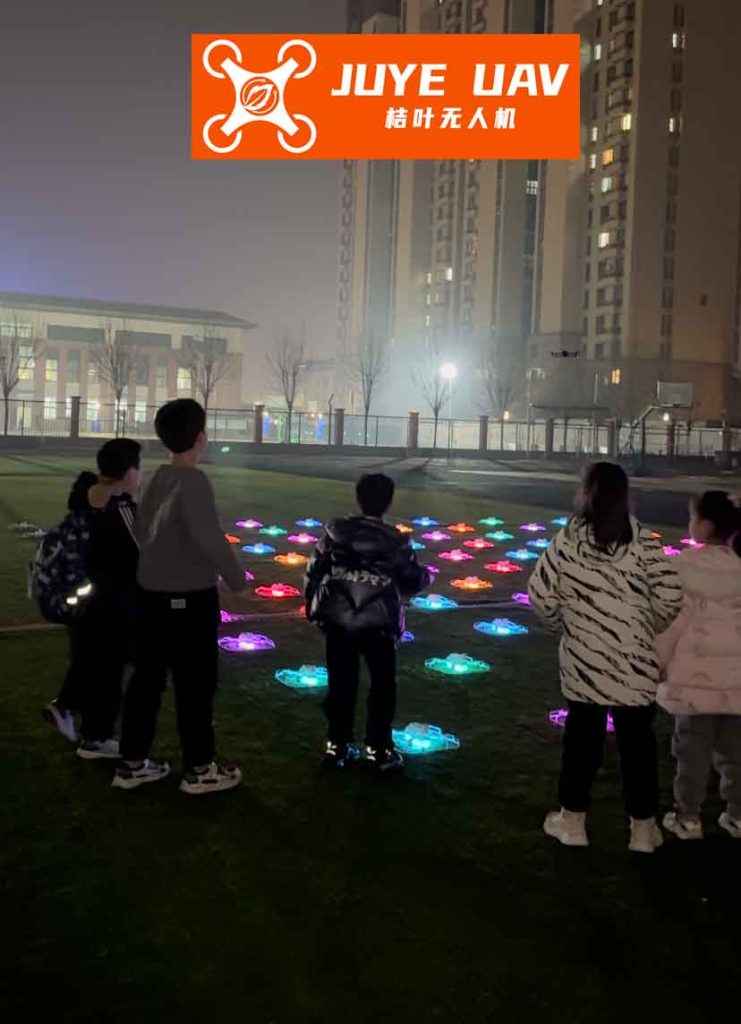
Looking ahead, the integration of consensus with emerging technologies will shape the next generation of drone formation systems. For instance, 5G networks offer low-latency communication, enabling real-time consensus updates for high-speed drone formations. Edge computing can process consensus algorithms locally on drones, reducing reliance on cloud servers. Additionally, quantum-inspired algorithms might solve consensus problems faster, though this is speculative. In military contexts, consensus-based drone formation could enable autonomous swarms for surveillance or suppression, with drones coordinating attacks while maintaining formation integrity. In civilian use, such as light shows or delivery fleets, consensus ensures precise patterns and safe operations. The image above exemplifies a drone formation in a light show, where consensus algorithms likely coordinate the drones’ positions and colors to create stunning displays.
In conclusion, consensus-based drone formation control is a dynamic field that merges theory with practice. From basic protocols to advanced adaptive schemes, it provides a framework for scalable and robust multi-drone coordination. As research addresses challenges like security, saturation, and real-time adaptation, we can expect drone formations to become more autonomous and ubiquitous. The consensus approach, with its emphasis on local interactions and global emergence, mirrors natural systems like bird flocks, offering inspiration for future innovations. Whether in defense, entertainment, or logistics, consensus-based drone formation will continue to evolve, driving the future of collaborative aerial systems.