
The degradation of grassland ecosystems poses a significant threat to animal husbandry and environmental stability, with pest infestations being a primary driver of this decline. Traditional control methods, relying heavily on large machinery, manual sprayers, or manned aircraft, are often labor-intensive, costly, and struggle to access complex terrains. The advent of agricultural UAV technology has revolutionized this field, offering a precise, efficient, and adaptable solution for large-scale grassland management. This article delves into the operational specifics of employing agricultural UAV systems for unified pest prevention and control, providing a comprehensive technical reference to optimize efficacy and safety.
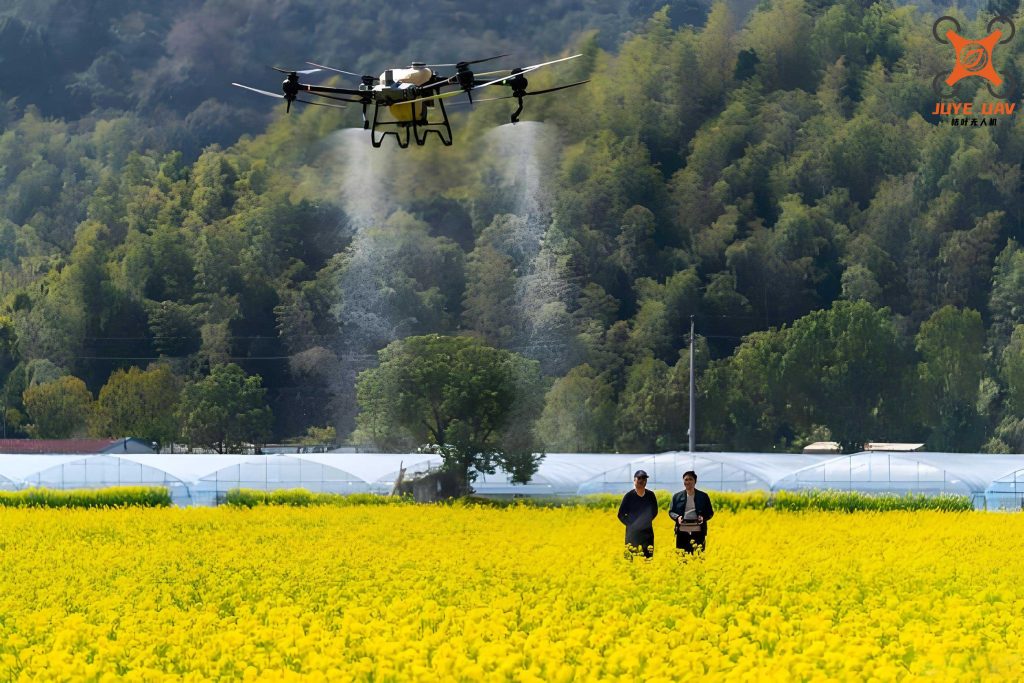
Grasslands are vital for livestock production and play a crucial role in soil conservation and biodiversity. However, these ecosystems are increasingly vulnerable to pest outbreaks, particularly locusts and other herbivorous insects, which can denude vast areas, leading to severe ecological and economic consequences. Agricultural UAV spraying, or Unmanned Aerial Vehicle (UAV) based aerial application, presents a paradigm shift. It enables rapid response to contain outbreaks, significantly reduces chemical and water usage through ultra-low volume (ULV) spraying, and enhances operator safety by distancing personnel from pesticides. The downwash generated by multi-rotor agricultural UAV systems improves droplet penetration and deposition on target vegetation, leading to superior control outcomes. The core principle of modern integrated pest management (IPM)—”scientific monitoring, precise control, unified planning”—is perfectly embodied in the capabilities of a well-operated agricultural UAV fleet.
Fundamental Flight and Application Parameters for Agricultural UAVs
The performance of an agricultural UAV is defined by key parameters that directly influence operational efficiency and application quality. For a typical model like the DJI T20, these include:
- Maximum Operational Speed: 7 m/s
- Maximum Travel Speed: 10 m/s
- Wind Resistance: Up to 8 m/s (operational limits are lower)
- Theoretical Work Efficiency: Up to 10 hectares per hour
The relationship between work rate, swath width, and flight speed is fundamental:
$$ \text{Work Rate} (ha/h) = \text{Swath Width} (m) \times \text{Flight Speed} (m/s) \times 3.6 $$
This formula highlights that while speed increases coverage, it must be balanced against application rate and droplet deposition quality.
Comprehensive Technical Workflow for Agricultural UAV Operations
1. Operational Timing and Environmental Conditions
Selecting the optimal time for agricultural UAV spraying is critical for maximizing pesticide efficacy and minimizing drift. Operations should be scheduled based on the following matrix:
| Factor | Optimal Condition | Rationale & Risk |
|---|---|---|
| Temperature | 20°C – 30°C | Minimizes evaporation (high temp) and poor insect activity/metabolism (low temp). Operations should cease above 35°C. |
| Wind Speed | < 4 m/s | Prevents excessive spray drift, ensuring accurate deposition on target zones. |
| Precipitation | No rain forecast for 4-6 hours post-spray. | Allows pesticide to dry and adhere to foliage, preventing wash-off. |
| Time of Day | Early morning or late evening | Lower wind speeds, higher relative humidity, and reduced convective air currents enhance droplet settlement and absorption. |
| Dew | Avoid periods of heavy dew | Can dilute pesticide concentration on leaf surfaces. |
2. Pre-Operational Preparations
Meticulous preparation is the foundation of a successful agricultural UAV mission. This phase encompasses team coordination, equipment checks, and precise chemical handling.
A. Personnel and Equipment Readiness: The crew must include a licensed UAV pilot, a spotter for safety observation, and ground support for mixing and loading chemicals. A pre-flight checklist for the agricultural UAV must be rigorously followed: inspecting airframe integrity, propeller condition, battery charge levels, pump and nozzle functionality, and ensuring the spraying system is clean and unobstructed.
B. Chemical Selection and Tank Mix Preparation: Agricultural UAV spraying utilizes Ultra-Low Volume (ULV) formulations. Product selection should align with IPM principles, prioritizing biological agents in low-to-moderate infestation areas and reserving selective, low-toxicity chemicals for high-density outbreaks.
| Pest Density | Agent Type | Example & Application Rate | Key Property |
|---|---|---|---|
| Low to Moderate | Biological Pesticide | 1.0% Matrine AS, 450 mL/ha | Botanical origin, lower environmental impact. |
| Low to Moderate | Biological Pesticide | Metarhizium anisopliae Oil Suspension (100 billion spores/mL), 100.05 g spore powder/ha | Entomopathogenic fungus, species-specific. |
| High | Chemical Pesticide | 4.5% Beta-cypermethrin EC, 525 mL/ha | Fast-acting, broad-spectrum; use with caution. |
Critical Practice – Secondary Dilution: To ensure homogeneity and prevent nozzle clogging, always use a secondary dilution method. First, mix the concentrated pesticide with a small amount of water in a separate container to form a stock solution. Then, pour this stock solution into the agricultural UAV‘s tank, which is already partially filled with the required amount of water, while gently agitating.
3. Flight Parameter Configuration for Grassland
Configuring the agricultural UAV‘s flight parameters requires balancing efficiency, coverage, and efficacy. Key interrelated variables are flight height and speed.
A. Flight Height (Altitude Above Ground Level – AGL): The optimal height is a compromise between swath width and droplet penetration. The effective swath width (W) for a pressure-based fan nozzle system can be modeled as a function of height (h) until wind interference dominates:
$$ W(h) = k \cdot h + b \quad \text{for } h \leq H_{critical} $$
Where \(k\) is a gain factor and \(b\) is the initial offset. Beyond a critical height \(H_{critical}\), turbulence causes dispersion, reducing effective coverage.
- Standard Grassland: For uniformly short grass, an AGL of 1.0 – 1.5 m is recommended. This provides good swath width (typically 4-6m) while maintaining strong droplet momentum for penetration.
- Dense or Uneven Vegetation: In areas with tall, dense, or variable-height foliage, raising the AGL to 2.0 – 2.5 m can prevent constant collision avoidance alarms and ensure a more consistent application plane. The agricultural UAV‘s terrain-following (or “mountain”) mode should be activated in undulating terrain to maintain a constant AGL.
B. Flight Speed: As per the work rate formula, speed is a primary driver of efficiency. However, it inversely affects the Volume Application Rate (VAR, in L/ha):
$$ VAR = \frac{\text{Flow Rate (L/min)} \times 600}{\text{Speed (km/h)} \times \text{Swath Width (m)}} $$
Therefore, flying too fast reduces the dose per unit area, potentially leading to under-application. Conversely, flying too slow can cause over-application and runoff.
- General Grassland: A speed of 6 – 7 m/s (21.6 – 25.2 km/h) is effective for open areas, balancing coverage and chemical deposition.
- Severe Infestation Patches or Denser Cover: Reduce speed to 4 – 5 m/s (14.4 – 18 km/h) to increase the VAR and ensure thorough coverage in critical zones.
4. Operational Mode Selection and Mission Planning
Modern agricultural UAV systems offer multiple operational modes. The choice depends on the field’s size, shape, and the required precision.
| Operational Mode | Mechanism | Advantages | Disadvantages | Best For |
|---|---|---|---|---|
| Manual Operation | Pilot controls all flight movements in real-time. | Maximum flexibility for irregular shapes; immediate response. | High pilot workload; prone to overlap and missed strips. | Small, irregular, or severe patchy infestation areas. |
| AB Line Operation | Pilot sets A and B points to define a straight baseline; UAV generates parallel automated passes. | Reduced workload compared to manual; consistent line spacing. | Only suitable for rectangular or very regular plots. | Large, regular-shaped grassland blocks. |
| Full Route Planning | UAV or remote controller is used to map the field boundary and obstacles, generating an optimized flight path. | Fully autonomous, high precision, optimal pathing, records history. | Requires time for pre-flight mapping. | Large, complex-shaped fields (primary mode for grassland). |
For extensive grassland campaigns, Full Route Planning is the cornerstone of efficiency. The process involves:
1. Reconnaissance: Survey the area for physical obstacles (power lines, poles, trees) and no-fly zones.
2. Mapping: Use the remote controller to walk or fly around the perimeter, marking waypoints at each vertex.
3. Editing: In the flight planning software, connect the waypoints to form a closed polygon. Set the “Boundary Inset” parameter. For open grasslands, this can often be set to 0m or a minimal value (0.5-1m) to ensure complete coverage up to the very edge, unlike in cropland where insetting protects bordering fields.
4. Parameter Assignment: Assign the pre-determined flight height, speed, and application rate to the planned mission. The software calculates the required battery swaps and refill points.
5. In-Flight Management and Post-Operation Protocols
Smooth operation of the agricultural UAV requires attentive management of consumables and systematic procedures.
A. Battery and Chemical Load Management: Set low-battery and low-chemical warnings appropriately (e.g., 30% and 10%). When the low-battery alarm sounds, assess the UAV’s position. If it is near the end of a swath or close to the launch point, command an immediate return. If far out, it may be more efficient to let it finish the current swath line. Never allow the battery to drop below 10% mid-air, as forced landings may occur. After refilling the chemical tank, always prime the spray system to remove air from the lines before resuming spraying.
B. Post-Operation Cleandown: Proper maintenance is essential for the longevity of the agricultural UAV and to prevent cross-contamination.
$$ \text{Cleanup Procedure} = \begin{cases}
\text{Spray tank empty: } & \text{Spray residual, flush with clean water, run pump dry.} \\
\text{End of day/long storage: } & \text{Disassemble tank, clean filters, flush entire system with clean water multiple times.}
\end{cases} $$
All used chemical packaging must be collected according to local regulations for proper disposal.
Integrated Discussion and Future Outlook
The integration of agricultural UAV technology into grassland pest management addresses long-standing challenges of scale, accessibility, and precision. Its ability to treat otherwise inaccessible gullies, steep slopes, and rocky outcrops is unparalleled by ground-based machinery. The data collected during mission planning—field boundaries, infestation maps—can feed into Geographic Information Systems (GIS) for long-term monitoring and predictive modeling of pest populations.
Future advancements will likely focus on increasing the autonomy and intelligence of the agricultural UAV. This includes:
– AI-Powered Scouting: Using onboard multispectral or hyperspectral sensors to identify pest hotspots in real-time, enabling variable-rate application (VRA) where the agricultural UAV automatically adjusts spray volume based on localized need.
– Swarm Technology: Coordinating fleets of multiple agricultural UAV units to cover vast areas simultaneously, managed by a single ground control station.
– Advanced Formulations: Development of more specialized ULV formulations and adjuvants that further enhance droplet adhesion, rainfastness, and uptake when applied via agricultural UAV.
In conclusion, the systematic application of the technical points outlined—from environmental timing and chemical selection to precise parameter configuration and mission planning—ensures that agricultural UAV spraying is not just a novel tool, but a reliable, efficient, and sustainable cornerstone of modern integrated grassland pest management. Its continued adoption and refinement are pivotal for safeguarding these critical ecosystems.