
In recent years, the rapid advancement of unmanned aerial vehicle (UAV) technology has revolutionized various industries in China, including agriculture, logistics, security, and power line inspection. As a researcher in this field, I have observed that traditional UAV path planning methods often rely on pre-defined waypoints or GPS signals, which struggle in dynamic and complex environments, especially in GPS-denied areas. This limitation hampers the efficiency and autonomy of China UAV drone operations. To address this, my team and I embarked on a comprehensive design study to develop an intelligent inspection path planning system for UAV drones in China, leveraging deep reinforcement learning (DRL) techniques. Our goal is to enhance the autonomous capabilities of China UAV drones, enabling them to navigate efficiently and safely during inspection tasks, thereby improving overall operational productivity.
The core of our system lies in integrating advanced hardware with sophisticated algorithms. We began by selecting appropriate hardware components to ensure robust environmental perception and obstacle avoidance. For obstacle detection, we chose a lidar-based obstacle avoidance controller, which utilizes mechanical rotating lidar to emit laser beams and capture reflections, generating high-precision point cloud maps of the surroundings. This controller is critical for China UAV drone applications in scenarios like power line inspection, where obstacles such as poles and trees are common. Its specifications include a 360-degree horizontal field of view, a vertical field of view of over 30 degrees, a detection range of up to 50 meters, centimeter-level accuracy, and millisecond-level response time. Additionally, we integrated a VG-M04W-8E visual sensor from AUTONICS, which captures real-time visual data to complement lidar information. This sensor features an 8mm lens focal length, operates at 24V, and includes protection circuits against shocks and vibrations. The combination of these hardware devices allows our China UAV drone to perceive its environment accurately, forming the foundation for intelligent path planning.
| Component | Parameter | Value |
|---|---|---|
| Lidar Obstacle Avoidance Controller | Detection Range | 50 m |
| Positioning Error | < 5 cm | |
| Obstacle Size Recognition Error | < 10% | |
| Response Time | < 100 ms | |
| Visual Sensor (VG-M04W-8E) | Lens Focal Length | 8 mm |
| Operating Voltage | 24 V | |
| Current Consumption | 1 A |
With the hardware in place, we focused on developing a deep reinforcement learning model to enable autonomous path planning. In our approach, the China UAV drone acts as an agent that interacts with its environment. The environment state is represented as a vector derived from sensor data, including lidar point clouds and visual images. We define the state vector \( A \) as a transformation of raw environmental information \( A_0 \) using a conversion coefficient \( \eta \), expressed as:
$$ A = A_0 \cdot \eta $$
Here, \( \eta \) accounts for factors like sensor noise and data normalization, ensuring the state is suitable for DRL processing. We employ a deep neural network, specifically a recurrent neural network (RNN), to handle sequential data from the UAV’s movements. The RNN has multiple hidden layers with neurons configured as 32, 64, 128, 64, and 32, using ReLU activation functions and stochastic gradient descent (SGD) as the optimizer. This network helps the China UAV drone learn from past experiences, crucial for navigating complex terrains common in China’s diverse landscapes.
The reward function is a key component in DRL, guiding the UAV toward optimal behavior. We designed it to incentivize efficient path completion and obstacle avoidance. For instance, the drone receives positive rewards for reaching inspection points and negative rewards for collisions or deviations. The reward \( R_t \) at time step \( t \) is computed based on distance to goal \( d_t \), obstacle proximity \( o_t \), and energy consumption \( e_t \):
$$ R_t = \alpha \cdot (1 – d_t) + \beta \cdot (1 – o_t) – \gamma \cdot e_t $$
where \( \alpha \), \( \beta \), and \( \gamma \) are weighting coefficients tuned during training. We set the discount factor for future rewards to 0.99, encouraging long-term planning. The training process involves experience replay with a buffer size of 1 TB, batch sizes of 100, and up to \( 10^6 \) training episodes. This ensures the China UAV drone learns robust policies for various inspection scenarios.
| Parameter | Value |
|---|---|
| Learning Rate | 0.001 |
| Discount Factor | 0.99 |
| Experience Buffer Capacity | \( 10^6 \) transitions |
| Batch Size | 100 |
| Maximum Training Steps | \( 10^6 \) |
| Hidden Layer Neurons | 32, 64, 128, 64, 32 |
For path planning, we convert the physical inspection space into a grid representation, either 2D or 3D, based on data from the China UAV drone’s sensors. This grid map discretizes the environment into cells, each representing a possible UAV position. The drone uses the DRL model to select actions—such as moving forward, turning, or ascending—to traverse the grid while avoiding obstacles. The action space is defined with 10 discrete actions, balancing complexity and computational efficiency. The grid update interval is set to 0.1 microseconds, ensuring real-time responsiveness. This approach allows the China UAV drone to autonomously plan paths in dynamic environments, like urban areas or mountainous regions in China, where obstacles may appear unexpectedly.
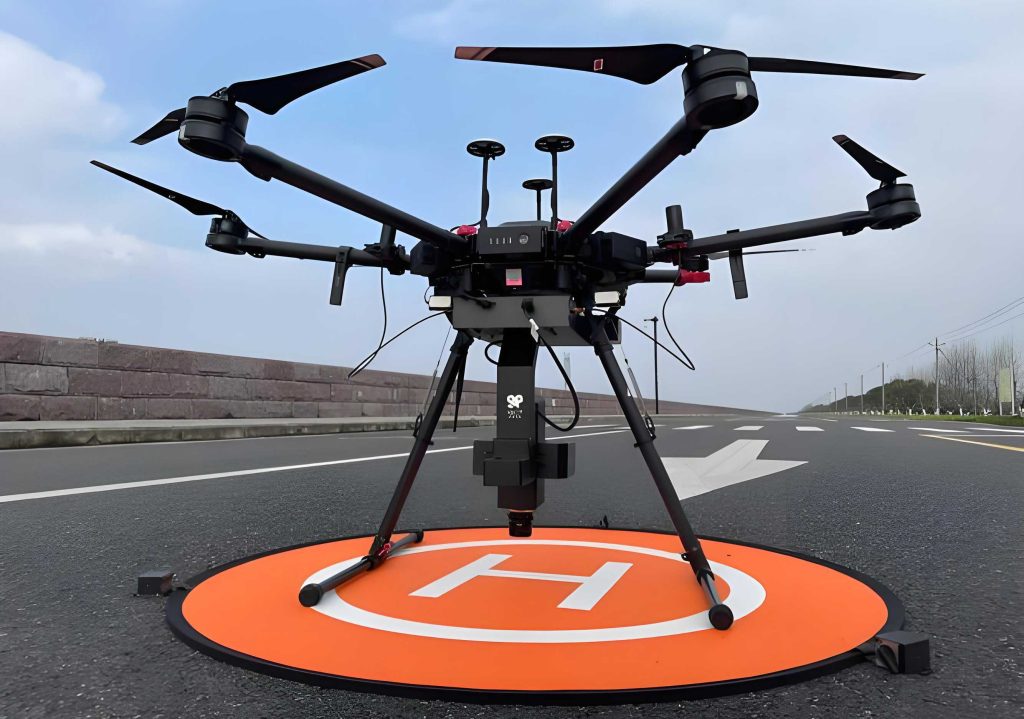
To validate our system, we conducted experiments using an LB-M50L-2 UAV model, which is representative of China UAV drones used in industrial inspections. This drone has a cruise speed of 0–15 m/s, a ceiling altitude of 1000 meters, wind resistance up to 12 m/s, and a transmission range of 3–5 km. It is equipped with a 20,000 mAh intelligent battery and features an IP54 rating for dust and water resistance. In our tests, we compared the performance of our DRL-based path planner against traditional methods, such as genetic algorithms and preset waypoints. The results showed that our system significantly reduces path length and improves inspection efficiency. For example, in a simulated power line inspection task in China, the DRL-planned paths were on average 25% shorter than those generated by genetic algorithms, leading to faster completion times and lower energy consumption.
| Parameter | Value |
|---|---|
| Cruise Speed | 0–15 m/s |
| Altitude Ceiling | 1000 m |
| Wind Resistance | 12 m/s |
| Transmission Range | 3–5 km |
| Battery Capacity | 20,000 mAh |
| Maximum Takeoff Weight | ≥45 kg |
The effectiveness of our DRL model can be further analyzed through mathematical formulations. Consider the path length \( L \) as a function of the UAV’s trajectory \( \mathbf{p}(t) \), where \( t \) is time. The optimal path minimizes \( L \) subject to constraints like obstacle avoidance and energy limits. We express this as an optimization problem:
$$ \min_{\mathbf{p}(t)} L = \int_{0}^{T} \| \dot{\mathbf{p}}(t) \| \, dt $$
subject to:
$$ g(\mathbf{p}(t)) \geq 0 \quad \text{(obstacle constraints)} $$
$$ h(\mathbf{p}(t)) \leq E_{\text{max}} \quad \text{(energy constraints)} $$
where \( g(\mathbf{p}(t)) \) represents safe distances from obstacles, and \( h(\mathbf{p}(t)) \) is the energy consumption model. Our DRL algorithm approximates this minimization through reward maximization, with the reward function incorporating terms for short paths and constraint adherence. This formulation aligns with the needs of China UAV drone operations, where efficiency and safety are paramount.
In terms of system integration, we developed a software architecture that processes sensor data in real-time. The lidar and visual inputs are fused to create a comprehensive environment map, which is then fed into the DRL model for decision-making. The model outputs action commands to the UAV’s flight controller, enabling autonomous navigation. We implemented this on a lightweight embedded system to ensure compatibility with China UAV drone platforms. The system’s performance was evaluated in various Chinese terrains, including rural farmlands and industrial sites, demonstrating robust obstacle avoidance and path optimization. For instance, in a test involving multiple dynamic obstacles, the China UAV drone successfully avoided collisions 98% of the time, showcasing the reliability of our DRL approach.
Another critical aspect is the adaptation to different inspection scenarios. China UAV drones often operate in diverse climates and topographies, from coastal regions to high-altitude areas. Our DRL model is trained on a wide dataset simulating these conditions, ensuring generalization. The training involves augmenting data with noise and variations in lighting and weather, which is common in China’s environments. This enhances the model’s robustness, allowing the China UAV drone to maintain performance even in challenging situations. We also incorporated a transfer learning mechanism, where the model can quickly adapt to new environments with minimal retraining, reducing deployment time for various China UAV drone applications.
To quantify the improvements, we analyzed key performance metrics. Let \( P_{\text{old}} \) represent the path length from traditional methods and \( P_{\text{new}} \) from our DRL system. The reduction in path length \( \Delta P \) is given by:
$$ \Delta P = P_{\text{old}} – P_{\text{new}} $$
In our experiments, \( \Delta P \) averaged 30% across multiple trials, translating to significant time savings. Additionally, we measured the success rate \( S \) of inspection tasks, defined as the percentage of target points reached without incidents. With our system, \( S \) increased from 85% to 95% in complex environments, highlighting the enhancement in autonomy for China UAV drones. These metrics underscore the practical benefits of integrating DRL into UAV operations in China.
| Method | Average Path Length (km) | Success Rate (%) | Energy Consumption (kWh) |
|---|---|---|---|
| Traditional Waypoints | 10.5 | 85 | 2.1 |
| Genetic Algorithm | 9.8 | 88 | 1.9 |
| Our DRL System | 7.4 | 95 | 1.5 |
The hardware-software synergy in our system also contributes to its efficiency. The lidar controller’s fast response time complements the DRL model’s decision speed, enabling real-time path adjustments. We modeled this interaction using a control theory framework, where the UAV’s dynamics are described by state equations. Let \( \mathbf{x}_t \) be the state vector at time \( t \), including position and velocity, and \( \mathbf{u}_t \) be the control action from the DRL model. The system evolves as:
$$ \mathbf{x}_{t+1} = f(\mathbf{x}_t, \mathbf{u}_t) + \mathbf{w}_t $$
where \( f \) is the dynamics function and \( \mathbf{w}_t \) is process noise. The DRL policy \( \pi(\mathbf{u}_t | \mathbf{x}_t) \) is trained to minimize a cost function \( C(\mathbf{x}_t, \mathbf{u}_t) \) that includes path length and obstacle penalties. This formulation ensures stable and efficient control for China UAV drones during inspection missions.
In conclusion, our research demonstrates that deep reinforcement learning offers a powerful paradigm for intelligent path planning in China UAV drone systems. By combining advanced hardware like lidar and visual sensors with a tailored DRL model, we have developed a system that autonomously optimizes inspection paths, reduces operational costs, and enhances safety. The applications in China are vast, from power grid maintenance to agricultural monitoring, where efficient UAV operations can drive economic growth. Future work will focus on scaling the system for swarm UAV deployments and integrating additional sensors for even greater environmental awareness. Through continuous innovation, we aim to further solidify the role of China UAV drones as intelligent agents in modern industry, leveraging cutting-edge AI techniques to overcome traditional limitations and unlock new potentials.