
In recent years, the rapid advancement of technology has ushered in a new era for emergency response, particularly in high-risk industrial settings. As an expert in fire safety and unmanned systems, I have witnessed firsthand the transformative impact of fire UAV (Unmanned Aerial Vehicle) technology on firefighting and rescue operations. This article delves into the application of fire UAVs in LNG (Liquefied Natural Gas) terminals, exploring their critical role in mitigating catastrophic fires. LNG terminals are vital infrastructure for energy supply, but their unique hazards—such as cryogenic storage, dense piping networks, and the potential for rapid fire spread—demand innovative solutions. Traditional firefighting methods often fall short due to safety constraints and limited visibility. Here, fire UAVs emerge as a game-changer, offering unparalleled capabilities in reconnaissance, command, and direct intervention. Through this first-person perspective, I will detail the characteristics of LNG terminal fires, the advantages of fire UAV technology, and strategic applications, supported by tables and formulas to encapsulate key concepts. The goal is to provide a comprehensive resource that underscores why fire UAVs are indispensable in modern fire rescue frameworks.
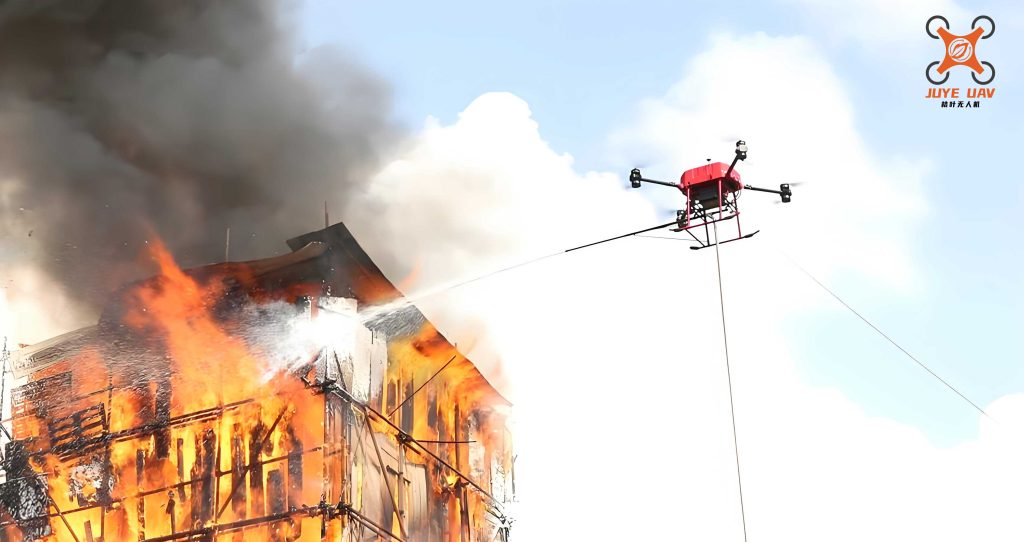
LNG terminals handle methane-rich fuels stored at temperatures as low as -162°C, creating distinct fire risks. When a leak occurs, LNG rapidly vaporizes, forming flammable gas clouds that can ignite with devastating consequences. The fire dynamics in such environments are characterized by intense heat radiation, fast propagation, and high re-ignition probabilities. For instance, the heat flux from an LNG pool fire can exceed 200 kW/m², posing severe threats to personnel and equipment. Mathematically, the radiative heat transfer from a fire can be modeled using the Stefan-Boltzmann law: $$Q = \sigma \epsilon A (T_f^4 – T_a^4)$$ where \(Q\) is the radiative heat flux, \(\sigma\) is the Stefan-Boltzmann constant (\(5.67 \times 10^{-8} \, \text{W/m}^2\text{K}^4\)), \(\epsilon\) is the emissivity, \(A\) is the area, \(T_f\) is the flame temperature, and \(T_a\) is the ambient temperature. In LNG fires, \(T_f\) can reach 2000°C, leading to \(Q\) values that challenge conventional cooling systems. Additionally, the dense white vapor clouds from evaporation reduce visibility, complicating rescue efforts. Table 1 summarizes key fire characteristics in LNG terminals, highlighting why human intervention is often perilous.
| Characteristic | Description | Impact on Firefighting |
|---|---|---|
| High Burn Rate | LNG fires exhibit rapid combustion due to high methane content. | Requires quick response; delays lead to escalation. |
| Fast Propagation | Flames spread quickly across pools and pipelines. | Limits access points; increases risk of domino effects. |
| Elevated Flame Temperature | Temperatures can exceed 2000°C, causing severe thermal radiation. | Degrades equipment and hinders human approach. |
| Large Fire Area | Pool fires can cover extensive areas, especially in containment zones. | Demands widespread resource deployment. |
| High Re-ignition Tendency | Residual flammable vapors can reignite after initial suppression. | Needs prolonged monitoring and cooling. |
| Reduced Visibility | Vapor clouds obscure vision, creating whiteout conditions. | Impedes situational awareness for ground crews. |
Fire UAV technology encompasses a suite of systems designed for aerial operations in hazardous environments. A typical fire UAV consists of a flight platform, sensors, data transmission modules, and ground control stations. The flight platform, often a multi-rotor or fixed-wing design, offers agility and stability. Sensors include high-resolution cameras, thermal imagers, gas detectors, and LiDAR, enabling comprehensive data collection. Data transmission relies on secure, low-latency links, while ground stations provide real-time analytics. The integration of these components allows fire UAVs to perform tasks beyond human capability. For example, the maneuverability of a fire UAV can be described by its dynamics: $$\dot{x} = v \cos(\theta), \quad \dot{y} = v \sin(\theta), \quad \dot{\theta} = \omega$$ where \(x\) and \(y\) are positional coordinates, \(v\) is velocity, \(\theta\) is heading angle, and \(\omega\) is angular velocity. This model facilitates precise navigation in complex geometries like LNG terminal pipe racks. The advantages of fire UAVs are multifaceted, as outlined in Table 2, which compares traditional methods with fire UAV-assisted approaches.
| Aspect | Traditional Firefighting | Fire UAV-Assisted Firefighting |
|---|---|---|
| Flexibility | Limited by terrain and accessibility; heavy equipment required. | High agility; can launch from any location, even handheld. |
| Reconnaissance Scope | Ground-based views often obstructed; risky for personnel. | Broad aerial perspectives with zoom and thermal imaging. |
| Safety | Exposes firefighters to extreme heat and toxic fumes. | Removes humans from direct danger; operates in hostile zones. |
| Response Time | Slower due to mobilization and setup delays. | Rapid deployment; can be airborne within minutes. |
| Data Acquisition | Relies on manual reports and fixed cameras. | Real-time video, gas concentrations, and 3D mapping. |
| Cost-Efficiency | High personnel and equipment costs for prolonged operations. | Lower operational costs; reusable platforms with minimal maintenance. |
In fire reconnaissance, fire UAVs excel by providing critical intelligence that shapes rescue strategies. Upon arrival at an LNG terminal incident, I deploy fire UAVs to scan the area, identifying ignition sources, leak points, and structural integrity. Thermal cameras detect hotspots through smoke and vapor, using algorithms like: $$T_{pixel} = k \ln \left( \frac{R}{S} + 1 \right)$$ where \(T_{pixel}\) is the temperature per pixel, \(k\) is a calibration constant, \(R\) is the radiant power, and \(S\) is the sensor response. This allows mapping of fire boundaries with precision. For instance, in a simulated LNG spill fire, fire UAVs can hover above storage tanks, assessing dome conditions and valve statuses without risking lives. The data feeds into command centers, where I analyze fire spread patterns using computational fluid dynamics (CFD) models: $$\frac{\partial \rho}{\partial t} + \nabla \cdot (\rho \mathbf{u}) = 0$$ $$\rho \left( \frac{\partial \mathbf{u}}{\partial t} + \mathbf{u} \cdot \nabla \mathbf{u} \right) = -\nabla p + \mu \nabla^2 \mathbf{u} + \mathbf{f}$$ where \(\rho\) is density, \(\mathbf{u}\) is velocity, \(p\) is pressure, \(\mu\) is viscosity, and \(\mathbf{f}\) represents body forces. These equations help predict how fires evolve, enabling proactive measures.
Command and control benefit immensely from fire UAV integration. During complex incidents, communication breakdowns are common due to interference or infrastructure damage. Fire UAVs equipped with relay nodes establish ad-hoc networks, ensuring uninterrupted flow of audio and video. I have used this to coordinate multiple teams, directing them away from flashover zones. The fire UAV’s positioning system, often based on GPS and inertial measurement units (IMUs), provides real-time location data for all personnel, enhancing situational awareness. The effectiveness of such systems can be quantified by the network throughput \(C\): $$C = B \log_2 \left( 1 + \frac{S}{N} \right)$$ where \(B\) is bandwidth, \(S\) is signal power, and \(N\) is noise power. By optimizing \(C\), fire UAVs maintain high-quality streams even in electromagnetically noisy environments. Table 3 illustrates a typical command structure augmented by fire UAVs, showing how decision-making loops are shortened.
| Stage | Traditional Approach | Fire UAV-Enhanced Approach |
|---|---|---|
| Situation Assessment | Delayed reports from ground scouts; limited data. | Immediate aerial feeds with overlays of heat and gas data. |
| Resource Allocation | Manual coordination based on incomplete information. | Dynamic dispatch guided by real-time UAV analytics. |
| Communication | Radio channels prone to congestion and dropout. | Redundant UAV relays ensuring clear channels. |
| Safety Monitoring | Periodic checks by safety officers; gaps possible. | Continuous UAV surveillance of personnel and hotspots. |
| Post-Incident Analysis | Relies on after-action reviews and static reports. | Comprehensive data logs from UAVs for debriefing. |
Direct firefighting assistance is another frontier where fire UAVs prove invaluable. By mounting extinguishing agents or specialized modules, these UAVs can suppress fires in inaccessible areas. For LNG terminals, I have designed fire UAVs that carry dry chemical powders or foam concentrates, targeting small leaks before they escalate. The discharge rate can be modeled as: $$\dot{m} = C_d A \sqrt{2 \rho \Delta P}$$ where \(\dot{m}\) is the mass flow rate, \(C_d\) is the discharge coefficient, \(A\) is the nozzle area, \(\rho\) is the agent density, and \(\Delta P\) is the pressure differential. This allows precise application, minimizing agent waste. In one scenario, a fire UAV delivered foam to a piping junction, reducing vapor dispersion and cooling the metal to prevent rupture. Additionally, fire UAVs can deploy payloads like life rafts or medical kits to trapped individuals, leveraging their precision hover capabilities. The lift force \(L\) generated by a multi-rotor fire UAV is given by: $$L = \frac{1}{2} \rho v^2 C_L A_r$$ where \(v\) is rotor speed, \(C_L\) is the lift coefficient, and \(A_r\) is the rotor area. By adjusting \(v\), the fire UAV can maintain stability while releasing resources.
The operational strategies for fire UAVs in LNG terminals encompass pre-incident planning, real-time response, and post-event evaluation. During routine inspections, fire UAVs conduct autonomous patrols, using machine learning algorithms to detect anomalies such as corrosion or gas leaks. The detection algorithm might involve a convolutional neural network (CNN) trained on thermal images: $$y = f(W * x + b)$$ where \(y\) is the output, \(W\) are weights, \(x\) is the input image, \(b\) is bias, and \(f\) is an activation function. This proactive use prevents fires by identifying risks early. In emergency mode, fire UAVs follow predefined protocols, such as ascending to safe altitudes to avoid turbulence from fire plumes. The plume dynamics can be described by the buoyancy flux \(B\): $$B = g \frac{\Delta \rho}{\rho} Q$$ where \(g\) is gravity, \(\Delta \rho\) is density difference, and \(Q\) is the volumetric flow rate. Understanding \(B\) helps in positioning fire UAVs for optimal data capture. Post-incident, fire UAVs map the site using photogrammetry, creating 3D models for forensic analysis. The accuracy of such models depends on the point cloud density \(D\): $$D = \frac{N}{V}$$ where \(N\) is the number of points and \(V\) is the volume surveyed. High \(D\) values ensure detailed reconstructions.
Technological challenges persist, including battery life, payload capacity, and regulatory hurdles. Current fire UAVs typically offer flight times of 30-60 minutes, which may suffice for initial response but not for prolonged operations. Innovations in hybrid power systems, such as hydrogen fuel cells, are extending endurance. The energy equation for a fire UAV is: $$E_{total} = E_{battery} + E_{fuel} = P t$$ where \(E_{total}\) is total energy, \(P\) is power consumption, and \(t\) is time. By increasing \(E_{total}\) through advanced materials, we can enhance mission duration. Payload limits restrict the size of extinguishing agents, but collaborative swarms of fire UAVs can overcome this. Swarm coordination relies on distributed algorithms: $$\dot{x}_i = \sum_{j \neq i} (x_j – x_i) + u_i$$ where \(x_i\) is the position of UAV \(i\), and \(u_i\) is a control input. This enables multiple fire UAVs to act in unison, covering larger areas. Regulatory frameworks are evolving to integrate fire UAVs into national airspace, requiring standards for communication and safety. I advocate for certifications that ensure fire UAVs meet industrial firefighting grades, akin to those for traditional equipment.
Future directions for fire UAV technology in LNG firefighting include full autonomy, AI-driven decision support, and integration with Internet of Things (IoT) networks. Autonomous fire UAVs could self-navigate through dense smoke using LiDAR and SLAM (Simultaneous Localization and Mapping) techniques: $$\hat{x}_{k|k} = \hat{x}_{k|k-1} + K_k (z_k – H_k \hat{x}_{k|k-1})$$ where \(\hat{x}\) is the state estimate, \(K\) is the Kalman gain, \(z\) is measurement, and \(H\) is the observation matrix. This would reduce reliance on human pilots. AI systems could analyze fire progression in real-time, suggesting optimal suppression tactics. Moreover, linking fire UAVs with fixed sensors in LNG terminals creates a holistic monitoring ecosystem, where data fusion improves accuracy. The fusion process can be expressed as: $$p(x|z) = \frac{p(z|x) p(x)}{p(z)}$$ where \(p(x|z)\) is the posterior distribution given measurements \(z\). This Bayesian approach refines risk assessments.
In conclusion, the adoption of fire UAVs in LNG terminal firefighting and rescue represents a paradigm shift toward safer, more efficient operations. From my experience, these systems mitigate human risk, enhance situational awareness, and enable precise interventions. The fire UAV’s versatility in reconnaissance, command, and direct firefighting makes it an indispensable tool for modern emergency responders. As technology advances, we can expect fire UAVs to become even more integrated into safety protocols, potentially saving lives and protecting critical infrastructure. The journey from manual methods to automated fire UAV fleets underscores the power of innovation in confronting industrial hazards. By embracing fire UAVs, we not only address current challenges but also pave the way for a resilient future in fire management.
To encapsulate key technical parameters, Table 4 provides a summary of typical specifications for fire UAVs deployed in LNG terminals, based on industry standards and my field observations. This table serves as a reference for selecting and optimizing fire UAV systems for specific scenarios.
| Parameter | Range or Value | Importance for LNG Firefighting |
|---|---|---|
| Flight Time | 30-90 minutes | Determines sustained operation during incidents. |
| Payload Capacity | 5-20 kg | Affects ability to carry extinguishers or sensors. |
| Max Altitude | 500-1000 m | Enables overview of large terminal areas. |
| Wind Resistance | Up to 15 m/s | Ensures stability in windy conditions near fires. |
| Sensor Suite | Thermal, visual, gas, LiDAR | Provides comprehensive data for decision-making. |
| Data Link Range | 1-10 km | Allows remote operation from safe distances. |
| Autonomy Level | From manual to fully autonomous | Reduces pilot workload and enhances response speed. |
| IP Rating | IP67 or higher | Ensures durability against water and dust in harsh environments. |
The mathematical modeling of fire UAV performance further solidifies their utility. For instance, the coverage area \(A_c\) of a fire UAV during reconnaissance can be estimated as: $$A_c = v t w$$ where \(v\) is velocity, \(t\) is time, and \(w\) is the sensor swath width. Optimizing these variables maximizes efficiency. Similarly, the suppression effectiveness \(E_s\) of a fire UAV-delivered agent is: $$E_s = \frac{\dot{m}_{agent}}{\dot{m}_{fire}} \eta$$ where \(\dot{m}_{agent}\) is the agent flow rate, \(\dot{m}_{fire}\) is the fuel burn rate, and \(\eta\) is an efficiency factor. By tuning \(E_s\) through better nozzle designs, fire UAVs can extinguish fires faster. These formulas guide the engineering of next-generation fire UAVs tailored for LNG risks.
Ultimately, the success of fire UAVs hinges on continuous training and interdisciplinary collaboration. As a practitioner, I emphasize the need for joint exercises between fire departments and UAV operators, simulating LNG fire scenarios to refine protocols. The fire UAV is not a standalone solution but part of an integrated response ecosystem. By fostering innovation and sharing knowledge, we can harness the full potential of fire UAVs to safeguard LNG terminals and, by extension, global energy security. The journey ahead involves scaling these technologies, addressing ethical considerations, and ensuring accessibility for all regions. With fire UAVs at the forefront, the future of industrial firefighting looks promisingly resilient and intelligent.