
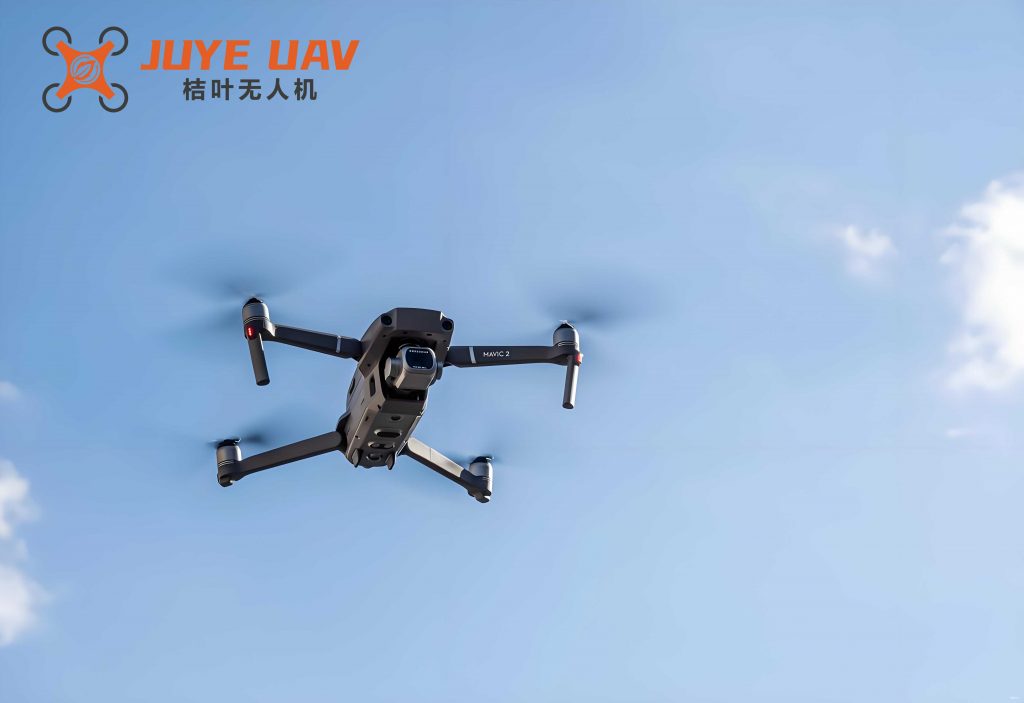
The field of unmanned aerial vehicles (UAVs) has witnessed remarkable growth, with the quadrotor drone emerging as a quintessential platform due to its mechanical simplicity, vertical take-off and landing (VTOL) capability, and exceptional maneuverability. This versatile aircraft finds applications spanning from precision agriculture and infrastructure inspection to search and rescue operations and delivery services. However, the realization of a robust, intelligent, and autonomous quadrotor drone is a significant engineering challenge. The system is inherently nonlinear, underactuated, and highly coupled, meaning its six degrees of freedom (position and orientation) are controlled by only four independent motor thrusts. This report details the comprehensive design and implementation of an intelligent flight control system for a quadrotor drone, encompassing mathematical modeling, nonlinear control strategy development, hardware integration, and the implementation of advanced features like autonomous obstacle avoidance and a novel rotating arm mechanism for enhanced agility.
The cornerstone of any effective flight control system is a precise mathematical model. For the quadrotor drone, we begin by defining two essential coordinate frames. The body-fixed frame \( \mathcal{B} \) is attached to the drone’s center of mass with axes \( \{x_b, y_b, z_b\} \). The inertial frame \( \mathcal{I} \) is fixed to the earth, typically following the North-East-Down (NED) convention with axes \( \{e_1, e_2, e_3\} \). The drone’s pose is described by its position \( \xi = [x, y, z]^T \) in \( \mathcal{I} \) and its orientation defined by the Euler angles \( \eta = [\phi, \theta, \psi]^T \) (roll, pitch, yaw). The transformation between these frames is governed by the rotation matrix \( \mathbf{R} \in SO(3) \), derived from the “ZYX” convention:
$$
\mathbf{R} = \mathbf{R}_\psi \mathbf{R}_\theta \mathbf{R}_\phi =
\begin{bmatrix}
c_\theta c_\psi & s_\phi s_\theta c_\psi – c_\phi s_\psi & c_\phi s_\theta c_\psi + s_\phi s_\psi \\
c_\theta s_\psi & s_\phi s_\theta s_\psi + c_\phi c_\psi & c_\phi s_\theta s_\psi – s_\phi c_\psi \\
-s_\theta & s_\phi c_\theta & c_\phi c_\theta
\end{bmatrix}
$$
where \( s_\cdot \) and \( c_\cdot \) denote \( \sin(\cdot) \) and \( \cos(\cdot) \), respectively. The dynamics of a rigid quadrotor drone with mass \( m \) and inertia matrix \( \mathbf{J} = \text{diag}(J_x, J_y, J_z) \) are derived from the Newton-Euler formalism. The translational and rotational dynamics in the body frame are:
$$
\begin{aligned}
m \dot{\mathbf{V}} + \boldsymbol{\Omega} \times m\mathbf{V} &= \mathbf{F}_{\text{ext}} \\
\mathbf{J} \dot{\boldsymbol{\Omega}} + \boldsymbol{\Omega} \times \mathbf{J} \boldsymbol{\Omega} &= \boldsymbol{\tau}
\end{aligned}
$$
Here, \( \mathbf{V} = [u, v, w]^T \) and \( \boldsymbol{\Omega} = [p, q, r]^T \) are the linear and angular velocities in \( \mathcal{B} \). The external force \( \mathbf{F}_{\text{ext}} \) includes the total thrust \( \mathbf{F} = [0, 0, -T]^T \) and the gravitational force when expressed in the inertial frame. The control moments are \( \boldsymbol{\tau} = [\tau_\phi, \tau_\theta, \tau_\psi]^T \). Transforming these equations to the inertial frame and relating angular velocities to Euler angle derivatives via \( \dot{\eta} = \mathbf{\Phi}(\eta) \boldsymbol{\Omega} \), we obtain the standard nonlinear model for the quadrotor drone:
$$
\begin{aligned}
m \ddot{\xi} &= -\mathbf{R} \mathbf{F} + m g \mathbf{e}_3 \\
\mathbf{M}(\eta) \ddot{\eta} + \mathbf{C}(\eta, \dot{\eta}) \dot{\eta} &= \mathbf{\Psi}(\eta)^T \boldsymbol{\tau}
\end{aligned}
$$
where \( \mathbf{e}_3 = [0,0,1]^T \), \( g \) is gravity, \( \mathbf{M}(\eta) \) is the inertial matrix, and \( \mathbf{C}(\eta, \dot{\eta}) \) represents Coriolis and centrifugal terms. The total thrust \( T \) is the sum of the individual motor thrusts \( f_i \): \( T = \sum_{i=1}^4 f_i \). The moments are generated from differences in these thrusts:
$$
\begin{bmatrix} T \\ \tau_\phi \\ \tau_\theta \\ \tau_\psi \end{bmatrix} =
\begin{bmatrix}
1 & 1 & 1 & 1 \\
0 & -l & 0 & l \\
l & 0 & -l & 0 \\
-k & k & -k & k
\end{bmatrix}
\begin{bmatrix} f_1 \\ f_2 \\ f_3 \\ f_4 \end{bmatrix}
$$
where \( l \) is the arm length and \( k \) is a drag coefficient relating thrust to yaw moment. This underactuation is evident: four inputs \( (f_1, f_2, f_3, f_4) \) control six outputs \( (x, y, z, \phi, \theta, \psi) \).
To control this complex system, a hierarchical strategy is employed. The inner loop stabilizes the attitude \( (\phi, \theta, \psi) \), while the outer loop controls the position \( (x, y, z) \). A common and effective approach is feedback linearization. We define a virtual control input \( \mathbf{u} = [u_x, u_y, u_z]^T \) for the translational dynamics:
$$
\mathbf{u} = -\frac{1}{m} \mathbf{R} \mathbf{F} + g \mathbf{e}_3 = \begin{bmatrix}
-\frac{T}{m}(c_\phi s_\theta c_\psi + s_\phi s_\psi) \\
-\frac{T}{m}(c_\phi s_\theta s_\psi – s_\phi c_\psi) \\
-\frac{T}{m} c_\phi c_\theta + g
\end{bmatrix}
$$
Given a desired acceleration from a position controller \( \mathbf{u}_d \), we can solve for the required total thrust \( T_d \) and desired roll/pitch angles \( (\phi_d, \theta_d) \), assuming \( \psi_d \) is specified independently:
$$
\begin{aligned}
T_d &= m \sqrt{u_{x,d}^2 + u_{y,d}^2 + (g – u_{z,d})^2} \\
\phi_d &= \arcsin\left( \frac{m}{T_d} (u_{x,d} \sin\psi_d – u_{y,d} \cos\psi_d) \right) \\
\theta_d &= \arctan\left( \frac{u_{x,d} \cos\psi_d + u_{y,d} \sin\psi_d}{g – u_{z,d}} \right)
\end{aligned}
$$
These desired angles \( \eta_d = [\phi_d, \theta_d, \psi_d]^T \) become the setpoints for the attitude controller. Both position and attitude loops can be regulated using Proportional-Derivative (PD) or Proportional-Integral-Derivative (PID) controllers. For the attitude error \( \mathbf{e}_\eta = \eta_d – \eta \), a PD control law for the moments is:
$$
\boldsymbol{\tau} = \mathbf{K}_{P,\eta} \mathbf{e}_\eta + \mathbf{K}_{D,\eta} \dot{\mathbf{e}}_\eta
$$
Similarly, the virtual control input for position is generated from the position error \( \mathbf{e}_\xi = \xi_d – \xi \):
$$
\mathbf{u} = \mathbf{K}_{P,\xi} \mathbf{e}_\xi + \mathbf{K}_{D,\xi} \dot{\mathbf{e}}_\xi + \ddot{\xi}_d
$$
These control signals are then translated into individual motor commands using the allocation matrix from the dynamics equation. This cascaded control structure effectively decouples and stabilizes the quadrotor drone’s flight.
| Component Category | Selection & Specification | Primary Function |
|---|---|---|
| Airframe | Carbon Fiber Composite, “X” configuration, 450mm diagonal motor-to-motor distance. | Provides structural integrity with minimal weight. Serves as the chassis for all components. |
| Propulsion System | 4x Brushless DC Motors (920KV), 4x Electronic Speed Controllers (ESCs, 30A), 10×4.5″ Propellers. | Generates lift and control torques. ESCs translate flight controller signals into motor speed. |
| Power System | Lithium Polymer (LiPo) Battery (4S, 5200mAh), Power Distribution Board (PDB). | Supplies regulated power to all electronic subsystems. PDB ensures clean power distribution. |
| Flight Controller (FC) | STM32F7-based autopilot running ArduPilot firmware. Includes IMU (Gyro/Accel), Barometer, Magnetometer. | The “brain”. Runs control algorithms, state estimation (sensor fusion), and manages autonomous flight. |
| Sensing & Perception | Global Navigation Satellite System (GNSS) module, Downward-facing Optical Flow sensor, Ultrasonic Rangefinder (HC-SR04). | Provides position, velocity, and altitude data. Ultrasonic sensor is key for low-altitude hold and obstacle detection. |
| Communication | Radio Control (RC) Receiver (2.4GHz), Telemetry Radio (915MHz), Wi-Fi module. | RC for manual override, telemetry for ground station communication, Wi-Fi for high-level commands. |
| Companion Computer | Raspberry Pi 4 with camera module. | Runs high-level autonomy software (e.g., obstacle avoidance, path planning, computer vision). |
A critical feature of an intelligent quadrotor drone is autonomous obstacle avoidance. Our implementation uses the lightweight ultrasonic sensors (HC-SR04) for close-range detection and the companion computer with a camera for longer-range, richer perception. The avoidance logic runs as a high-level behavior on the Raspberry Pi. It subscribes to sensor data and the current flight plan. Using a potential field or vector field histogram algorithm, it calculates repulsive forces from detected obstacles and attractive forces toward the waypoint. This results in a modified velocity or position command that is sent to the flight controller via the MAVLink protocol. The flight controller, running its stabilized position control loop, seamlessly executes these corrective commands, allowing the quadrotor drone to navigate cluttered environments safely. This creates a robust sense-and-avoid pipeline, enhancing the autonomy of the quadrotor drone.
To push the performance envelope, we designed and integrated a novel rotating arm mechanism. Traditional quadrotor drones accelerate by tilting their entire body, which points the thrust vector in the desired horizontal direction. Our design incorporates servomotors at the junction of each arm and the central body, allowing the arms (and thus the propellers) to tilt independently of the main fuselage. This introduces a second control layer. The primary flight controller still manages the thrust of each motor as before. However, a secondary controller manipulates the arm tilt angles \( \alpha_i \). This enables fascinating maneuvers. For instance, by tilting all arms synchronously forward, the quadrotor drone can accelerate rapidly without needing to change its body attitude, keeping the camera or payload level. Differential tilting can induce complex turns and slips. The dynamics become more complex, as the thrust vector from each motor \( i \) is now rotated by \( \alpha_i \):
$$
\mathbf{F}_i^{\mathcal{B}} = f_i \begin{bmatrix} \sin\alpha_i \\ 0 \\ -\cos\alpha_i \end{bmatrix} \quad \text{(for arms on the x-axis)}
$$
The control allocation matrix must be expanded to map desired total force and moments to both motor thrusts \( f_i \) and servo angles \( \alpha_i \). This mechanism significantly augments the agility and operational flexibility of the advanced quadrotor drone.
The final and most crucial phase is the integration and experimental validation of the complete intelligent quadrotor drone system. All hardware components are meticulously mounted, ensuring a balanced and vibration-isolated setup, especially for the IMU. Wiring is carefully routed to minimize electromagnetic interference. The software stack is layered: the low-level firmware (ArduPilot) on the flight controller handles real-time stabilization and basic autonomy, while the high-level autonomy stack (ROS-based) runs on the companion computer. Extensive bench testing precedes flight tests. We calibrate sensors, verify motor spin directions, and test individual subsystems like obstacle detection in a static setup.
| Flight Test Phase | Objective | Key Performance Indicators (KPIs) & Results |
|---|---|---|
| 1. Basic Stabilization | Verify attitude and altitude hold without manual input. | Attitude error < ±2°. Altitude drift < ±0.3m in calm air. Achieved stable hover. |
| 2. Position Control | Test ability to hold or move to a specified GPS/optical flow position. | Position hold accuracy < ±0.5m outdoors with GNSS. Responsive to step inputs without overshoot >15%. |
| 3. Autonomous Navigation | Execute pre-planned waypoint missions. | Successfully completed 10-waypoint missions. Average cross-track error < 1.2m. |
| 4. Obstacle Avoidance | Navigate an environment with static obstacles. | Consistently detected obstacles > 1.5m away. Generated smooth avoidance trajectories. Zero collisions in test course. |
| 5. Rotating Arm Agility | Demonstrate enhanced acceleration and maneuvering. | Achieved 20% faster forward acceleration at level attitude compared to standard tilt. Executed complex lateral slides. |
| 6. Endurance & Stress | Assess overall system reliability and flight time. | Flight time: 18 minutes with full sensor payload. System remained stable under aggressive maneuvers. |
The flight test results, summarized in the table above, validate the design. The quadrotor drone demonstrated stable, responsive, and intelligent flight behavior. The implemented nonlinear control strategy effectively managed the inherent dynamics of the vehicle. The autonomous obstacle avoidance system reliably prevented collisions, and the rotating arm mechanism provided tangible benefits in acceleration and maneuverability, confirming the value of this innovative actuation approach for specialized quadrotor drone applications. Future work will focus on integrating more advanced sensors like LiDAR, implementing swarm coordination algorithms, and refining the control laws for the rotating arms to fully exploit their potential. This project serves as a comprehensive framework for developing high-performance, intelligent quadrotor drones capable of tackling complex real-world tasks.