
In recent years, the rapid advancement of technology has led to the widespread integration of Unmanned Aerial Vehicles (UAVs) into law enforcement operations. From large-scale security events and pandemic control measures to routine patrols and crime scene investigation, the police UAV has proven to be a transformative tool. The strategic importance of this technology was underscored by high-level directives emphasizing the need to strengthen research, professional development, and talent cultivation in unmanned systems for both defense and public security applications. This imperative places a significant responsibility on police academies and universities, which serve as the primary incubators for practical talent and hubs for tactical research. They must leverage their strengths in education and scientific service to construct and refine comprehensive training curricula for police UAV operations. While some institutions have begun offering certification courses for officers, the number of qualified personnel remains critically low. Furthermore, existing training often focuses predominantly on basic flight mechanics, leaving a substantial gap in advanced tactical application, such as forensic scene reconstruction, suspect tracking, technical surveillance, and sophisticated data capture and analysis. This article, from my perspective as an educator and researcher involved in this field, explores the necessity, current challenges, and potential strategies for building an effective police UAV training program within law enforcement educational institutions.
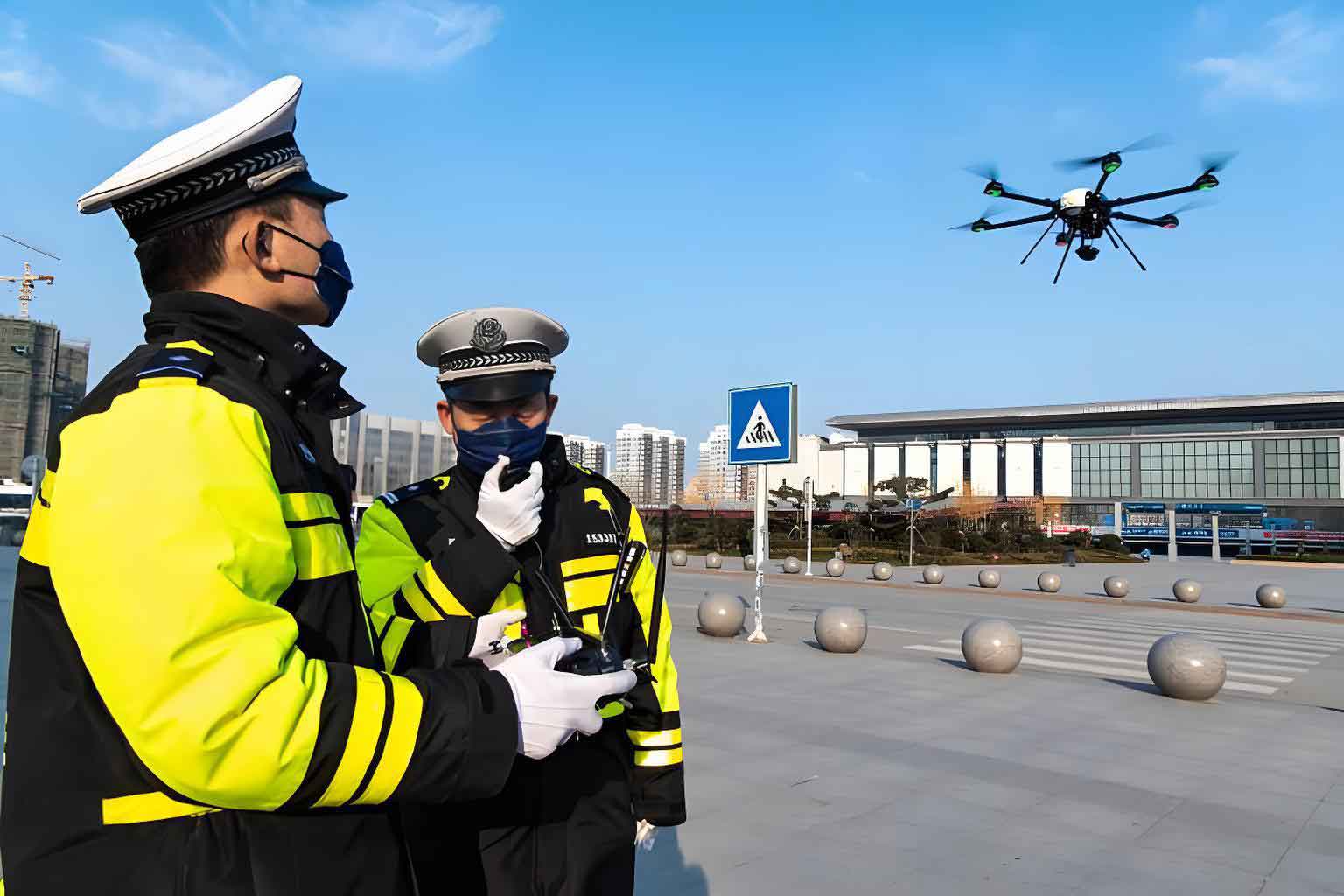
The Critical Importance of Specialized Police UAV Training
The current shortage of professionally trained police UAV operators poses a direct challenge to the full implementation of technology-enhanced policing strategies. Often, officers assigned to UAV units are transferred from other departments or have only hobbyist experience, having acquired operational skills through abbreviated courses. This results in teams that are functional only at a basic, “flying-for-observation” level, primarily useful for aerial patrols. The deeper, more analytical applications remain underdeveloped. The tactical potential of a police UAV is vast and varied, extending far beyond simple surveillance.
Consider geographically challenging environments. Long borders, complex terrain, and inaccessible areas create corridors for smuggling, trafficking, and other illicit activities. A police UAV equipped with appropriate sensors can conduct persistent, multi-spectral reconnaissance in these zones, providing a force-multiplying effect for border and rural patrols. Similarly, in forensic and investigative contexts, a police UAV搭载 (equipped with) a thermal infrared camera can identify anomalous heat signatures, potentially revealing clandestine drug labs or hidden suspects. The ability to extract precise geospatial data, create orthomosaics, and generate 3D models of accident or crime scenes revolutionizes evidence collection and scene analysis, saving time and increasing accuracy. The gap between this potential and current operational capability highlights the urgent need for structured, advanced training. Law enforcement academies, as the cradle of technical talent and centers for professional development, must lead this educational evolution, injecting new technological methodologies into modern policing.
Core Challenges in Current Police UAV Training Curricula
The development of effective training programs is hindered by several systemic issues that must be addressed.
1. Lack of a Standardized Curriculum and Unified Teaching Materials
Operating a police UAV safely and effectively requires a foundational knowledge base spanning multiple disciplines: aviation law and regulations, meteorology, basic aerodynamics, geography, and mechanical maintenance. Existing courses are often fragmented, heavily emphasizing regulations and basic flight physics while neglecting critical areas like terrain analysis, specific payload operations, and field maintenance. The theoretical instruction, when present, can be misaligned; for example, diving deeply into complex fluid dynamics equations may be less practical for officers than understanding how wind shear affects a multirotor at low altitude. The absence of professionally curated, unified textbooks tailored to law enforcement needs leads to inconsistent training quality and knowledge gaps. A standardized core curriculum is essential for scalable and effective training.
2. Generic Content Lacking Tactical Depth and Specialization
Training often fails to transition from “drone piloting” to “police UAV tactical operation.” While case studies are presented, the instruction frequently lacks the depth required to develop true mastery. The training is typically one-size-fits-all, not tailored to the distinct operational profiles of different police units. The needs of a traffic police unit using UAVs for accident reconstruction differ markedly from those of a special weapons and tactics (SWAT) team conducting tactical reconnaissance or a detective unit analyzing a large-scale crime scene.
The following table contrasts the generic versus specialized skill requirements:
| Police Unit | Generic Training Skill | Required Specialized Skill |
|---|---|---|
| Traffic Police | Basic aerial photography | High-precision photogrammetry for scene measurement, rapid orthomosaic generation for diagramming, LiDAR scanning for deformation analysis. |
| Patrol & SWAT | Live video feed observation | Stealth flight patterns, coordinated multi-drone operations (swarming), real-time target tracking and marking using AI-assisted video analytics, tactical communication relay. |
| Criminal Investigation | Taking overview photos | Systematic grid search patterns, multispectral imaging (thermal, hyperspectral) for evidence detection, creation of georeferenced 3D models for virtual scene walkthroughs and measurement. |
| Border & Maritime | Long-range patrol | Beyond visual line of sight (BVLOS) operations, automated patrol route planning, sensor fusion (EO/IR/Radar) for target classification in complex environments. |
Without this layer of specialization, personnel remain operators, not tactical experts.
3. Shortage of Qualified Instructors
The instructor is the cornerstone of effective training. The nascent state of police UAV as a discipline means there is a severe shortage of educators who combine expert-level flight proficiency, deep theoretical knowledge, practical law enforcement experience, and formal instructional credentials. Many instructors hold pilot certificates but lack the tactical background to teach advanced applications. Others may understand the policing context but lack the technical depth to explain, for instance, the principles of photogrammetry or the limitations of different sensor types. This bottleneck severely restricts the ability to develop and deliver high-level curriculum content.
4. Inadequate Logistical and Technical Support Infrastructure
UAVs are complex systems requiring consistent maintenance, repair, and management. The common model of “the user is the maintainer” places an undue burden on instructors, diverting time from curriculum development and teaching. Conversely, assigning management to general technicians without specific UAV expertise leads to prolonged downtime as equipment is sent away for repair. Furthermore, the lack of dedicated, feature-rich training facilities—such as simulation labs with VR capabilities for mission rehearsal, or workshops for maintenance practice—hinders the delivery of comprehensive, hands-on education. A robust support ecosystem is a prerequisite for a sustainable training program.
Strategic Countermeasures for Building Effective Police UAV Courses
Addressing these challenges requires a multi-faceted, strategic approach centered on collaboration, standardization, and innovation.
1. Deepening the “Academy-Agency-Industry” Tripartite Collaboration
A synergistic partnership between police academies (Academy), operational police departments (Agency), and technology companies (Industry) is vital for creating a realistic and dynamic training ecosystem.
- Academy to Agency: Encourage and facilitate faculty placements within operational UAV units. This immersion allows instructors to understand real-world challenges, current tactics, and unmet needs firsthand. This experience directly informs curriculum relevance.
- Agency to Academy: Integrate seasoned tactical UAV operators from police departments into the teaching team as adjunct instructors or curriculum consultants. Their frontline experience is invaluable for designing realistic scenarios and evaluating student performance.
- Industry to Academy & Agency: Leverage the technical expertise of UAV manufacturers and software developers. Engineers can provide deep-dive training on system capabilities, data processing software, and emerging technologies. Furthermore, internships or workshops at company facilities expose students and officers to cutting-edge tools and professional workflows.
This triad model fosters the development of “dual-qualified” instructors who are both pedagogically sound and tactically proficient, ensuring training is grounded in both theory and practice.
2. Developing a Standardized, Tiered Curriculum with Unified Materials
The curriculum must be structured to build competency from foundation to expert specialization. A national framework would ensure consistency and quality.
| Training Tier | Core Content Modules | Learning Objectives |
|---|---|---|
| Tier 1: Core Operator | 1. Regulations & Airspace Law 2. UAV Aerodynamics & Systems 3. Meteorology for UAV Operations 4. Basic Flight Skills & Safety 5. Mission Planning & Risk Assessment |
Certify for safe, legal VLOS flight. Understand platform limitations and basic maintenance. |
| Tier 2: Tactical Operator | 1. Advanced Flight Maneuvers 2. Sensor Payload Theory (EO, IR, LiDAR) 3. Basic Data Capture Protocols 4. Introduction to Tactical Scenarios 5. Communications & Coordination |
Execute complex flight patterns for specific scenarios. Operate basic payloads and capture usable data. |
| Tier 3: Mission Specialist | Choose Specialization: – Forensic Mapping & 3D Modeling – Tactical ISR (Intelligence, Surveillance, Reconnaissance) – Search & Rescue / Disaster Response – BVLOS & Automated Operations – Data Analysis & GIS Integration |
Master end-to-end mission execution in a chosen field, from planning and data acquisition to processing and report generation. |
| Tier 4: Instructor/Manager | 1. Instructional Methodology 2. Curriculum Development 3. Unit Logistics & Fleet Management 4. Advanced Technology Integration 5. Legal & Ethical Review |
Qualify to train others, manage a UAV unit, and evaluate new technologies for departmental adoption. |
Each tier should be supported by officially endorsed textbooks, practical manuals, and digital resources, creating a unified body of knowledge for the national law enforcement community.
3. Optimizing Teaching Content and Innovating Pedagogical Methods
Content must be dynamic and teaching methods immersive to bridge the theory-practice gap effectively.
- Modular, Customizable Training: Beyond the core tiers, offer short, focused modules for specific units (e.g., a 20-hour module on “Accident Scene Reconstruction for Traffic Officers”). This ensures immediate relevance and skill applicability.
- Scenario-Based and Immersive Learning: Move beyond lectures. Use high-fidelity simulations and Virtual Reality (VR) to recreate high-stress, complex environments—a nighttime search in a forest, a hostile crowd management scenario, or a complex crime scene. VR allows for infinite repetition of critical procedures without risk or resource cost. The effectiveness of training for stressful tasks can be modeled by equations considering stress inoculation; for instance, performance $P$ under real conditions might relate to simulated training performance $P_s$, stress level $\\sigma$, and training repetitions $n$ in a simplified form:
$$P = P_s \\cdot (1 – \\alpha \\cdot e^{-\\beta n}) \\cdot f(\\sigma)$$
where $\\alpha$ and $\\beta$ are constants related to training transfer, and $f(\\sigma)$ is a function modeling stress resistance built through simulation. - Data-Centric Skill Development: Training must emphasize that the UAV is a data collection platform. Courses should include hands-on work with processing software to create maps, models, and analytics. For example, teach the photogrammetry process: from planning a flight with sufficient overlap (e.g., 80% frontlap, 70% sidelap) to generating a 3D model. The basic principle of generating a point cloud from overlapping images relies on solving for camera positions and 3D points simultaneously (Structure from Motion – SfM), a concept that can be introduced at the specialist level.
4. Establishing Robust Institutional Support Structures
The academy must provide the physical and administrative backbone for success.
- Dedicated UAV Laboratory & Support Unit: Establish a center with a dedicated manager/technician responsible for fleet maintenance, logistics, and facility upkeep. This frees instructors to focus on teaching and research.
- Advanced Training Facilities: Equip the lab with:
- VR/Simulation Suites: For risk-free tactical and emergency response training.
- Post-Processing Workstations: With industry-standard software for imagery, video, and LiDAR data.
- Workshop Area: For maintenance training, repair practice, and payload integration testing.
- Controlled Flying Area: For safe practice of advanced maneuvers.
- Specialized Research & Development Wing: Encourage faculty and students to collaborate with agencies on developing and testing new police UAV tactics, techniques, and procedures (TTPs). This keeps the institution at the forefront of the field.
The Future Trajectory: Integrating Advanced Technologies
The future of police UAV training lies in the convergence of the physical platform with advanced digital technologies. The curriculum must evolve to include:
- Artificial Intelligence and Machine Learning: Training for AI-assisted object detection (e.g., finding a missing person, identifying a specific vehicle), automated anomaly detection in large areas, and predictive analytics based on aerial data streams.
- Swarm Intelligence: Concepts and protocols for controlling multiple, collaborating UAVs to cover vast areas, perform coordinated searches, or create communication networks.
- Cybersecurity for UAV Systems: Understanding and mitigating vulnerabilities related to jamming, spoofing, and data interception is becoming a critical operational security skill.
- Integration with Broader IoT and Command Systems: Teaching how UAV-derived data flows into and enhances common operational pictures (COPs) in real-time command centers.
The performance of a future police UAV system can be conceptualized as a function of its integrated capabilities:
$$ \\text{System Effectiveness} = \\sum_{i} (\\text{Sensor Quality}_i \\times \\text{Data Fusion Weight}_i) + \\text{AI Processing Power} \\times \\text{Connectivity Robustness} $$
where the sum is over all integrated sensors (visual, thermal, LiDAR, etc.), emphasizing the move from single-purpose tools to intelligent, networked systems.
Conclusion
The construction and continuous refinement of police UAV training courses are not merely academic exercises but essential investments in public safety capability. The path forward requires a steadfast commitment to aligning education with frontline operational realities. By forging strong tripartite partnerships between academies, agencies, and industry, we can build a robust pipeline of qualified instructors. By developing and adhering to a standardized, tiered, and specialized national curriculum, we ensure that every officer receives relevant, high-quality training. By embracing innovative teaching methods like VR simulation and data-centric projects, we can transform novice pilots into tactical experts and data analysts. Finally, by establishing dedicated institutional support structures, we create a sustainable environment for this critical training to thrive. Through this comprehensive approach, law enforcement academies can fulfill their role as engines of innovation, propelling police UAV capabilities onto a standardized, professional, and tactically superior trajectory, ready to meet the complex challenges of modern policing.