
In modern urban landscapes, the proliferation of high-rise buildings has significantly increased the probability of fire incidents, leading to frequent casualties and property damage. Traditional firefighting equipment, such as elevated platforms, often faces limitations due to spatial constraints, prolonged setup times for hose deployment, and challenges in delivering extinguishing agents to targeted areas. As a result, the integration of multi-rotor fire drones with electric-controlled water cannons has emerged as a transformative solution in emergency response. From my perspective as a researcher in fire rescue technology, I believe that fire drones represent a pivotal advancement, offering mobility, flexibility, and the ability to operate in complex environments. These fire drones can quickly reach disaster zones, carry payloads like water cannons, and execute aerial firefighting missions, thereby addressing critical gaps in high-risk scenarios. This article delves into the technological innovations behind fire drones, drawing inspiration from global developments and proposing enhanced designs for future applications. Throughout this discussion, the term ‘fire drone’ will be emphasized to underscore its growing role in smart and尖端 emergency response systems.
The evolution of firefighting aircraft globally provides valuable insights for advancing fire drone technology. Countries like the United States, Japan, and Russia have developed sophisticated消防直升机 systems with integrated water cannons, which serve as benchmarks for无人机-based solutions. For instance, U.S. fire helicopters feature large-capacity tanks and fixed water cannons with impressive flow rates and ranges, while Japanese models emphasize compact design and rapid water intake from natural sources. Russian designs, such as the Ka-32A11BC, utilize co-axial rotor structures for extended flight endurance and high-pressure water jets to penetrate building exteriors. These innovations highlight the importance of payload capacity, range, and供液 systems—key factors that fire drones must optimize. Below is a comparative table summarizing these international消防直升机 systems, which can inform the development of more capable fire drones.
| Country | Helicopter Model | Water Tank Capacity (L) | Water Cannon Diameter (mm) | Flow Rate (L/s) | Range (m) | Notable Features |
|---|---|---|---|---|---|---|
| United States | Fire Helicopter System | 9500 | 50 | 20 | 55 | Includes auxiliary foam tank, rapid吸水 capability |
| Japan | Super Puma | 1200 | 18 | 10 | 40 | Dual water cannons, horizontal coverage up to 100°, 60s water filling |
| Russia | Ka-32A11BC | N/A (focused on water jet) | N/A | High-pressure喷射 | 50 | Co-axial rotors for long endurance, glass-breaking water jets |
In contrast, the domestic development of消防救援机 technology, particularly for fire drones, is still in its nascent stages in China. Early attempts, such as the H425 helicopter by Harbin Aircraft Industry Group, faced challenges like high costs, maintenance expenses, and infrastructure requirements, limiting widespread adoption in fire departments. More recently, companies like Chongqing Guofei General Aviation Equipment Manufacturing Co., Ltd. have explored multi-rotor fire drones with electric water cannons. However, these fire drones often suffer from limited payload capacity (e.g., 25 kg) and short endurance (e.g., 35 minutes on lithium batteries), which restricts their effectiveness in prolonged救援 operations. From my analysis, these limitations hinder the full potential of fire drones in high-rise fire scenarios, where sustained供液 and heavy负载 are crucial. Thus, there is a pressing need for technological breakthroughs to enhance fire drone capabilities, aligning with global standards while addressing local constraints.
To overcome these challenges, I propose several innovative technologies for fire drones, focusing on hybrid power systems, water cannon integration, and供液 solutions. These advancements aim to transform fire drones into robust aerial platforms for emergency response.
First, the power system of a fire drone is critical for its负载 and endurance. Currently, most fire drones rely on lithium batteries, which offer limited energy density and constrain flight time. Based on my research, a油电混合动力 design can significantly improve performance. By adapting principles from manned aircraft like the EHang 216, which uses automotive-grade engines, fire drones can achieve greater thrust and payload capacity. For example, a medium-duty engine from the PW600 series can provide 900 to 3000 pounds of thrust, enabling the fire drone to carry heavy equipment like water cannons and hoses. The energy density of fuel is approximately 7.3 times that of lithium batteries, as expressed in the formula for energy density comparison: $$E_{fuel} = 7.3 \times E_{battery}$$ where \(E\) represents energy per unit mass. This hybrid approach allows fire drones to operate longer and support heavier loads, making them more viable for complex救援 tasks.
A串联式油电混合系统 is an optimal configuration for fire drones. In this design, a fuel engine drives a generator to produce alternating current (AC), which is converted to direct current (DC) to power motors that propel the rotors. The mathematical representation of this energy conversion can be modeled as: $$P_{mech} = \eta_g \times P_{engine}$$ where \(P_{mech}\) is the mechanical power output, \(P_{engine}\) is the engine power, and \(\eta_g\) is the generator efficiency. The electrical power then drives the motors: $$P_{elec} = \eta_m \times P_{motor}$$ with \(\eta_m\) as motor efficiency. Batteries in the system buffer energy and ensure stability, allowing the engine to run at optimal efficiency. This setup decouples mechanical and electrical drives, enhancing the fire drone’s reliability and control. The table below summarizes key parameters for such a hybrid fire drone system.
| Component | Specification | Value | Impact on Fire Drone |
|---|---|---|---|
| Engine Type | PW600 Series | Thrust: 900-3000 lbs | Enables high payload capacity |
| Generator Efficiency | AC to DC Conversion | \(\eta_g \approx 0.85\) | Improves energy utilization |
| Battery Buffer | Lithium-ion | Emergency backup,充电 capability | Ensures safe landing during engine failure |
| Overall Endurance | Hybrid System | Up to 2-3 hours | Extends mission time for fire drones |
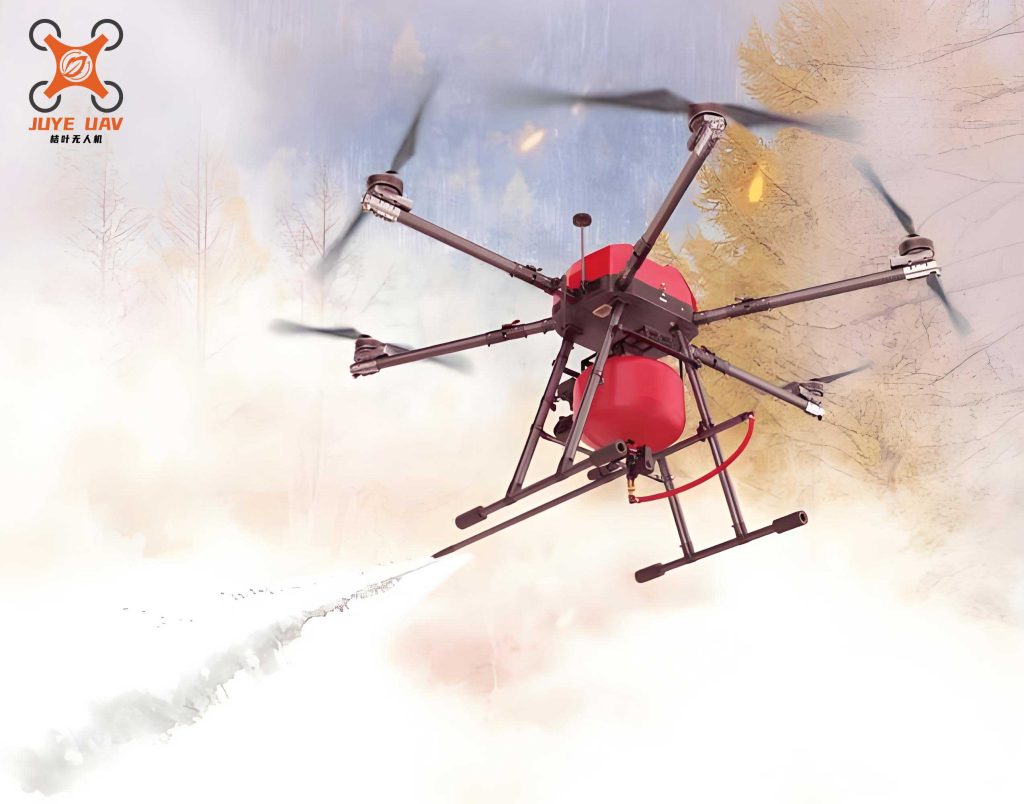
Second, the integration of an electric-controlled water cannon is essential for effective firefighting with fire drones. Once the power system supports sufficient负载, a water cannon like the PSKDY20 model can be mounted underneath the fire drone. This cannon weighs 36 kg, with a flow rate of 20 L/s and a range exceeding 48 meters. Its remote-controlled operation allows for precise targeting, with horizontal rotation of 90° and vertical tilt from 30° to 70°. The water cannon system consists of three main components: the喷射 system, remote control, and供液管线. The dynamics of water喷射 can be described by the formula for射流 velocity: $$v = \sqrt{\frac{2P}{\rho}}$$ where \(v\) is the velocity, \(P\) is the pressure (0.8 MPa for PSKDY20), and \(\rho\) is the water density (1000 kg/m³). This enables the fire drone to deliver powerful streams, covering large areas and penetrating building exteriors. Below is a table detailing the water cannon specifications for fire drone applications.
| Parameter | Value | Significance for Fire Drone |
|---|---|---|
| Weight | 36 kg | Must be within fire drone’s payload limit |
| Flow Rate | 20 L/s | Determines灭火 intensity |
| Range | ≥ 48 m | Enables operation from safe distances |
| Pressure | 0.8 MPa | Affects射流 force and penetration |
| Remote Control Distance | ≥ 150 m | Allows operators to steer fire drone safely |
Third, the供液 system for fire drones presents a major challenge due to the weight of water-filled hoses. As derived from the formula for hose weight: $$m = \rho v = \rho s l = \rho \pi r^2 l$$ where \(m\) is the mass, \(\rho\) is water density (1 g/cm³), \(r\) is the hose radius, and \(l\) is the length. For instance, a 20-meter长 hose with a 65 mm diameter weighs approximately 66 kg when filled, and scaling this to higher altitudes (e.g., 50 meters with multiple hoses) can result in loads exceeding 400 kg. Such weights strain the fire drone’s capacity, impacting its flight stability and endurance. To address this, I recommend using compressed air foam (CAF) systems, which mix air with water to reduce hose weight. Experimental data shows that for a 100-meter供水, CAF hoses weigh only 154 kg—significantly lighter than traditional water-filled hoses. This reduction can be quantified by adjusting the density term in the formula: $$\rho_{CAF} = \alpha \rho_{water}$$ where \(\alpha\) is the air fraction (e.g., 0.2 for 80% air), leading to lower mass. By integrating CAF technology, fire drones can maintain continuous供液 without overloading, enabling sustained operations in high-rise fires. The table below compares hose weights for different供液 methods in fire drone scenarios.
| 供液 Method | Hose Diameter (mm) | Length (m) | Calculated Weight (kg) | Suitability for Fire Drone |
|---|---|---|---|---|
| Traditional Water | 65 | 20 | 66 (per hose) | High weight, limits fire drone payload |
| Compressed Air Foam (CAF) | 65 | 100 | 154 (total) | Lightweight, ideal for fire drone operations |
| Dual Inlet Water (PSKDY20) | 65 x 2 | 60 (3 hoses each) | ~400 | Impractical without CAF adaptation |
In conclusion, the optimization of fire drone technology through hybrid power, electric water cannons, and advanced供液 systems holds profound implications for future firefighting strategies. From my viewpoint, these innovations will not only enhance the efficiency of emergency responses but also pave the way for smarter, more resilient urban safety networks. By learning from global消防直升机 advancements and addressing domestic technical gaps, fire drones can evolve into versatile tools capable of tackling high-risk scenarios like skyscraper fires. The repeated emphasis on ‘fire drone’ throughout this discussion underscores its centrality in this transformation. As research progresses, further refinements in aerodynamics, material science, and automation will likely expand the capabilities of fire drones, solidifying their role as indispensable assets in消防应急救援. Ultimately, the integration of these technologies promises to revolutionize how we approach disaster management, making fire drones a cornerstone of next-generation emergency response.