
In this research, we present a comprehensive study on the robust control of a fixed-wing UAV subject to high sensor noise and actuator constraints. The core contribution of our work is the integration of an Unscented Kalman Filter (UKF) for state estimation with a Nonlinear Model Predictive Control (NMPC) framework for attitude and airspeed tracking. We demonstrate through rigorous simulation that this hybrid approach significantly outperforms the traditional combination of NMPC with an Extended Kalman Filter (EKF), particularly under challenging noise environments. Our findings provide a practical and theoretically sound methodology for enhancing the flight stability of fixed-wing UAV systems when sensor fidelity is compromised.
The control of a fixed-wing UAV is inherently challenging due to its complex nonlinear dynamics and the stringent physical limits of its actuators. Furthermore, the quality of flight control is severely degraded by measurement noise from low-cost sensors commonly used in small fixed-wing UAV platforms. To address these coupled issues, we have designed a novel control framework. The first component is a state estimator based on the UKF, which estimates critical local flight states such as angle of attack, sideslip angle, and body angular rates that are highly susceptible to noise. The second component is an NMPC-based airspeed-attitude controller that leverages these estimated states to compute optimal control inputs while respecting actuator constraints like deflection limits and rate limits. This integrated architecture ensures that the fixed-wing UAV can maintain stable and accurate attitude tracking even when sensor readings are heavily corrupted.
System Architecture and Problem Formulation
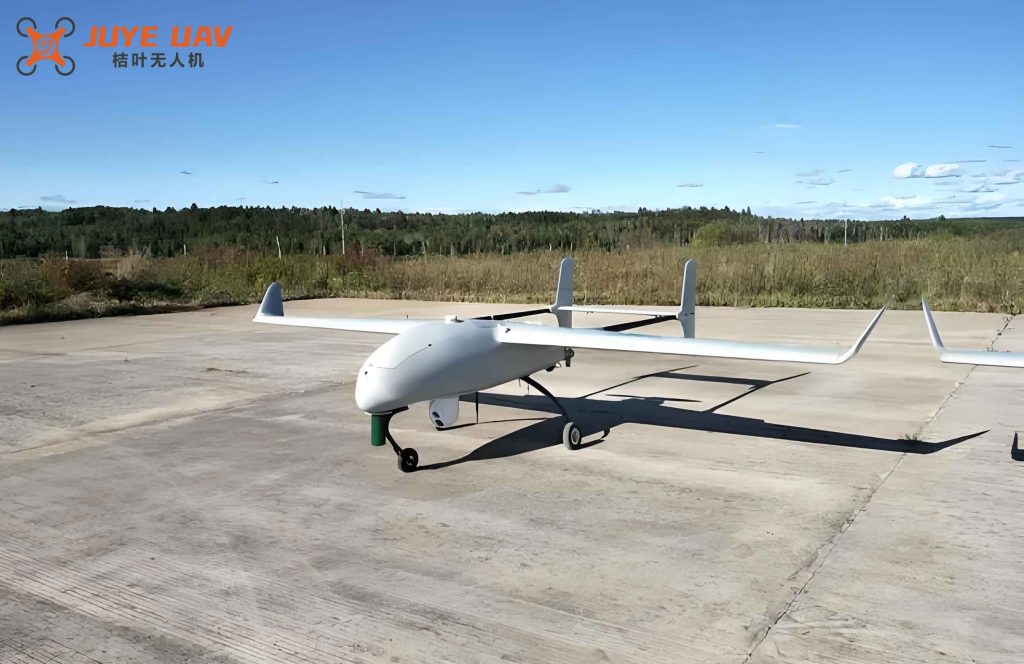
We consider a conventional fixed-wing UAV with five independent control surfaces: left aileron, right aileron, left elevator, right elevator, and rudder. The engine provides thrust along the body x-axis. The complete six-degree-of-freedom (6-DOF) nonlinear equations of motion for the fixed-wing UAV are derived under the assumptions of a flat Earth, constant mass, and a symmetric airframe. The state vector and control input vector are defined as:
$$
x = [V_T, \alpha, \beta, \phi, \theta, \psi, p, q, r]^T \in \mathbb{R}^9
$$
$$
u = [\delta_T, \delta_{al}, \delta_{ar}, \delta_{el}, \delta_{er}, \delta_r]^T \in \mathbb{R}^6
$$
Where \(V_T\) is true airspeed, \(\alpha\) is angle of attack, \(\beta\) is sideslip angle, \(\phi, \theta, \psi\) are Euler angles (roll, pitch, yaw), and \(p, q, r\) are the body angular rates. The control inputs include throttle \(\delta_T\), left and right ailerons \(\delta_{al}, \delta_{ar}\), left and right elevators \(\delta_{el}, \delta_{er}\), and rudder \(\delta_r\). The aerodynamic forces and moments are modeled as polynomial functions of the states and control surfaces. The nonlinear system is represented in a general form as:
$$
\dot{x} = f(x, u, t), \quad y = h(x, t)
$$
This model serves as the foundation for both our state estimator and our nonlinear controller design. The actuators are modeled as second-order systems with a natural frequency of 100 rad/s and damping ratio of 0.75. The deflection limits for each surface are constrained to \([-25^\circ, 25^\circ]\), and the deflection rate is limited to \([-120^\circ/s, 120^\circ/s]\).
Unscented Kalman Filter for State Estimation
In the context of a fixed-wing UAV, the signals for angle of attack \(\alpha\), sideslip angle \(\beta\), and angular rates \(p, q, r\) are critically important for flight performance, yet they are highly susceptible to sensor measurement noise. To mitigate this issue, we design a UKF-based state estimator specifically for these key states. The local system for estimation is defined as:
$$
x_s = [\alpha, \beta, p, q, r]^T, \quad y_s = [\alpha, \beta, p, q, r]^T
$$
The UKF is chosen over the EKF because it avoids the complex linearization process and provides better accuracy for highly nonlinear systems, which is the case for the fixed-wing UAV dynamics. The UKF algorithm proceeds as follows. First, a set of Sigma points is selected to approximate the state distribution:
$$
\begin{aligned}
\hat{x}^{(0)}_{k|k} &= \hat{x}_{k|k} \\
\hat{x}^{(i)}_{k|k} &= \hat{x}_{k|k} + (\alpha^2 (n+\kappa) \sqrt{P_{k|k}})_i, \quad i=1,…,n \\
\hat{x}^{(i)}_{k|k} &= \hat{x}_{k|k} – (\alpha^2 (n+\kappa) \sqrt{P_{k|k}})_i, \quad i=n+1,…,2n
\end{aligned}
$$
where \(n=5\) is the dimension of the local state, \(\alpha=0.01\), and \(\kappa=0\). These Sigma points are propagated through the nonlinear system function \(F_s\) to obtain a set of predicted points:
$$
\hat{x}^{(i)}_{k+1|k} = F_s(\hat{x}^{(i)}_{k|k}, u(k))
$$
The predicted state and covariance are then computed as weighted sums:
$$
\begin{aligned}
\hat{x}_{k+1|k} &= \sum_{i=0}^{2n} w^{(i)}_m \hat{x}^{(i)}_{k+1|k} \\
P_{k+1|k} &= \sum_{i=0}^{2n} w^{(i)}_c (\hat{x}^{(i)}_{k+1|k} – \hat{x}_{k+1|k})(\hat{x}^{(i)}_{k+1|k} – \hat{x}_{k+1|k})^T + Q_k
\end{aligned}
$$
The weights are given by:
$$
\begin{aligned}
w^{(0)}_m &= 1 – n / (\alpha^2 (n+\kappa)) \\
w^{(0)}_c &= (2 – \alpha^2 + \beta) – n / (\alpha^2 (n+\kappa)) \\
w^{(i)}_m &= w^{(i)}_c = 1 / (2\alpha^2 (n+\kappa)), \quad i=1,…,2n
\end{aligned}
$$
The update step involves computing new Sigma points from the predicted state, propagating them through the measurement function \(H\), and calculating the Kalman gain:
$$
\begin{aligned}
K_{k+1} &= P_{xy} P_y^{-1} \\
\hat{x}_{k+1|k+1} &= \hat{x}_{k+1|k} + K_{k+1}(y_{k+1} – \hat{y}_{k+1}) \\
P_{k+1|k+1} &= P_{k+1|k} – K_{k+1} P_y K_{k+1}^T
\end{aligned}
$$
This UKF estimation process provides filtered, high-fidelity estimates of the critical states that are then fed into the NMPC controller. Compared to the EKF, which relies on first-order linearization, the UKF captures the true mean and covariance of the state distribution more accurately, leading to more robust performance for fixed-wing UAV control in noisy environments.
Nonlinear Model Predictive Controller Design
The NMPC controller is designed to track a reference trajectory in airspeed and attitude while respecting state and input constraints. The discrete-time model of the fixed-wing UAV is obtained via Euler discretization:
$$
x(k+1) = x(k) + T_s \cdot f(x(k), u(k))
$$
The cost function for the optimal control problem is defined over a prediction horizon \(N_p\) and includes a terminal cost for stability:
$$
J = \sum_{i=0}^{N_p-1} (||x_e(k+i|k)||_Q^2 + ||u(k+i)||_R^2) + ||x(k+N_p|k)||_P^2
$$
where \(x_e = x – x_{ref}\) is the tracking error, \(Q\) and \(R\) are weight matrices for state error and control effort respectively, and \(P\) is the terminal penalty matrix. The optimization problem is subject to the system dynamics, initial condition, and constraints:
$$
\begin{aligned}
\min_{u} &\quad J \\
\text{s.t.} &\quad x(k+1+i|k) = F(x(k+i|k), u(k)), \quad i \in [0, N_p-1] \\
&\quad y(k|k) = H(x(k)) \\
&\quad u_{min} \leq u(k) \leq u_{max} \\
&\quad \Delta u_{min} \leq \Delta u(k) \leq \Delta u_{max} \\
&\quad x_{min} \leq x(k) \leq x_{max} \\
&\quad x(k+N_p|k) \in \Omega
\end{aligned}
$$
The terminal region \(\Omega\) is defined based on the linearized system around the equilibrium point. If the system is stabilizable, a terminal controller \(u = Kx\) exists, and the terminal region is defined as:
$$
\Omega = \{ x(k) \in X \mid x^T(k) P x(k) \leq a \}
$$
The feasibility and stability of the NMPC scheme are guaranteed. Assuming a feasible solution exists at time \(k=0\), a candidate solution at time \(k+1\) can be constructed from the optimal solution at time \(k\) by appending the terminal control law. The Lyapunov function \(V(x^*(k), k)\) is chosen as the optimal cost. It can be shown that:
$$
V(x^*(k+1), k+1) – V(x^*(k), k) \leq – (||x^*(k|k)||_Q^2 + ||u(k)||_R^2)
$$
Since the Lyapunov function difference is negative, the closed-loop system is asymptotically stable. This theoretical guarantee is crucial for ensuring the safe operation of the fixed-wing UAV in real-world scenarios.
Simulations and Comparative Analysis
We validate the performance of our proposed UKF+NMPC framework through extensive simulations on a fixed-wing UAV model. The sensor noise characteristics are modeled as Gaussian white noise with standard deviations \(\sigma_{\alpha,\beta} = 2^\circ/s\) for airflow angles and \(\sigma_{p,q,r} = 5^\circ/s\) for angular rates, simulating a high-noise environment. The NMPC parameters are set as follows: sampling time \(T_s = 50ms\), prediction horizon \(N_p = 2\), control horizon \(N_c = 1\), and weight matrices \(Q = \text{diag}(3,0,0,3,3,3,0,0,0)\), \(R = 0 \times I_6\), and \(P = \text{diag}(3,0.01,0.01,3,3,3,0.01,0.01,0.01)\).
We compare the performance of our approach against a benchmark system that uses an EKF instead of a UKF for state estimation. The process and measurement noise covariance matrices are identical for both filters to ensure a fair comparison.
| State Variable | UKF RMSE | EKF RMSE | Error Reduction (%) |
|---|---|---|---|
| Angle of Attack α (°) | 0.5493 | 2.1785 | 74.49% |
| Sideslip Angle β (°) | 0.0335 | 0.2530 | 86.86% |
| Roll Rate p (°/s) | 1.0901 | 1.9202 | 43.23% |
| Pitch Rate q (°/s) | 1.4182 | 3.8164 | 62.84% |
| Yaw Rate r (°/s) | 0.7311 | 1.7608 | 58.49% |
The results in the first table clearly show the superior estimation accuracy of the UKF compared to the EKF. For the angle of attack, the UKF achieves an RMSE of 0.5493°, which is a 74.49% improvement over the EKF’s 2.1785°. The most significant improvement is observed for the sideslip angle, where the UKF reduces the error by 86.86%. This superior estimation accuracy is due to the UKF’s ability to handle nonlinearity without linearization errors, which is especially important in the high-dynamic regime of a fixed-wing UAV during aggressive maneuvers or in turbulent conditions.
| Attitude Angle | No Filter | NMPC + EKF | NMPC + UKF (Ours) | Error Reduction (EKF vs. UKF) (%) |
|---|---|---|---|---|
| Roll Angle φ (°) | 4.30 | 0.94 | 0.24 | 74.47% |
| Pitch Angle θ (°) | 0.91 | 0.31 | 0.28 | 9.68% |
| Yaw Angle ψ (°) | 7.72 | 3.01 | 0.60 | 80.07% |
The second table demonstrates the impact of the filter on the overall closed-loop control performance. Without any filter, the tracking errors are very large, especially for the yaw angle, which reaches a maximum error of 7.72°. Introducing an EKF reduces the errors significantly, but considerable fluctuations remain. Our proposed UKF+NMPC framework dramatically improves the tracking accuracy. The maximum tracking error for the roll angle is reduced by 74.47% compared to the EKF case, and the yaw angle tracking error is reduced by 80.07%. The improvement for the pitch angle is less pronounced (9.68%) but still positive. These results highlight the synergistic benefit of combining the UKF with NMPC for fixed-wing UAV control. The clean, accurate state estimates provided by the UKF allow the NMPC to compute optimal control actions that are not dominated by measurement noise, resulting in smoother and more accurate attitude tracking.
Conclusion
In this work, we have successfully developed and validated a robust control strategy for fixed-wing UAVs by fusing a UKF state estimator with an NMPC controller. Our main conclusions are as follows. First, the NMPC method is highly effective for multi-constraint control but its performance is severely degraded under high sensor noise. Second, integrating a filter into the control loop is essential for practical applications. Third, the UKF significantly outperforms the EKF in both state estimation accuracy and closed-loop control performance for fixed-wing UAVs operating under strong noise. The UKF reduces estimation errors for key aerodynamic and inertial states by up to 86.86% compared to the EKF, and the resulting attitude tracking errors are reduced by up to 80.07%. Our findings prove that the UKF+NMPC framework is a highly promising solution for achieving stable and precise flight control for fixed-wing UAVs in challenging, sensor-limited environments, paving the way for more reliable autonomous operations.