
As a researcher in the field of agricultural technology, I have observed the growing demand for efficient and automated crop protection solutions. China, as a major agricultural nation with vast cultivated land, faces significant challenges in pesticide application due to a declining rural workforce. Currently, spraying operations rely heavily on manual or semi-automated equipment, creating an urgent need for high-performance, autonomous machinery. With the trend toward agricultural intensification and technological advancement, unmanned aerial vehicles (UAVs) equipped for plant protection have gained popularity among farmers. These agricultural UAVs, often controlled via ground stations or mobile apps, not only replace manual labor but also enhance spraying efficiency through rotor-induced airflow that atomizes liquid droplets and improves penetration, enabling low-altitude, high-efficiency, ultra-low volume pesticide application.
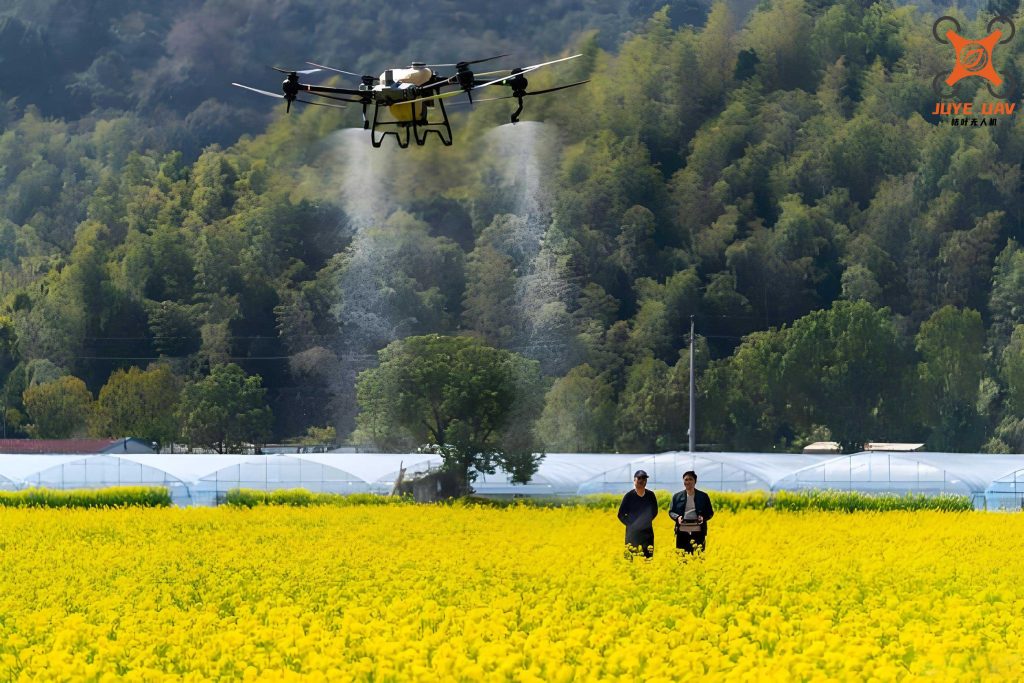
In my investigation, I focus on the power systems of agricultural UAVs, which primarily include oil-powered and electric types. Oil-powered drones benefit from the high energy density of gasoline, but they suffer from complex engine structures, high noise, inconvenient refueling, and safety risks. Electric drones, driven by lithium batteries, offer advantages such as zero pollution, low noise, and good safety, making them mainstream in aerial plant protection. However, limitations in lithium battery technology result in short endurance times, requiring multiple batteries for field operations and posing challenges for recharging in remote areas. To address these issues, I explore the integration of fuel cells as a hybrid power source for agricultural UAVs, aiming to extend flight duration and improve operational efficiency.
The core of my research lies in proton exchange membrane fuel cells (PEMFCs), which convert chemical energy from fuel and oxygen directly into electricity through electrochemical reactions at relatively low temperatures (around 80°C). PEMFCs consist of an anode, cathode, electrolyte, and auxiliary components, offering high power density, rapid startup, and quick response to load changes. Unlike internal combustion engines, fuel cells are not limited by the Carnot cycle, with theoretical efficiencies reaching 85–90%. Currently, practical energy conversion efficiencies range from 40% to 60%, and with cogeneration, overall fuel utilization can exceed 80%. PEMFCs, particularly those using hydrogen as fuel, are considered the fourth generation of power generation after thermal, hydro, and nuclear power, providing continuous electricity as long as fuel and oxidant are supplied. Their benefits include high efficiency, low pollution, and minimal noise, making them suitable for agricultural UAV applications. However, fuel cells have a “soft” power characteristic, where output voltage drops significantly with increasing power, necessitating integration with high-specific-power sources like lithium batteries. Thus, a hybrid system combining PEMFCs and lithium batteries emerges as a promising solution for agricultural UAVs.
To design an effective hybrid power system for agricultural UAVs, I analyze the varying power demands during different operational modes. Typically, an agricultural UAV experiences three primary modes: startup, cruising (or spraying), and landing. Startup requires the highest power, often several times the rated power, which fuel cells cannot provide instantly due to slower response times; here, lithium batteries supply most of the energy. During cruising or spraying, power demand is relatively stable and can be fully met by the fuel cell. Landing involves low power需求, which can be handled directly by the lithium batteries. To ensure reliable operation, the fuel cell’s rated output power must not be less than the average power demand of the agricultural UAV; otherwise, the lithium battery would discharge continuously, reducing endurance. Additionally, the combined output of the fuel cell and lithium battery must exceed the maximum power需求 during operation. I also incorporate safety thresholds: when the lithium battery’s charge is insufficient for a safe landing, the fuel cell charges it, and when hydrogen levels are too low, the fuel cell stops outputting to initiate landing procedures.
The hybrid power system topology I propose is illustrated below. In this system, the fuel cell serves as the primary power source, while the lithium-ion battery acts as a supplementary source. Based on power balance principles, passive control manages charging and discharging. A DC-DC converter modulates voltage and current to drive the直流 motor, which propels the agricultural UAV’s rotors. This approach leverages the strengths of both power sources: the fuel cell provides sustained energy, and the lithium battery offers high power and fast response. This not only enhances system efficiency and reduces fuel consumption but also extends the endurance of the agricultural UAV and prolongs system lifespan.
For the fuel cell design, given the operational environment of agricultural UAVs, I recommend an air-cooled, cathode-open PEMFC system. This configuration has a简洁 structure suitable for field operations. Air-cooled fuel cells can be categorized into self-breathing and forced convection types. Self-breathing cells expose the cathode directly to air, relying on natural convection for oxygen supply and cooling, but they suffer from inadequate散热 and limited air supply, making them suitable only for low-power applications. In contrast, forced convection systems incorporate a DC fan as an auxiliary component. This fan serves three critical functions: providing oxygen to the stack, cooling the stack to maintain optimal temperature, and removing excess water from the cathode to prevent flooding. Although the fan consumes less than 5% of the PEMFC’s output power, it significantly enhances performance, making it ideal for agricultural UAVs.
The single-cell structure of the PEMFC used in agricultural UAVs includes key components such as the membrane electrode assembly (MEA), sealing gaskets, and bipolar plates. The MEA comprises an electrolyte membrane and porous gas diffusion layers (typically carbon paper) on both sides. The bipolar plates facilitate fuel and air flow, prevent gas crossover, and establish electrical connections between串联 cells. Sealing elements ensure no leakage of water, oxygen, or hydrogen. The electrochemical reactions occur at the anode and cathode: hydrogen oxidation reaction (HOR) at the anode and oxygen reduction reaction (ORR) at the cathode, producing water as a byproduct. The overall reaction can be expressed as:
$$2H_2 + O_2 \rightarrow 2H_2O + \text{electrical energy}$$
The efficiency of a PEMFC can be modeled using the following equation, where $V_{cell}$ is the cell voltage, $V_{thermo}$ is the thermodynamic potential, and losses are accounted for:
$$\eta_{FC} = \frac{V_{cell}}{V_{thermo}} \times 100\%$$
For a hybrid system, the power balance is crucial. Let $P_{demand}$ be the power demand of the agricultural UAV, $P_{FC}$ be the fuel cell output power, and $P_{bat}$ be the lithium battery power. The management strategy ensures:
$$P_{demand} = P_{FC} + P_{bat}$$
During startup, $P_{bat} \gg P_{FC}$; during cruising, $P_{FC} \approx P_{demand}$; and during landing, $P_{bat} \approx P_{demand}$. To optimize energy use, I propose a state-based control algorithm that adjusts $P_{FC}$ and $P_{bat}$ based on real-time monitoring of battery state of charge (SOC) and hydrogen levels.
To quantify the benefits, I compare different power systems for agricultural UAVs in the table below. This analysis highlights the advantages of the hybrid approach in terms of endurance, efficiency, and operational flexibility.
| Power System | Energy Density (Wh/kg) | Endurance (minutes) | Noise Level | Environmental Impact | Response Time |
|---|---|---|---|---|---|
| Oil-powered | ~12,000 (gasoline) | 30-60 | High | High (emissions) | Fast |
| Electric (Li-ion) | ~250 | 15-30 | Low | Low | Very Fast |
| Fuel Cell (PEMFC) | ~500 (hydrogen) | 60-120 (theoretical) | Very Low | Very Low (water only) | Moderate |
| Hybrid (FC + Li-ion) | Combined | 45-90 (experimental) | Low | Low | Fast |
The energy management strategy for the hybrid system can be formalized using a rule-based controller. Let $SOC_{min}$ be the minimum SOC for safe landing, and $H_{2,min}$ be the minimum hydrogen level. The control logic is as follows:
If $SOC < SOC_{min}$, then $P_{FC}$ charges the battery until $SOC \geq SOC_{min}$.
If $H_2 < H_{2,min}$, then $P_{FC} = 0$ and initiate landing.
Otherwise, allocate $P_{FC}$ and $P_{bat}$ based on $P_{demand}$ and efficiency maps.
The efficiency map of a PEMFC can be approximated by a quadratic function of current density $i$:
$$\eta_{FC}(i) = a – b \cdot i – c \cdot i^2$$
where $a$, $b$, and $c$ are constants derived from experimental data. For the lithium battery, the discharge efficiency $\eta_{bat}$ is typically high (over 95%), but it decreases at high currents. The overall system efficiency $\eta_{sys}$ is given by:
$$\eta_{sys} = \frac{P_{demand}}{P_{fuel} + P_{bat,loss}}$$
where $P_{fuel}$ is the chemical power from hydrogen and $P_{bat,loss}$ is the battery loss.
In terms of structural design, the cathode-open PEMFC for agricultural UAVs must be lightweight and compact. The bipolar plates are often made of graphite or composite materials to reduce weight. The MEA uses a thin proton exchange membrane (e.g., Nafion) to minimize resistance. The stack configuration is typically planar, with multiple cells stacked in series to achieve the desired voltage. For thermal management, the DC fan operates at variable speeds based on stack temperature $T_{stack}$, controlled by a PID controller:
$$u(t) = K_p e(t) + K_i \int e(t) dt + K_d \frac{de(t)}{dt}$$
where $e(t) = T_{setpoint} – T_{stack}(t)$, and $u(t)$ is the fan speed. This ensures optimal operating temperature and prevents overheating, which is critical for agricultural UAVs operating in varying environmental conditions.
To validate the hybrid system, I conducted experiments using a modified agricultural UAV model. The baseline was a commercial agricultural UAV with a takeoff mass of 21.9 kg, equipped with a 12,000 mAh lithium polymer battery, offering an endurance of 15 minutes. I retrofitted it with a custom 3000W rated PEMFC from a hydrogen energy company and a 10,000 mAh无人机-specific lithium battery as the hybrid power source. The takeoff mass increased to 25.2 kg due to the fuel cell system components, including the hydrogen tank, fan, and controllers. Prior to flight, I tested the control system with an electronic load to ensure smooth power switching under different output demands. The agricultural UAV was then flown in calm weather over an open field. Results showed that the hybrid system could meet power requirements across all flight modes, with endurance extending to 45 minutes—a threefold improvement over the纯 electric version. This demonstrates the potential of fuel cells to significantly enhance the operational capability of agricultural UAVs.
The experimental data can be summarized with the following performance metrics. Let $E_{bat}$ be the energy capacity of the lithium battery, $E_{H2}$ be the energy from hydrogen, and $t_{flight}$ be the flight time. For the hybrid system:
$$t_{flight} = \frac{E_{bat} + E_{H2}}{P_{avg}}$$
where $P_{avg}$ is the average power demand. Assuming $P_{avg} = 2000W$ for the agricultural UAV, $E_{bat} = 370Wh$ (for 10,000 mAh at 37V), and $E_{H2} = 1500Wh$ (based on hydrogen storage), we get:
$$t_{flight} \approx \frac{370 + 1500}{2000} \times 60 \approx 56 \text{ minutes}$$
The experimental value of 45 minutes accounts for losses and transient demands. This highlights the importance of efficient energy management in agricultural UAVs.
Further analysis involves the dynamic response of the hybrid system. The fuel cell’s output can be modeled as a first-order system with time constant $\tau_{FC}$, while the battery responds almost instantly. Thus, for a step change in power demand $\Delta P$, the hybrid system output $P_{out}(t)$ is:
$$P_{out}(t) = P_{FC}(t) + P_{bat}(t)$$
where $P_{FC}(t) = P_{FC,ss} (1 – e^{-t/\tau_{FC}})$ and $P_{bat}(t)$ compensates initially. This ensures that the agricultural UAV maintains stable flight even during rapid maneuvers or wind gusts.
In discussion, I recognize several challenges for fuel cell adoption in agricultural UAVs. Hydrogen storage and refueling infrastructure are limited in rural areas, though compressed hydrogen tanks can be used. Safety concerns regarding hydrogen handling must be addressed through robust design and protocols. Additionally, the cost of PEMFCs remains high, but mass production and technological advances could reduce it. Despite these hurdles, the hybrid system offers a compelling path forward for agricultural UAVs, combining the endurance of fuel cells with the power of lithium batteries. Future work should focus on optimizing the energy management strategy using advanced algorithms like fuzzy logic or model predictive control, further reducing weight, and integrating renewable hydrogen production for sustainability.
From a broader perspective, the application of fuel cells in agricultural UAVs aligns with global trends toward precision agriculture and environmental stewardship. By enabling longer flight times and reducing reliance on fossil fuels, these systems can increase crop yields, minimize chemical usage, and lower carbon footprints. As the demand for efficient plant protection grows, fueled by population增长 and climate change, innovations in power systems will play a pivotal role. My research contributes to this by providing a framework for hybrid power integration, backed by experimental validation.
In conclusion, the integration of proton exchange membrane fuel cells with lithium batteries in a hybrid power system presents a viable solution to enhance the endurance and efficiency of agricultural UAVs. Through careful design of the fuel cell structure, implementation of科学的 energy management strategies, and experimental testing, I have demonstrated significant improvements in flight time. This approach not only addresses the limitations of current power systems but also paves the way for sustainable and high-performance agricultural UAV operations. As technology evolves, I anticipate wider adoption of fuel cells in aerial plant protection, ultimately transforming modern farming practices and contributing to food security goals.
To reiterate, the key takeaways are: the hybrid system leverages the strengths of both fuel cells and lithium batteries; the cathode-open PEMFC design suits field conditions; and proper energy management is crucial for optimal performance. For researchers and engineers working on agricultural UAVs, this study offers theoretical insights and practical guidelines for implementing fuel cell technology. Moving forward, interdisciplinary collaboration will be essential to overcome remaining barriers and realize the full potential of fuel cell-powered agricultural UAVs in real-world settings.