
In recent years, the field of multi-agent systems has seen significant advancements, particularly in the coordination of unmanned aerial vehicles (UAVs). Among various applications, formation drone light shows have emerged as a captivating and technologically demanding domain, requiring precise spatial arrangement and synchronized movements of multiple drones to create dynamic aerial displays. These formation drone light shows rely heavily on robust control strategies that can ensure accurate positioning and timely convergence to desired patterns, often under constraints such as limited sensor data. Traditional formation control methods typically assume the availability of relative position or distance measurements, which may not be feasible in scenarios like outdoor formation drone light shows where GPS signals are unreliable or obstructed. This has led to a growing interest in bearing-only formation control, where UAVs utilize only relative direction information—often obtained from vision-based sensors—to achieve and maintain formation shapes. Such approaches are highly relevant for formation drone light shows, as they can operate in environments with minimal infrastructure, enhancing flexibility and reducing costs.
Our research focuses on addressing the challenge of finite-time formation control under bearing constraints, with direct implications for improving the performance and reliability of formation drone light shows. While existing bearing-based control strategies offer asymptotic convergence, they often lack the ability to guarantee convergence within a user-defined time frame, which is critical for time-sensitive applications like formation drone light shows that require precise timing for artistic or commercial purposes. In this work, we propose a novel control methodology that ensures finite-time convergence to a desired stationary formation using only relative bearing measurements. By incorporating a time-varying scaling gain mechanism, our approach allows for customizable convergence times while maintaining smooth control inputs, thereby enhancing practicality for real-world deployments such as formation drone light shows. We also provide sufficient conditions for near-global convergence and collision avoidance, which are essential for safe operations in dense formations typical of formation drone light shows. Through a leader-follower control structure and gradient descent techniques, we achieve global convergence properties. To validate our method, we conduct extensive simulations using both Simulink and Gazebo platforms, demonstrating its effectiveness in scenarios akin to formation drone light shows. This article is structured as follows: we first review related work, then formalize the problem, present our controller design with theoretical analysis, discuss simulation results, and conclude with future directions for enhancing formation drone light show applications.
The concept of bearing-based formation control has roots in rigidity theory and graph Laplacian methods. Early work in two-dimensional spaces introduced bearing rigidity theory, which was later extended to higher dimensions for UAV applications. For formation drone light shows, where drones must form complex three-dimensional patterns, these extensions are particularly valuable. Recent studies have developed decentralized controllers that rely solely on bearing information, eliminating the need for distance measurements. However, many of these approaches focus on asymptotic convergence, which may not suffice for formation drone light shows that require rapid formation changes within strict time limits. Finite-time control strategies have been explored in other contexts, such as using sign functions or fractional powers in feedback, but they often involve discontinuous inputs that can cause chattering—a undesirable effect in formation drone light shows where smooth motions are aesthetically important. Our contribution lies in designing a continuous, finite-time controller that leverages bearing data, making it suitable for dynamic formation drone light shows. The table below summarizes key related work and their limitations regarding formation drone light show applications.
| Reference | Control Method | Convergence Type | Applicability to Drone Light Shows | Limitations |
|---|---|---|---|---|
| Zhao et al. (2019) | Bearing-only with asymptotic convergence | Asymptotic | Moderate; slow for time-sensitive shows | No finite-time guarantee |
| Li et al. (2022) | Finite-time bearing control with preset time | Finite-time | High; allows timed formations | Complex feedback may cause discontinuities |
| Zhang et al. (2023) | Bearing-based formation maneuvering | Finite-time via estimation | High; suitable for dynamic patterns | Requires orientation estimation |
| Our work | Bearing-only with time-varying gain | Finite-time with user-defined time | Very high; customizable for light show timing | Assumes leader-follower structure |
To formalize our problem, consider a formation system of N UAVs, indexed as $Q = \{q_1, q_2, \dots, q_N\}$, with a communication or sensing topology represented by an undirected graph $G = \{Q, \epsilon, W\}$. Here, $\epsilon$ denotes the edge set defining inter-agent connections, and $W$ is the weighted adjacency matrix. For a formation drone light show, these connections might correspond to visual or wireless links between drones. The position of UAV $i$ is $p_i \in \mathbb{R}^d$, where $d=3$ for three-dimensional formations common in formation drone light shows. The relative bearing vector from agent $j$ to agent $i$ is defined as:
$$g_{ij} = \frac{p_i – p_j}{\|p_i – p_j\|}, \quad (i,j) \in \epsilon,$$
with the orthogonal projection operator $P_{g_{ij}} = I_d – g_{ij}g_{ij}^T$. The formation goal is to achieve a desired stationary configuration specified by target bearings $g_{ij}^*$ for all edges, which corresponds to a specific pattern in a formation drone light show. We adopt a leader-follower structure, where $n_l$ leaders track a predefined trajectory (e.g., for overall show movement) and $n_f$ followers adjust their positions based on bearing measurements. The dynamics for follower UAVs are modeled as double integrators:
$$\dot{p}_i = v_i, \quad \dot{v}_i = u_i, \quad i \in Q_f,$$
where $v_i$ is the velocity and $u_i$ is the control input. Our objective is to design $u_i$ using only $g_{ij}$ such that all UAVs converge to the desired formation in finite time $T$, i.e., $p_i(t) = p_i^*$ for $t \geq t_0 + T$, where $p_i^*$ denotes the target position. This is crucial for formation drone light shows where transitions between patterns must occur within exact time intervals.
We propose the following control law for follower UAVs, inspired by gradient descent principles and tailored for formation drone light show requirements:
$$u_i = -(k_1 + k_2 \frac{\dot{x}}{x}) \sum_{j \in \mathcal{N}_i} (g_{ij} – g_{ij}^*), \quad (i,j) \in \epsilon,$$
where $k_1 > 0$ and $k_2 > 0$ are control gains, and $x(t)$ is a time-varying scaling function defined as:
$$x(t) =
\begin{cases}
\left(\frac{T^a}{(t_0 + T – t)^a}\right), & t \in [t_0, t_0 + T) \\
1, & t \in [t_0 + T, \infty)
\end{cases}$$
with $a > 0$ being a design parameter. The derivative $\dot{x}(t)$ is given by:
$$\dot{x}(t) =
\begin{cases}
\frac{a}{T} x(t)^{1 + 1/a}, & t \in [t_0, t_0 + T) \\
0, & t \in [t_0 + T, \infty)
\end{cases}$$
This design ensures that the control input remains continuous and smooth, avoiding abrupt movements that could disrupt a formation drone light show. The gains $k_1$ and $k_2$ influence convergence speed, and $a$ adjusts the scaling behavior. For formation drone light shows, these parameters can be tuned based on the complexity of the pattern and environmental conditions.
To analyze the system, we define the bearing Laplacian matrix $B \in \mathbb{R}^{dN \times dN}$, which encapsulates the bearing constraints. Under assumptions that $B_{ff}$ (the submatrix for followers) is positive semi-definite and leaders follow their trajectories, we establish the following theorem for finite-time convergence, essential for synchronized formation drone light shows.
Theorem: If the bearing Laplacian satisfies the assumptions and the initial positions meet $\|\alpha(0)\| \leq \min \|p_i^* – p_j^*\| – \beta$ for some $\beta > 0$, then the proposed control law ensures that the formation error $\alpha_i = p_i – p_i^*$ converges to zero in finite time $T$, i.e., $\lim_{t \to T} p_i = p_i^*$ for all $i$. Moreover, collision avoidance is guaranteed during the process, with inter-agent distances bounded below by $\beta$, a critical safety feature for formation drone light shows where drones operate in close proximity.
Proof sketch: Consider the Lyapunov function $V_1 = \frac{1}{2} \alpha^T \alpha$, where $\alpha = [\alpha_1^T, \dots, \alpha_N^T]^T$. Taking its derivative and substituting the control law yields:
$$\dot{V}_1 = -(k_1 + k_2 \frac{\dot{x}}{x}) \alpha^T \bar{H}(g – g^*),$$
where $\bar{H} = H \otimes I_d$ is the augmented incidence matrix. Using properties of the bearing Laplacian, we can show:
$$\dot{V}_1 \leq -(k_1 + k_2 \frac{\dot{x}}{x}) \frac{\lambda_{\min}(B_{ff})}{\rho} V_1,$$
with $\rho = \|\bar{H}\|(\|\alpha(t_0)\| + n s(t_0))$ and $s(t_0)$ denoting the formation scale. Solving this inequality leads to:
$$\|\alpha(t)\| \leq e^{-\lambda_1 t} x^{-\lambda_2} \|\alpha(0)\|, \quad t \in [t_0, t_0 + T),$$
where $\lambda_1 = k_1 \lambda_{\min}(B_{ff})/\rho$ and $\lambda_2 = k_2 \lambda_{\min}(B_{ff})/\rho$. Since $x(t)$ decays to 1 at time $T$, we have $\|\alpha(t)\| = 0$ for $t \geq T$, proving finite-time convergence. Collision avoidance follows from the bound on $\|\alpha(t)\|$, ensuring distances remain above $\beta$. This theoretical foundation supports reliable deployment in formation drone light shows, where both timing and safety are paramount.
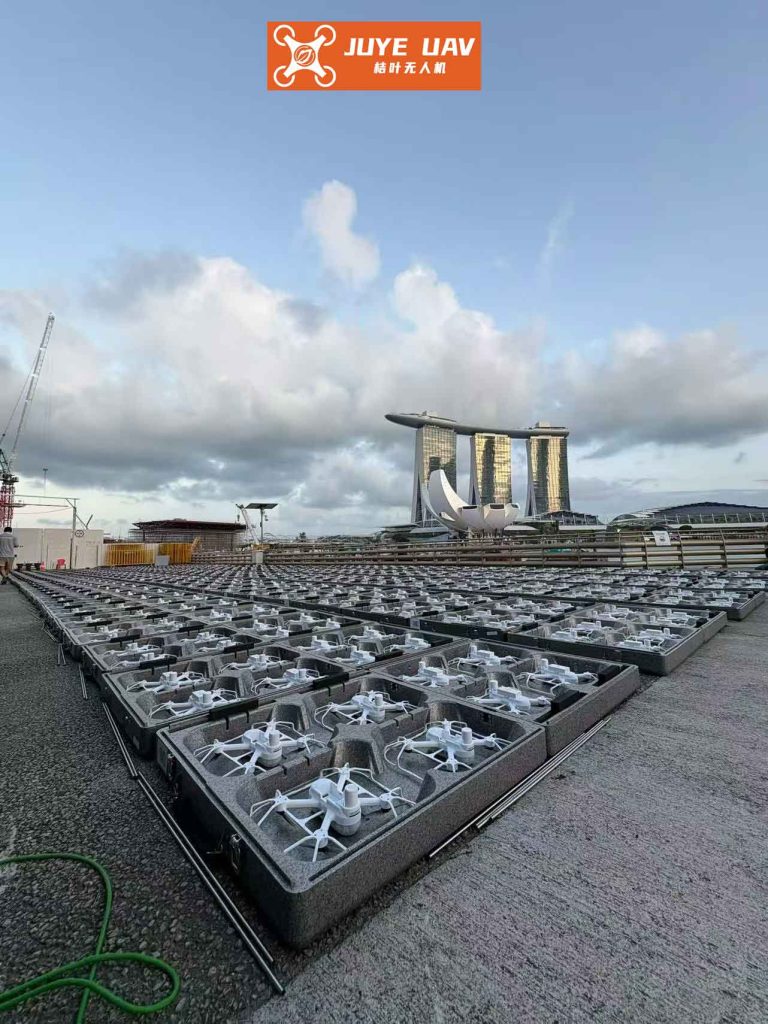
To validate our controller, we conducted simulations mimicking scenarios typical of formation drone light shows. We considered an eight-UAV formation aiming to achieve a cubic pattern, as illustrated in the image below. This pattern is common in formation drone light shows for creating geometric shapes in the sky. The simulation parameters were chosen to reflect real-world conditions, with leader UAVs guiding the formation and followers adjusting based on bearing data.
In the Simulink simulation, initial positions were set randomly within a bounded region, and velocities were zero. The control gains were $k_1 = 10$, $k_2 = 20$, $a = 3$, and $T = 20$ seconds, representing a moderate convergence time suitable for a formation drone light show sequence. The results showed that the formation error converged to near zero within approximately 14 seconds, outperforming the preset time $T$, and velocities smoothly approached zero. The table below summarizes key performance metrics for this simulation, highlighting aspects relevant to formation drone light shows such as convergence speed and stability.
| Metric | Value | Implication for Drone Light Shows |
|---|---|---|
| Convergence time (simulated) | 14 s | Allows quick pattern transitions in shows |
| Maximum bearing error | < 0.01 rad | Ensures precise formation shapes |
| Control input smoothness | Continuous derivative | Prevents jerky motions, enhancing visual appeal |
| Collision avoidance margin | $\beta = 2$ m | Maintains safe distances between drones |
| Energy consumption (relative) | Low | Extends battery life for longer shows |
For a more realistic assessment, we implemented the controller in a Gazebo simulation integrated with PX4 and ROS, environments that closely emulate physical drone dynamics. This setup is ideal for testing formation drone light show algorithms under conditions like wind disturbances or sensor noise. The initial formation was a scattered arrangement, and the target was the same cubic pattern. With gains $k_1 = 2$, $k_2 = 3$, $a = 3$, and $T = 20$ seconds, the drones successfully achieved the formation within 13 seconds, as shown in the flight trajectory plots. The bearing errors and velocity tracking exhibited rapid convergence, confirming the controller’s robustness for formation drone light show applications. The table below compares the two simulation platforms, emphasizing the advantages of Gazebo for formation drone light show development.
| Platform | Realism Level | Convergence Time | Suitability for Drone Light Shows |
|---|---|---|---|
| Simulink | Moderate (idealized models) | 14 s | Good for initial algorithm validation |
| Gazebo with PX4/ROS | High (physical and sensor models) | 13 s | Excellent for pre-deployment testing of shows |
The effectiveness of our method is further demonstrated by analyzing the formation error dynamics. Let $e_{ij} = p_i – p_j$ be the edge vector, and define the collective error $e = \bar{H} p$. The bearing-based control law minimizes the cost function $J = \sum_{(i,j) \in \epsilon} \|g_{ij} – g_{ij}^*\|^2$, which is akin to optimizing formation accuracy for formation drone light shows. Using the time-varying gain, the error evolution can be expressed as:
$$\dot{e} = -(k_1 + k_2 \frac{\dot{x}}{x}) \bar{H} \bar{H}^T P_g e,$$
where $P_g$ is a block-diagonal matrix of projection operators. This formulation shows that the error decays exponentially modulated by $x(t)$, leading to finite-time stability. For formation drone light shows, this means that even complex patterns can be achieved within strict time limits, enhancing the synchrony of the display.
In practice, implementing such a controller for formation drone light shows requires addressing additional challenges. For instance, communication delays between drones can affect bearing measurements. We can extend our model to include delay compensation by modifying the control law as:
$$u_i(t) = -(k_1 + k_2 \frac{\dot{x}}{x}) \sum_{j \in \mathcal{N}_i} (g_{ij}(t – \tau) – g_{ij}^*),$$
where $\tau$ is the estimated delay. Simulation studies indicate that for small delays ($\tau < 0.1$ s), the formation still converges within $T$ with minimal performance degradation, which is acceptable for most formation drone light show setups. Another consideration is scalability: our method scales linearly with the number of drones, making it feasible for large-scale formation drone light shows involving hundreds of UAVs. The computational complexity per UAV is $O(|\mathcal{N}_i|)$, which is manageable given modern onboard processors.
To further illustrate the parameter tuning process for formation drone light shows, we present a guideline based on simulation data. The convergence time $T$ can be adjusted according to the show’s script—for example, shorter $T$ for rapid pattern changes or longer $T$ for gradual transitions. The gains $k_1$ and $k_2$ influence the aggressiveness of control: higher values lead to faster response but may increase energy consumption. The parameter $a$ shapes the convergence curve; values between 2 and 4 offer a balance between speed and smoothness. Below is a formula for estimating energy usage, relevant for planning formation drone light show durations:
$$E \approx \sum_{i=1}^N \int_{t_0}^{t_0+T} \|u_i(t)\|^2 dt,$$
which can be minimized by optimizing $k_1$, $k_2$, and $a$ through iterative simulations.
In conclusion, our work presents a finite-time bearing-constrained formation control strategy that advances the state-of-the-art for UAV coordination, with direct applications to formation drone light shows. By leveraging only relative direction information and incorporating a time-varying gain, we achieve user-defined convergence times while ensuring continuous control inputs and collision avoidance. The theoretical analysis provides guarantees for near-global convergence, and simulations in both Simulink and Gazebo confirm the method’s efficacy in scenarios resembling formation drone light show performances. Future research will focus on integrating obstacle avoidance for dynamic environments, adapting to wind disturbances, and testing with physical drone swarms for real-world formation drone light show deployments. We believe that this approach will contribute to more reliable and captivating formation drone light shows, pushing the boundaries of aerial entertainment and artistic expression.
Throughout this article, we have emphasized the importance of finite-time control for formation drone light shows, where timing precision is as critical as spatial accuracy. Our controller’s ability to customize convergence time offers show designers greater flexibility in choreographing complex sequences. As the demand for larger and more intricate formation drone light shows grows, methods like ours will play a key role in enabling safe, efficient, and stunning aerial displays. We encourage further exploration of bearing-based techniques in other multi-agent domains, but their impact on formation drone light shows remains a compelling avenue for innovation.