
The deployment of military UAVs has fundamentally reconfigured contemporary warfare, collapsing the traditional separation between action, memory, and representation. Unlike conventional media studies that privilege ocularcentrism – framing drone operations through cinematic paradigms of detached spectatorship – we argue that military drone technology demands a phenomenological investigation of gesture. This approach reveals how operational interfaces reconfigure embodiment through distributed agency and sensory recombination.
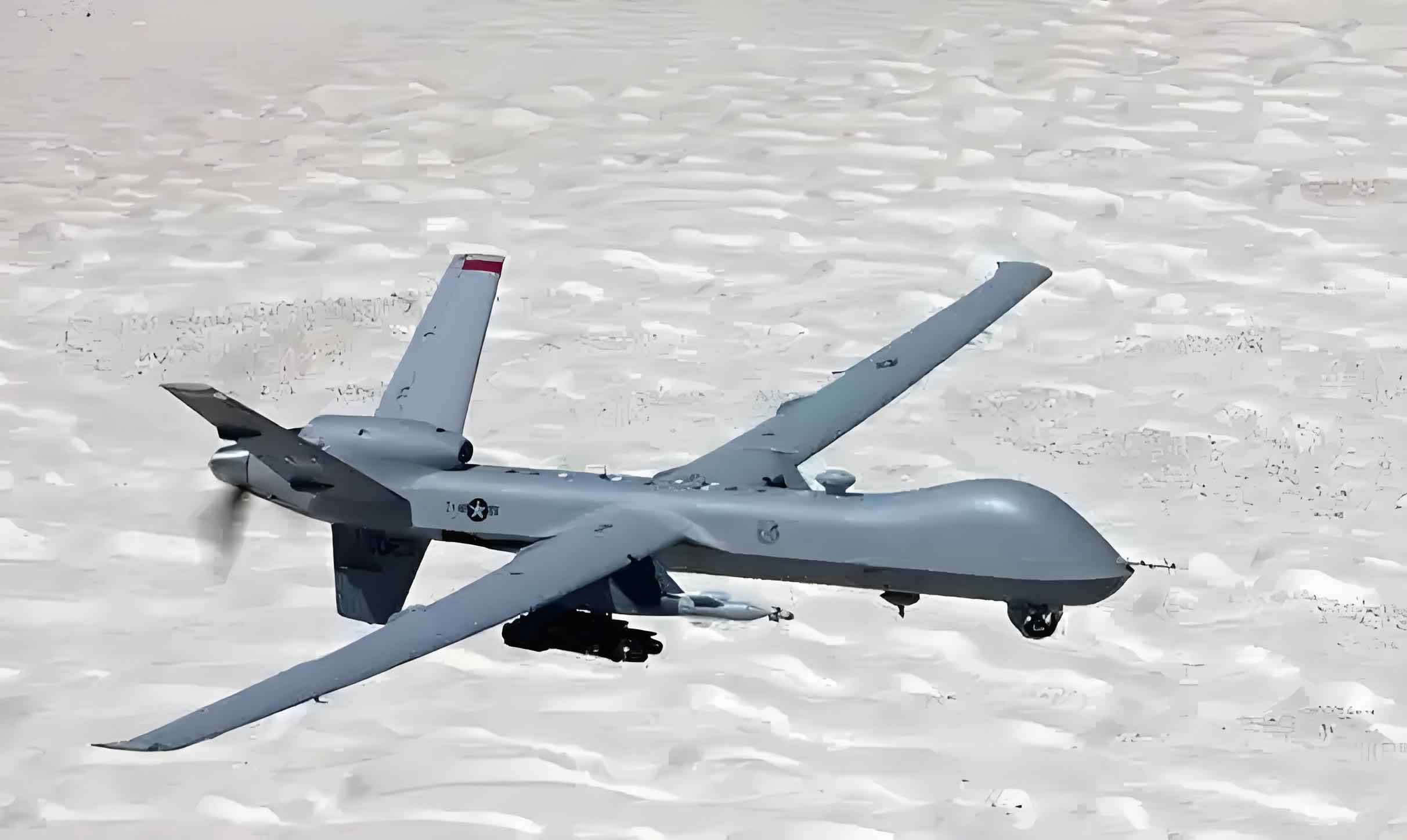
Visual-centric discourse reduces military UAVs to surveillance apparatuses, epitomized by the “Gorgon stare” metaphor. This perspective overlooks the operational unity where perception and action converge in real-time feedback loops. Unlike cinematic viewing where:
$$Visual\,Experience = \frac{Passive\,Reception}{Textual\,Interpretation}$$
Military drone interfaces establish:
$$Operational\,Embodiment = \int_{t_0}^{t_1} (Kinesthetic\,Input \oplus Visual\,Feedback) \, dt$$
where $\oplus$ denotes sensory integration through haptic interface dynamics.
The Ocularcentric Blind Spot
Prevailing scholarship analyzes military UAV imagery as visual texts, perpetuating three limitations:
- Binary Reduction: Frameworks like “observer-observed” ignore the proprioceptive dimensions of interface operation
- Cinematic Paradigm: Continuity with aerial photography and film obscures real-time action-perception coupling
- Interpretive Primacy: Overemphasis on symbolic analysis neglects pre-hermeneutic gestural intelligence
This creates what we term the representational fallacy – analyzing military drone outputs as content rather than operational traces.
Gesture as Phenomenological Ground
Military UAV systems constitute distributed cognitive assemblages where human operators and technical components interoperate through three integrated layers:
| Functional Layer | Technical Manifestation | Embodiment Mechanism |
|---|---|---|
| Sensory-Action Synthesis | Electro-optical sensors + weapons systems | Proprioceptive extension through control surfaces |
| Cybernetics Loop | Kill chain: OODA cycle (Observe-Orient-Decide-Act) | Haptic-visual feedback synchronization |
| Interface Transparency | Ground Control Station (GCS) ergonomics | Body schema incorporation of UAV kinematics |
The control loop formalizes this distributed agency:
$$Human \xrightarrow{Gesture} Interface \xrightarrow{Signal} UAV \xrightarrow{Sensor} Environment$$
$$Environment \xrightarrow{Feedback} Display \xrightarrow{Perception} Human$$
This creates telepresent embodiment where operators develop what pilots call “stick-to-picture” synchronicity – the kinesthetic unification of control input with visual returns.
Operational Reconfiguration of Embodiment
Military drone interfaces dissolve the sensory hierarchy through two interconnected processes:
1. Operational Subsumption
Unlike cinematic images requiring hermeneutic engagement, operational images function as haptic surfaces. Targeting sequences demonstrate this shift:
$$Aim = \underbrace{Target\,Acquisition}_{Visual} + \underbrace{Weapon\,Guidance}_{Haptic}$$
Traditional weapon aiming involved interpretive translation: 3D space → 2D representation → coordinate data → ballistic calculation. Military UAV interfaces collapse this chain:
$$\text{Visual Field} \xrightarrow{\text{HUD Integration}} \text{Motor Intent}$$
The Heads-Up Display (HUD) becomes what phenomenologists call a “ready-to-hand” artifact – transparent until breakdown.
2. Sensory Rebalancing
Military drone operation redistributes sensory ratios:
| Sensory Mode | Cinematic Paradigm | Operational Paradigm |
|---|---|---|
| Vision | Dominant (85%) | Integrated (40%) |
| Haptics/Kinesthesia | Marginal (5%) | Primary (50%) |
| Interpretive Cognition | High (10%) | Low (10%) |
This generates what we term electronic proprioception – the extension of bodily spatial awareness through machine kinematics. As one Reaper operator noted: “After 50 flight hours, the bird stops feeling like equipment and starts feeling like new limbs.”
Distributed Subjectivity
The operational synthesis produces a multi-layered presence:
$$\Psi_{Operator} = \alpha(\text{Physical Space}) + \beta(\text{Data Space}) + \gamma(\text{Battlefield Space})$$
where coefficients $\alpha$, $\beta$, $\gamma$ represent phenomenological weighting during mission execution. This configuration challenges the Cartesian theater of consciousness, replacing it with what Clark and Chalmers termed the “extended mind” – cognition distributed across biological and technological components.
Conclusion
Military UAV interfaces reconfigure embodiment through operational unification: vision becomes enactive, touch becomes electronic, and agency becomes distributed. This represents not merely technological augmentation, but a fundamental recalibration of human-world relations. The military drone operator exists simultaneously across discontinuous spaces through gestural integration with the apparatus. As military UAV technology proliferates, its phenomenological implications will increasingly define post-human perceptual paradigms.