
The rapid evolution of unmanned systems has ushered in a new era of distributed aerial capabilities, epitomized by drone swarm technology. Inspired by the collective behavior of social insects like bees, a drone swarm comprises multiple unmanned aerial vehicles (UAVs) that operate collaboratively through information exchange and coordinated task execution. This paradigm shift from single-platform operations to networked, autonomous swarms offers unprecedented flexibility, resilience, and efficiency for applications ranging from logistics and disaster response to precision agriculture. However, this very power presents formidable security challenges. The malicious use of drone swarms for surveillance, disruptive attacks, or coordinated strikes against critical infrastructure necessitates the urgent and parallel development of robust countermeasures. A deep understanding of the threat landscape and the advancement of integrated anti-drone systems are paramount for safeguarding public safety, national security, and the stability of modern societies.
Background and Strategic Imperative
The maturation of drone swarm technology is underpinned by concurrent advances in micro-electromechanical systems (MEMS), enabling miniaturization; high-speed, low-latency wireless communications (e.g., 5G, mesh networks); and sophisticated artificial intelligence (AI) algorithms for distributed decision-making. These swarms demonstrate emergent behaviors such as self-organization, dynamic re-tasking, and collective adaptation, making them potent tools. Globally, incidents involving swarms disrupting airport operations, conducting illicit surveillance, or breaching secure perimeters have highlighted the limitations of traditional, point-defense anti-drone systems. In military contexts, drone swarms represent a cornerstone of asymmetric warfare, potentially overwhelming conventional air defense systems through sheer numbers, low cost, and intelligent saturation tactics. Therefore, researching the unique characteristics of swarm threats and developing scalable, adaptive counter-swarm technologies is not merely a technical pursuit but a critical strategic imperative for maintaining defense parity and protecting civilian domains.
Analysis of Drone Swarm Threat Vectors
The threat posed by drone swarms is multifaceted, stemming from their inherent structural and operational characteristics. A systematic analysis reveals several high-concern vectors.
Stealth and Suddenness of Attack
Individual drones in a swarm are typically small, with low radar cross-sections (RCS), and are capable of nap-of-the-earth flight, exploiting terrain and urban clutter for masking. The radar cross-section for a small commercial quadcopter can be as low as 0.01 m², making detection by conventional air surveillance radars exceptionally difficult at low altitudes. A swarm amplifies this challenge by enabling a distributed, multi-axis approach. The attack vector and timing become highly unpredictable, compressing the defender’s decision and engagement timeline to create a tactical surprise.
Collective Destructive Potential
While a single drone’s payload is limited, the aggregate effect of a swarm can be catastrophic. Through synchronized attacks, swarms can deliver coordinated strikes on critical nodes. The destructive energy $E_{swarm}$ from a swarm carrying explosive payloads can be modeled as a function of the number of agents $n$, individual yield $y_i$, and coordination factor $C_{sync}$ (where $C_{sync} > 1$ for coordinated detonations):
$$E_{swarm} = C_{sync} \cdot \sum_{i=1}^{n} y_i$$
This makes them potent threats against infrastructure like electrical substations, communication hubs, and transportation networks, where simultaneous, pinpoint attacks can trigger cascading failures.
Information Warfare and Electronic Attack
Drone swarms are potent vectors for information operations. They can be equipped with electronic warfare (EW) payloads to jam communication and navigation signals within a target area. Furthermore, swarms equipped with multi-spectral sensors (RGB cameras, infrared, RF sniffers) can create a pervasive surveillance grid, collecting intelligence on troop movements, industrial processes, or private activities, leading to significant security and privacy breaches.
Cost-Imbalance and Defense Saturation
This is perhaps the most defining challenge. Swarms exploit a fundamental cost asymmetry. A single interceptor missile may cost hundreds of thousands to millions of dollars, while a swarm drone can cost merely hundreds or thousands. Defeating a large swarm with traditional kinetic interceptors becomes economically prohibitive and physically limited by magazine depth. The swarm’s inherent redundancy and adaptability allow it to sustain losses and continue the mission, rendering single-shot-kill approaches inefficient.
| Threat Characteristic | Traditional Single UAV | Drone Swarm | Impact on Defense |
|---|---|---|---|
| Detectability | Low to Moderate RCS | Very Low RCS; Distributed Clutter | Overwhelms sensor tracking capacity |
| Attack Vector | Single axis, predictable | Multi-axis, adaptive | Compromises perimeter defense focus |
| Resilience | Single point of failure | High redundancy; Graceful degradation | Requires near-total attrition for defeat |
| Cost Ratio (Attacker:Defender) | Moderately unfavorable | Extremely unfavorable for kinetic defense | Forces non-kinetic and scalable countermeasures |
| Primary Risk | Limited tactical effect | Strategic disruption via saturation | Demands layered, networked anti-drone systems |
Counter-Swarm (Anti-Drone) Technology Ecosystem
Effective defense against drone swarms requires a layered, multi-technology approach, often conceptualized as a “detect, track, identify, decide, and effect” kill chain. No single solution is sufficient; integration is key.
Detection and Tracking Technologies
Reliable detection is the foundational layer. A fusion of sensor modalities is essential to overcome individual weaknesses.
1. Radar Detection: Modern radar systems are evolving to counter low, slow, small (LSS) targets. Multiple-Input Multiple-Output (MIMO) radars improve resolution and tracking of multiple small targets by transmitting orthogonal waveforms. The signal-to-noise ratio (SNR) for detecting a small drone at range $R$ is given by the radar range equation adapted for small RCS ($\sigma$):
$$SNR = \frac{P_t G_t G_r \lambda^2 \sigma}{(4\pi)^3 R^4 k T_s B F L}$$
where $P_t$ is transmit power, $G_t$ and $G_r$ are antenna gains, $\lambda$ is wavelength, $k$ is Boltzmann’s constant, $T_s$ is system temperature, $B$ is bandwidth, $F$ is noise figure, and $L$ is loss. Synthetic Aperture Radar (SAR) can provide high-resolution imagery for classification. However, radar performance degrades in cluttered environments and is susceptible to electronic countermeasures (ECM).
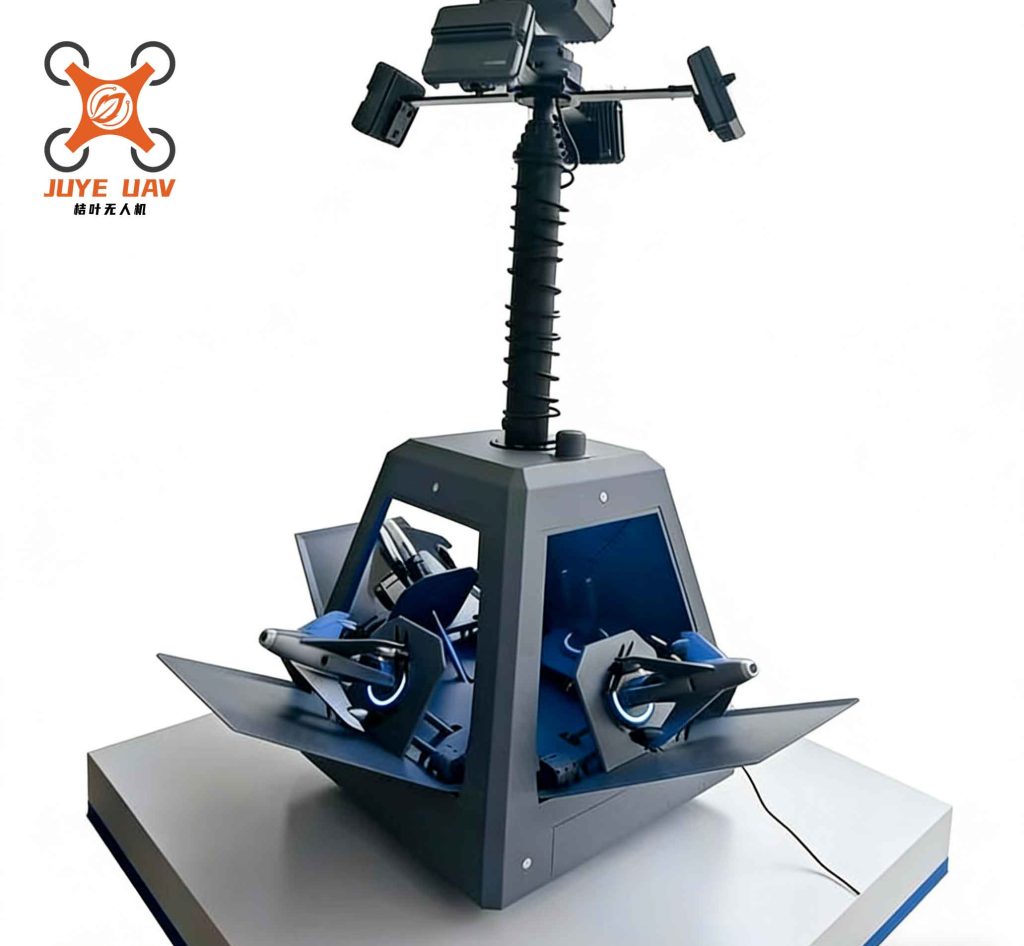
2. Electro-Optical/Infrared (EO/IR): These systems provide passive, visual confirmation and tracking. IR sensors detect heat signatures from motors and electronics, effective day and night. High-resolution cameras coupled with AI-based computer vision algorithms enable real-time detection, classification, and intent analysis based on flight patterns. Performance is, however, weather-dependent (fog, rain).
3. Radio Frequency (RF) Sensing: This passive method detects the control and telemetry signals between drones and their operator or within the swarm network. By analyzing signal patterns, direction-finding, and fingerprinting, RF sensors can locate ground control stations and classify drone types, even before visual acquisition.
4. Acoustic Sensing: Microphone arrays can detect and localize drones based on the distinctive acoustic signature of their rotors. Useful for short-range, perimeter defense in urban canyons where other sensors struggle, but vulnerable to ambient noise.
| Technology | Principle | Range | Advantages | Limitations |
|---|---|---|---|---|
| MIMO Radar | Active RF reflection | Long (several km) | All-weather, good range, tracks multiple targets | Expensive, susceptible to ECM, clutter issues |
| EO/IR + AI Vision | Passive light/heat detection | Medium (1-3 km) | Positive identification, good classification | Weather dependent, requires line-of-sight |
| RF Sensing | Passive signal interception | Medium (2-5 km) | Passive, detects controller, classifies type | Requires drone to transmit, less effective against pre-programmed swarms |
| Acoustic Array | Passive sound wave analysis | Short (<1 km) | Passive, works in NLOS conditions, low cost | Very short range, high false alarms in noisy areas |
Disruption and Neutralization (Soft-Kill) Technologies
These technologies aim to disable the swarm without physical destruction, often offering more scalable and cost-effective solutions.
1. Radio Frequency Jamming: This is a primary anti-drone technique. Jammers transmit high-power noise or protocol-specific denial signals on frequency bands used for drone control (e.g., 2.4 GHz, 5.8 GHz), GNSS navigation (e.g., GPS, GLONASS, Galileo), or swarm communication. The effectiveness depends on the jamming-to-signal ratio (JSR) at the drone’s receiver:
$$JSR_{drone} = \frac{P_j G_j(\theta) / L_j}{P_s G_s / L_s}$$
where $P_j$ and $P_s$ are jammer and signal power, $G_j$ and $G_s$ are antenna gains, and $L_j$ and $L_s$ are path losses. Directional jammers offer precise engagement, while area-denial systems create protective bubbles. The challenge lies in keeping pace with frequency-hopping and encrypted swarm protocols.
2. GNSS Spoofing: A more sophisticated cousin to jamming, spoofing generates counterfeit but stronger GNSS signals to deceive the drone’s receiver, causing navigation hijack. This can redirect a swarm to a false location or command a controlled landing. It requires precise timing and knowledge of signal structures.
3. Laser Dazzling and Directed Energy (DE): High-energy lasers (HEL) offer a speed-of-light, magazine-depth-unlimited engagement. They can thermally disable critical components (motors, electronics) or dazzle/saturate optical guidance sensors. The required energy on target $E_{req}$ to achieve a damage threshold fluence $F_{th}$ over spot area $A_{spot}$ at range $R$ through atmospheric transmission $\tau_{atm}$ is:
$$E_{req} = \frac{F_{th} \cdot A_{spot}}{\tau_{atm}(R)}$$
DE systems are highly effective but face challenges with beam attenuation in poor weather and thermal management.
4. Cyber-Electronic Takeover: The most advanced soft-kill method involves exploiting vulnerabilities in the swarm’s communication or control algorithms. This could involve injecting malicious data packets to induce chaotic behavior, trigger self-destruct protocols, or even seize control of part of the swarm. It requires deep protocol analysis and real-time exploit generation.
Physical Interception (Hard-Kill) Technologies
When soft-kill fails or is inappropriate, physical neutralization is necessary.
1. Kinetic Interceptors: This includes modified anti-aircraft artillery (AAA) with airburst munitions and missiles. To be effective against swarms, they require high rates of fire, low cost per round, and advanced fusing. The engagement dynamics can be modeled as a Lanchester-style attrition problem for area defense. The rate of change of the swarm size $S(t)$ under fire from $D$ defenders with rate $\mu$ is:
$$\frac{dS}{dt} = -\mu D \cdot f_{hit}(S)$$
where $f_{hit}(S)$ is a function of swarm density and defensive coverage.
2. Net-Based Capture: Launched from ground cannons or interceptor drones, nets offer a low-collateral-damage option for capturing drones intact for forensic analysis. The kinematics involve projectile motion and net deployment dynamics.
3. Counter-Drone Swarms (“Swarm vs. Swarm”): Deploying defensive swarms represents a dynamic frontier. These anti-drone swarms can physically intercept, emit localized jamming, or deploy nets. They operate on similar AI principles but are tasked with hunt-and-neutralize missions. The interaction becomes a complex multi-agent system game.
4. High-Power Microwave (HPM): These systems emit short, intense bursts of microwave energy to fry the microelectronics of multiple drones within a wide cone, offering a “one-shot, many-kill” capability ideal for swarm defense.
| Method | Type | Engagement Time | Scalability vs. Swarm | Collateral Risk | Relative Cost per Engagement |
|---|---|---|---|---|---|
| RF Jamming | Soft-Kill / Area | Instantaneous | High (affects all in cone/area) | Low to Medium (comm. disruption) | Low |
| Laser (DE) | Hard-Kill / Point | Seconds (dwell time) | Medium (sequential engagement) | Very Low (precise) | Very Low (per shot) |
| Net Cannon | Hard-Kill / Point | Fast (projectile) | Low (single target) | Very Low | Low |
| Counter-Swarm UAV | Hard/Soft-Kill | Minutes (pursuit) | High (distributed counter-swarm) | Low | Medium |
| HPM | Hard-Kill / Area | Instantaneous | Very High (wide area effect) | High (fries all electronics in cone) | Medium per pulse |
Command, Control, and Integration: The Anti-Drone System of Systems
The true force multiplier lies in integrating these technologies into a cohesive anti-drone Command and Control (C2) system. This system performs sensor fusion, threat assessment, weapon assignment, and battle damage assessment. AI and machine learning are critical here for:
- Predictive Threat Analysis: Using pattern recognition to predict swarm intent and likely attack axes based on early flight behavior.
- Dynamic Resource Allocation: Automatically assigning the optimal sensor and effector (e.g., jammer vs. interceptor) based on threat type, number, range, and rules of engagement.
- Adaptive Jamming/Deception: Learning and adapting to new swarm communication protocols in real-time to maintain jamming or spoofing effectiveness.
The integrated anti-drone system effectiveness $E_{system}$ can be conceptualized as a function of its layered detection probability $P_d$, decision accuracy $A_d$, and neutralization probability $P_n$ across $m$ layers:
$$E_{system} = 1 – \prod_{k=1}^{m} \left(1 – P_d^{(k)} \cdot A_d^{(k)} \cdot P_n^{(k)}\right)$$
This highlights the value of a defense-in-depth architecture.
Conclusion and Future Trajectory
Drone swarm technology represents a dual-use frontier with profound implications for both civilian innovation and security landscapes. Its threat profile—characterized by stealth, saturation, resilience, and asymmetry—renders legacy defense paradigms inadequate. The response must be a holistic, technology-driven anti-drone ecosystem that seamlessly blends detection, soft-kill, and hard-kill capabilities under an intelligent, unified C2 framework. The future will see an accelerated race between swarm intelligence and counter-swarm AI. Key research and development vectors will include: quantum sensing for improved detection; agile, cognitive EW systems that learn and adapt faster than the swarm; scalable directed energy weapons; and robust autonomous C2 for anti-drone networks. Ultimately, ensuring public safety and national security in the coming decade will depend on sustained investment, international cooperation on norms, and the agile development of these integrated anti-drone solutions to maintain a stable and secure technological balance.