
As someone deeply immersed in the field of autonomous systems, I have witnessed a fascinating evolution: the migration of advanced formation flight control technologies from specialized military and research platforms to the spectacular realm of public entertainment—the formation drone light show. What began as a pursuit for cooperative surveillance or efficient air refueling has found a luminous new expression in the night sky, choreographing hundreds of unmanned aerial vehicles (UAVs) into dynamic, glowing sculptures. This article delves into the core control principles that make these aerial ballets possible, translating rigorous aerospace engineering concepts into the language of synchronized artistry. The mesmerizing spectacle of a formation drone light show is, at its heart, a massive, real-time validation of distributed control theory.
The fundamental challenge in any multi-drone system, whether for precision agriculture or a dazzling formation drone light show, is maintaining accurate relative positioning while following a predefined trajectory. The most prevalent and practical architecture for this is the “leader-follower” or “guide-wing” paradigm. In this model, one drone (or a virtual reference) acts as the leader, defining the path and timing of the overall formation. Each follower, or “wing” drone, calculates its own required trajectory based on the leader’s state (position, velocity, heading) and a predefined geometric offset. The core control objective for every drone in the formation drone light show is to eliminate the error between its current state and its desired state relative to the moving reference.
To break down this complex problem, we define a local coordinate frame for each follower. Let the leader’s instantaneous velocity vector define the x-axis of this frame. The y-axis is perpendicular to the x-axis in the horizontal plane. The relative kinematics between the leader (L) and a wing (W) drone in a formation drone light show can be described by:
$$
\begin{aligned}
\frac{dx}{dt} &= \dot{\psi}_W y – V_W + V_L \cos(\psi_e) \\
\frac{dy}{dt} &= -\dot{\psi}_W x + V_L \sin(\psi_e)
\end{aligned}
$$
where $(x, y)$ is the leader’s position in the wing’s local frame, $V_L$ and $V_W$ are their speeds, $\psi_L$ and $\psi_W$ their headings, and $\psi_e = \psi_L – \psi_W$ is the heading error. The desired position for the wing drone in the global frame, which is crucial for plotting the moving image in a formation drone light show, is computed from the leader’s state:
$$
\begin{aligned}
X_{W,des} &= X_L – x_r \cos(\psi_L) + y_r \sin(\psi_L) \\
Y_{W,des} &= Y_L – x_r \sin(\psi_L) – y_r \cos(\psi_L) \\
\psi_{W,des} &= \psi_L \\
V_{W,des} &= V_L
\end{aligned}
$$
Here, $(x_r, y_r)$ is the constant desired offset in the leader’s body frame that defines the wing’s place in the formation pattern, be it a letter, a shape, or a complex figure in the formation drone light show. The control error for the wing drone is then the difference between this desired state and its actual state, often projected back into its local frame for control law design. The ultimate goal is to drive all errors—lateral, longitudinal, and vertical—to zero.
Technical Implementation: Decoupling the Control Problem
In practice, especially for the agile drones used in a formation drone light show, the controller is decomposed into three independent channels: forward/speed, lateral, and vertical. This modular approach aligns perfectly with standard autopilot modes and simplifies tuning. The following table summarizes this decomposition:
| Control Channel | Primary Error States | Typical Autopilot Command | Objective in Formation Drone Light Show |
|---|---|---|---|
| Forward (Longitudinal) | $\Delta x$, $\Delta V$ | Speed Hold ($V_{cmd}$) | Maintain correct spacing along the formation’s path. |
| Lateral | $\Delta y$, $\Delta \psi$ | Roll Angle / Heading Hold ($\phi_{cmd}$ or $\psi_{cmd}$) | Maintain correct lateral offset and align heading with the formation. |
| Vertical | $\Delta H$ | Altitude Hold ($H_{cmd}$) | Maintain correct vertical layer in 3D shapes. |
The forward channel combines distance and speed errors. A common control law to generate the speed command $V_{cmd}$ is:
$$
e_x = k_{x} \Delta x + k_{V} \Delta V
$$
$$
V_{cmd} = K_{P}^{V} e_x + K_{I}^{V} \int e_x \, dt
$$
This ensures the drone not only corrects its spacing but does so with an appropriate speed profile, vital for the smooth flow of a formation drone light show.
The lateral channel is often the most active. The error in cross-track distance $\Delta y$ and heading $\Delta \psi$ are blended to create a heading command:
$$
\psi_{cmd} = K_{y} \Delta y + K_{\psi} \Delta \psi
$$
This command is fed to the drone’s inner-loop autopilot, which uses aileron control (roll) to achieve the desired heading. For a tight formation drone light show, precise lateral control is non-negotiable.
The vertical channel is typically a simpler PID controller on altitude error:
$$
H_{cmd} = K_{P}^{H} \Delta H + K_{I}^{H} \int \Delta H \, dt
$$
In a complex formation drone light show, drones are often arranged in multiple vertical layers, making this a critical axis of control.
Optimization for Dynamics: The Turn Problem and Line-of-Sight Guidance
A significant challenge arises during aggressive maneuvers, such as when the formation drone light show pattern involves sharp turns or rotations. If the wing drone strictly tries to maintain its geometric offset $(x_r, y_r)$ behind a turning leader, it may be commanded to make an excessively tight turn or rapidly change speed, leading to overshoot and loss of formation integrity upon exiting the turn.
This is where an optimized approach, such as a Line-of-Sight (LOS) guidance law, becomes invaluable. Instead of blindly tracking a offset point, the wing drone calculates the direct line-of-sight vector to its desired position in space. It then commands itself to fly directly along that line. This produces a much smoother and more natural intercept trajectory, especially during curved paths. The logic can be summarized as follows:
First, compute the line-of-sight angle $\chi_{LOS}$ from the wing’s current position $(X_W, Y_W)$ to its desired position $(X_{W,des}, Y_{W,des})$:
$$
\rho = \sqrt{(X_{W,des} – X_W)^2 + (Y_{W,des} – Y_W)^2}
$$
$$
\chi_{LOS} = \text{atan2}(Y_{W,des} – Y_W, X_{W,des} – X_W)
$$
where $\text{atan2}$ is the four-quadrant inverse tangent, ensuring $\chi_{LOS} \in (-\pi, \pi]$. The core command is to align the drone’s velocity vector with this line-of-sight:
$$
\psi_{cmd} = \chi_{LOS}
$$
For speed control during the maneuver, a rule-based command can prevent excessive speed buildup or deficit:
$$
V_{cmd} =
\begin{cases}
V_{max}, & \text{if } \rho > \Delta + 2\delta \\
V_L + \frac{\rho – \delta_0}{\Delta + 2\delta} \sqrt{2 a_{min} \delta}, & \text{if } \rho \le \Delta + 2\delta
\end{cases}
$$
Here, $\delta$ is a safety distance margin, $\Delta$ is a threshold distance based on maximum deceleration, and $\delta_0$ is a final allowed distance error. This algorithm ensures the drone in the formation drone light show arrives at its target point with the correct speed and minimal overshoot, crucial for maintaining the crispness of fast-transforming shapes.
System Architecture for a Formation Drone Light Show
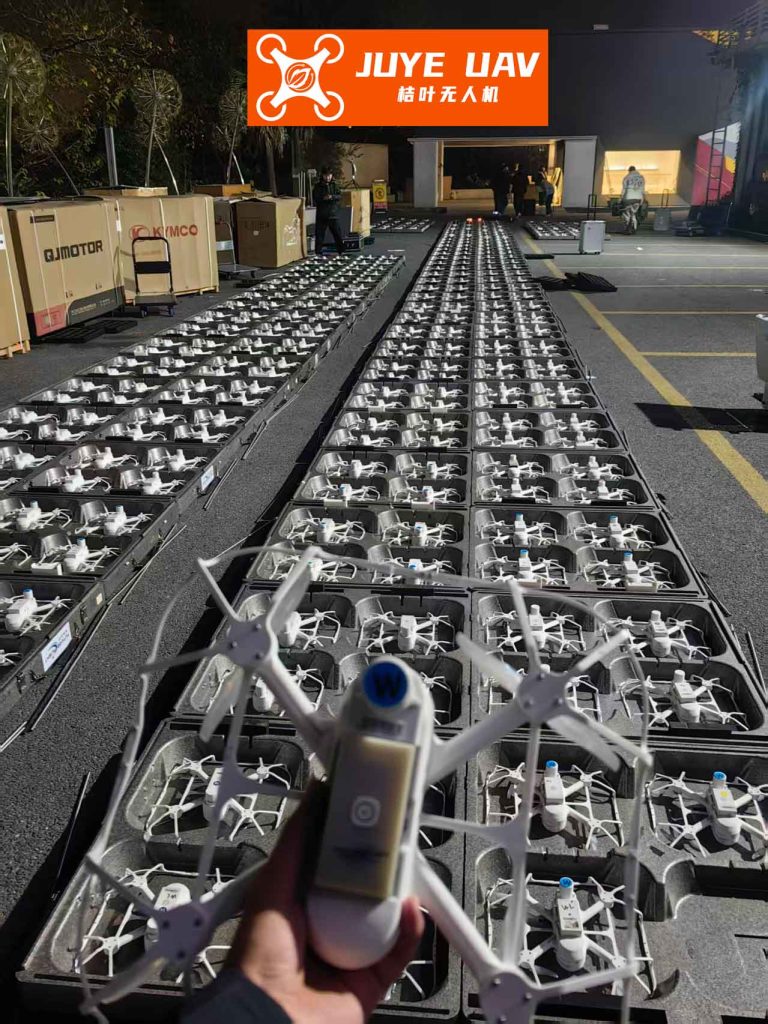
The implementation of these algorithms for a large-scale formation drone light show requires a robust and hierarchical system architecture. It typically consists of a central ground control station (GCS) and the fleet of drones.
1. Ground Control System (GCS): This is the master brain of the formation drone light show. It holds the entire show script—a timeline of 3D waypoints and formation patterns for every drone. It performs centralized trajectory planning and conflict detection. Using a high-bandwidth, low-latency radio link (like Wi-Fi 6 mesh or private 4G/5G), it broadcasts synchronized time and high-level commands (e.g., “transition to shape S1 at time T1”) to the entire fleet.
2. Onboard Drone Systems: Each drone is an intelligent node. Its key components include:
- Flight Controller/Autopilot: Runs low-level attitude stabilization (PID loops for roll, pitch, yaw) and interfaces with actuators (ESCs, motors).
- Onboard Computer (Single-Board): Executes the formation control algorithms in real-time. It receives the leader’s state (which could be a virtual reference broadcast by the GCS) and its own assigned offset $(x_r, y_r, z_r)$. Using its own state from the GNSS/IMU, it calculates the control errors and generates the $V_{cmd}$, $\psi_{cmd}$, and $H_{cmd}$ for the autopilot.
- Precise Positioning: Real-Time Kinematic (RTK) GNSS is the gold standard. It provides centimeter-level absolute positioning, which is essential for maintaining the precise gaps needed in a high-density formation drone light show.
- Synchronized Communication & Lighting: A dedicated module receives timing pulses from the GCS to trigger LED color changes with microsecond accuracy, ensuring the visual effect is perfectly synchronized across the fleet.
The interaction can be summarized by this simplified data flow for a single drone in the formation drone light show:
$$
\text{GCS Show Script} \rightarrow \text{Virtual Leader State} + \text{Drone-Specific Offset}
$$
$$
\text{Drone State (GNSS/IMU)} + \text{Above Data} \rightarrow \text{Formation Control Law} \rightarrow \text{Autopilot Commands} \rightarrow \text{Propulsion System}
$$
This distributed yet coordinated control architecture is what enables the scalability and robustness of modern formation drone light show systems.
Practical Challenges and Scaling Up
Moving from a two-drone test to a 500-drone formation drone light show introduces profound challenges. The following table outlines key considerations:
| Challenge | Description | Mitigation Strategy |
|---|---|---|
| Communication Latency & Dropouts | Delayed or lost state data from the leader/virtual reference causes instability. | Use predictive estimation (Kalman Filters) to estimate the leader’s state during short dropouts. Implement robust mesh networking for redundant data paths. |
| GNSS Degradation | Multipath or interference in urban environments degrades positioning accuracy. | Use RTK with a local base station. Fuse GNSS with onboard vision or UWB (Ultra-Wideband) for relative positioning in the swarm. |
| Collision Avoidance | Pre-planned paths may bring drones too close during transitions. | Implement decentralized reactive avoidance layers (e.g., potential fields, VO) that override the formation commands only in imminent danger. |
| Wind & Atmospheric Disturbances | Gusts can push drones out of position, blurring the visual shape. | Design high-gain, robust controllers. Use drones with sufficient thrust-to-weight ratio to reject disturbances. Incorporate wind estimation into the control loop. |
| Scalability of Computation | Centralized calculation of all paths for thousands of drones is computationally heavy. | Use a hybrid approach: GCS handles high-level choreography and broadcasts virtual structure waypoints; each drone independently computes its precise formation-keeping control relative to its assigned spot in that virtual structure. |
The evolution of the formation drone light show is a direct driver for innovation in these areas. The requirement for flawless public performance pushes the boundaries of what is possible in reliable swarm coordination.
Future Trajectories: Beyond Static Patterns
The future of formation drone light show technology lies in increased autonomy, interactivity, and artistic expression. We are moving towards systems where:
- AI-Powered Choreography: Machine learning algorithms could generate optimal, collision-free paths for thousands of drones in real-time, enabling more complex and fluid animations that are currently impossible to script manually.
- Real-Time Audience Interaction: Drones could react to sound, light, or audience input from smartphones, making each formation drone light show a unique, participatory event. Control laws would need to handle dynamic, unpredictable target states.
- Heterogeneous Swarms: Combining different drone types (multi-rotors, fixed-wing) in a single formation drone light show to create novel visual and dynamic effects.
- Enhanced Storytelling: Integrating drones with ground-based projections, fireworks, and music to create fully immersive multi-sensory experiences, where the drone swarm is one character in a larger narrative.
In conclusion, the breathtaking beauty of a formation drone light show is a direct application of sophisticated multi-agent control theory. It stands as a powerful testament to how technologies developed in laboratories—like leader-follower control, line-of-sight guidance, and decentralized state estimation—can be refined and scaled to create profound public art. Every perfectly held line and seamless transformation in the night sky is the result of solving the precise mathematical problem of driving a set of $\Delta x$, $\Delta y$, and $\Delta H$ errors to zero, hundreds of times per second, across a fleet of flying robots. As the algorithms become more robust and the systems more intelligent, the canvas of the night sky will only grow more vivid and dynamic, pushing the art of the formation drone light show into uncharted territories.