
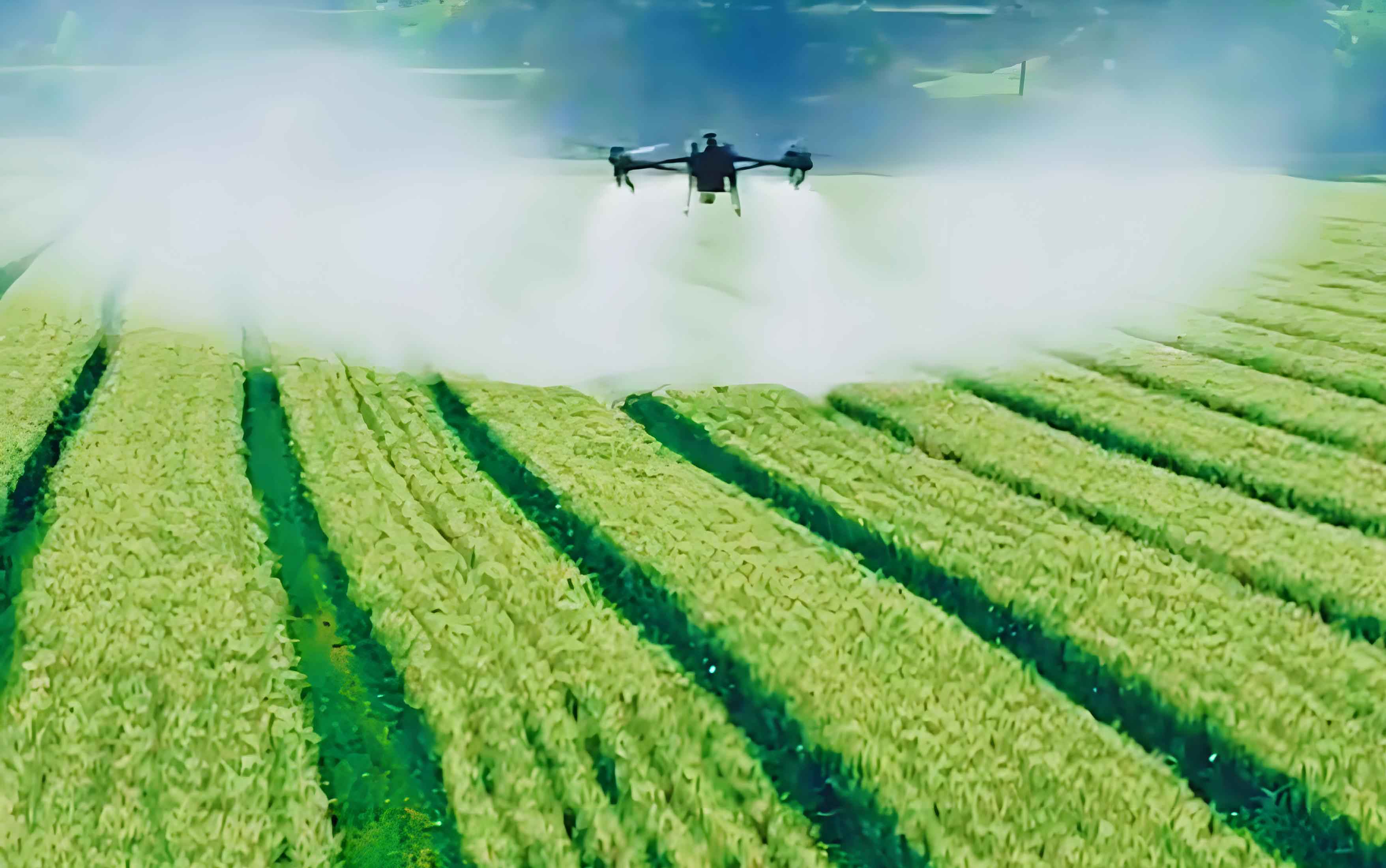
The rapid development of modern agriculture demands efficient and eco-friendly solutions beyond traditional plant protection methods. Agricultural drones, or agricultural UAVs, have emerged as transformative tools in this domain. This article explores their current applications, advantages, technical advancements, and future trends in fruit tree cultivation.
Current Application Status
Agricultural drones have expanded from initial pesticide spraying to multifaceted roles in orchard management. Key applications include:
- Pest Control: Replacing manual spraying with aerial coverage at 5-10 times the efficiency.
- Fertilization: Precision granular fertilizer distribution using centrifugal spreaders.
- Pollination: Experimental pollen dispersal simulating insect activity.
- Data Collection: Multispectral sensors monitor chlorophyll content (NDVI) and pest incidence.
Global adoption is accelerating, with Japan utilizing agricultural UAVs on 20% of farmland. China’s market grows at 30% CAGR, especially in mountainous orchards where terrain limits traditional machinery. The operational efficiency of agricultural UAVs follows:
$$E = \frac{A_c}{t} \times \eta_s$$
Where \(E\) = operational efficiency (ha/h), \(A_c\) = coverage area, \(t\) = time, \(\eta_s\) = spray uniformity coefficient (0.8-0.95).
| Application | Coverage Rate (ha/h) | Input Reduction |
|---|---|---|
| Pesticide Spraying | 2.0-4.0 | 30-50% chemicals |
| Granular Fertilization | 3.5-5.0 | 25-40% fertilizer |
| Multispectral Scanning | 10.0-15.0 | N/A |
Application Advantages
Enhanced Pest Management
Agricultural UAVs generate downwash airflow (\(V_d = 3-8\) m/s) that improves canopy penetration. Spray deposition efficiency (\(\eta_d\)) is calculated as:
$$\eta_d = 1 – e^{-k \cdot V_d \cdot \rho_l}$$
Where \(k\) = canopy permeability constant, \(\rho_l\) = leaf area density. Field tests show 40% improvement in underside leaf coverage versus ground sprayers.
Optimized Orchard Management
- Soil Preservation: Zero ground contact prevents soil compaction, maintaining porosity (\(P_s > 40\%\)).
- Ecological Minimization: Noise levels < 75 dB reduce wildlife disturbance by 60%.
- Precision Nutrition: Variable-rate fertilization algorithms adjust dosage based on NDVI readings:
$$Q_f = \beta \cdot (1 – \text{NDVI}) \cdot S_z$$
Where \(Q_f\) = fertilizer quantity (g), \(\beta\) = crop coefficient, \(S_z\) = zone area (m²).
Technical Comparison: Domestic vs. International
Hardware Capabilities
| Parameter | Chinese Agricultural UAVs | Japanese Agricultural UAVs | US Agricultural UAVs |
|---|---|---|---|
| Payload Capacity | 15-40 kg | 8-16 kg | 20-50 kg |
| Endurance | 15-30 min | 12-20 min | 25-40 min |
| Positioning Accuracy | ±2 cm (RTK) | ±10 cm (GPS) | ±5 cm (RTK) |
Spraying and AI Technologies
China leads in swarm intelligence with path planning algorithms minimizing overlap (\(\delta_o < 5\%\)). Japanese systems prioritize drift control using ultra-low volume (ULV) nozzles generating 100-200 μm droplets. US agricultural UAVs integrate hyperspectral sensors for real-time disease detection, achieving 90% identification accuracy through convolutional neural networks:
$$y = \sigma \left( \sum_{i=1}^{n} w_i x_i + b \right)$$
Where \(\sigma\) = activation function, \(w_i\) = weights, \(x_i\) = input features from spectral bands.
Future Development Trends
Performance Evolution
Solid-state battery adoption will extend flight times to >60 min, while hydrogen fuel cells promise 120+ min endurance. Hybrid propulsion systems will enhance payload-to-weight ratios (\(R_{p/w} > 0.7\)):
$$R_{p/w} = \frac{m_p}{m_{uav}}$$
Where \(m_p\) = payload mass, \(m_{uav}\) = drone mass.
Intelligent Systems Integration
- Autonomous Swarms: 5G-enabled cooperative fleets covering 100 ha/day with <1% human intervention.
- Predictive Analytics: Fusion of IoT soil sensors and weather data for preemptive pest modeling:
$$P_i = \frac{1}{1 + e^{-(\alpha \cdot T + \beta \cdot H + \gamma \cdot C)}}$$
Where \(P_i\) = infection probability, \(T\) = temperature, \(H\) = humidity, \(C\) = spore concentration.
Application Diversification
Agricultural drones will expand to:
| Emerging Application | Technology Enablers | Projected Efficiency Gain |
|---|---|---|
| Frost Protection | Thermal updraft generators | 40-60% energy savings |
| Selective Harvesting | Robotic arms + computer vision | 30% labor reduction |
| Seedling Transplantation | Precision dibbling mechanisms | 5000 plants/hour |
Conclusion
Agricultural drones represent a technological leap in precision orchard management. Current advancements in AI, propulsion, and sensing will further enhance their capabilities. As battery technologies and swarm algorithms mature, agricultural UAVs will become indispensable for sustainable fruit production, potentially covering 80% of commercial orchards by 2030. Continuous innovation in automation and ecological compatibility will solidify their role as the cornerstone of modern arboriculture.