
In recent years, formation drone light shows have emerged as a captivating spectacle, widely used in entertainment, advertising, and public events. These shows involve multiple unmanned aerial vehicles (UAVs) operating in coordinated patterns to create dynamic light displays in the sky. The performance of a formation drone light show depends on various factors, such as the number of drones, their operational capabilities, and the complexity of the show’s targets (e.g., multiple shapes or moving patterns). Understanding these factors is crucial for optimizing the show’s quality, reliability, and efficiency. In this study, we explore the simulation of formation drone light shows in multi-target scenarios using agent-based modeling and simulation (ABMS). We analyze how the scale of the drone formation (i.e., the number of drones), the drones’ performance parameters (e.g., lighting accuracy and control precision), and target intensity (i.e., the frequency and complexity of light patterns) affect the overall show performance. Through simulation experiments, we aim to provide insights into designing effective formation drone light show systems.
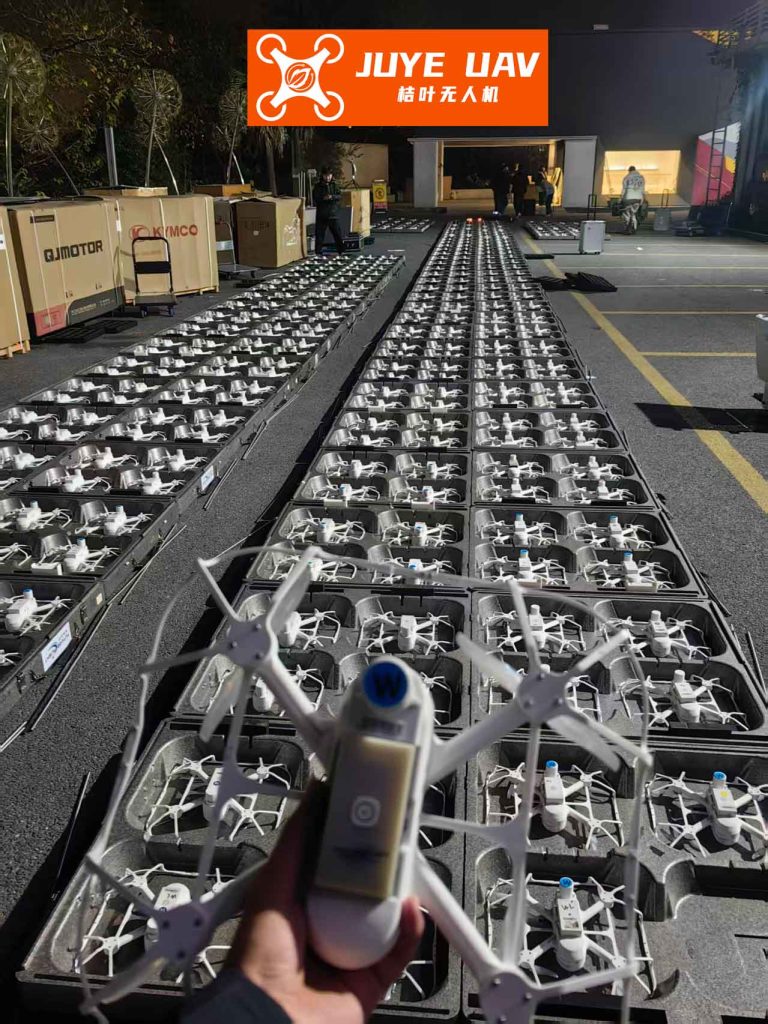
The formation drone light show is typically conducted in a defined airspace, considered as a rectangular area for simulation purposes. The show involves a ground control system and a fleet of drones equipped with lighting devices and communication systems. The ground control system coordinates the drones, sending commands and receiving status updates, while the drones execute pre-programmed flight paths to display light patterns. Targets in this context refer to specific light patterns or shapes that need to be formed in the sky, such as logos, text, or animated sequences. These targets may appear at different times and locations within the performance area, simulating a multi-target scenario. The intensity of targets is represented by their arrival rate—higher intensity means more frequent or complex pattern changes, which can challenge the drones’ ability to maintain a continuous and synchronized show. We assume that targets appear randomly along the edges of the rectangular area, following a uniform distribution, and move toward random points within the area before disappearing. The time intervals between target arrivals follow an exponential distribution, modeled using a Poisson process. This setup allows us to study the formation drone light show under varying conditions and assess its performance metrics.
To simulate the formation drone light show, we employ an agent-based modeling and simulation (ABMS) approach. ABMS is ideal for capturing the autonomous behavior of drones and their interactions, which are essential for understanding emergent behaviors in complex systems like a formation drone light show. In our model, key entities include agent entities (e.g., drones and ground control systems), device entities (e.g., lighting and communication devices), and environmental factors that may affect performance. Each drone is modeled as an agent with its own control logic, capable of processing commands from the ground control system and interacting with other drones via communication devices. The lighting devices simulate the drones’ ability to emit light with specific colors and intensities, while communication devices enable data exchange for coordination. The environment may influence factors like signal interference or weather conditions, but for simplicity, we focus on intrinsic parameters. The behavior of drones is programmed using a tactic programming language, defining their flight paths—typically a cross-line search pattern adapted for light show performances, where drones sweep across assigned sub-areas to cover targets. Targets are modeled as moving entities that appear periodically, and drones must detect and align their lights to form the desired patterns. The interactions in the system include communication relationships (e.g., command transmission) and detection relationships (e.g., drones sensing target positions). This ABMS framework allows us to simulate the formation drone light show dynamically and evaluate its performance under different scenarios.
The performance of a formation drone light show is measured by the coverage ratio $\eta$, which indicates how well the drones cover the targets over time. It is defined as the ratio of the total time drones successfully illuminate targets to the total time targets are active in the show area. Mathematically, for $n$ targets, let $t_i$ be the time drone formation illuminates target $i$, and $T_i$ be the total active time of target $i$. Then, the coverage ratio is:
$$ \eta = \frac{\sum_{i=1}^{n} t_i}{\sum_{i=1}^{n} T_i} $$
A higher $\eta$ signifies better continuous performance in the formation drone light show, meaning drones effectively maintain light patterns despite target changes. To analyze factors affecting $\eta$, we design simulation experiments with three parameters: drone formation scale (number of drones), drone performance capability (lighting accuracy and control precision), and target intensity (arrival rate of patterns). The drone formation scale is tested with 2, 4, 6, and 8 drones, representing small to large formations. Drone performance capability is categorized into low, medium, and high levels, based on lighting device parameters like effective range and probability of accurate illumination. For example, high capability might correspond to a lighting range of 200 units and an accuracy probability of 0.8, while low capability might be 100 units and 0.4. Target intensity is modeled using the Poisson distribution parameter $\lambda$, where $\lambda = 4$, 8, or 12 represents low, medium, and high arrival rates of light patterns per unit time. The arrival intervals follow an exponential distribution with mean $1/\lambda$, as described by:
$$ P(t) = \lambda e^{-\lambda t} $$
where $P(t)$ is the probability density function for inter-arrival times. We use a full factorial design with 36 experimental points (4 drone scales × 3 capability levels × 3 intensity levels). Each simulation runs for a fixed duration, repeated 100 times to average results, ensuring statistical reliability. The simulation is implemented in an ABMS platform similar to SEAS, with drones executing cross-line search patterns in subdivided rectangular areas. The table below summarizes the experimental parameters for the formation drone light show simulation.
| Parameter Type | Low (-1) | Medium (0) | High (1) |
|---|---|---|---|
| Drone Performance Capability | 100 range, 0.4 accuracy | 150 range, 0.6 accuracy | 200 range, 0.8 accuracy |
| Target Intensity ($\lambda$) | 4 patterns/unit time | 8 patterns/unit time | 12 patterns/unit time |
| Drone Formation Scale | 2, 4, 6, 8 drones (separate levels) | ||
Simulation results for the formation drone light show indicate that the coverage ratio $\eta$ varies significantly with drone formation scale and drone performance capability, while target intensity has a milder effect. The table below shows partial results for selected experimental points, highlighting how $\eta$ changes under different conditions. For instance, with 2 drones and low capability, $\eta$ is around 0.02-0.03, whereas with 8 drones and high capability, $\eta$ reaches 0.26-0.28. This demonstrates the importance of scaling up the formation drone light show and enhancing drone capabilities for better performance.
| Design Point | Drone Scale | Capability Level | Target Intensity | Coverage Ratio $\eta$ |
|---|---|---|---|---|
| 1 | 2 | High | High | 0.06231 |
| 2 | 2 | High | Medium | 0.06346 |
| 3 | 2 | High | Low | 0.06647 |
| 4 | 2 | Medium | High | 0.04763 |
| 5 | 2 | Medium | Medium | 0.04797 |
| 6 | 2 | Medium | Low | 0.05015 |
| 7 | 2 | Low | High | 0.02027 |
| 8 | 2 | Low | Medium | 0.02012 |
| 9 | 2 | Low | Low | 0.02236 |
| 28 | 8 | High | High | 0.26460 |
| 29 | 8 | High | Medium | 0.27975 |
| 30 | 8 | High | Low | 0.28155 |
| 31 | 8 | Medium | High | 0.20167 |
| 32 | 8 | Medium | Medium | 0.21273 |
| 33 | 8 | Medium | Low | 0.21534 |
| 34 | 8 | Low | High | 0.08555 |
| 35 | 8 | Low | Medium | 0.08964 |
| 36 | 8 | Low | Low | 0.09815 |
To further analyze the impact of each factor on the formation drone light show performance, we plot the coverage ratio $\eta$ against drone formation scale for different target intensity levels. The curves show that $\eta$ increases substantially as the number of drones grows, especially from 4 to 6 drones, where the gain is most pronounced. For example, with high capability and medium target intensity, $\eta$ rises from 0.063 for 2 drones to 0.212 for 8 drones. This suggests that expanding the drone formation scale is a key lever for improving the formation drone light show, but diminishing returns may set in beyond 6 drones. Similarly, drone performance capability has a strong influence: upgrading from low to medium capability boosts $\eta$ more than from medium to high, indicating a saturation effect. For instance, with 8 drones and low target intensity, $\eta$ jumps from 0.098 at low capability to 0.215 at medium capability, but only to 0.282 at high capability. Target intensity, however, shows a weaker effect; higher intensity (more frequent pattern changes) slightly reduces $\eta$, as drones struggle to keep up, but the difference is marginal. This implies that the formation drone light show is resilient to target complexity, but scaling and capability are more critical.
The mathematical models underlying the formation drone light show simulation help quantify these relationships. For target arrivals, the Poisson distribution governs the number of patterns appearing in time $t$:
$$ P_n(t) = \frac{(\lambda t)^n e^{-\lambda t}}{n!} $$
where $P_n(t)$ is the probability of $n$ targets arriving in time $t$, and $\lambda$ is the average arrival rate. The inter-arrival time $t$ follows an exponential distribution with mean $1/\lambda$, as noted earlier. For drone performance, we model the probability of a drone accurately illuminating a target as a function of distance and device accuracy. If a drone’s lighting device has a maximum range $R$ and accuracy probability $p_0$ at zero distance, the effective probability $p$ at distance $d$ can be approximated by:
$$ p(d) = p_0 \cdot e^{-kd} $$
where $k$ is a decay constant. This accounts for reduced performance with distance in the formation drone light show. The coverage ratio $\eta$ can then be derived by integrating over time and targets, but in simulation, it is computed directly from agent interactions. These formulas provide a theoretical foundation for understanding the dynamics of formation drone light shows.
Our simulation experiments reveal several practical insights for designing formation drone light shows. First, the drone formation scale should be chosen based on performance requirements; for instance, if a coverage ratio above 0.2 is needed, at least 6 drones with medium capability or 8 drones with low capability may suffice, but cost-benefit analysis is essential. Second, drone performance capability should be optimized up to a point—investing in better lighting devices yields significant returns initially, but beyond a threshold, improvements plateau. Third, target intensity has minimal impact, so formation drone light shows can handle complex patterns without major degradation, but planners should still consider buffer capacities. These findings can guide stakeholders in deploying formation drone light shows for events, ensuring reliable and captivating performances.
In conclusion, this study demonstrates the value of simulation in analyzing formation drone light shows. Using ABMS, we modeled a multi-target scenario and evaluated the effects of drone formation scale, drone performance capability, and target intensity on coverage ratio. Results show that scale and capability are dominant factors, with optimal gains observed at moderate expansion levels. The formation drone light show industry can leverage these insights to enhance system design, balancing resources for maximum impact. Future work could explore adaptive flight paths or real-time coordination algorithms to further boost performance. Overall, simulation provides a powerful tool for advancing the art and science of formation drone light shows, enabling more stunning and efficient aerial displays.
The formation drone light show simulation also highlights the importance of communication and coordination among drones. In our model, drones exchange information via communication devices, which affects their ability to synchronize light patterns. The latency and reliability of communication can be incorporated into future simulations to study network effects. Additionally, environmental factors like wind or interference could be added to make the formation drone light show model more realistic. From a broader perspective, the principles applied here—such as agent-based modeling and performance metrics—can be extended to other UAV applications, including surveillance or delivery, but the focus on light shows offers unique challenges in aesthetics and timing. By continuously refining these simulations, we can push the boundaries of what’s possible with formation drone light shows, creating ever more intricate and mesmerizing spectacles for audiences worldwide.
To summarize key quantitative relationships, we present the following table showing the average coverage ratio $\eta$ for different drone formation scales and capability levels, averaged over all target intensity levels. This table condenses the simulation results for the formation drone light show, emphasizing the trends discussed earlier.
| Drone Formation Scale | Low Capability ($\eta$) | Medium Capability ($\eta$) | High Capability ($\eta$) |
|---|---|---|---|
| 2 drones | 0.02092 | 0.04858 | 0.06408 |
| 4 drones | 0.04510 | 0.10520 | 0.13850 |
| 6 drones | 0.08530 | 0.18040 | 0.23500 |
| 8 drones | 0.09111 | 0.20991 | 0.27530 |
The data indicates that for a formation drone light show, increasing drone count from 2 to 6 drones nearly quadruples the coverage ratio, while from 6 to 8 drones, the gain is smaller. Similarly, moving from low to medium capability doubles or triples $\eta$, but from medium to high, the increase is about 30-40%. These patterns can inform resource allocation decisions for formation drone light show productions.
In terms of mathematical optimization, the formation drone light show performance can be framed as a maximization problem. Let $N$ be the number of drones, $C$ represent capability parameters (e.g., range $R$, accuracy $p_0$), and $\lambda$ be target intensity. The objective is to maximize $\eta(N, C, \lambda)$ subject to constraints like cost or energy limits. Using simulation data, we can fit approximate functions, such as:
$$ \eta \approx \alpha \cdot \ln(N+1) + \beta \cdot C – \gamma \cdot \lambda $$
where $\alpha$, $\beta$, and $\gamma$ are coefficients derived from regression. This simplified model can help planners quickly estimate outcomes for different formation drone light show configurations.
Finally, the agent-based approach for formation drone light show simulation offers flexibility for future enhancements. For example, drones could be programmed with machine learning algorithms to adapt their paths based on real-time target movements, potentially improving $\eta$ in dynamic shows. Moreover, incorporating audience feedback metrics, like visual clarity or emotional impact, could add new dimensions to performance evaluation. As technology evolves, formation drone light shows will likely become more interactive and complex, necessitating advanced simulation tools. Our work lays a foundation for such developments, emphasizing the interplay between scale, capability, and targets. By continuing to explore these factors, we can ensure that formation drone light shows remain at the forefront of entertainment innovation, delivering awe-inspiring experiences with precision and reliability.