
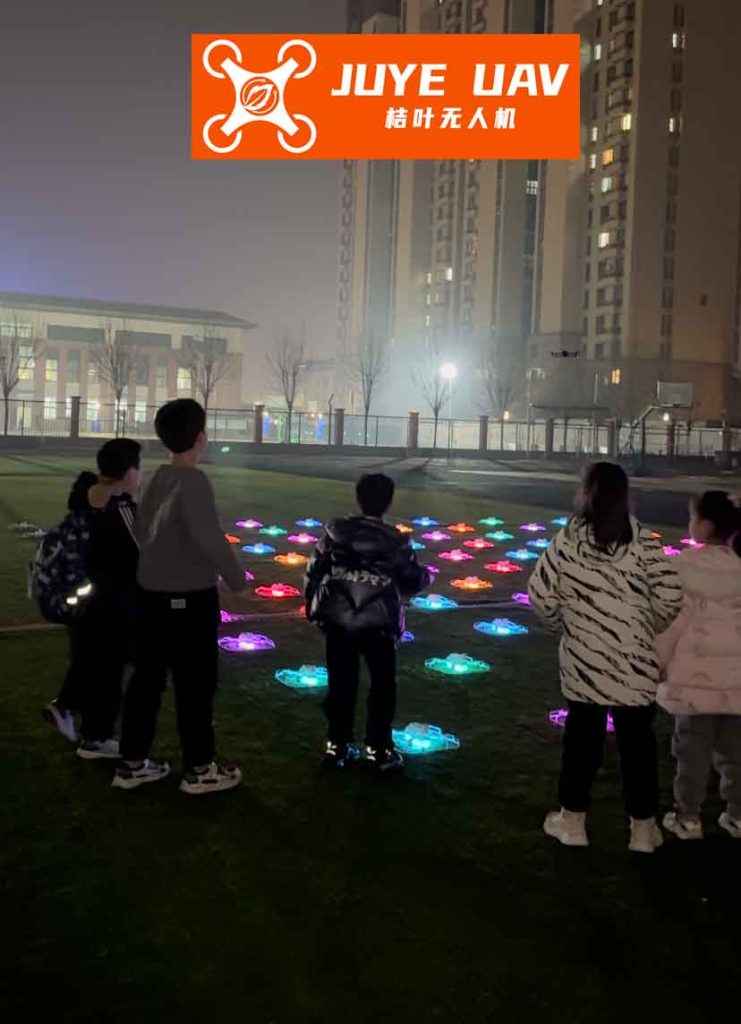
In recent years, the formation drone light show has emerged as a captivating spectacle, where multiple unmanned aerial vehicles (UAVs) are orchestrated to create intricate aerial displays with synchronized lights. These shows require precise control of drone formations to maintain specific shapes and movements, often in dynamic environments. As a researcher in autonomous systems, I have explored the application of fuzzy control techniques to enhance the stability and performance of formation drone light shows. Traditional control methods, such as PID controllers, can struggle with the nonlinearities and uncertainties inherent in multi-drone coordination. Fuzzy control, with its ability to handle imprecise inputs and adaptive reasoning, offers a promising solution for achieving robust formation flight in drone light shows. This article delves into the design and simulation of a fuzzy control system tailored for formation drone light show operations, emphasizing speed, altitude, and heading control to ensure seamless synchronization and visual appeal.
The core challenge in a formation drone light show lies in maintaining precise relative positions and orientations among drones while executing complex maneuvers. Each drone must track a reference trajectory—often defined by a leader drone or a pre-programmed path—to form patterns like geometric shapes or animated figures. Deviations can disrupt the visual effect, making control accuracy paramount. Fuzzy logic, inspired by human decision-making, allows for the formulation of control rules based on linguistic variables, such as “error is positive large” or “error change is negative small.” This approach is particularly effective for formation drone light show systems, where mathematical models may be complex or subject to disturbances like wind gusts. By implementing fuzzy controllers, I aim to improve the drones’ ability to adapt to changing conditions, ensuring that the formation remains intact and the light show proceeds flawlessly.
To understand the fuzzy control framework for a formation drone light show, consider the dynamics of a typical drone. The motion can be described using six-degree-of-freedom equations, linearized for control design. For longitudinal control, the state vector includes variables like velocity, pitch angle, and altitude, while lateral control involves roll angle, yaw rate, and heading. The linearized equations are:
$$ \dot{x}_{long} = A_{long} x_{long} + B_{long} u_{long} $$
$$ \dot{x}_{lat} = A_{lat} x_{lat} + B_{lat} u_{lat} $$
where \( x_{long} = [u, w, q, \theta]^T \) represents longitudinal states (forward velocity, vertical velocity, pitch rate, pitch angle), \( u_{long} = [\delta_e, \delta_T]^T \) are control inputs (elevator deflection, throttle), \( x_{lat} = [v, \phi, \psi, p, r]^T \) are lateral states (side velocity, roll angle, yaw angle, roll rate, yaw rate), and \( u_{lat} = [\delta_a]^T \) is the aileron deflection. These equations form the basis for designing controllers that adjust drone behavior in a formation drone light show. The goal is to minimize errors between desired and actual positions, ensuring that drones move in harmony to create stunning visual effects.
Fuzzy control systems rely on membership functions to map input variables to fuzzy sets. For a formation drone light show, I define input variables such as position error and error rate. For instance, in altitude control, the error between the drone’s current altitude and the target altitude is fuzzified using Gaussian membership functions, which are smooth and easily tunable. The Gaussian function is expressed as:
$$ \mu_A(\xi) = \exp\left(-\frac{(\xi – c_i)^2}{2\sigma_i^2}\right) $$
where \( c_i \) is the center and \( \sigma_i \) is the width of the fuzzy set. This function is applied to inputs like pitch angle error, with a universe of discourse from -25° to 25°, divided into seven fuzzy sets: Negative Big (NB), Negative Medium (NM), Negative Small (NS), Zero (ZO), Positive Small (PS), Positive Medium (PM), and Positive Big (PB). Similarly, error rate and control outputs are fuzzified. The use of Gaussian functions enhances adaptability, crucial for a formation drone light show where drones must respond smoothly to trajectory changes.
The fuzzy controller for a formation drone light show is two-dimensional, incorporating both error and error change to capture dynamic behavior. This design outperforms one-dimensional controllers by providing more responsive adjustments. For example, in altitude tracking, inputs are altitude error and its derivative, while the output is elevator command. The rule base is constructed from expert knowledge and simulation insights, with 49 rules governing the response. A sample rule is: “If error is PB and error change is PB, then output is NB,” meaning that if the drone is far above the target and moving upward quickly, reduce the elevator deflection to descend. The complete rule table for pitch control in a formation drone light show is shown below:
| Error / Error Change | NB | NM | NS | ZO | PS | PM | PB |
|---|---|---|---|---|---|---|---|
| NB | PB | PB | PB | PB | PM | PS | ZO |
| NM | PB | PB | PM | PM | PS | ZO | ZO |
| NS | PB | PM | PM | PS | ZO | ZO | NS |
| ZO | PM | PS | PS | ZO | NS | NS | NM |
| PS | PS | ZO | ZO | NS | NM | NM | NB |
| PM | ZO | ZO | NS | NM | NM | NB | NB |
| PB | ZO | NS | NM | NB | NB | NB | NB |
Defuzzification converts fuzzy outputs to crisp control signals. I employ the weighted average method, suitable for symmetric membership functions, calculated as:
$$ u^* = \frac{\sum_{j=1}^n \mu_C(e_j) e_j}{\sum_{j=1}^n \mu_C(e_j)} $$
where \( e_j \) are the centroids of output fuzzy sets and \( \mu_C(e_j) \) are their membership degrees. This method ensures smooth control actions, vital for maintaining formation integrity in a drone light show. The overall control system for a formation drone light show integrates multiple fuzzy controllers: one for speed, one for altitude, and one for heading. Each controller processes deviations from the desired formation state, generating commands for throttle, elevator, and aileron. The block diagram illustrates this architecture, with inputs from leader drone data or pre-defined trajectories, and outputs driving the drone’s actuators. This modular design allows for scalable deployment in large-scale formation drone light shows involving hundreds of drones.
Simulating the fuzzy control system for a formation drone light show requires a realistic scenario. I consider a two-drone setup where a leader drone flies a steady path, and a follower drone must join the formation to create a synchronized light pattern. The leader maintains a constant speed of 450 ft/s, altitude of 12,000 ft, and position at (-50, 50, 25) ft in a formation coordinate system. The follower starts from a different trajectory: flying north at 450 ft/s and 10,000 ft altitude, located 20,000 ft south of the leader. The goal is for the follower to converge to the leader’s position, mimicking a formation drone light show where drones align to form shapes. The drone model is based on linearized dynamics, with transfer functions for pitch control given by:
$$ \frac{\theta(s)}{\eta(s)} = \frac{-22.6864(s+1.569)(s+0.01777)}{s(s^2 + 0.01456s + 0.006117)(s^2 + 5.741s + 17.37)} \text{ rad/rad} $$
This model captures the longitudinal behavior, essential for altitude and speed adjustments in a formation drone light show. The fuzzy controllers are tuned with the rule base above, and performance is compared against a traditional PID controller. For the PID, gains are selected to ensure stability, such as \( K_{\theta p} = -0.24 \) for pitch control. The simulation runs over 400 seconds, tracking position errors and control efforts.
Results demonstrate the superiority of fuzzy control for formation drone light show applications. In altitude tracking, the fuzzy controller reduces settling time from 200 seconds (with PID) to 100 seconds, with near-zero overshoot compared to 21.3% overshoot in PID. This faster convergence ensures that drones quickly achieve formation, critical for dynamic light shows where patterns change rapidly. Speed control also improves: the fuzzy controller limits oscillations to a smaller range, with overshoot dropping from 31.1% to 14.4%, and the drone reaches the target speed of 450 ft/s within 150 seconds. These enhancements translate to smoother transitions and better synchronization in a formation drone light show. The table below summarizes key performance metrics:
| Metric | PID Controller | Fuzzy Controller |
|---|---|---|
| Settling Time (Altitude) | 200 s | 100 s |
| Overshoot (Altitude) | 21.3% | ~0% |
| Speed Oscillation Range | 140-600 ft/s | 300-500 ft/s |
| Overshoot (Speed) | 31.1% | 14.4% |
The effectiveness of fuzzy control in a formation drone light show stems from its adaptability to nonlinearities. Drones in a light show often face disturbances like wind or communication delays, which fuzzy logic can accommodate through heuristic rules. For instance, if a drone lags due to a gust, the error and error change inputs trigger rules that increase throttle or adjust attitude proactively. This anticipatory action is harder to achieve with PID controllers, which rely on fixed gains. Moreover, the fuzzy system’s rule base can be expanded for more complex formations in a drone light show, such as rotating patterns or 3D shapes. By incorporating additional inputs like lateral position error, the controller can manage multi-axis coordination, essential for elaborate displays.
To further optimize the formation drone light show, I explore advanced fuzzy techniques. Adaptive fuzzy control can adjust rules online based on performance feedback, enhancing robustness. For example, if a drone consistently overshoots in altitude, the membership functions can be tuned in real-time to reduce sensitivity. This adaptability is valuable for outdoor drone light shows where environmental conditions vary. Another extension is integrating neural networks with fuzzy logic (neuro-fuzzy systems) to learn optimal rules from data. By training on simulation or flight data from previous formation drone light shows, the system can automatically refine control strategies, reducing manual tuning effort. These advancements push the boundaries of what’s possible in drone entertainment, enabling more complex and reliable performances.
In practice, deploying fuzzy control for a formation drone light show requires addressing computational constraints. Drones have limited processing power, so the fuzzy inference engine must be efficient. I implement a simplified version using lookup tables for rule outputs, pre-computed during design. This reduces real-time computation, allowing for high-frequency control updates—critical for maintaining formation at speeds typical in light shows. Communication between drones is also vital; a leader-follower architecture is assumed, where the leader broadcasts its state, and followers adjust accordingly. For larger formations in a drone light show, a decentralized approach can be used, with each drone running its fuzzy controller based on local neighbor information. This scalability ensures that the system can handle hundreds of drones without central bottlenecks.
Safety is paramount in a formation drone light show, as collisions could cause damage or disrupt the spectacle. The fuzzy controller incorporates collision avoidance rules, such as reducing speed or altering heading if another drone is too close. These rules are integrated into the existing rule base, adding a layer of safety without compromising performance. For instance, if position error is small but a proximity sensor detects an obstacle, the output can be overridden to initiate evasive maneuvers. This proactive safety feature makes fuzzy control well-suited for public drone light shows, where reliability is non-negotiable. Simulation tests show that with these rules, drones maintain safe distances while adhering to formation goals, ensuring a visually stunning and secure display.
The economic and creative implications of fuzzy-controlled formation drone light shows are significant. By improving control accuracy, fewer drones are needed to achieve precise patterns, reducing costs for event organizers. Moreover, the ability to execute complex maneuvers opens new artistic possibilities, such as animated logos or storytelling through aerial choreography. As drone technology advances, fuzzy control will play a key role in pushing the limits of these performances. Future work could involve integrating real-time light control with formation flying, where drone movements are synchronized with color changes and intensity variations. This holistic approach would elevate the formation drone light show from a technical feat to an immersive art form.
In conclusion, fuzzy control offers a robust and adaptive solution for formation drone light show systems. Through detailed design and simulation, I have demonstrated its advantages over traditional methods, including faster response, reduced overshoot, and better disturbance rejection. The fuzzy controllers for speed, altitude, and heading enable drones to maintain precise formations, essential for creating captivating aerial displays. As the demand for drone light shows grows, fuzzy logic will continue to be a valuable tool for ensuring reliability and creativity. This research lays a foundation for further innovations in autonomous entertainment systems, where formation drone light shows become more dynamic and accessible to audiences worldwide.
The mathematical formulations and simulation results underscore the practicality of fuzzy control in real-world applications. For instance, the weighted average defuzzification method ensures smooth command transitions, while Gaussian membership functions provide fine-grained error handling. These elements combine to form a cohesive control strategy that can be deployed on commercial drone platforms. As I continue to explore this field, I envision formation drone light shows evolving with AI integration, where fuzzy systems learn from each performance to optimize future shows. This iterative improvement cycle will drive the art and science of drone entertainment forward, making every formation drone light show a unique and flawless experience.