
In recent years, the proliferation of unmanned aerial vehicles (UAVs), especially small and medium-sized ones, has posed significant threats to national security and critical infrastructure due to their low cost, small size, lightweight, ease of operation, and adaptability. These UAVs are increasingly employed in criminal activities, terrorist attacks, and military strikes, particularly in conflict-prone regions like the Middle East, where anti-UAV operations have become a新兴袭扰手段. To counter these threats, many countries are developing and deploying anti-UAV systems. However, UAVs differ from traditional防空 targets by exhibiting “low, small, and slow” characteristics, and the engagement methods and operational procedures for anti-UAV systems are distinct from conventional air defense systems. Therefore, rapidly and effectively learning to use anti-UAV systems is crucial post-deployment. This paper presents a design for an anti-UAV combat simulation training system that addresses these challenges by incorporating target modeling, sensor and weapon modeling, and complex scene design, ultimately enhancing user proficiency and reducing training time and costs.
The need for an anti-UAV simulation training system stems from limitations in real-world training. Training with actual anti-UAV systems on operational vehicles faces constraints such as equipment availability, environmental factors (e.g., weather affecting electro-optical device performance), and场地 restrictions. For instance, in adverse weather conditions like fog or rain, the visual range of electro-optical sensors can drop from 5 km to 1-2 km, hindering target tracking and laser engagement. Additionally, the limited number of deployed anti-UAV systems, typically comprising around five command vehicles per system, restricts training scalability, as the confined spaces impede simultaneous training for large groups of trainees. Using real UAVs as targets for live-fire exercises is costly—commercial drones like DJI quadcopters or hexacopters can cost over ten thousand dollars each—and requires careful planning for attack patterns and协同 control in swarm scenarios. Moreover, the absence of multimedia materials (e.g., videos, images, PPTs) in实装 training can lead to inadequate preparation, with trainees struggling to recall hardware and software operations. Thus, a simulation-based approach offers a viable solution by virtualizing targets, sensors, and weapons, enabling efficient, cost-effective, and scalable training without physical constraints.
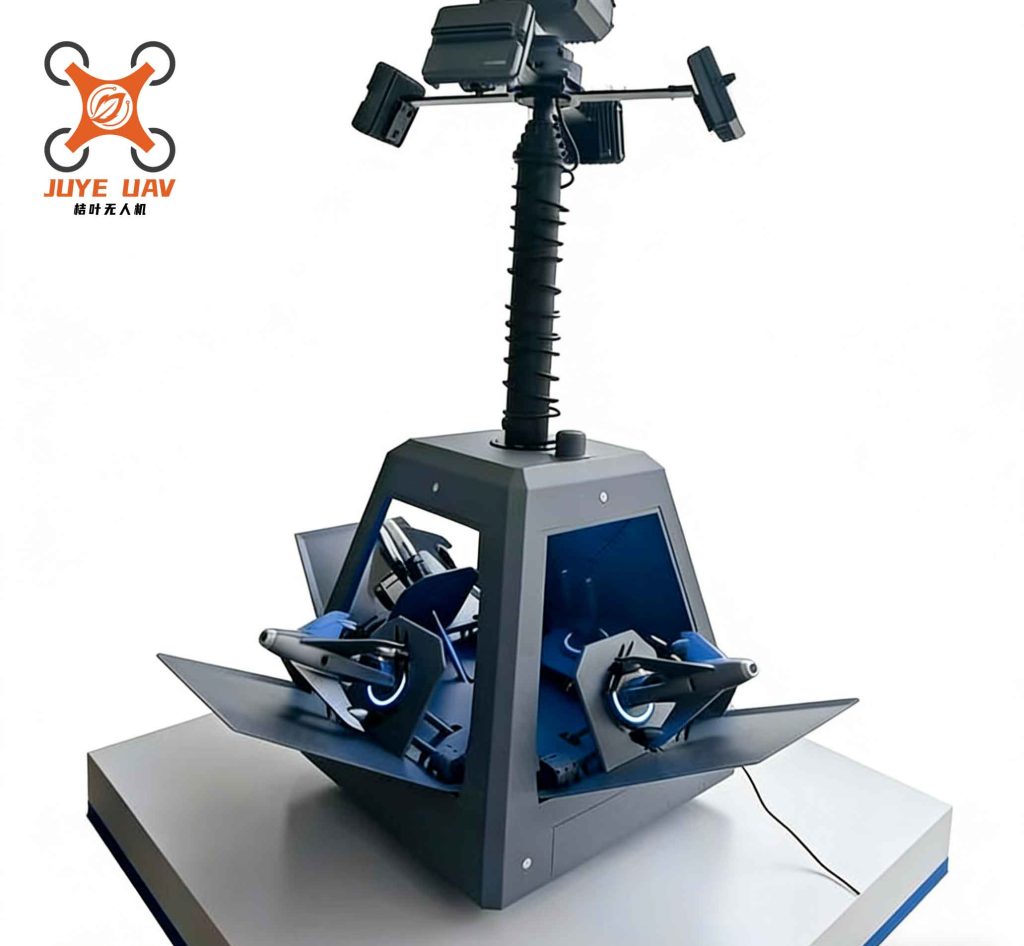
The core of the anti-UAV simulation training system lies in the simulator design, which virtualizes UAV targets, sensors, and weapons through detailed modeling. To realistically replicate the “low, small, slow” attributes of UAVs, the target model is constructed from three aspects: unique attributes (e.g., cross-sectional area, uplink/downlink signal frequencies, speed range, takeoff weight, maximum climb/descent rates), motion characteristics (e.g., velocity, altitude, heading, hover, rapid climbs, descents, high maneuverability, flight path planning), and实战 identifiable properties (e.g., sortie count, identity, threat level, model). This comprehensive modeling allows for accurate simulation of anti-UAV scenarios. A feature database for typical “low, small, slow” targets is established, incorporating data from various rotary-wing and fixed-wing UAVs used in military and civilian contexts, enabling effective identification and analysis through comparison. The target model structure can be summarized as follows:
| Aspect | Parameters | Description |
|---|---|---|
| Unique Attributes | Cross-sectional area, signal frequencies, speed range, weight | Defines physical and operational limits for anti-UAV engagement |
| Motion Characteristics | Velocity, altitude, heading, hover,机动 paths | Simulates realistic UAV behaviors in complex scenes |
| Identifiable Properties | Sortie, identity, threat level, model | Supports target recognition and threat assessment in anti-UAV operations |
For sensors and weapons, the models encompass four components: general performance parameters (e.g., detection coverage, error, accuracy), device-specific features (e.g., radar工作频率 and scanning modes, radio干扰频段 and methods), detection and engagement capabilities against UAVs (e.g.,最小探测范围 for不同横截面积 targets,打击成功概率), and message information (e.g., radar track reports, laser fire control reports). This ensures realistic simulation of sensor data and weapon interactions in anti-UAV scenarios. The sensor and weapon model structure is illustrated below:
| Component | Examples | Anti-UAV Relevance |
|---|---|---|
| General Parameters | Detection range, accuracy, error margins | Base metrics for evaluating anti-UAV system performance |
| Device Features | Radar frequency bands, interference bandwidths | Tailored to counter UAV-specific signals and behaviors |
| Capabilities | Min detectable speed, engagement probability | Critical for effective anti-UAV targeting and neutralization |
| Message Information | Track reports, status updates | Facilitates communication in anti-UAV command and control |
To enhance the anti-UAV training experience, mathematical models can be integrated. For instance, the detection probability of a radar against a UAV can be expressed using the radar equation adapted for small targets. Let \(P_d\) be the detection probability, \(R\) the range to the target, \(\sigma\) the radar cross-section (RCS) of the UAV, and \(k\) a constant incorporating radar parameters. A simplified formula is:
$$P_d = \frac{k \cdot \sigma}{R^4}$$
This highlights the challenge in anti-UAV operations, as UAVs often have small \(\sigma\) values, reducing \(P_d\) significantly at longer ranges. Similarly, for laser武器 engagement, the success probability \(P_s\) against a UAV might depend on factors like atmospheric attenuation \(\alpha\), beam divergence \(\theta\), and target maneuverability. A potential model is:
$$P_s = e^{-\alpha R} \cdot \frac{1}{1 + (\theta R)^2} \cdot f(\text{maneuver})$$
where \(f(\text{maneuver})\) accounts for UAV evasion tactics, emphasizing the complexity of anti-UAV engagements.
Building on these models, complex anti-UAV作战 scenes are designed by规划 target appearances, flight paths, and states, as well as deploying and initializing sensors and weapons. Key scenarios include UAV swarm operations, where multiple drones协同 attack, presenting detection and处置 challenges due to their low altitude, slow speed, and small RCS. In such anti-UAV scenarios, integrated sensors (e.g., radar, electro-optical, radio frequency detectors) must work together in cluttered electromagnetic environments to identify threats. Engagement strategies combine “soft kill” methods like electronic干扰 and deception with “hard kill” approaches such as laser interception, reflecting the multifaceted nature of anti-UAV defense. Other scenes simulate high-maneuver UAVs, approaching friendly units from afar, or hovering状态 where only radio detectors can detect them (as radar may fail due to zero Doppler shift). These复杂 scenes ensure trainees experience realistic anti-UAV challenges, from initial detection to final engagement.
The simulation training functionality is centered on an instructor station, which adds an交互 layer for enhanced anti-UAV training. The instructor can monitor complex scene states, issue commands, oversee trainee operations, conduct assessments, manage multimedia materials, and maintain trainee records. Specifically, scene monitoring interfaces allow real-time tracking of target statuses (e.g., position, speed), sensor modes (e.g., radar work modes), and weapon readiness, enabling informed decision-making during anti-UAV exercises. For example, an instructor might command trainees to adjust radar settings or initiate laser strikes based on scenario developments. The training流程 mirrors actual anti-UAV operations, comprising pre-combat preparation, battlefield reconnaissance, command and control, target engagement, and战后 evaluation. Trainees, acting as情报侦察,作战指挥, and system monitoring personnel, follow instructor directives to perform tasks like setting flight plans, configuring sensor parameters, identifying and tracking UAVs, conducting threat assessments, and executing干扰 or laser attacks. This structured approach ensures comprehensive anti-UAV skill development.
To quantify training effectiveness, the system evaluates trainees on proficiency, accuracy, and completeness. Proficiency is measured by time taken to complete指令; accuracy by correctness of actions (e.g., setting radar to “low, small, slow” mode versus误操作); and completeness by the percentage of instructions fulfilled. Scores are automatically generated post-training, with historical records stored for progress tracking. A sample scoring table is shown below:
| Operation | Proficiency Score (Time-based) | Accuracy Score (Correctness) | Overall Rating |
|---|---|---|---|
| Set radar mode to anti-UAV focus | 90% (completed in 30s) | 100% (correct mode selected) | 95% |
| Allocate laser武器 to target | 80% (completed in 45s) | 90% (proper target assigned) | 85% |
| Configure干扰 device | 85% (completed in 40s) | 95% (频段 set accurately) | 90% |
Multimedia training complements hands-on practice by providing images, 3D models of command vehicles, instructional videos on device operation, PPT materials on system functionalities, and online exams for理论 and practical knowledge assessment. This blended approach prepares trainees for实操 sessions, reducing confusion and improving overall anti-UAV training efficiency. For instance, trainees can study vehicle layouts or watch tutorials on laser weapon usage before attempting simulated engagements, reinforcing learning through varied modalities.
In conclusion, the anti-UAV combat simulation training system based on complex scenes virtualizes targets, sensors, and weapons through detailed modeling, eliminating physical constraints like equipment limitations, environmental factors, and high costs associated with live training. By incorporating an instructor station, it enables scalable, interactive training that enhances both trainee proficiency and instructor指挥 skills in anti-UAV operations. The use of multimedia resources further smooths the learning curve, ensuring trainees are well-prepared for real-world anti-UAV challenges. This system represents a significant advancement in anti-UAV defense training, offering a practical solution to meet the growing demand for effective counter-UAV capabilities in modern security landscapes.