
In the evolving landscape of emergency response, I have observed that technological advancements are reshaping how we approach disaster management. Among these, drone technology, particularly fire drones, has emerged as a transformative tool in firefighting communications. As an analyst in this field, I believe that the integration of fire drones into消防 systems offers unprecedented capabilities for real-time data acquisition, communication relay, and operational efficiency. This analysis delves into the application of fire drone technology in消防 communications, exploring its functional architecture, advantages, implementation pathways, and future considerations. The goal is to provide a comprehensive perspective on how fire drones can enhance救援 efforts, ensuring safety and effectiveness in critical scenarios.
The adoption of fire drones is driven by the need for rapid, reliable communication during emergencies. Traditional communication infrastructures often fail in disaster zones due to damage or obstruction, highlighting the necessity for flexible alternatives. Fire drones address this gap by serving as airborne platforms that facilitate data transmission, situational awareness, and command coordination. From my perspective, the proliferation of fire drones represents a paradigm shift in消防 strategies, enabling responders to navigate complex environments with greater precision. Throughout this discussion, I will emphasize the role of fire drones as a cornerstone of modern消防通信, underscoring their potential to save lives and mitigate property damage.
To understand the efficacy of fire drones, it is essential to examine their functional architecture. A fire drone is a sophisticated system comprising multiple integrated components that work in harmony to perform specific tasks. Based on my analysis, I can break down the architecture into several core subsystems, each contributing to the drone’s overall functionality in消防 communications. Below, I present a detailed table summarizing these components, their descriptions, and key functions in the context of firefighting.
| Component | Description | Function in Firefighting Communications |
|---|---|---|
| Flight Control System | Includes flight controllers, gyroscopes, accelerometers, motors, and propellers. | Ensures stable flight, attitude control, and navigation, allowing precise maneuvering in hazardous areas. It forms the backbone of drone operations, enabling autonomous or remote-controlled movement. |
| Communication System | Comprises wireless modules, antennas, and data links (e.g., LTE, satellite). | Facilitates real-time transmission of data, images, video, and commands between the fire drone and ground stations. This system is critical for maintaining continuous communication links in disrupted environments. |
| Sensor System | Incorporates cameras (HD, thermal), radar, gas sensors, and meteorological instruments. | Gathers environmental data such as fire intensity, smoke distribution, gas concentrations, and weather conditions. These sensors provide actionable intelligence for rescue planning and hazard assessment. |
| Payload System | Carries specialized equipment like speakers, lights, or delivery mechanisms. | Enables specific tasks, e.g., broadcasting救援 instructions, illuminating dark areas, or deploying supplies. The payload adapts the fire drone for diverse operational needs. |
| Data Processing and Storage | Involves embedded processors, memory units, and algorithms for image analysis. | Processes raw sensor data in real-time, extracting meaningful insights (e.g., heat signatures) and storing information for post-incident review. This enhances decision-making speed and accuracy. |
| Navigation and Positioning | Utilizes GPS, inertial navigation systems, and compasses. | Determines the fire drone’s location and orientation, enabling precise mapping of disaster zones and reliable return-to-home functions. Accuracy is vital for coordinating with ground teams. |
| Power System | Consists of batteries, fuel cells, or generators. | Supplies electrical energy to all subsystems, with endurance being a key factor for prolonged missions. Advanced power management extends operational time in critical situations. |
From this architecture, I derive that the interoperability of these components is what makes fire drones so effective. For instance, the sensor system feeds data into the processing unit, which then communicates findings via the communication system. A mathematical representation of this data flow can be expressed using a formula for information throughput. Let $$C = B \log_2\left(1 + \frac{S}{N}\right)$$, where \(C\) is the channel capacity in bits per second, \(B\) is the bandwidth, \(S\) is the signal power from the fire drone’s transmitter, and \(N\) is the noise power. This equation highlights how fire drones optimize communication links under varying environmental conditions, ensuring robust data exchange during消防 operations.
The advantages of employing fire drones in消防 communications are multifaceted, as I have noted through various case studies and theoretical models. These benefits stem from the unique capabilities of fire drones to overcome traditional limitations in disaster response. In my assessment, the primary advantages include rapid deployment, aerial perspective, communication relay, network flexibility, post-disaster reconnaissance, and risk reduction for personnel. To encapsulate these, I provide a comparative table that outlines each advantage alongside its impact on消防 efficiency.
| Advantage | Description | Impact on Firefighting Communications |
|---|---|---|
| Rapid Deployment and Flexibility | Fire drones can be launched quickly without extensive setup, adapting to complex terrains. | Enables immediate communication support at incident sites, reducing response times and enhancing agility in dynamic environments. |
| Aerial Perspective and Wide Coverage | Equipped with cameras and sensors, fire drones offer overhead views of large areas. | Provides real-time imagery for assessing fire spread and personnel locations, improving situational awareness and command decisions. |
| Communication Relay and Signal Enhancement | Fire drones act as airborne repeaters, extending signal range and bridging gaps in ground networks. | Ensures uninterrupted communication between command centers and frontline responders, even in remote or obstructed zones. |
| Flexible Network Construction | Fire drones can form ad-hoc mesh networks through wireless interlinks. | Creates temporary, scalable communication infrastructures that support multiple data streams and devices, enhancing coordination. |
| Post-Disaster Reconnaissance and救援 Support | Fire drones conduct surveys and search operations after incidents. | Accelerates victim location and damage assessment, feeding critical data back to rescue teams for informed actions. |
| Personnel Risk Reduction | Fire drones access hazardous areas instead of humans, minimizing exposure to dangers. | Protects消防 personnel from threats like extreme heat or toxic fumes, while still delivering essential communication services. |
I further analyze these advantages through a quantitative lens. For example, the coverage area of a fire drone’s communication relay can be modeled using the formula for the area of a circle: $$A = \pi r^2$$, where \(A\) is the coverage area and \(r\) is the effective communication radius. By deploying multiple fire drones, the total coverage expands significantly, as shown by the summation $$A_{\text{total}} = \sum_{i=1}^{n} \pi r_i^2$$, where \(n\) is the number of fire drones. This mathematical approach underscores how fire drones amplify通信 capabilities in large-scale disasters. Additionally, the risk reduction benefit can be expressed in terms of probability: if \(P_h\) represents the probability of harm to personnel in a high-risk zone, the use of a fire drone reduces this to $$P_h’ = P_h \cdot (1 – e)$$, where \(e\) is the effectiveness factor of the fire drone substitution (typically \(0 < e \leq 1\)). Such formulations illustrate the tangible value of fire drones in safeguarding human lives.
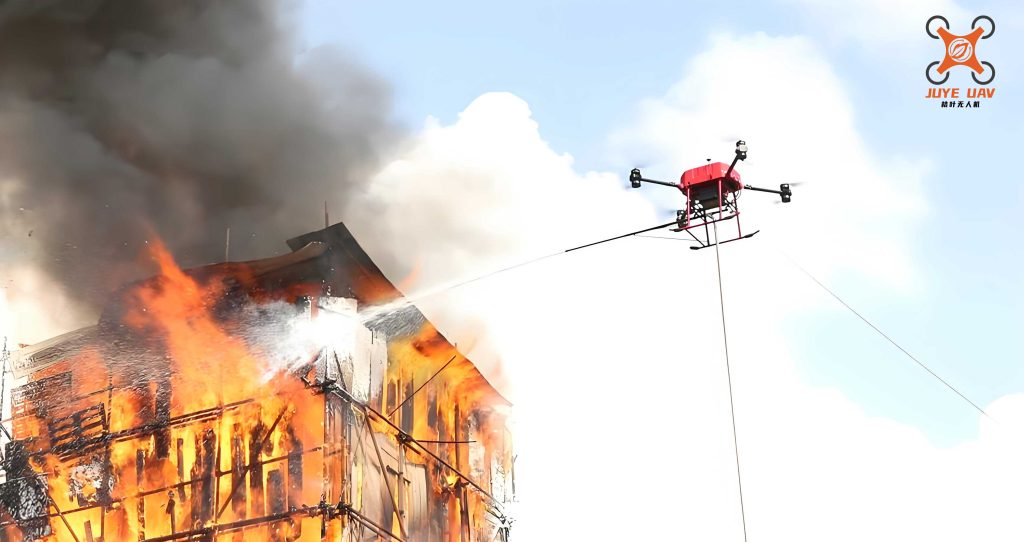
Having established the advantages, I now explore the practical application paths for fire drones in消防 communications. Based on my research, these paths can be categorized into three main domains: command and control at救援 sites, real-time situational detection, and dynamic instruction dissemination. Each domain leverages the fire drone’s capabilities to address specific challenges in firefighting operations. I will detail these with examples and theoretical frameworks, emphasizing how fire drones integrate into existing消防 protocols.
First, in command and control, fire drones serve as vital tools for on-scene救援 coordination. I have observed that by transmitting live video and sensor data, fire drones provide commanders with a comprehensive view of the incident. This enables informed decision-making regarding resource allocation and tactic adjustments. For instance, a fire drone equipped with a thermal camera can detect hotspots through smoke, using algorithms to quantify heat intensity. The data can be processed using a formula like $$T(x,y) = \kappa \cdot I(x,y)$$, where \(T\) is the temperature at pixel coordinates \((x,y)\), \(\kappa\) is a calibration constant, and \(I\) is the infrared intensity. This allows commanders to prioritize areas for intervention. Moreover, fire drones facilitate communication relay by acting as nodes in a network. Consider a scenario where ground communication is jammed; a fire drone can establish a link using a protocol modeled by $$L = \frac{P_t G_t G_r \lambda^2}{(4\pi d)^2}$$, where \(L\) is the link budget, \(P_t\) is transmit power, \(G_t\) and \(G_r\) are antenna gains, \(\lambda\) is wavelength, and \(d\) is distance. This ensures that vital指令 reach responders without delay.
Second, for situational detection, fire drones excel in gathering environmental intelligence. I analyze this through the lens of multi-sensor fusion, where data from various sensors are combined to form a coherent picture. A fire drone might use gas sensors to measure concentrations of hazardous substances like carbon monoxide (CO). The reading can be expressed as $$C_{\text{CO}} = \alpha \cdot S_{\text{gas}} + \beta$$, where \(C_{\text{CO}}\) is the CO concentration, \(S_{\text{gas}}\) is the sensor output, and \(\alpha, \beta\) are calibration parameters. This real-time monitoring helps assess air quality and guide evacuation routes. Additionally, fire drones employ acoustic sensors to detect distress sounds, processed using Fourier transforms: $$F(\omega) = \int_{-\infty}^{\infty} f(t) e^{-i\omega t} dt$$, where \(F(\omega)\) is the frequency spectrum of the audio signal \(f(t)\). By identifying human voices or cries, fire drones can pinpoint trapped individuals, enhancing救援 precision. The integration of these detection capabilities into a unified system is key, as summarized in the table below.
| Detection Type | Sensor Used | Data Output | Application in Firefighting |
|---|---|---|---|
| Thermal Imaging | Infrared Camera | Heat maps and temperature gradients | Locating fire sources and hidden flames through obstructions. |
| Gas Concentration | Chemical Sensors | Parts per million (ppm) readings | Monitoring toxic fumes to ensure responder safety and air quality. |
| Acoustic Monitoring | Microphones | Audio waveforms and frequency analyses | Identifying求救 calls or structural noises indicating collapse risks. |
| Visual Surveillance | HD Cameras | High-resolution images and video streams | Documenting fire progression and structural integrity for post-incident review. |
Third, in dynamic instruction dissemination, fire drones leverage payload systems like loudspeakers to broadcast救援 commands. I find this particularly valuable in chaotic environments where traditional communication may be overwhelmed. The effectiveness of such broadcasts depends on factors like audio clarity and range. A simple model for sound propagation is given by $$I = \frac{P}{4\pi r^2}$$, where \(I\) is sound intensity at distance \(r\) from the fire drone’s speaker of power \(P\). This ensures that instructions are audible over wide areas. Furthermore, fire drones can use light signals or drop messaging devices to convey information. In my analysis, the integration of these methods creates a multi-modal communication strategy, enhancing redundancy and reliability. For example, a fire drone might simultaneously transmit data via radio while broadcasting voice alerts, using a protocol efficiency metric $$E = \frac{D_{\text{delivered}}}{D_{\text{total}}} \times 100\%$$, where \(E\) is efficiency, \(D_{\text{delivered}}\) is data successfully received, and \(D_{\text{total}}\) is data sent. Optimizing this metric is crucial for mission success.
Beyond these application paths, I believe that the sustained use of fire drones in消防 communications requires addressing several strategic considerations. From my perspective, these include institutional frameworks, maintenance protocols, and operator proficiency. Each aspect contributes to the long-term viability and safety of fire drone deployments. I will discuss these in detail, proposing actionable insights and theoretical models to guide implementation.
First, regarding institutional frameworks, I advocate for the development of comprehensive policies that govern fire drone operations. This involves standardizing procedures for data privacy, airspace management, and inter-agency coordination. A regulatory model can be conceptualized using a set of equations that balance innovation with safety. For instance, let \(R\) represent regulatory strictness, \(I\) innovation incentive, and \(S\) safety level. A feasible relationship might be $$S = k_1 R + k_2 I$$, where \(k_1\) and \(k_2\) are positive constants, indicating that both regulation and innovation drive safety. Additionally, privacy protection can be quantified through entropy measures: $$H(X) = -\sum_{i} p(x_i) \log p(x_i)$$, where \(H(X)\) is the information entropy of collected data, with higher values implying better privacy preservation when data is anonymized. By embedding such principles into policies, we can ensure that fire drone applications are both effective and ethical.
Second, maintenance of fire drones is critical for operational readiness. I emphasize that regular upkeep prevents failures during critical missions. A preventive maintenance schedule can be optimized using reliability theory. The failure rate \(\lambda(t)\) of a fire drone component might follow a Weibull distribution: $$\lambda(t) = \frac{\beta}{\eta} \left( \frac{t}{\eta} \right)^{\beta-1}$$, where \(\eta\) is the scale parameter and \(\beta\) is the shape parameter. By monitoring these parameters, maintenance intervals can be adjusted to minimize downtime. Moreover, spare parts inventory management can be modeled using economic order quantity (EOQ) formulas: $$Q^* = \sqrt{\frac{2DS}{H}}$$, where \(Q^*\) is the optimal order quantity, \(D\) is demand rate, \(S\) is ordering cost, and \(H\) is holding cost. This ensures that components like batteries or propellers are available when needed, as summarized in the table below.
| Maintenance Aspect | Key Activities | Mathematical Model | Outcome |
|---|---|---|---|
| Routine Inspection | Visual checks, sensor calibration, software updates. | Use of statistical process control charts to detect anomalies. | Early identification of potential issues, reducing unexpected failures. |
| Component Replacement | Swapping batteries, motors, or cameras based on wear. | Reliability analysis with failure distributions (e.g., exponential or Weibull). | Extended operational lifespan and consistent performance of fire drones. |
| Data Management | Backing up flight logs and sensor data for analysis. | Information theory metrics to assess data integrity and storage efficiency. | Improved post-mission debriefing and algorithmic training for future operations. |
Third, operator proficiency is paramount for safe and effective fire drone usage. I argue that training programs must encompass technical skills, safety protocols, and ethical guidelines. The competency of an operator can be assessed using a scoring system based on multiple criteria. For example, let \(C_{\text{op}}\) represent overall competency, calculated as a weighted sum: $$C_{\text{op}} = w_1 S_{\text{flight}} + w_2 S_{\text{comms}} + w_3 S_{\text{safety}}$$, where \(S_{\text{flight}}, S_{\text{comms}}, S_{\text{safety}}\) are scores in flight control, communication handling, and safety adherence, respectively, and \(w_i\) are weights summing to 1. Regular certification ensures that operators meet minimum thresholds, say \(C_{\text{op}} \geq T\), where \(T\) is a threshold value. Additionally, simulation-based training can enhance decision-making under pressure, modeled using stochastic processes: $$P(\text{success}) = 1 – e^{-\lambda t}$$, where \(P(\text{success})\) is the probability of correct action in time \(t\), and \(\lambda\) is the learning rate. By fostering a culture of continuous improvement, we can maximize the potential of fire drones in消防 communications.
In conclusion, I assert that fire drone technology represents a significant advancement in消防 communications, offering robust solutions to longstanding challenges. Through my analysis, I have highlighted how the functional architecture of fire drones enables diverse applications, from command coordination to real-time detection and instruction dissemination. The advantages, such as rapid deployment and risk reduction, are substantiated by mathematical models and practical examples. Moreover, the implementation paths demonstrate the versatility of fire drones in enhancing救援 efficiency. Looking ahead, I recommend a focus on institutional support, rigorous maintenance, and operator training to sustain these benefits. As fire drones continue to evolve, their integration into消防 strategies will undoubtedly save lives and protect communities, solidifying their role as indispensable tools in modern emergency response. This perspective underscores my belief that innovation, when coupled with thoughtful planning, can transform disaster management for the better.
To encapsulate key formulas discussed, I list them here for reference:
- Channel capacity: $$C = B \log_2\left(1 + \frac{S}{N}\right)$$
- Coverage area: $$A = \pi r^2$$ and $$A_{\text{total}} = \sum_{i=1}^{n} \pi r_i^2$$
- Risk reduction probability: $$P_h’ = P_h \cdot (1 – e)$$
- Temperature estimation: $$T(x,y) = \kappa \cdot I(x,y)$$
- Link budget: $$L = \frac{P_t G_t G_r \lambda^2}{(4\pi d)^2}$$
- Gas concentration: $$C_{\text{CO}} = \alpha \cdot S_{\text{gas}} + \beta$$
- Fourier transform: $$F(\omega) = \int_{-\infty}^{\infty} f(t) e^{-i\omega t} dt$$
- Sound intensity: $$I = \frac{P}{4\pi r^2}$$
- Protocol efficiency: $$E = \frac{D_{\text{delivered}}}{D_{\text{total}}} \times 100\%$$
- Regulatory safety model: $$S = k_1 R + k_2 I$$
- Information entropy: $$H(X) = -\sum_{i} p(x_i) \log p(x_i)$$
- Weibull failure rate: $$\lambda(t) = \frac{\beta}{\eta} \left( \frac{t}{\eta} \right)^{\beta-1}$$
- Economic order quantity: $$Q^* = \sqrt{\frac{2DS}{H}}$$
- Operator competency: $$C_{\text{op}} = w_1 S_{\text{flight}} + w_2 S_{\text{comms}} + w_3 S_{\text{safety}}$$
- Learning probability: $$P(\text{success}) = 1 – e^{-\lambda t}$$
These equations, combined with the tables and narratives, provide a thorough foundation for understanding and advancing fire drone applications in消防 communications.