
In the context of advancing national public security work, there is a pressing need to enhance all-police practical training and promote tactical methodologies. As a researcher and practitioner in this field, I have observed that organizing tactical training for police UAVs across the entire police force is essential to meet deployment requirements for real-world readiness. Through instructional activities, conducting relevant training on police UAV tactics is a practical necessity to adapt to combat training deployments and improve the capacity to combat crime.
In the new era, police UAVs face challenges in public security work, such as superficial applications, rigid thinking, and low integration. Conducting realistic training is a key measure to enhance the combat effectiveness of police agencies. In this paper, we explore specific applications of police UAV tactical methods in policing activities, aiming to provide more solutions for related dilemmas in police work. Therefore, based on the actual needs of public security work, analyzing, researching, and training in police UAV tactics holds significant practical importance for maintaining social order and combating crime.
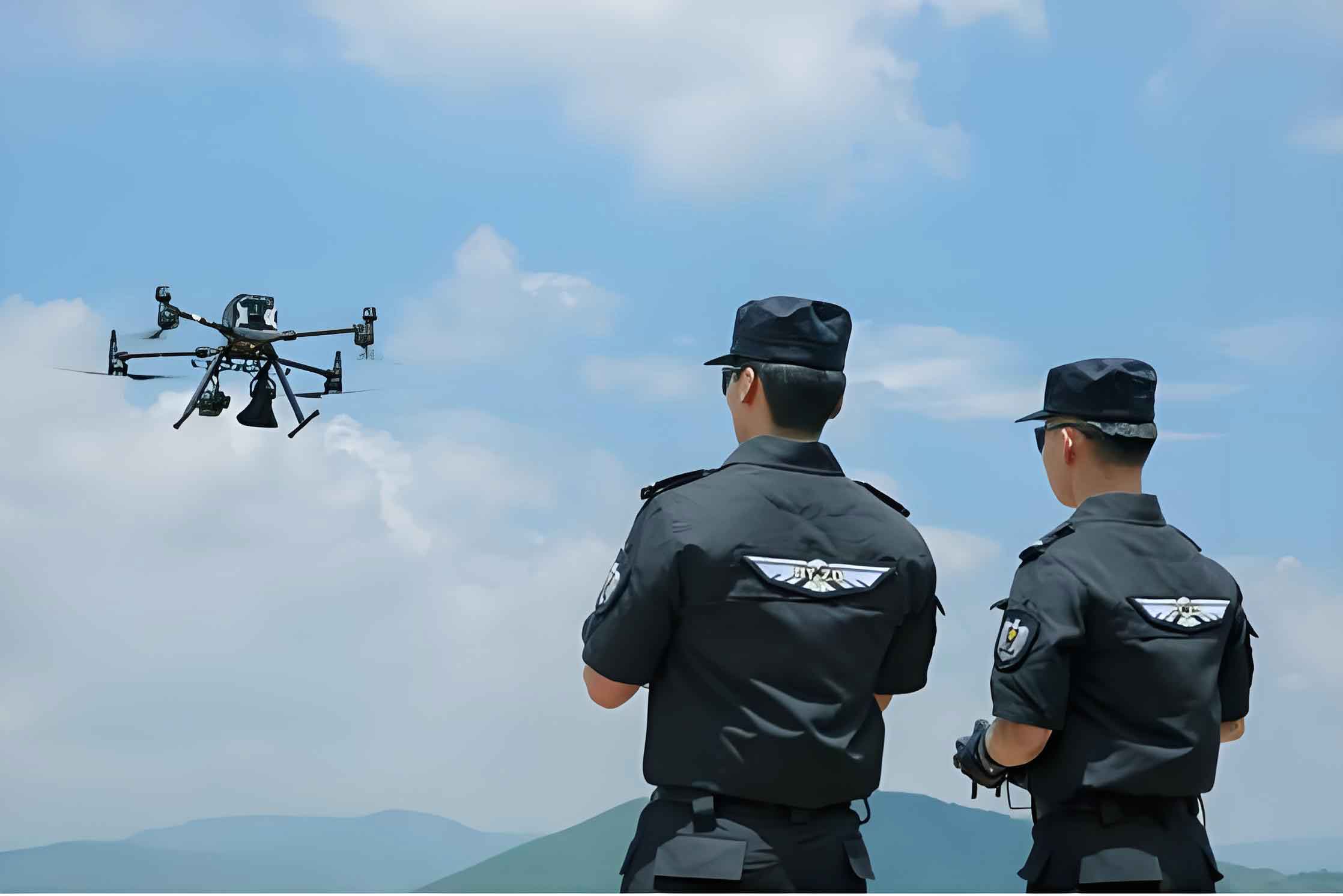
Overview of Police UAV Tactical Methods
Unmanned Aerial Vehicles (UAVs), broadly defined, refer to various aircraft that do not require an onboard pilot, including autonomous and remotely piloted aircraft. Police UAVs, specifically, are aircraft equipped by police agencies, suitable for executing policing tasks, without an onboard pilot, excluding model aircraft, unmanned free balloons, tethered balloons, and special police aircraft for specific policing needs.
Police UAV tactical methods refer to the skills and combat methods used by police personnel in complex environments, according to policing task requirements, by operating police UAVs equipped with different mission payload subsystems, to independently or assistively complete multiple policing tasks such as investigation and evidence collection, patrol surveillance, security management, prevention and early warning, and area positioning.
To fully explore and research police UAV tactical methods, it is crucial to classify them scientifically and reasonably. Based on the different policing tasks performed by police UAVs, we categorize police UAV tactical methods into emergency response tactics, cruise comparison tactics, prevention and warning tactics, covert reconnaissance tactics, area positioning tactics, and containment and arrest tactics. This classification facilitates systematic research and application by allowing the use of different tactics according to scenario needs.
The application of police UAV tactical methods has shown promising development. Some police agencies have applied “cruise comparison” and “prevention and warning” tactics to regional surveillance activities, while others have used “area positioning” and “investigation and search” tactics in case investigation, achieving tangible results. As a targeted and highly coordinated tactic, police UAV methods have erected an aerial barrier for police work. Police agencies are continuously researching and exploring to develop new tactics to adapt to more demanding and complex policing tasks. However, aligning tactics with practical needs and refining their classification and application in training remain pressing issues.
Dilemmas in the Practical Application of Police UAVs
As a new type of police equipment with high technical content, police UAVs have become a new利器 in police work. Despite the introduction of new UAVs by various police agencies, and some achievements in the development and application of police UAV tactics, current research and practical applications often treat police UAVs merely as aerial surveillance tools. Deeper applications in打击, arrest, and air-ground coordinated operations need strengthening. Practical tactical methods in policing work require further excavation, and there is still a gap from truly achieving intelligent, informationalized, and practical police law enforcement.
In some policing activities, the positioning of police UAVs is limited to single responsibilities like video monitoring and定点 observation, lacking a comprehensive认知. This在一定程度上固化了 the practical application of police UAV tactics. Additionally, the primary police UAVs used for policing tasks are small multi-rotor and fixed-wing UAVs, which also束缚 the diversity of tactical applications. Current tactics are often based on pre-analyzed policing environments without adaptive changes. While police UAVs can complete tasks like aerial monitoring, communication disruption, and处置打击, there is a significant gap in梳理,归纳, summarizing their applications into effective tactical systems.
The effective integration of police UAVs with policing applications remains a major challenge, primarily in technical aspects. Comprehensive application is still in the early exploration stage, with limited实战 data, incomplete data analysis, and insufficient related research. Insufficient understanding of police UAV application processes and policing needs leads to applications limited to现场 data collection, with time gaps in backend analysis, unable to bridge the链接瓶颈 between collection, analysis, and judgment. Moreover, the lack of universal technical standards and usage norms for police UAVs hinders the maximization of their advantages in functional integration and operational applicability, preventing quick and efficient completion of policing tasks and deeper exploration of applications in公安 practice.
Currently, police UAV training courses are单一, lacking a targeted teaching structure, especially in business management and analytical applications. The absence of实战-oriented professional training makes it difficult for police UAV tactics to play their due role, hindering协同对接 and合成作战 with other systems in practical operations, resulting in a serious disconnect between skill operation and实战过程. With the increasing introduction of police UAVs, the issue of professional talent队伍建设 is becoming prominent. There is a shortage of skilled operators, urgently requiring professional skill training to establish specialized teams and foster new application scenarios for police UAVs in policing activities.
Research on Practical Applications of Police UAV Tactical Methods
In recent years, with the rapid development of technology and information, police UAVs have advanced in技术开发 and战术应用, particularly in differentiated analysis based on policing activity scenarios, which is highly significant for deepening tactical applications. Based on the problems in the practical application of police UAVs, this paper,立足问题导向, proposes six tactical methods for specific use in policing activities, aiming to provide direction for tactical training and solutions to突破现阶段困境.
Emergency Response Tactical Method
For处置突发事件 tasks, the “emergency response tactical method” can be employed. Using police UAVs in coordination with various police departments统一行动 can effectively improve the efficiency of incident处置, minimizing casualties and economic losses. In the face of emergencies, police UAV teams select payloads such as强光手电, high-power speakers, net guns, tear gas, stun grenades,声波武器, and other警械武器装备 based on task needs. They immediately take off and hover, using the mounted speakers for宣传教育 towards suspects. Additionally, police UAV teams can use multiple UAVs in “formation hovering,” “环绕巡飞,” and “往返巡飞” tactical flight maneuvers, along with the noise generated during low-altitude flight, to create psychological恐慌 in suspects,暗示 they are surrounded, and动摇 their意志 to continue illegal activities.
In practical application, operators must focus高度专注, operate谨慎操控,精准灵活, and control flight动作幅度 when carrying payloads to avoid accidents and harm to innocent people. Simultaneously, low-altitude flight requires constant attention to suspect方位 and actions to prevent attacks on the police UAV, avoiding injuries and property damage. The effectiveness of this police UAV tactic can be modeled using a threat assessment formula: $$ T = \frac{P_{d} \cdot I_{s}}{R_{a}} $$ where $T$ is the threat level, $P_{d}$ is the probability of detection, $I_{s}$ is the suspect’s intent score, and $R_{a}$ is the response ability. By deploying police UAVs, $P_{d}$ increases, potentially reducing $T$ through deterrence.
Cruise Comparison Tactical Method
For forestry patrols, the “cruise comparison tactical method” is applicable. Forest areas have茂盛 vegetation, numerous trees, and杂草丛生, with complex地形地貌 due to plant影响, water erosion, wind, and frost. Since the public rarely enters these areas, they can become hotspots for illegal activities like聚众赌博,非法传销,毒品原植物种植,毒品加工, and捕杀野生动物. Natural disasters such as森林火灾,山体滑坡, and泥石流 also occur. Using this police UAV tactic to compare航片 from不同时段巡航拍摄 highlights changes in relevant areas, enabling complete and accurate monitoring of forest changes over time.
Furthermore, this police UAV tactic focuses on observing变动 and异常 in periodic images. For毒品原植物种植, multispectral cameras can be mounted on police UAVs to cruise forests, capture images, and compare with previous成像 based on different plant signatures in multispectral imaging to analyze and identify种植. For railway security,重点比对 of巡航区域的重点部位, such as tracks, isolation nets, and switch points, requires放大对比 to detect细小隐患. In multi-period comparison,新出现的异物 and environmental changes around railways are observed, aiding in timely discovery and elimination of threats to railway safety. The image difference can be quantified as: $$ \Delta I(x,y) = |I_{t}(x,y) – I_{t-1}(x,y)| $$ where $\Delta I$ is the difference image at pixel $(x,y)$, $I_{t}$ is the current image, and $I_{t-1}$ is the previous image. A threshold $\theta$ can be set to detect anomalies: $$ A(x,y) = \begin{cases} 1 & \text{if } \Delta I(x,y) > \theta \\ 0 & \text{otherwise} \end{cases} $$ where $A$ indicates anomalous pixels for further investigation by police UAV operators.
| Scenario | Police UAV Payload | Key Tactical Action | Expected Outcome |
|---|---|---|---|
| Forestry Patrol | Multispectral Camera | S-shaped scanning flight | Detection of illegal plant cultivation |
| Railway Security | High-Resolution Camera | Low-altitude hover at key points | Identification of safety hazards |
| Urban Monitoring | Thermal Imaging | Grid pattern巡航 | Tracking of suspicious movements |
Prevention and Warning Tactical Method
For railway jurisdiction防控, this police UAV tactic is useful. China’s railway lines are characterized by点多,线长,面广, with complex environments including natural and人文景观, and diverse terrains like高原,山岭,平原,丘陵,盆地. On railways, incidents such as破坏隔离网,随意穿越铁路线路,破坏轨道, and盗窃铁路设备 occur. Due to the vast area, sparse population, uneven警力分配, and special地理条件, current patrol methods mainly involve徒步巡逻 by line police, leading to low efficiency and difficulty in completing巡线 tasks or detecting细微变化, often resulting in post-incident discovery of crimes.
Applying the “prevention and warning tactical method,” police UAVs can be used for railway patrols, replacing manpower with machines. Considering railway characteristics, fixed-wing police UAVs are chosen for巡航. When planning航线 and setting航点, design according to railway走向, setting航线 on both sides and covering重点路段 like road-rail crossings,高架桥, and村庄路段. In重点路段, reduce巡航高度 and speed, set more航点 to obtain comprehensive, high-precision data for effective prevention and warning.
Similarly, this police UAV tactic applies to人员密集场所 like火车站站前广场, stadiums, music festivals, and农村集市, which have large areas and dense crowds with insufficient固定监控探头. To manage such places during peak人流, use police UAVs to航拍获取街边信息点资源 based on area and crowd density, then extract and transmit信息点属性 to shorten collection time and improve data quality. Quickly deploy police UAV teams to designated机位 for全局监控,弥补 fixed监控数量不足 and视角固定的缺点. Since crowds gather quickly and高峰时段 may last hours, deploy police UAV teams as gathering begins. Equip teams with tethered police UAVs for prolonged高空监控. Police UAVs should carry高清摄像头: first, a multi-rotor police UAV ascends for overall信息采集 and机位 planning; second, rapidly deploy tethered police UAVs to specified positions for monitoring dense areas; third, combine with patrolling police UAVs to form an全视角,多功能空中监控网. The coverage efficiency can be expressed as: $$ E_{c} = \frac{N_{uav} \cdot A_{cov} \cdot t_{mon}}{A_{total} \cdot t_{total}} $$ where $E_{c}$ is the coverage efficiency, $N_{uav}$ is the number of police UAVs, $A_{cov}$ is the area covered per police UAV, $t_{mon}$ is the monitoring time, $A_{total}$ is the total area, and $t_{total}$ is the total operation time. Maximizing $E_{c}$ enhances prevention and warning capabilities.
Area Positioning Tactical Method
In cracking组织非法传销犯罪 cases, the “area positioning tactical method” can be used. Such cases involve difficult and模糊定位 of聚集窝点, requiring对症下药 through热感分析 to locate异常区域 of suspect聚集. Police need “两个了解” of the jurisdiction: understanding the distribution of常驻人口 and流动人口, and knowing易发生违法犯罪的地点场所.传销犯罪行为 are extremely隐蔽, hard to discover or report. Without intelligence,排查整个辖区 is challenging. To change this, more主动侦查理念 are needed. Police can use infrared thermal imaging technology to拍摄并分析重点区域, promptly identifying异常人员聚集,定位重点区域, and recognizing犯罪窝点.
This police UAV tactic also applies to打击制售假冒伪劣产品 cases. Counterfeiting团伙 typically have fixed members, clear分工,默契配合,严密组织,隐蔽作案手段, with窝点 often in偏僻地区,独门独院,门禁森严, and隐蔽性极强. In complex现场环境 where传统侦查模式 may expose operations, police UAVs’高空优势 enables rapid空中侦查,清楚定位厂房内部情况,拍照和摄录制假设备,包装器材,假冒伪劣产品, and犯罪过程 to固定犯罪证据. The positioning accuracy can be modeled as: $$ P_{acc} = 1 – \frac{\sqrt{(x_{est} – x_{true})^2 + (y_{est} – y_{true})^2}}{R_{max}} $$ where $P_{acc}$ is the positioning accuracy (with 1 being perfect), $(x_{est}, y_{est})$ are estimated coordinates from police UAV data, $(x_{true}, y_{true})$ are true coordinates, and $R_{max}$ is the maximum error radius. Using thermal imaging, police UAVs can detect heat signatures $H(x,y)$ and identify clusters via: $$ C = \{(x,y) | H(x,y) > H_{threshold} \} $$ where $C$ is the set of coordinates indicating potential illegal gatherings for further investigation.
| Crime Type | Recommended Police UAV Tactic | Key Payload | Operational Formula |
|---|---|---|---|
| Illegal Gathering (e.g.,传销) | Area Positioning | Thermal Imaging Camera | $C = \{(x,y) | H(x,y) > H_{threshold} \}$ |
| Environmental Pollution | Covert Reconnaissance | High-Resolution Video | $\Delta I = |I_{t} – I_{t-1}|$ |
| Armed Suspect Pursuit | Containment and Arrest | Speaker, Net Gun | $T = \frac{P_{d} \cdot I_{s}}{R_{a}}$ |
Covert Reconnaissance Tactical Method
For environmental pollution cases, where地面固定监控设备 and人工侦查取证 cannot obtain清晰完整有效证据, police UAVs can be used for空中侦查, collecting case information,固定案件证据, and完整清晰取证 of the entire排污过程,污染物流动, and resulting pollution of大气,江河,湖泊, or水库. First, task team officers thoroughly understand the case, select police UAV category and model based on needs, and apply for飞行许可 from air traffic control. Second, operators follow航线规划, hover the police UAV above the排污工厂, use “from high to low,不断抵近” tactical flight to总体观察和拍摄, then perform “S-shaped scanning航拍” along预设航线 of the factory and surroundings. Third, operators hover the police UAV above the排污口 for拍摄, recording随意排放或倾倒违规污染物, and拍摄污染物流入江河、湖泊或水库的流动情况 and污染状态, or直接排放到大气中 and空气污染情况. Finally, task team officers submit拍摄的排污现场图像和视频,合成正射影像和清晰视频 to relevant执法部门.
In聚众赌博 and非法传销 cases, involved团伙主要成员 often operate in偏僻寂静的小区,藏匿于村庄内部及周边山林, with frequent藏匿地点更换,强流动性.团伙成员 have严密组织结构,明确分工, often setting岗哨 at藏匿窝点周边路口, posing significant侦查困难. Police can use police UAVs with the “隐蔽侦查,嫌疑标注” tactic to directly fly over反侦查岗哨 for高空秘密侦查, collecting and固定证据. First, conduct先期实地勘验 of the任务区域环境, secretly assessing电信基站,电力高压线, weather, etc., to研判是否存在干扰 police UAV图传,数传信号 or飞行安全 factors. Second,细致科学评估目标建筑物及周边障碍物实际环境, confirming飞行高度 and航线 for警察无人机任务规划. Third, select appropriate机型 based on task特点. Police UAVs are机动灵活,反应快速, completing航拍 in最短时间. Investigators synthesize multiple清晰图片 into正射图,标注聚众赌博,非法传销嫌疑团伙的参与规模,岗哨位置,活动规律. Police then propose所需警力规模,警力行动路线 for查处窝点, ensuring successful抓捕行动. The reconnaissance effectiveness can be calculated as: $$ E_{r} = \frac{N_{detect}}{N_{total}} \cdot \frac{t_{mission}}{t_{exposure}} $$ where $E_{r}$ is the reconnaissance effectiveness, $N_{detect}$ is the number of detected targets, $N_{total}$ is the total suspected targets, $t_{mission}$ is the mission duration, and $t_{exposure}$ is the time until exposure risk. Covert police UAV operations aim to maximize $E_{r}$ while minimizing $t_{exposure}$.
Containment and Arrest Tactical Method
For apprehending suspects in重大刑事案件, where抓捕地点 often involve城乡结合部,村庄,山区等交通复杂区域, posing greater challenges for封控与抓捕, the “containment and arrest tactical method” is effective. Using police UAVs for实时巡查监控 of抓捕区域及其周边道路,配合地面警力进行封控抓捕, can有效隐蔽地面警力,降低犯罪嫌疑人警惕性, and improve抓捕成功率. During抓捕, coordinate police UAVs with地面警力 for立体巡查封控 of areas suspects may flee to,迅速设置卡口拦截 on possible escape channels, forming a “瓮中捉鳖”之势. Alternatively, use police UAVs to降低飞行高度, perform “往返巡飞,声波袭扰” on one possible escape route, and “虚留生路,张网以待” on another,干扰犯罪嫌疑人逃跑路线选择, driving them into the封控包围圈. This police UAV tactic can also complete目标标记 of suspects,引导地面警力快速缩小封控圈, forming a “合围之势.” Police UAVs can even coordinate with警犬 for封控抓捕: “警犬嗅味确向,飞机快速出击”—after警犬嗅到犯罪嫌疑人逃跑方向, leverage police UAVs’机动灵活性能 for快速追击 and apprehension. The success probability of containment can be modeled as: $$ P_{s} = \Phi\left( \frac{S_{uav} + S_{ground} – E_{suspect}}{\sigma} \right) $$ where $P_{s}$ is the success probability, $\Phi$ is the cumulative distribution function of a standard normal distribution, $S_{uav}$ is the effectiveness score of police UAV deployment, $S_{ground}$ is the ground force effectiveness, $E_{suspect}$ is the suspect’s evasion capability, and $\sigma$ is the uncertainty factor. By optimizing police UAV tactics, $S_{uav}$ increases, boosting $P_{s}$.
Conclusion
Adhering to the principle of “training as combat demands and focusing on what is most lacking,” it is essential to emphasize实战实用实效, promoting training that fully aligns with and efficiently integrates into real-world scenarios. Supported by various tactical methods, police UAVs as new police equipment are destined to become a尖刀 in combating crime in公安 practice. Although current applications face issues like insufficient development and regional imbalances, we believe that under the backdrop of实战练兵, police agencies as the刀把子 of治安维稳 and实训场 of警务技能研究 have the obligation and capability to vigorously advance the research, practice, and training of police UAV tactical methods. This will enhance警务执法效能 and contribute to elevating police work to new heights. The continuous evolution of police UAV technology and tactics promises to address existing dilemmas through innovation and adaptation, ultimately strengthening public security and justice.
To further quantify the impact of police UAV tactics, consider an integrated effectiveness metric: $$ E_{total} = \sum_{i=1}^{n} w_i \cdot E_i $$ where $E_{total}$ is the overall effectiveness across $n$ tactical dimensions (e.g., surveillance, response, apprehension), $w_i$ are weight factors reflecting operational priorities, and $E_i$ are dimension-specific efficiencies derived from formulas like $E_c$, $E_r$, or $P_s$. Regular training and scenario-based drills for police UAV units can optimize these weights and efficiencies, ensuring that police UAVs remain at the forefront of modern law enforcement capabilities.