
In my extensive research and practical experience within the firefighting domain, I have observed a paradigm shift driven by technological advancements, particularly the integration of Unmanned Aerial Vehicles (UAVs), commonly known as drones. Specifically, the emergence of dedicated fire UAV systems has revolutionized how we approach灭火救援 (firefighting and rescue) operations. This article delves into the profound applications, technical underpinnings, and future potential of fire UAVs, drawing from firsthand analysis and field observations. I aim to provide a comprehensive overview that underscores why these aerial platforms are indispensable in contemporary emergency response.
The escalating complexity of fire incidents, from urban infernos to hazardous industrial blazes, demands innovative tools for situational awareness and operational efficiency. Traditional methods often fall short in rapidly assessing dynamic, dangerous environments. Herein lies the critical value of the fire UAV. As a resilient, versatile, and intelligent tool, the fire UAV empowers firefighting teams with real-time data, enhanced safety, and unprecedented tactical capabilities. Throughout this discussion, I will repeatedly emphasize the transformative role of the fire UAV, exploring its characteristics, classifications, operational principles, and multifaceted applications in disaster response.
To systematically understand the fire UAV, we must first examine its core attributes. The defining features of a modern fire UAV include high precision in monitoring, cost-effectiveness, operational safety, and exceptional flexibility. These attributes are not merely theoretical; they have been proven in numerous emergency scenarios I have studied or witnessed.
Technical Characteristics and Advantages of Fire UAVs
My analysis identifies several key performance metrics that make the fire UAV superior for firefighting. The precision of a fire UAV stems from its low-altitude flight capability, enabling detailed photogrammetry and thermal imaging. We can quantify this precision using a simplified model for spatial resolution:
$$ R = \frac{H \times s}{f} $$
where \( R \) is the ground sample distance (resolution in cm/pixel), \( H \) is the flight altitude, \( s \) is the sensor pixel size, and \( f \) is the lens focal length. For a typical fire UAV operating at 50 meters with standard sensors, \( R \) can achieve sub-centimeter accuracy, crucial for identifying structural weaknesses or trapped individuals.
Cost-effectiveness is another hallmark. The operational cost per flight hour for an electric fire UAV is significantly lower than manned aircraft, calculated approximately as:
$$ C_{op} = C_{dep} + C_{energy} + C_{maintenance} $$
where \( C_{dep} \) is depreciation, \( C_{energy} \) is energy cost (e.g., battery), and \( C_{maintenance} \) is routine upkeep. Compared to the fuel and crew costs of helicopters, the fire UAV presents a compelling economic case for widespread deployment.
Safety and flexibility are perhaps the most critical advantages. A fire UAV can access areas deemed too hazardous for human responders, such as toxic smoke plumes or unstable structures. Its maneuverability allows for multi-angle reconnaissance, providing a comprehensive view of the incident. The following table summarizes the core advantages of employing a fire UAV in contrast to traditional methods:
| Aspect | Traditional Methods (e.g., Ground Teams, Manned Aircraft) | Fire UAV System | Impact on Firefighting Efficacy |
|---|---|---|---|
| Situational Awareness | Limited, often obstructed by terrain or smoke. | High, via aerial俯瞰 and real-time video feed. | Enables faster, more informed decision-making. |
| Operator Risk | High, personnel exposed to direct danger. | Minimal, operators remain at a safe distance. | Dramatically reduces firefighter casualties. |
| Response Time | Slower, especially for aerial assessment. | Rapid deployment (often within minutes). | Accelerates initial assessment and resource allocation. |
| Operational Cost | High (fuel, maintenance, crew). | Relatively low (electric power, minimal crew). | Makes advanced reconnaissance accessible to more departments. |
| Data Diversity | Primarily visual and manual reports. | Multi-spectral (visual, thermal, gas sensing). | Provides deeper insights into fire behavior and hazards. |
Understanding the taxonomy of fire UAVs is essential for selecting the right tool for the mission. Based on my evaluation, we can classify fire UAVs primarily by propulsion and airframe design. Each type offers distinct trade-offs relevant to firefighting operations.
Classification of Fire UAVs
Propulsion systems are a fundamental differentiator. The choice between油动 (combustion engine) and电动 (electric motor) power significantly impacts mission profile. For a fire UAV,续航 (endurance) is a key parameter. The flight time for an electric fire UAV can be modeled as:
$$ T_{flight} = \frac{E_{battery} \times \eta}{P_{avg}} $$
where \( T_{flight} \) is total flight time, \( E_{battery} \) is battery energy capacity (in Watt-hours), \( \eta \) is the overall system efficiency, and \( P_{avg} \) is the average power draw during flight. While油动 fire UAVs may offer longer \( T_{flight} \), they pose an ignition risk if crashed, a factor that must be carefully weighed. In many fire scenarios I’ve analyzed, the safety of electric fire UAVs makes them the preferred choice despite somewhat shorter endurance.
Airframe design is equally critical. The main categories are multi-rotor, fixed-wing, and hybrid VTOL (Vertical Take-Off and Landing) models. The following table compares these configurations specifically for fire UAV applications:
| Airframe Type | Key Characteristics | Advantages for Firefighting | Limitations for Firefighting |
|---|---|---|---|
| Multi-Rotor Fire UAV | Vertical take-off/landing, hovering capability. | Excellent for stable, close-range inspection of structures and hotspots. Ideal for deploying payloads like extinguishing agents. | Limited flight time and speed compared to fixed-wing. |
| Fixed-Wing Fire UAV | Forward flight like an airplane, requires runway or launcher. | Superior endurance and coverage area for surveying large wildfires or industrial complexes. | Cannot hover; less effective for precise, stationary observation. |
| Hybrid VTOL Fire UAV | Combines vertical take-off with efficient forward flight. | Versatile; good for both broad area scans and focused inspection without needing a runway. | More complex mechanically and often higher cost. |
In my operational planning, I often recommend a fleet mix: multi-rotor fire UAVs for tactical, close-quarter missions and fixed-wing fire UAVs for strategic, wide-area assessment.
The operational efficacy of a fire UAV hinges on its integrated systems. I have deconstructed the architecture of a typical fire UAV to understand its workflow. At its core is the flight control system (FCS), the “brain” that stabilizes the aircraft and executes commands. The performance of the FCS can be described by control loop equations, such as for attitude stabilization:
$$ \tau = K_p \cdot e(t) + K_i \cdot \int e(t) dt + K_d \cdot \frac{de(t)}{dt} $$
where \( \tau \) is the control torque output, \( e(t) \) is the error between desired and actual attitude, and \( K_p, K_i, K_d \) are PID controller gains. A finely tuned FCS is what allows a fire UAV to maintain position in turbulent thermal updrafts common at fire scenes.
The data link system is the lifeline, ensuring continuous communication between the fire UAV and the ground control station (GCS). The maximum reliable communication range \( R_{max} \) in an urban or wildland fire environment can be approximated by:
$$ R_{max} = \sqrt{\frac{P_t G_t G_r \lambda^2}{(4\pi)^2 P_{rmin} L}} $$
where \( P_t \) is transmit power, \( G_t \) and \( G_r \) are antenna gains, \( \lambda \) is wavelength, \( P_{rmin} \) is minimum receivable power, and \( L \) is system loss. Maintaining this link is paramount for real-time video and telemetry, a factor I always stress in training.
The payload system defines the mission-specific capabilities of the fire UAV. For firefighting, this typically includes high-definition and thermal imaging cameras, gas sensors, loudspeakers, and sometimes payload release mechanisms. The total weight the fire UAV can carry is constrained by its thrust-to-weight ratio:
$$ \text{Thrust-to-Weight Ratio} = \frac{T_{total}}{W_{total}} $$
where \( T_{total} \) is the combined thrust from all motors and \( W_{total} \) is the all-up weight (airframe + battery + payload). A ratio greater than 1.5 is generally desired for agile maneuvering under payload.
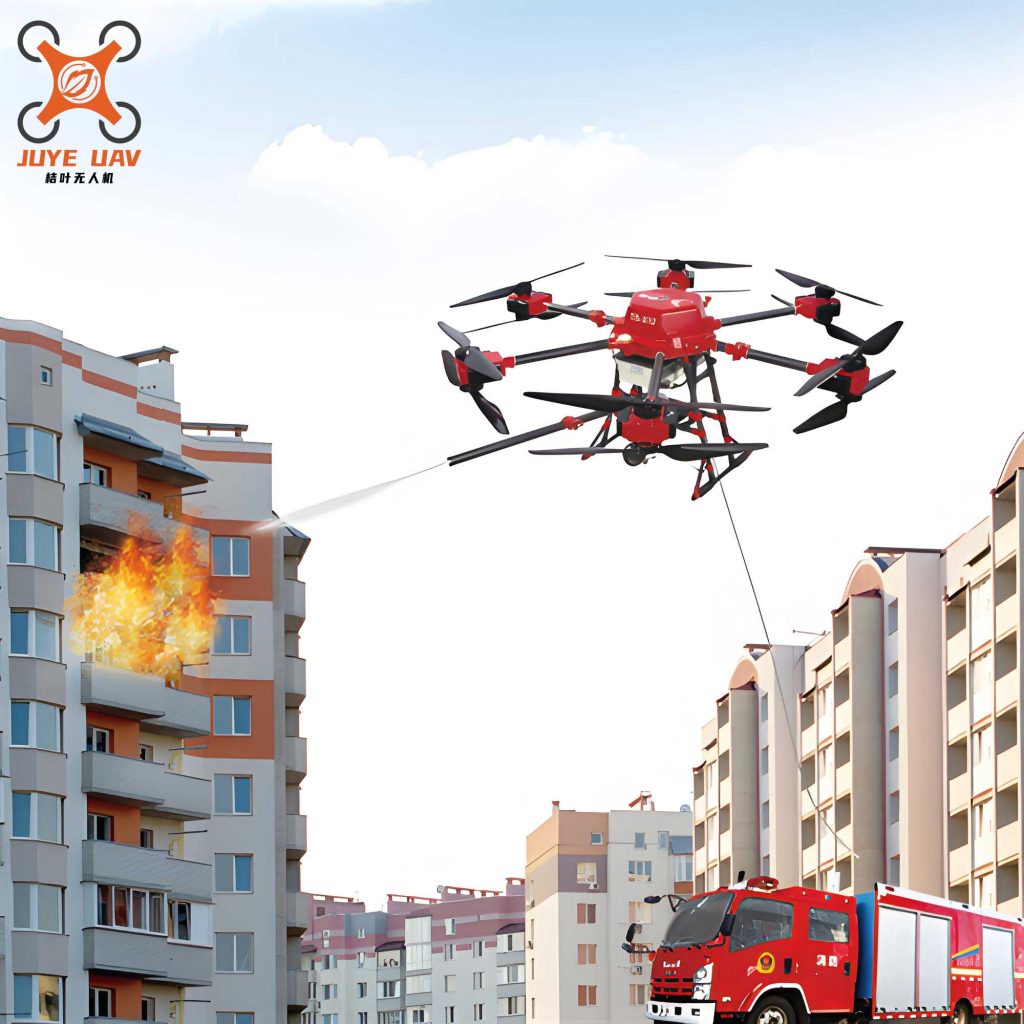
Having established the technical foundation, I will now elaborate on the concrete applications where the fire UAV proves invaluable. These applications are not hypothetical; they are derived from compiled case studies and after-action reports I have reviewed.
Application 1: Fire UAV for Disaster Scene Reconnaissance
The primary and most immediate application of a fire UAV is in灾情侦查 (disaster scene reconnaissance). Upon arrival, the fire UAV can be deployed within minutes, often ahead of ground teams entering hazardous zones. I have seen how a fire UAV equipped with a thermal camera can penetrate thick smoke to identify the seat of a fire, a task impossible for human vision. The thermal data helps in modeling fire spread using simplified heat transfer equations. For instance, the radiant heat flux \( q” \) received by the fire UAV sensor from a flame can be related to temperature:
$$ q” = \epsilon \sigma T^4 $$
where \( \epsilon \) is emissivity, \( \sigma \) is the Stefan-Boltzmann constant, and \( T \) is the absolute temperature of the target. This data, streamed live to the command post, allows for dynamic risk assessment and helps in predicting flashover or structural collapse zones.
Application 2: Fire UAV for Comprehensive Information Gathering
Beyond initial recon, the fire UAV serves as a persistent intelligence, surveillance, and reconnaissance (ISR) platform. It can be tasked to collect a wide array of data: high-resolution imagery for damage assessment, gas concentration readings for detecting toxic leaks (e.g., CO, HCN), and wind speed/direction data crucial for wildfire behavior prediction. For example, monitoring plume dispersion often involves models that the fire UAV data can feed into, such as the Gaussian plume model for gas concentration \( C \):
$$ C(x,y,z) = \frac{Q}{2\pi u \sigma_y \sigma_z} \exp\left(-\frac{y^2}{2\sigma_y^2}\right) \left[ \exp\left(-\frac{(z-H)^2}{2\sigma_z^2}\right) + \exp\left(-\frac{(z+H)^2}{2\sigma_z^2}\right) \right] $$
where \( Q \) is emission rate, \( u \) is wind speed, \( \sigma_y, \sigma_z \) are dispersion parameters, and \( H \) is effective release height. The mobility of the fire UAV allows for measuring parameters like \( u \) at multiple points, refining the model in real-time.
Application 3: Fire UAV in Command, Control, and Coordination
The real-time data from the fire UAV fundamentally transforms指挥调度 (command and control). Acting as an aerial command node, the fire UAV provides a common operational picture to all responding units. I have participated in exercises where the live feed from a fire UAV was integrated into GIS-based command software, enabling precise resource deployment. The fire UAV can also act as a communications relay in areas where terrestrial networks are damaged, extending the operational range of ground team radios. The benefit here is quantifiable in terms of reduced decision latency and improved resource allocation efficiency.
Application 4: Fire UAV in Direct辅助救援 (Auxiliary Rescue)
Perhaps the most evolving role of the fire UAV is in direct auxiliary support. Modern fire UAVs can be equipped to carry out active interventions. For instance, they can deliver emergency supplies like life vests, respirators, or communication devices to trapped victims before rescue teams can reach them. Some specialized fire UAVs are designed for direct fire suppression, carrying and discharging extinguishing agents like dry chemical or compressed aerosol fire suppressants. The amount of agent \( m_{agent} \) required can be estimated based on fire size and agent effectiveness:
$$ m_{agent} = A_{fire} \times \rho_{application} $$
where \( A_{fire} \) is the estimated fire area and \( \rho_{application} \) is the recommended application density of the agent (\( kg/m^2 \)). While still an emerging capability, the potential for a fire UAV to knock down incipient fires in hard-to-reach electrical equipment or create safe egress paths is immense.
Furthermore, a fire UAV equipped with a powerful loudspeaker and spotlight can guide disoriented civilians to safety, a function I find particularly valuable in large-scale evacuations during nighttime incidents.
Integration Challenges and Future Trajectory
In my assessment, the integration of fire UAV systems into standard operating procedures is not without challenges. Regulatory airspace restrictions, pilot training requirements, data management, and interoperability with existing systems are key hurdles. However, the trend is decisively positive. The future fire UAV will likely feature greater autonomy, swarming capabilities for coordinated coverage, and advanced AI for real-time hazard recognition (e.g., automatic detection of structural cracks or victim heat signatures).
The return on investment (ROI) for deploying a fire UAV fleet can be modeled over time, considering both tangible savings (e.g., reduced property damage due to faster containment) and intangible benefits (e.g., lives saved, firefighter safety). A simplified ROI formula might be:
$$ ROI = \frac{\sum (Benefits) – \sum (Costs)}{\sum (Costs)} \times 100\% $$
where Benefits include estimated value of damage prevention and operational efficiencies gained.
To encapsulate the operational parameters and mission profiles, I present a summary table that ties together the capabilities of a modern fire UAV system:
| Mission Phase | Fire UAV Core Task | Typical Payload | Key Performance Metric | Formula/Model Relevance |
|---|---|---|---|---|
| Pre-incident & Preparedness | Risk area mapping, training simulations. | RGB camera, LiDAR. | Map accuracy and resolution. | Photogrammetry models, \( R = \frac{H \times s}{f} \). |
| Initial Response | Rapid situation assessment. | Thermal camera, gas sensor. | Deployment time, sensor accuracy. | Heat flux calculation \( q” = \epsilon \sigma T^4 \). |
| Active Operations | Persistent monitoring, communication relay. | HD video, data link repeater. | Endurance \( T_{flight} \), link reliability \( R_{max} \). | \( T_{flight} = \frac{E_{battery} \times \eta}{P_{avg}} \), Communication range equation. |
| Tactical Intervention | Payload delivery, suppression support. | Loudspeaker, release mechanism, extinguisher. | Payload capacity, delivery precision. | Thrust-to-weight ratio, \( m_{agent} = A_{fire} \times \rho_{application} \). |
| Post-incident | Damage assessment, investigation. | High-res camera, multispectral sensor. | Data comprehensiveness. | GIS integration, 3D reconstruction algorithms. |
In conclusion, my investigation and hands-on engagement with this technology lead me to firmly believe that the fire UAV is not merely an auxiliary tool but a cornerstone of next-generation firefighting. The synergy of its technical attributes—precision, economy, safety, and adaptability—with its broad application spectrum in reconnaissance, data collection, command support, and direct rescue, creates a force multiplier effect. The continual evolution of the fire UAV, driven by advancements in battery technology, artificial intelligence, and materials science, promises even greater capabilities. As fire services worldwide strive to enhance their effectiveness and protect both civilians and responders, the strategic adoption and sophisticated employment of the fire UAV will undoubtedly be a defining factor. Therefore, I advocate for continued research, investment, and training to fully harness the potential of the fire UAV, ensuring it remains a reliable ally in our relentless pursuit of safer communities.