
In recent years, the formation drone light show has emerged as a captivating spectacle, widely used in entertainment, advertising, and public events. These shows involve multiple unmanned aerial vehicles (UAVs) flying in precise formations to create dynamic light patterns in the sky. However, ensuring the reliability and safety of a formation drone light show poses significant challenges, including communication topological faults, actuator failures, control surface damages, and environmental uncertainties. In this article, I propose a comprehensive fault-tolerant control method to address these issues, enabling robust and seamless performances in formation drone light shows.
The formation drone light show relies on coordinated movements of UAVs, where each drone must maintain specific positions relative to others. To model this, I consider a leader-follower formation, where one drone acts as the leader, and others follow to achieve desired patterns. Let the position of the leader drone be denoted as $(x_L, y_L, z_L)$ and its velocity, flight path angle, and heading angle as $v_L$, $\gamma_L$, and $\chi_L$, respectively. For a follower drone $i$, its position is $(x_i, y_i, z_i)$ with corresponding states $v_i$, $\gamma_i$, and $\chi_i$. The formation errors in longitudinal, lateral, and vertical directions are defined as:
$$\tilde{f}_i = f_{iL} – f^d_{iL} = \tilde{x}_i \cos \chi_L + \tilde{y}_i \sin \chi_L + s \cos \tilde{\chi}_i – f^d_i$$
$$\tilde{l}_i = l_{iL} – l^d_{iL} = \tilde{x}_i \sin \chi_L – \tilde{y}_i \cos \chi_L – s \sin \tilde{\chi}_i – l^d_i$$
$$\tilde{z}_i = z_{iL} – z^d_i$$
Here, $\tilde{x}_i = x_i – x_L$, $\tilde{y}_i = y_i – y_L$, $\tilde{\chi}_i = \chi_i – \chi_L$, $s$ is the distance from the engine nozzle to the drone’s center of mass, and $f^d_i$, $l^d_i$, $z^d_i$ are desired distances for the formation drone light show. Differentiating these errors yields the formation error dynamics, which are crucial for control design in a formation drone light show.
For the drone dynamics, I consider nonlinear models accounting for faults. The velocity dynamics are given by $\dot{v} = f(v) + G(v) \delta_p$, where $\delta_p$ is the throttle input. The attitude dynamics involve flight path angles $\Omega = [\chi, \gamma, \beta]^T$ and angular rates $\omega = [p, q, r]^T$, with $\dot{\Omega} = f_s(\Omega) + G_s(\Omega) \omega$ and $\dot{\omega} = f_f(\omega) + G_f(\omega) u + d$, where $u = [\delta_a, \delta_e, \delta_r]^T$ represents aileron, elevator, and rudder deflections, and $d$ denotes uncertainties like wind gusts. In a formation drone light show, faults can occur in control surfaces or actuators. Control surface faults are modeled as $\delta^R_i = r_i \delta_i$, with $r_i \in (0,1]$ indicating the fault extent. Actuator faults include stuck and damage faults: $\delta_i = \sigma_i k_i \delta_{ci} + (1 – \sigma_i) \bar{\delta}_i$, where $\sigma_i \in \{0,1\}$ for stuck faults and $k_i \in (0,1]$ for damage faults. The combined fault model for a drone in a formation drone light show is:
$$\dot{v} = f(v) + G(v) \delta_p$$
$$\dot{\Omega} = f_s(\Omega) + G_s(\Omega) \omega$$
$$\dot{\omega} = f_f(\omega) + G_f(\omega) R \Sigma K u_c + G_f(\omega) R (I – \Sigma) \bar{u} + d$$
where $R = \text{diag}[r_a, r_e, r_r, r_p]$, $\Sigma = \text{diag}[\sigma_a, \sigma_e, \sigma_r, \sigma_p]$, $K = \text{diag}[k_a, k_e, k_r, k_p]$, and $u_c$ is the control input command. This model underpins the fault-tolerant control design for formation drone light shows.
To handle topological faults in a formation drone light show, I propose a fault detection and reconstruction optimization algorithm. Topological faults can include broadcast transmitter faults, broadcast receiver faults, unicast faults, and drone losses. The detection method assumes that each drone can detect its own communication faults and that broadcast receivers are fault-free. When a drone detects a severe fault, it leaves the formation. The reconstruction algorithm aims to minimize communication and formation reconfiguration costs. Let the formation topology be represented as a weighted directed graph $D = (V, A, W, P)$, where $V$ is the set of drones, $A$ is communication links, $W$ is communication costs (e.g., distance), and $P$ is position assignments. The algorithm involves constructing a cost matrix for position reassignment and finding a minimum spanning tree for communication. The steps are summarized in Table 1.
| Step | Description |
|---|---|
| 1 | Compute cost matrix $C = [c_{ij}]$ for drone $i$ to position $j$. |
| 2 | Reduce $C$ to $C’$ by subtracting row and column minima. |
| 3 | Circle zero elements to find optimal assignment; repeat if needed. |
| 4 | Adjust $C’$ and iterate until $m$ zeros are circled. |
| 5 | Set $x_{ij}=1$ for circled zeros to get optimal position assignment. |
| 6 | Add a virtual node $v_0$ to form graph $D_0$. |
| 7 | Build link set with minimum communication costs from $v_0$. |
| 8 | Check for cycles; if found, contract nodes and repeat. |
| 9 | Expand contracted nodes to obtain minimum spanning tree $T_0$. |
| 10 | Output optimal communication topology for the formation drone light show. |
For control design, I use a backstepping fault-tolerant approach. The outer loop generates formation commands for velocity, heading, and flight path angle. For drone $i$, the desired commands are:
$$\begin{bmatrix} v^d_i \\ \dot{\chi}^d_i \\ \sin \gamma^d_i \end{bmatrix} = \begin{bmatrix} \cos \gamma_i \cos \tilde{\chi}_i & -s \sin \tilde{\chi}_i & 0 \\ -\cos \gamma_i \sin \tilde{\chi}_i & -s \cos \tilde{\chi}_i & 0 \\ 0 & 0 & v_i \end{bmatrix}^{-1} \cdot \begin{bmatrix} -k_1 \tilde{f}_i + v_L \cos \gamma_L + l_i \dot{\chi}_L \\ -k_2 \tilde{l}_i – f_i \dot{\chi}_L \\ -k_3 \tilde{z}_i + v_L \sin \gamma_L \end{bmatrix}$$
where $k_1, k_2, k_3 > 0$ are gains. This ensures input-to-state stability for the formation drone light show. The inner loop employs fault identification and compensation. For actuator faults, adaptive observers are designed. For stuck faults:
$$\dot{\delta}^s_i = -a_i \hat{\sigma}_i (\delta_i – \delta_{ci}) – n^s_i (\delta^s_i – \delta_i)$$
$$\hat{\sigma}_i = \text{sgn}[a_i \tilde{\delta}^s_i (\delta_i – \delta_{ci})]$$
where $\tilde{\delta}^s_i = \delta^s_i – \delta_i$. For damage faults:
$$\dot{\delta}^l_i = -a_i (\delta_i – \hat{k}_i \delta_{ci}) – n^l_i (\delta^l_i – \delta_i)$$
$$\hat{k}_i = \text{Proj}_{\hat{k}_i}[\Gamma_i (-a_i \tilde{\delta}^l_i \delta_{ci})]$$
with $\tilde{\delta}^l_i = \delta^l_i – \delta_i$ and $\Gamma_i > 0$. An auxiliary system estimates control surface faults and uncertainties:
$$\dot{\hat{\omega}} = L \tilde{\omega} + f_f(\omega) + G_f(\omega) U \hat{r} + \hat{d}$$
where $\tilde{\omega} = \hat{\omega} – \omega$, $L$ is a positive definite matrix, $\hat{r}$ is estimated via $\dot{\hat{r}} = \text{Proj}_{\hat{r}}\{\Gamma [-U^T G_f^T(\omega) P \tilde{\omega}]\}$, and $\hat{d}$ is from a high-order disturbance observer. The control law is derived using backstepping. Define tracking errors $\Omega_e = \Omega – \Omega_c$ and $\omega_e = \hat{\omega} – \omega_d$, where $\Omega_c$ and $\omega_d$ are desired values. The control input is:
$$u_c = -[G_f(\omega) \hat{R} \hat{K} \hat{\Sigma}]^{-1} [K_\epsilon \omega_e + L \tilde{\omega} + f_f(\omega) + G_f(\omega) \hat{R} (I – \hat{\Sigma}) u + \hat{d} – \dot{\omega}_c]$$
with $K_\epsilon > 0$. This ensures asymptotic stability for the formation drone light show despite faults.
To validate the method, I simulate a formation drone light show with six drones. The initial formation is hexagonal, with drones assigned to positions $\{a,b,c,d,e,f\}$. The simulation runs for 60 seconds, with faults injected: at $t=10$ s, drone 3 is lost; at $t=20$ s, drone 2 has a 60% aileron surface fault; at $t=30$ s, drone 2 has a unicast transmitter fault; at $t=40$ s, drone 4 has a 70% rudder actuator damage fault; at $t=50$ s, drone 6 has an elevator actuator stuck fault. The controller parameters are listed in Table 2.
| Parameter | Value |
|---|---|
| $L$ | $[3, 8, 6]$ |
| $\Gamma$ | $[3, 2, 7]$ |
| $n^s_i$ | 6 |
| $K_\Omega$ | $[7, 9, 4]$ |
| $L_0(\tilde{\omega})$ | $[12, 18, 25]$ |
| $Q$ | $[2, 7, 3]$ |
| $a_i$ | 30 |
| $n^l_i$ | 5 |
| $K_\omega$ | $[6, 3, 7]$ |
| $k_1, k_2, k_3$ | 4 |
The topological fault reconstruction algorithm is compared with an existing method. Results show that for the formation drone light show, my algorithm achieves lower communication and reconfiguration costs, as summarized in Table 3.
| Time (s) | Proposed Algorithm Cost | Existing Algorithm Cost |
|---|---|---|
| 0–10 | 2,915 | 3,498 |
| t=10 | 583 | 1,290 |
| 10–30 | 2,332 | 3,498 |
| 30–60 | 2,906 | 3,498 |
The fault-tolerant control performance is evaluated through response curves for velocity, heading, flight path angle, and sideslip angle. Under the proposed control, the formation drone light show maintains stable tracking within 4 seconds, despite faults and uncertainties. In contrast, a general control law without fault compensation causes oscillations and instability. The fault identification modules accurately estimate faults: for drone 2, the aileron fault parameter converges to 0.6; for drone 4, the rudder damage fault converges to 0.7; and for drone 6, the stuck fault is detected with $\hat{\sigma}=0$. These results highlight the robustness of the method for formation drone light shows.
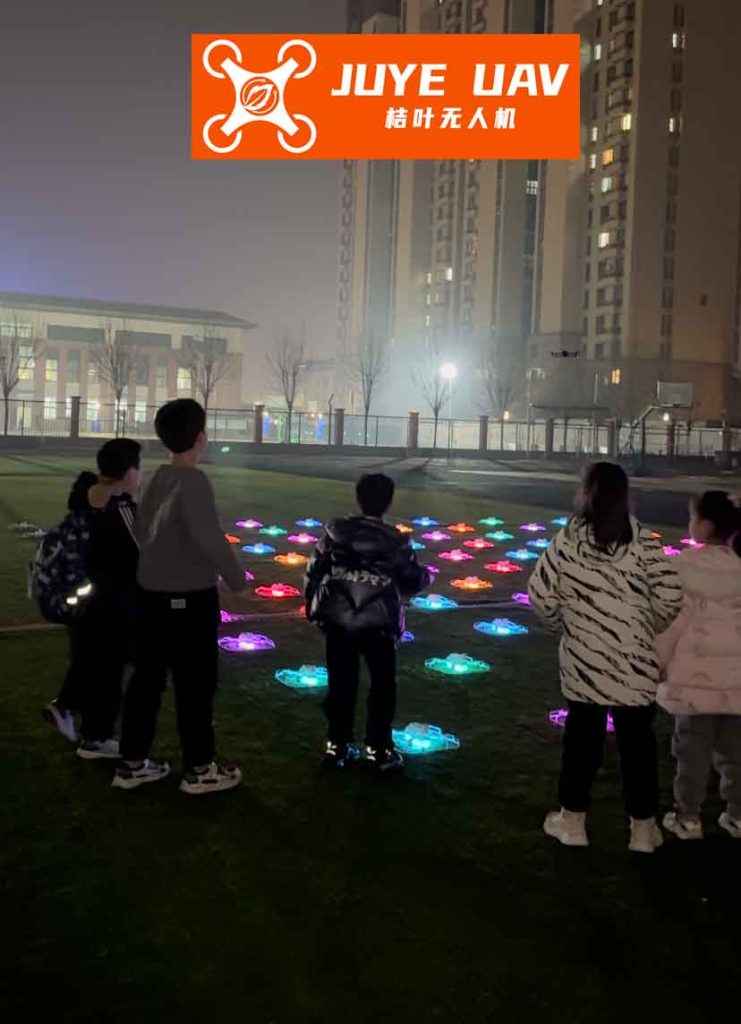
In conclusion, the proposed fault-tolerant control method effectively handles topological faults, actuator faults, control surface faults, and uncertainties in formation drone light shows. The topological fault reconstruction algorithm minimizes costs, while the backstepping control with adaptive observers ensures reliable performance. This approach enhances the safety and spectacle of formation drone light shows, making them more resilient to real-world disruptions. Future work may extend to larger swarms or integration with real-time path planning for dynamic formations in formation drone light shows.