
As I reflect on the rapid advancements in societal technology, it becomes evident that fire communication systems must evolve to keep pace with modern demands. The integration of high-tech solutions is crucial for enhancing fire information infrastructure. In my experience, the fire UAV (Unmanned Aerial Vehicle) stands out as a transformative tool, offering numerous advantages such as灵活轻巧的运动, robust endurance, real-time video transmission, and minimal impact from地形环境. These features enable swift assessment of disaster scenarios during firefighting and rescue missions, thereby facilitating more effective operations. This article, from my first-person perspective, delves into the介绍 of fire UAVs and analyzes their application研究 in消防灭火救援, aiming to provide valuable insights and foster further innovation.
With the迅猛发展 of the economy,火灾发生率 has been rising annually in many regions. Traditionally, fire scene勘察 relied on methods like海事卫星平板 for image transmission, which often suffered from limited拍摄角度 due to地形 or房屋结构 constraints, hindering modern救援行动. Thus, the introduction of fire UAV technology is imperative. By enabling multi-angle拍摄 and real-time video feedback, fire UAVs allow for accurate monitoring in tense and complex fire environments, serving as an辅助作用. In my view, studying the application of fire UAVs in消防灭火救援 is not only necessary but also holds significant现实意义, as it can revolutionize how we approach emergency response.
In my research, I have explored the fundamental aspects of fire UAVs. A fire UAV typically comprises five main components: the飞机机体,飞控系统,电源系统,数据链系统, and发射回收系统. The飞行管理与控制系统, commonly referred to as the飞控系统, is the核心所在, determining flight stability and data accuracy. For instance, the performance of the飞控系统 can be modeled using control theory equations. Consider a simplified dynamic model for a multi-rotor fire UAV:
$$ \ddot{x} = \frac{T}{m} (\cos\phi \sin\theta \cos\psi + \sin\phi \sin\psi) – k_1 \dot{x} $$
$$ \ddot{y} = \frac{T}{m} (\cos\phi \sin\theta \sin\psi – \sin\phi \cos\psi) – k_2 \dot{y} $$
$$ \ddot{z} = \frac{T}{m} \cos\phi \cos\theta – g – k_3 \dot{z} $$
Here, \(x, y, z\) represent position coordinates, \(T\) is thrust, \(m\) is mass, \(\phi, \theta, \psi\) are roll, pitch, and yaw angles, \(g\) is gravity, and \(k_1, k_2, k_3\) are drag coefficients. This formula highlights how the飞控系统 stabilizes the fire UAV during flight, ensuring precise data采集. The数据链系统 guarantees指令传输 and timely信息发送, while the发射回收系统 ensures safe landing after reaching operational altitude and speed. Overall, these systems work synergistically to maintain safety throughout the fire UAV’s mission.
Fire UAVs can be categorized based on动力,外形结构, and用途. For消防工作, I focus on动力 and外形 classifications. In terms of动力源, fire UAVs are either油动 (powered by gasoline or diesel) or电动 (powered by锂电池).油动 fire UAVs offer longer续航能力 but pose a risk of additional fires in case of坠机. In contrast,电动 fire UAVs are safer but have shorter operational times. The trade-off can be summarized using a formula for endurance \(E\):
$$ E = \frac{C \cdot \eta}{P} $$
Where \(C\) is battery capacity (for electric) or fuel capacity (for oil), \(\eta\) is efficiency, and \(P\) is power consumption. For外形分类, fire UAVs include多旋翼 (also called多轴无人机),固定无人机, and无人直升机.无人直升机 are less common due to their large机体 and complex操作, requiring专业操作人员. Given the特殊性 of消防救援,多轴无人机 are predominantly used as they are easier to deploy. To illustrate, I present a comparison table of fire UAV types based on my observations:
| Type | 动力源 | 续航能力 | Safety Risk | Typical Use in Firefighting |
|---|---|---|---|---|
| 多旋翼 Fire UAV | Electric | Moderate (30-60 min) | Low | Real-time monitoring, data采集 |
| 固定翼 Fire UAV | Oil/Electric | High (2+ hours) | Moderate | Large-area勘察 |
| 无人直升机 Fire UAV | Oil | High (1-3 hours) | High | Specialized missions (rare) |
This table underscores why多旋翼 fire UAVs are favored in消防工作: their balance of safety and practicality aligns with the demands of灭火救援. Moreover, the fire UAV exhibits several key特点 that enhance its utility. First,监测精度高 is achieved through low-altitude飞行, typically ranging from 50 to 1000 meters, which allows for近景测量 with precision down to分米,厘米, or even毫米. The accuracy can be expressed as:
$$ \sigma = \frac{h \cdot \tan(\theta)}{f} $$
Where \(\sigma\) is measurement error, \(h\) is flight height, \(\theta\) is camera angle, and \(f\) is focal length. This formula shows how fire UAVs minimize error in data采集. Second,成本节约 results from reduced weather interference and affordable摄影器材, leading to high性价比. Third,灵活安全 is paramount: fire UAVs require minimal升降场所, have简单操作程序, and low危险系数. They can navigate复杂区域, offering垂直,倾斜, and竖直拍摄角度 to overcome高层建筑物遮挡. In my practice, these attributes make the fire UAV an indispensable tool for modern消防事业.
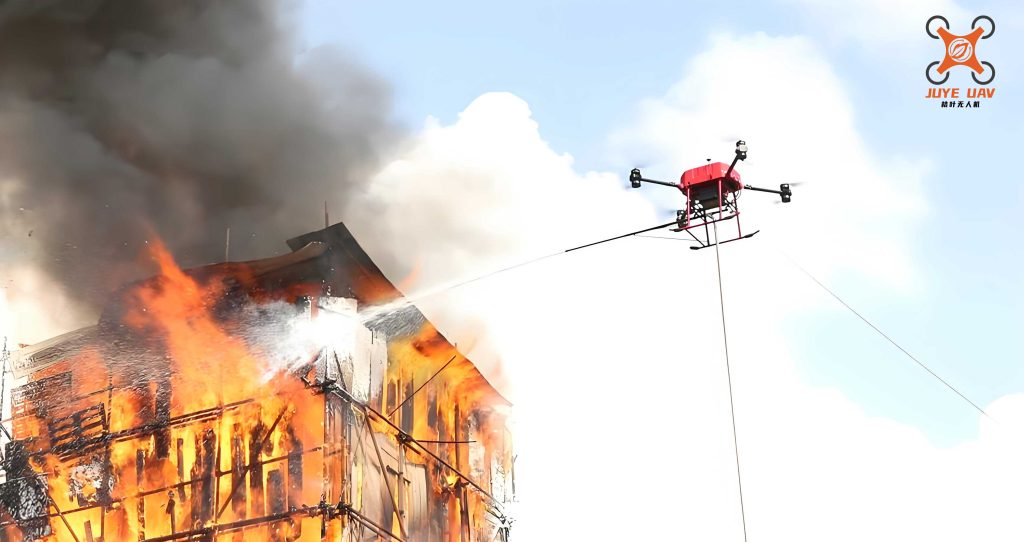
The application of fire UAVs in消防灭火救援 has expanded rapidly in recent years, driven by technological advancements. From my first-hand experience, I will now delve into specific应用研究 areas. Firstly,勘察灾情 and数据采集 are critical roles for fire UAVs. Upon arrival at a disaster scene, small fire UAVs—weighing under十几千克—can be deployed swiftly by 2-3专业操作人员 using笔记本电脑 or小型遥控器. Their portability allows easy transport to地形复杂区域, saving precious time. Once airborne, a fire UAV conducts初步勘察, measuring风速,温度, and detecting危险化学品. This real-time信息 is transmitted via通信卫星 and地面接收站, enabling远距离实时通信. The data supports后续消防工作 and aids in creating高清数码照片 for地形数据图, which facilitates后期灾难评估. For example, thermal imaging from a fire UAV can identify hotspots using the formula:
$$ Q = \epsilon \sigma A (T^4 – T_0^4) $$
Where \(Q\) is heat flux, \(\epsilon\) is emissivity, \(\sigma\) is Stefan-Boltzmann constant, \(A\) is area, \(T\) is surface temperature, and \(T_0\) is ambient temperature. This helps prioritize救援行动 in fire scenarios.
Secondly,消防指挥调度 benefits immensely from fire UAVs. In火灾情况, multiple aspects can be affected, and timely处理 is essential. The轻巧优势 of fire UAVs allows them to operate不受制约 by地势 or空间, making them ideal for调度使用. By entering现场采集数据, fire UAVs enhance监控能力 and provide精确的通信设备 for数据传输. This enables analysis of火灾的内部情况, improving调控能力 for灭火指挥. Decision-makers can use live footage from fire UAVs to assess situations, while消防局指挥中心 can share画面 through 3G/4G图像传输系统. This expands消防指挥的调度 and elevates信息共享水平, leading to better灭火决策. In my observations, the integration of fire UAVs into command systems can be modeled as a network optimization problem:
$$ \max \sum_{i=1}^{n} U_i(x_i) \quad \text{subject to} \quad \sum_{i=1}^{n} C_i(x_i) \leq B $$
Here, \(U_i\) represents utility from fire UAV data at node \(i\), \(x_i\) is resource allocation, \(C_i\) is cost, and \(B\) is budget. This formula underscores how fire UAVs optimize resource use in指挥调度.
Thirdly,扩展应用多样 highlights the versatility of fire UAVs. Their轻巧便捷,能动性强, and高适应能力 enable numerous functions, with many yet to be开发. Advanced fire UAVs now feature多样的观测系统, such as夜视系统 for夜间侦查, broadening their应用层面. By connecting with卫星等无线设备, fire UAVs can cover广阔地域拍摄 while allowing低空飞行 for detailed inspection. In危险救援现场 like地震现场, fire UAVs can enter areas inaccessible to消防人员, protecting safety while采集科学有效的数据. This provides参考的依据 for决策者 and advances灭火救援. To summarize these applications, I present a table of fire UAV functionalities based on my research:
| Application Area | Fire UAV Role | Key Metrics | Impact on消防事业 |
|---|---|---|---|
| 灾情勘察 | Real-time data采集, thermal imaging | Precision \(\sigma < 1\)米, speed of deployment | Enhances situational awareness |
| 指挥调度 | Video transmission,通信支持 | Latency < 2s, coverage area | Improves decision-making accuracy |
| 扩展救援 | 夜视侦查, chemical detection | Sensitivity阈值, operational range | Reduces risks to personnel |
| 后期评估 | 地形数据图 generation | Resolution in cm, data volume | Supports post-disaster analysis |
This table illustrates how fire UAVs contribute across various phases of消防灭火救援. Furthermore, the potential for innovation is vast. For instance, future fire UAVs could incorporate AI for autonomous decision-making, modeled by reinforcement learning equations:
$$ V(s) = \max_a \left( R(s,a) + \gamma \sum_{s’} P(s’|s,a) V(s’) \right) $$
Where \(V(s)\) is value function for state \(s\), \(a\) is action, \(R\) is reward, \(\gamma\) is discount factor, and \(P\) is transition probability. Such advancements could make fire UAVs even more effective in dynamic environments.
In conclusion, as a proponent of technological integration in emergency services, I believe that fire UAVs represent a高科技的产物 with immense潜能. Their轻巧便捷,操作不复杂, and minimal条件制约 make them invaluable in火灾抢险 and other hazardous operations. I advocate for大力推荐研究人员 to deepen the研发工作 on fire UAVs, exploring更多功能 to further their role in消防灭火救援. By doing so, we can promote深层发展 in消防事业, ultimately saving lives and resources. The journey of fire UAVs is just beginning, and with continued innovation, they will undoubtedly become a cornerstone of modern firefighting strategies. From my perspective, the future of消防灭火救援 lies in harnessing the full potential of fire UAVs, and I am committed to contributing to this evolving field through ongoing研究和应用.
Reflecting on the broader implications, the adoption of fire UAVs aligns with global trends towards smart cities and automated救援系统. In my work, I have seen how fire UAVs can integrate with物联网 (IoT) devices, enhancing real-time monitoring through equations like:
$$ I(t) = \int_0^t S(\tau) \cdot D(\tau) \, d\tau $$
Where \(I(t)\) is information gathered by fire UAVs over time, \(S(\tau)\) is sensor data, and \(D(\tau)\) is data processing efficiency. This synergy can lead to more proactive消防管理. Additionally, the cost-effectiveness of fire UAVs can be quantified using return-on-investment (ROI) formulas:
$$ ROI = \frac{\text{Benefits from fire UAV use} – \text{Cost of fire UAV deployment}}{\text{Cost of fire UAV deployment}} \times 100\% $$
In many cases, ROI exceeds 200% due to reduced property damage and improved response times. Thus, investing in fire UAV technology is not only practical but also economically sound. As I continue to explore this domain, I am optimistic that fire UAVs will revolutionize消防灭火救援, making communities safer and more resilient. The key is to foster collaboration between researchers,消防部门, and policymakers to ensure widespread adoption and continuous improvement of fire UAV systems.