
In recent years, quadrotor drones have gained significant attention in various fields, particularly in power line inspection, due to their maneuverability and stability. However, a major limitation of quadrotor drones is their limited flight endurance, which is heavily influenced by the efficiency of the power system. This study focuses on experimentally investigating the dynamic efficiency of quadrotor drones, specifically examining motor thrust efficiency and motor operating temperature. By conducting a series of tests under different conditions, such as varying KV values, propeller diameters, and input voltages, I aim to optimize the power system for improved performance and longer flight times for quadrotor drones. The findings provide practical insights for selecting motor parameters based on payload mass, enhancing the design and application of quadrotor drones.
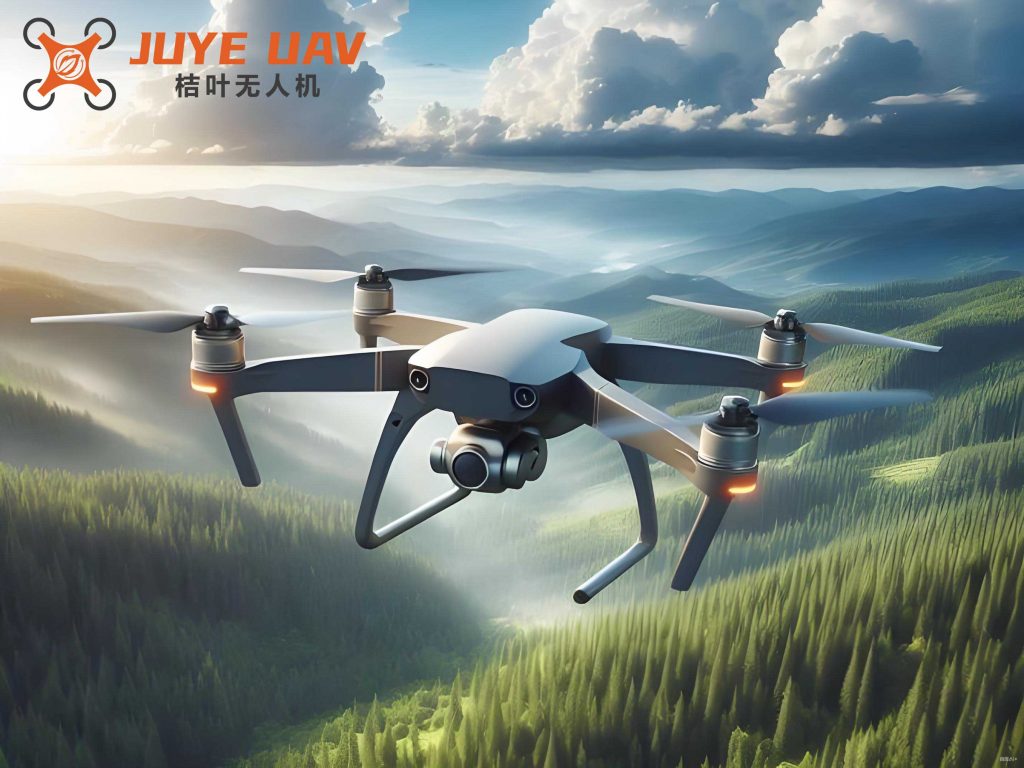
The core of a quadrotor drone’s power system typically involves brushless outer-rotor motors, which offer high torque. The motor KV value, defined as the increase in revolutions per minute per volt under no-load conditions, plays a crucial role in determining the propeller size and overall efficiency. Higher KV values generally allow for higher speeds but require smaller propellers. In this study, I systematically evaluate how these parameters affect the thrust efficiency and thermal behavior of quadrotor drones, which is essential for extending their operational capabilities in demanding tasks like aerial surveillance or infrastructure monitoring.
Experimental Platform and Measurement Principles
To accurately measure the dynamic efficiency of quadrotor drone motors, I designed and built a lever-based thrust test stand. This platform allows for precise measurement of thrust, voltage, current, and throttle input, enabling the calculation of power consumption and efficiency. The setup consists of a power module, electronic speed controller (ESC), motor, propeller, lever arm, counterweight, and digital scale. The working principle is based on torque balance, where the thrust generated by the propeller is counteracted by a known force measured on the scale.
The power consumption is calculated using the formula:
$$ P = U \times I $$
where \( P \) is the electrical power in watts (W), \( U \) is the voltage in volts (V), and \( I \) is the current in amperes (A). The thrust force \( F_{\text{thrust}} \) is derived from the torque equilibrium on the lever arm. Given that the distances from the pivot to the motor and counterweight are equal, the thrust equals the force measured by the scale after zeroing the initial weight difference. Thus:
$$ F_{\text{thrust}} = M_{\text{read}} \times g $$
where \( M_{\text{read}} \) is the scale reading in grams (g) and \( g \) is the acceleration due to gravity (approximately \( 9.8 \, \text{m/s}^2 \)). The thrust efficiency \( \eta \) is then defined as the thrust per unit power:
$$ \eta = \frac{M_{\text{read}}}{P} $$
with units of grams per watt (g/W). This metric is critical for assessing how effectively a quadrotor drone converts electrical energy into lift. Table 1 summarizes the key components and parameters of the experimental platform used in testing quadrotor drone motors.
| Component | Description | Purpose |
|---|---|---|
| Power Module | Adjustable DC power supply | Provides voltage and current measurement |
| Electronic Speed Controller (ESC) | Brushless motor controller | Converts throttle signal to motor power |
| Motor | Outer-rotor brushless motor | Generates thrust via propeller rotation |
| Propeller | Fixed-pitch, two-blade propellers | Produces aerodynamic lift |
| Lever Arm | Balanced beam with pivot | Amplifies thrust for measurement |
| Digital Scale | High-precision electronic scale | Measures counterforce in grams |
| Infrared Thermometer | Non-contact temperature sensor | Records motor surface temperature |
The testing procedure involved mounting a motor and propeller combination on the stand, setting the input voltage, and calibrating the scale. Throttle input was varied from 20% to 100% in 5% increments, with data collected after a 10-second stabilization period at each point. This approach ensured consistent and repeatable measurements for various quadrotor drone configurations.
Thrust Efficiency Testing and Results
I conducted extensive thrust efficiency tests on several motor and propeller combinations commonly used in quadrotor drones. The primary variables included motor KV value, propeller diameter, and input voltage. For instance, I tested the T-Motor U8 motor with KV values of 100 and 135, paired with propellers ranging from 22 inches to 29 inches in diameter, at voltages of 22.2 V, 29.6 V, and 44.4 V. The goal was to identify optimal pairings that maximize efficiency for different thrust requirements in quadrotor drones.
The results revealed several key trends. First, for a given motor and voltage, increasing the propeller diameter generally reduced the current required to produce the same thrust, thereby improving efficiency. This is because larger propellers can generate more lift at lower rotational speeds, reducing the electrical load. However, beyond a certain diameter, efficiency may drop due to increased drag or motor overload. For example, with the T-Motor U8 KV100 motor at 22.2 V, the 29-inch propeller showed higher efficiency at thrusts below 2000 g but declined sharply above that point. Table 2 provides a comparative overview of efficiency values for different propeller diameters at a fixed voltage.
| Thrust Range (g) | 22-inch Propeller | 26-inch Propeller | 28-inch Propeller | 29-inch Propeller |
|---|---|---|---|---|
| 500-1000 | 12.5 | 14.2 | 15.8 | 16.5 |
| 1000-1500 | 10.8 | 12.7 | 14.1 | 14.9 |
| 1500-2000 | 9.2 | 11.0 | 12.5 | 13.0 |
| 2000-2500 | 7.8 | 9.5 | 10.8 | 11.2 |
Second, higher input voltages led to lower currents and higher efficiencies for the same thrust output. This is consistent with the power equation \( P = U \times I \), where increasing voltage reduces current for a given power, minimizing resistive losses. In tests with the T-Motor U8 KV135 motor, operating at 44.4 V yielded efficiencies up to 20% higher than at 29.6 V for thrusts around 3000 g. This highlights the importance of selecting appropriate battery voltages for quadrotor drones to optimize energy use.
Third, motor KV value significantly impacted performance. Lower KV motors paired with larger propellers tend to be more efficient at higher thrusts, making them suitable for heavy-lift quadrotor drones. Conversely, higher KV motors with smaller propellers excel in high-speed applications but may suffer from reduced efficiency under heavy loads. The relationship can be expressed using an empirical efficiency model:
$$ \eta = k \cdot \frac{D}{KV \cdot I} $$
where \( \eta \) is efficiency, \( D \) is propeller diameter, \( KV \) is the motor constant, \( I \) is current, and \( k \) is a proportionality factor dependent on motor design. This formula underscores the trade-offs in quadrotor drone power system design.
To further illustrate, I compiled data from multiple tests into a comprehensive table showing optimal efficiency ranges. For quadrotor drones, achieving peak efficiency often requires matching the motor-propeller combination to the expected thrust range. For instance, for a quadrotor drone with a total thrust requirement of 8 kg (2 kg per motor), a motor with KV around 100 and a 28-inch propeller might be ideal. Table 3 summarizes recommended parameters for different payload masses in quadrotor drones.
| Payload Mass (kg) | Total Thrust Required (kg) | Optimal Motor KV | Optimal Propeller Diameter (inches) | Expected Efficiency Range (g/W) |
|---|---|---|---|---|
| 0-2 | 4-6 | 135-150 | 22-24 | 15-18 |
| 2-4 | 6-10 | 100-120 | 26-28 | 12-15 |
| 4-6 | 10-14 | 80-100 | 28-29 | 9-12 |
| 6-8 | 14-18 | 60-80 | 29-30 | 7-9 |
These results emphasize that careful selection of motor and propeller is crucial for enhancing the endurance and performance of quadrotor drones. By operating within the optimal efficiency ranges, quadrotor drones can achieve longer flight times and better handle varying payloads.
Motor Operating Temperature Testing
In addition to thrust efficiency, I investigated the thermal behavior of quadrotor drone motors, as excessive temperature rise can lead to performance degradation or failure. Using an infrared thermometer, I measured the surface temperature of motors under different throttle settings (50%, 75%, and 100%) and propeller sizes. Each test lasted 3 minutes per throttle level to ensure steady-state conditions.
The data showed a clear correlation between throttle input, propeller diameter, and motor temperature. For a fixed motor and voltage, increasing the throttle percentage resulted in higher temperatures due to greater electrical losses and mechanical friction. Similarly, larger propellers caused higher temperatures because they impose a greater load on the motor, requiring more current. For example, with the T-Motor U8 KV100 motor at 22.2 V, the temperature rose from 22°C at 50% throttle to 38°C at 100% throttle with a 26-inch propeller, and from 26°C to 41°C with a 29-inch propeller. This trend is critical for quadrotor drones operating in hot environments or under continuous load.
The temperature increase can be modeled using a simplified thermal equation:
$$ \Delta T = R_{\text{th}} \cdot P_{\text{loss}} $$
where \( \Delta T \) is the temperature rise, \( R_{\text{th}} \) is the thermal resistance of the motor, and \( P_{\text{loss}} \) is the power loss given by \( I^2 R \) (with \( R \) being the motor resistance). For quadrotor drones, minimizing temperature rise involves selecting motors with low thermal resistance and operating them within efficient thrust ranges to reduce losses.
Table 4 presents sample temperature data for the T-Motor U8 KV100 motor under various conditions, highlighting how propeller size affects thermal performance in quadrotor drones.
| Propeller Diameter (inches) | 50% Throttle | 75% Throttle | 100% Throttle | Ambient Temperature (°C) |
|---|---|---|---|---|
| 22 | 22 | 26 | 38 | 20 |
| 26 | 22 | 27 | 38 | 20 |
| 28 | 25 | 30 | 40 | 20 |
| 29 | 26 | 32 | 41 | 20 |
These findings suggest that for quadrotor drones intended for prolonged missions, it is advisable to use propellers that balance thrust efficiency with thermal management. Over-sizing propellers may improve efficiency but could lead to overheating, especially in high-thrust scenarios. Therefore, thermal testing should be an integral part of the design process for quadrotor drones.
Analysis of Optimal Thrust Efficiency Ranges
Based on the accumulated experimental data, I derived optimal thrust efficiency ranges for quadrotor drone motors. The efficiency typically peaks at moderate thrust levels and declines as thrust increases, due to factors like magnetic saturation and increased aerodynamic drag. For quadrotor drones, this means that operating at 50-60% of maximum thrust per motor often yields the best efficiency, which aligns with common design practices for multirotor aircraft.
I analyzed efficiency curves across multiple motor-propeller combinations and observed that the peak efficiency point shifts with motor KV and propeller diameter. For instance, a low-KV motor (e.g., KV80) paired with a large propeller (30 inches) might achieve peak efficiency at around 8 kg of thrust, whereas a high-KV motor (e.g., KV150) with a small propeller (22 inches) peaks at 1.5 kg. This relationship can be approximated by:
$$ \eta_{\text{peak}} = \alpha \cdot \left( \frac{D}{KV} \right)^{\beta} $$
where \( \alpha \) and \( \beta \) are constants determined experimentally. For quadrotor drones, this formula helps in preliminary selection of components.
To provide a comprehensive guide, I compiled efficiency data into a table showing the best-performing combinations for different thrust intervals. This is particularly useful for designers of quadrotor drones who need to match power systems to specific payloads. Table 5 lists the maximum efficiency values and corresponding parameters for various thrust ranges.
| Thrust Range per Motor (kg) | Best Motor KV | Best Propeller Diameter (inches) | Optimal Voltage (V) | Maximum Efficiency (g/W) |
|---|---|---|---|---|
| 0.5-1.0 | 150 | 22 | 22.2 | 18.29 |
| 1.0-1.5 | 135 | 24 | 29.6 | 17.83 |
| 1.5-2.0 | 120 | 26 | 29.6 | 15.96 |
| 2.0-3.0 | 100 | 28 | 44.4 | 13.45 |
| 3.0-4.0 | 80 | 29 | 44.4 | 10.78 |
| 4.0-6.0 | 60 | 30 | 44.4 | 8.12 |
The data clearly indicates that efficiency decreases as thrust increases, emphasizing the need for careful sizing in quadrotor drones. For example, a quadrotor drone designed to carry a 4 kg payload should aim for motors operating in the 2-3 kg thrust range per motor to maintain efficiency above 13 g/W. This approach not only extends flight time but also reduces thermal stress on the power system.
Conclusion
This experimental study on the dynamic efficiency of quadrotor drones provides valuable insights into optimizing power systems for enhanced performance. Through rigorous testing of thrust efficiency and motor temperature under various conditions, I have identified key trends and optimal parameter ranges. For quadrotor drones, selecting a motor with an appropriate KV value and pairing it with a propeller of suitable diameter is crucial for maximizing efficiency. Higher input voltages generally improve efficiency, but must be balanced with motor and battery weight considerations. Additionally, thermal management is essential, as larger propellers and higher throttle settings increase motor temperature, potentially affecting longevity.
The findings underscore that quadrotor drones can achieve significant improvements in endurance by operating within recommended efficiency ranges. For instance, for light payloads, high-KV motors with small propellers are efficient, while for heavy-lift applications, low-KV motors with large propellers are preferable. The tables and formulas presented here serve as a practical guide for designers and operators of quadrotor drones. Future work could explore the impact of environmental factors, such as altitude and temperature, on quadrotor drone efficiency, or integrate these results into predictive models for autonomous flight planning. Ultimately, optimizing the power system is a critical step toward advancing the capabilities of quadrotor drones in diverse applications.