
High-temperature stress has emerged as a critical environmental constraint for ornamental plants due to accelerating climate change. As key components in urban landscaping, garden chrysanthemums (Chrysanthemum morifolium Ramat.) face significant challenges in maintaining aesthetic performance during summer months. Traditional heat tolerance evaluation methods rely on labor-intensive manual measurements and destructive sampling, which limit large-scale germplasm screening. This study establishes an innovative phenotyping framework using agricultural UAV technology to overcome these limitations through high-throughput, non-destructive monitoring.
Our experimental design incorporated 22 garden chrysanthemum cultivars evaluated across two contrasting growing seasons (2023: normal summer conditions; 2024: extreme heat events). The agricultural drone platform utilized a DJI Phantom 4 Pro quadcopter equipped with RGB imaging sensors. Flight parameters were standardized at 13m altitude with 80% frontal and 70% lateral overlap, capturing 0.326 cm/pixel resolution imagery. Image processing employed Pix4Dmapper for generating digital surface models (DSM) and digital orthophoto maps (DOM).
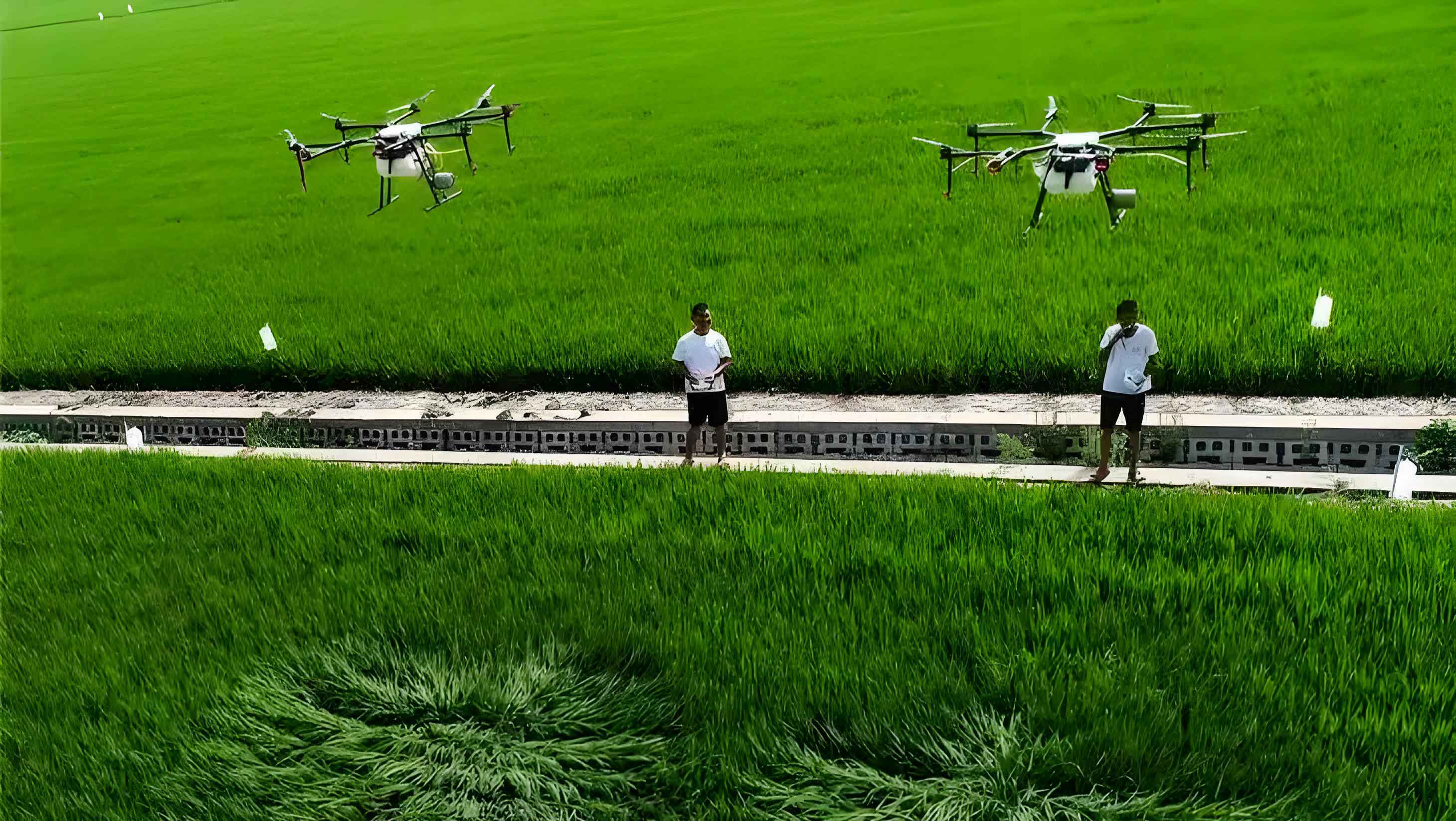
Four phenotypic indicators were extracted from UAV imagery to quantify heat responses: height increment (ΔH), crown diameter increment (ΔD), canopy orthoprojection area increment (ΔS), and coefficient of variation for chlorophyll stability (CVVARI). The visible atmospherically resistant index (VARI) served as a chlorophyll proxy:
$$ VARI = \frac{G – R}{G + R – B} $$
where R, G, and B represent red, green, and blue channel values. Canopy segmentation used HSV color space masking to exclude background interference. Plant height derivation employed canopy height models:
$$ H = \max(CHM_{rect}) $$
$$ CHM = DSM – DTM $$
Validation against ground measurements confirmed UAV phenotyping accuracy:
| Parameter | Date | R² | RMSE | rRMSE (%) | Bias |
|---|---|---|---|---|---|
| Crown diameter | 2023-08-17 | 0.95 | 2.11 cm | 5.26 | 0.38 |
| 2023-09-19 | 0.95 | 2.58 cm | 5.94 | 1.21 | |
| 2024-09-13 | 0.92 | 2.47 cm | 6.03 | 0.92 | |
| Plant height | 2023-07-14 | 0.96 | 2.38 cm | 15.72 | -2.03 |
| 2024-08-15 | 0.86 | 2.24 cm | 12.69 | -1.19 | |
| 2024-09-23 | 0.83 | 2.70 cm | 12.81 | -1.09 |
Meteorological analysis confirmed significantly intensified heat stress during the 68-day evaluation period (July-September) in 2024 compared to 2023:
- ≥35°C days: 6 (2023) vs 42 (2024)
- Mean daily temperature: 27.35°C (2023) vs 30.46°C (2024)
- Third quartile daily maximum: 33.78°C (2023) vs 37.68°C (2024)
The agricultural UAV platform captured cultivar-specific responses to differential heat stress:
| Cultivar | ΔH (cm) | ΔD (cm) | CVVARI (%) |
|---|---|---|---|
| 2023 (Normal summer) | |||
| Cultivar A | 20.21 ± 0.89 | 23.12 ± 0.83 | 9.0 ± 0.91 |
| Cultivar B | 12.83 ± 0.98 | 19.37 ± 0.86 | 8.0 ± 0.53 |
| Cultivar C | 9.98 ± 0.69 | 27.33 ± 0.62 | 9.0 ± 0.82 |
| 2024 (Extreme heat) | |||
| Cultivar A | 5.18 ± 0.14 | 7.53 ± 0.69 | 12.0 ± 0.49 |
| Cultivar B | 6.19 ± 0.45 | 11.77 ± 0.71 | 30.0 ± 1.34 |
| Cultivar C | 13.60 ± 0.53 | 23.86 ± 0.50 | 38.0 ± 3.12 |
Relative change rates (RCR) between years quantified heat-induced variations:
$$ RCR = \frac{index_{2024} – index_{2023}}{index_{2023}} $$
Hierarchical clustering (Euclidean distance, Ward’s method) of z-score normalized RCR values revealed three distinct thermotolerance groups:
| Tolerance Class | Cultivars | ΔH RCR | ΔD RCR | CVVARI RCR |
|---|---|---|---|---|
| Heat-tolerant (n=4) | Group A cultivars | 0.57-0.97 | 0.48-0.73 | -0.38-1.00 |
| Moderate (n=11) | Group B cultivars | -0.19-0.48 | -0.16-0.07 | -0.44-3.43 |
| Heat-sensitive (n=7) | Group C cultivars | -0.74–0.12 | -0.67–0.10 | 0.31-2.71 |
Agricultural drone technology demonstrated distinct advantages over conventional methods. The UAV platform captured dynamic phenotypic responses throughout the heat stress period, enabling calculation of growth trajectory derivatives rather than endpoint measurements. Heat-tolerant cultivars maintained photosynthetic efficiency under extreme conditions, evidenced by stable CVVARI values (mean RCR = 0.06) alongside significant biomass accumulation (ΔH RCR > 0.5). In contrast, heat-sensitive cultivars exhibited chlorophyll degradation (CVVARI RCR > 1.5) with growth suppression (ΔD RCR < -0.35).
The integration of agricultural UAV phenotyping with automated image analysis establishes a scalable framework for ornamental plant breeding. This approach successfully identified 15 heat-adapted chrysanthemum cultivars suitable for warming urban environments. Future applications could incorporate thermal and multispectral sensors to enhance physiological profiling, potentially enabling predictive modeling of thermotolerance mechanisms.
This research demonstrates that agricultural drone-based phenotyping effectively evaluates garden chrysanthemum thermotolerance through multi-temporal RGB image analysis. The non-destructive methodology quantified key growth parameters and chlorophyll stability across 22 cultivars under contrasting heat regimes. Four cultivars exhibited exceptional heat tolerance with increased biomass accumulation during extreme temperatures, while 11 showed moderate adaptability. The UAV approach significantly accelerated screening efficiency compared to conventional methods, processing >200 plants per flight mission. These findings validate agricultural UAV technology as a robust tool for climate-resilient ornamental breeding programs.