
From my perspective as an engineer deeply involved in aerospace structures, the evolution of the modern military drone is inextricably linked to the parallel advancement of composite materials technology. The shift from traditional aluminum alloys to advanced polymer-matrix composites (PMCs), ceramic-matrix composites (CMCs), and increasingly, metal-matrix composites (MMCs) represents a fundamental paradigm shift. This transition is not merely about swapping one material for another; it is about redefining the very possibilities of unmanned aerial vehicle (UAV) design, performance, and mission capability. The core driver is the unparalleled specific strength and specific stiffness offered by materials like carbon fiber reinforced polymers (CFRP). For a military drone, where every gram saved translates directly into extended range, increased payload, enhanced loiter time, or improved maneuverability, this is the most critical equation. The benefits extend far beyond simple weight savings, encompassing stealth, durability, manufacturability, and integrated functionality, making advanced composites the cornerstone upon which next-generation unmanned systems are built.
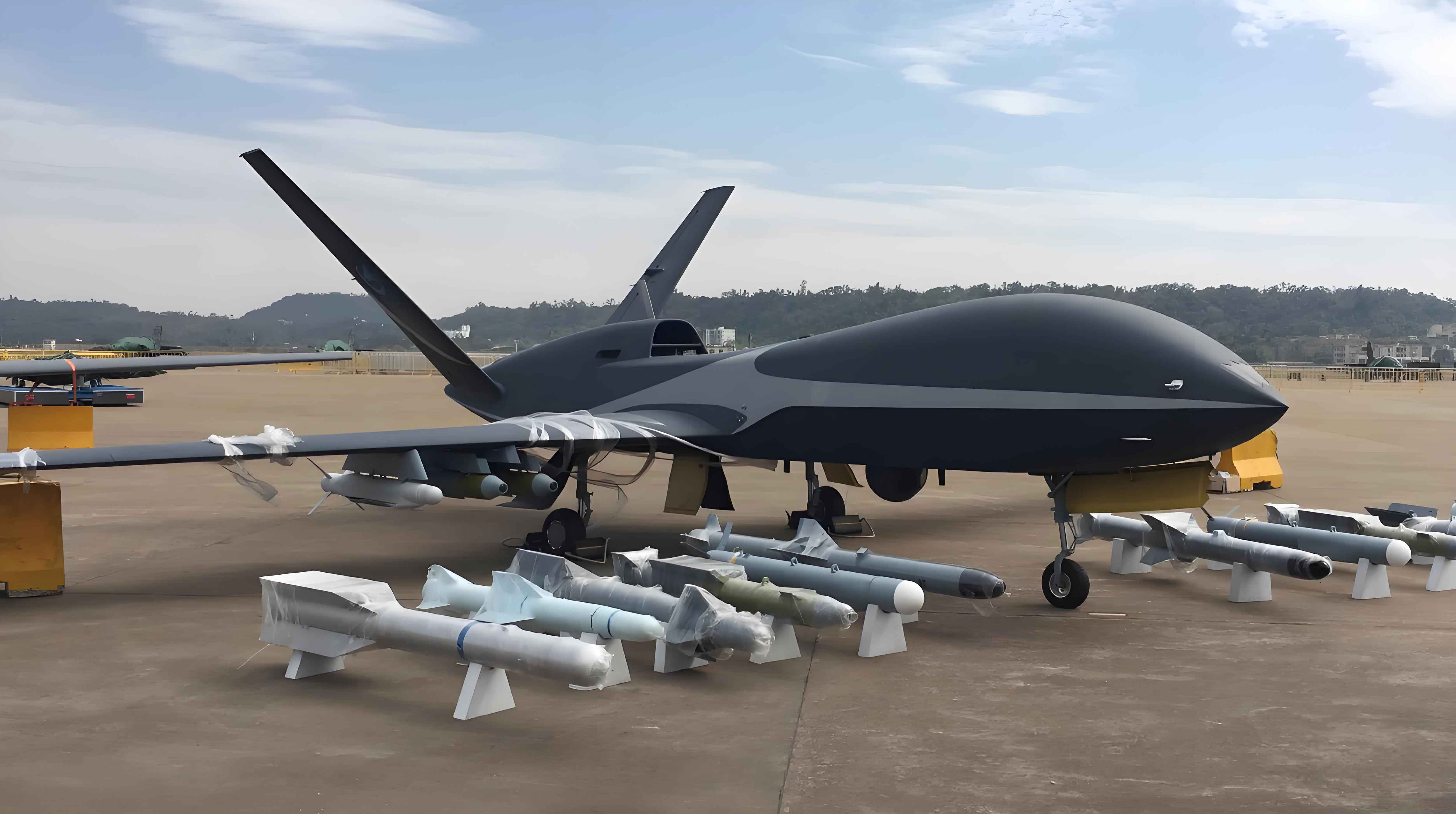
The fundamental advantage of advanced composites for a military drone lies in their exceptional specific properties. Unlike isotropic metals, composites are anisotropic, meaning their properties can be tailored in specific directions by orienting the reinforcing fibers. This allows structural designers to place material exactly where it is needed to carry loads, leading to massively efficient structures. The quantitative comparison is stark, as shown in the table below:
| Material | Density, ρ (g/cm³) | Tensile Strength, σ (MPa) | Young’s Modulus, E (GPa) | Specific Strength, σ/ρ (MPa·cm³/g) | Specific Stiffness, E/ρ (GPa·cm³/g) |
|---|---|---|---|---|---|
| Aluminum 7075-T6 | 2.81 | 572 | 71.7 | 203 | 25.5 |
| Steel 4340 | 7.85 | 1720 | 205 | 219 | 26.1 |
| Ti-6Al-4V | 4.43 | 1170 | 114 | 264 | 25.7 |
| CFRP (Quasi-Iso.) | 1.55 | 600 | 70 | 387 | 45.2 |
| CFRP (Unidirectional) | 1.55 | 1500 | 130 | 968 | 83.9 |
This table highlights why CFRP is the material of choice for primary structures in a high-performance military drone. The specific stiffness of unidirectional CFRP is more than three times that of aerospace aluminum, allowing for much lighter and stiffer wing and fuselage designs. The weight reduction benefit is often quantified as a saving of 20-30% compared to an equivalent metallic structure. This saving can be reapportioned, fundamentally altering the design trade-offs for a military drone. For instance, the saved weight can be used to carry more fuel, expressed by the Breguet range equation for a jet-powered military drone:
$$ R = \frac{V}{C} \frac{L}{D} \ln \left( \frac{W_{initial}}{W_{final}} \right) $$
Where \(R\) is range, \(V\) is velocity, \(C\) is specific fuel consumption, \(L/D\) is lift-to-drag ratio, and \(W\) are weights. A reduction in structural weight (\(W_{final}\)) directly increases the logarithmic term, extending range. Alternatively, the weight budget can be allocated to more sensors, weapons, or countermeasures, directly enhancing the mission effectiveness of the military drone.
The Design Revolution Enabled by Composites
The application of composites fundamentally changes the design philosophy for a military drone. Metal design is often a subtractive process: starting with a billet and machining away material. Composite design is an additive and integrative process: building up complex shapes layer by layer (laminate) and bonding large sub-assemblies into single, co-cured structures. This enables two transformative concepts: aeroelastic tailoring and highly integrated structures.
Aeroelastic Tailoring: By carefully varying the fiber orientation (ply angle \(\theta\)) and stacking sequence through a laminate, designers can couple structural deformations with aerodynamic loads beneficially. For a military drone wing, this can mean designing a laminate that twists as it bends (bend-twist coupling) to automatically wash out incidence at high loads, delaying stall or improving gust response. The stiffness matrix \([A,B,D]\) of a composite laminate governs this behavior:
$$
\begin{bmatrix}
N \\
M
\end{bmatrix}
=
\begin{bmatrix}
A & B \\
B & D
\end{bmatrix}
\begin{bmatrix}
\epsilon^0 \\
\kappa
\end{bmatrix}
$$
Where \(N\) are in-plane forces, \(M\) are moments, \(\epsilon^0\) are mid-plane strains, and \(\kappa\) are curvatures. The coupling matrix \(B\) is typically zero for symmetric metallic structures but can be intentionally designed to be non-zero in a composite military drone wing to create aeroelastic effects. The optimization problem for such a wing panel involves finding the ply angles \(\theta_i\) and thicknesses \(t_i\) that minimize weight while meeting strength, stiffness, and aeroelastic stability (flutter speed \(V_f\)) constraints:
$$
\min_{t, \theta} \quad & \text{Mass}(t) \\
\text{s.t.} \quad & \sigma_{max}(\theta, t) \leq \sigma_{allowable} \\
& \delta_{tip}(\theta, t) \leq \delta_{max} \\
& V_f(\theta, t) \geq 1.2 V_{dive} \\
& \text{Manufacturing Constraints}
$$
Highly Integrated Structures: Composites allow for the fabrication of large, co-cured or co-bonded components that eliminate hundreds or thousands of fasteners. A classic example is an integrally stiffened wing skin or fuselage panel, where stringers, ribs, and spars are bonded and cured simultaneously with the skin. This integration, crucial for a stealth-oriented military drone, reduces part count, assembly time, and potential radar-reflecting gaps and seams. It also improves structural efficiency by providing a more continuous load path. The development of Out-of-Autoclave (OOA) prepregs and large-scale automated fiber placement (AFP) machines has been pivotal in making such large integrated structures economically viable for military drone production.
Manufacturing Technologies: The Cost-Performance Balance
The widespread adoption of composites in military drones hinges on mastering manufacturing technologies that balance exceptional performance with acceptable cost. The landscape of processes is diverse, each suited to different volume, complexity, and performance requirements.
| Manufacturing Process | Key Characteristics | Typical Application in Military Drone | Relative Cost Driver |
|---|---|---|---|
| Autoclave Curing (Prepreg) | High fiber volume, excellent consolidation, repeatable quality. High capital and energy cost. | Primary structures (wing skins, fuselage panels, spars) for high-performance drones. | Autoclave capital, energy, tooling, prepreg material. |
| Resin Transfer Molding (RTM/VARTM) | Near-net shape, good surface finish, lower tooling cost than autoclave for complex shapes. Dry fabric handling. | Complex fuselage sections, inlet ducts, fairings, medium-load structures. | Tooling, resin injection system, fabric preforming. |
| Automated Fiber Placement (AFP) / Tape Laying (ATL) | High deposition rate, minimal material waste, enables large integrated structures and tailored layups. | Large, contoured skins for wings and fuselages. Essential for aeroelastic tailoring. | Machine capital (high), programming, material. |
| Additive Manufacturing (3D Printing) | Unprecedented design freedom for topology-optimized parts. Limited to thermoplastic matrices or short-fiber reinforcements currently. | Complex brackets, ducts, internal supports, tooling. Moving towards secondary structural parts. | Machine time, material cost per kg, post-processing. |
The pursuit of low-cost manufacturing for military drone composites is a multi-front effort. It targets material costs (e.g., lower-cost carbon fiber, optimized resin systems), process costs (e.g., OOA curing, rapid AFP), and assembly/inspection costs (e.g., integrated design reducing part count, advanced NDI). The overarching goal is to reduce the total acquisition and lifecycle cost of the military drone without compromising the performance advantages that composites confer.
Structural-Functional Integration: Beyond Mere Load-Bearing
Perhaps the most significant advantage composites offer a military drone is the ability to embed multiple functions directly into the structure. This “structurally integrated” approach moves beyond the classical design where structure, stealth, sensors, and power are separate subsystems bolted together.
1. Stealth (Low Observability): The radar cross-section (RCS) of a military drone is paramount to its survivability. Composites are inherently more radar-transparent than metals, but their true power lies in design integration.
* Material-Level Integration: Incorporating conductive fibers (e.g., metal-coated glass) or lossy dielectric particles (e.g., ferrites, carbon nanotubes) into the laminate can create a graded material that absorbs incident radar waves. The effectiveness can be modeled by the reflection coefficient \(\Gamma\) at an interface, dependent on the complex permittivity \(\epsilon_r = \epsilon’ – j\epsilon”\) of the composite.
* Structural Design: Smooth, continuous composite molds enable faceted or curved shapes that deflect radar energy away from the source. Integrated leading edges can house frequency selective surfaces (FSS) that are transparent to friendly communications but reflective to threat radar bands. Co-curing structures eliminates gaps and fasteners that are major radar reflectors.
2. De-icing & Thermal Management: Conductive layers, such as thin metallic meshes or carbon nanotube sheets, can be embedded within composite wing leading edges. When an electric current is passed, they generate resistive heat for de-icing—a fully integrated solution with no external probes or blankets. For a high-altitude military drone, this is critical.
3. Structural Health Monitoring (SHM): Networks of optical fiber Bragg gratings (FBG) or piezoelectric sensors can be embedded during layup. These sensors monitor strain \( \epsilon \), temperature, and even detect acoustic emissions from impact damage or crack growth in real-time, enabling condition-based maintenance for the military drone.
The integration strategy can be summarized by a multi-objective optimization framework for a fuselage panel of a military drone:
$$
\min_{x} \quad & [ \text{Mass}(x), -\text{Stealth\_Index}(x), -\text{Damage\_Tolerance}(x) ] \\
\text{s.t.} \quad & \text{Strength}(x) \geq \text{Req.} \\
& \text{Stiffness}(x) \geq \text{Req.} \\
& \text{Manufacturability}(x) = \text{Feasible} \\
& x = \{\theta, t, \text{material choice}, \text{sensor layout}, …\}
$$
Here, \(x\) represents the vast design space encompassing ply parameters, material choices for different layers, and the inclusion of functional elements.
Damage Tolerance and Life Prediction
A critical challenge for composite structures on a military drone is their damage tolerance and the prediction of residual life. Unlike metals, which typically exhibit ductile yielding and slow, visible crack growth, composites fail through complex, multi-scale damage mechanisms: matrix cracking, delamination, fiber breakage, and fiber-matrix debonding. This complicates inspection and repair protocols.
The fundamental approach involves fracture mechanics adapted for laminated composites. The strain energy release rate \(G\) for delamination growth is a key parameter. For a given mode (I-opening, II-sliding, III-tearing), growth occurs when \(G\) exceeds the material’s toughness \(G_c\). A typical mixed-mode criterion is:
$$ \left( \frac{G_I}{G_{Ic}} \right)^\alpha + \left( \frac{G_{II}}{G_{IIc}} \right)^\beta + \left( \frac{G_{III}}{G_{IIIc}} \right)^\gamma = 1 $$
Where \(\alpha, \beta, \gamma\) are empirical exponents. For a military drone undergoing cyclic loads, a damage evolution law analogous to the Paris Law for metals is used, relating the delamination growth rate \(da/dN\) to the cyclic strain energy release rate amplitude \(\Delta G\):
$$ \frac{da}{dN} = C (\Delta G)^m $$
Establishing reliable inspection intervals and “retirement for cause” schedules for a composite military drone requires building extensive datasets from coupon, element, and full-scale testing under realistic spectra. Probabilistic methods are increasingly important, acknowledging the inherent variability in composite properties and defect populations. The probability of failure \(P_f\) of a component can be estimated by integrating over the joint probability density function of strength \(f_R(r)\) and applied stress \(f_S(s)\):
$$ P_f = \int_{-\infty}^{\infty} F_R(s) f_S(s) \, ds $$
Where \(F_R(s)\) is the cumulative distribution function of strength. This statistical approach is vital for certifying the airworthiness of an unmanned but highly capable military drone.
Case Studies and Application Spectrum
The application of advanced composites spans the entire spectrum of military drone types, from small hand-launched systems to large high-altitude long-endurance (HALE) and unmanned combat aerial vehicles (UCAV).
| Military Drone Type | Exemplar Platform | Composite Usage & Key Features | Structural & Functional Benefits |
|---|---|---|---|
| HALE / MALE ISR (High/Medium Altitude Long Endurance) |
RQ-4 Global Hawk, MQ-9 Reaper | >65% composite by weight. CFRP wing (high aspect ratio for efficiency), fuselage sections, empennage. Honeycomb core sandwich structures. | Extreme stiffness for high-aspect-ratio wings, light weight for 30+ hour endurance, corrosion resistance for maritime patrol. |
| Stealth UCAV / Demonstrator | X-47B, nEUROn, BAE Taranis | Near-total composite airframe. Flying wing/blended wing-body design. Co-cured large structures. | Enables complex faceted shapes for low RCS. Eliminates fasteners/seams. Allows integral fuel tanks. High structural integration. |
| Tactical / Group 3-5 | RQ-7 Shadow, ScanEagle | Fuselage, wings, tail booms from glass/carbon fiber composites. Often modular designs. | Lightweight for tactical mobility (trailer launch). High durability for rough field operations. Low cost via RTM/OOA processes. |
| Low-Cost Attritable | Kratos XQ-58A Valkyrie | High-composite content but designed for low-cost manufacturing (e.g., snap-together composite parts, minimal tooling). | Balances performance with radically lower cost per airframe. Uses composites for performance but prioritizes manufacturing simplicity. |
The progression is clear: as the performance demands on the military drone increase—be it for stealth, endurance, or survivability—the reliance on advanced, highly integrated composite structures becomes absolute. The X-47B’s tailless, blended-body design would be impractical with conventional metals; it is a shape enabled by composites. Similarly, the >35-meter wingspan of the Global Hawk requires the specific stiffness of carbon fiber to prevent aeroelastic divergence while minimizing weight.
Future Trajectories and Concluding Perspective
The future of advanced composites in military drones is directed towards greater intelligence, multifunctionality, and sustainability. Key research vectors include:
1. Intelligent and Adaptive Structures: Integration of shape memory alloys (SMA) or piezoelectric actuators within composites to create morphing wings that can change camber or sweep in flight, optimizing the military drone for radically different flight regimes (loiter vs. dash).
2. Multifunctional Material Systems: Developing composites that are not just structural and stealthy, but also capable of energy storage (structural batteries), energy harvesting (piezoelectric layers), and even “self-healing” via embedded microcapsules of resin.
3. Digital Thread and Advanced Simulation: Creating a seamless digital flow from material property prediction (via micromechanics \( E_c = V_f E_f + V_m E_m \) ) to structural performance, manufacturing simulation (predicting residual stresses \( \sigma_{res} \) ), and in-service health management. This virtual certification process will accelerate the design of new military drone concepts.
4. Sustainable and Recyclable Composites: As production volumes grow, the lifecycle environmental impact and end-of-life disposal of composite military drones become concerns. Research into thermoplastic matrices (re-weldable and recyclable) and bio-derived fibers/resins is gaining momentum.
In conclusion, the relationship between advanced composites and the military drone is symbiotic and intensifying. Composites provide the material basis to achieve the conflicting demands of low weight, high strength, stealth, and integrated functionality. In turn, the unique mission profiles and cost-sensitive, performance-driven nature of military drone development push the boundaries of composite technology—driving innovations in low-cost manufacturing, automated fabrication, and multifunctional design. The modern military drone is not merely an aircraft that uses composites; it is a system whose very conception and capabilities are defined by the possibilities unlocked by these remarkable materials. The future unmanned combat systems will be, at their core, flying composite architectures where the distinction between airframe, sensor, and weapon system is seamlessly blurred—a testament to the enabling role of advanced composites.